The Canadian Quran Academy’s Arabic Conversation Course in Canada teaches practical spoken Arabic for daily interactions, social contexts, and community engagement. Students practice common greetings, introductions, asking directions, ordering food, and discussing everyday topics through structured dialogues. Lessons focus on conversational vocabulary, natural pronunciation patterns, and informal expressions that differ significantly from formal written Arabic students encounter in textbooks.
Canadian Muslims engaging Arabic-speaking community members, parents communicating with relatives abroad, and professionals networking with Middle Eastern contacts all require conversational fluency beyond reading ability. Toronto community organizers, Vancouver interfaith coordinators, and Montreal social workers benefit from spoken Arabic skills enabling direct relationship-building. The Canadian Quran Academy’s conversation-focused training addresses practical communication needs most textbook courses ignore entirely.
More Details Pricing Testimonials
The Canadian Quran Academy’s Arabic Conversation Course in Canada prioritizes active speaking practice over grammar lectures—students spend lessons conversing rather than listening to rule explanations. Practice includes role-playing common scenarios—shopping interactions, phone conversations, social invitations, and family discussions. Lessons teach colloquial expressions, polite refusals, conversational fillers, and question patterns that characterize natural spoken Arabic across different contexts.
Arabic listening comprehension training prepares students for real conversational speeds where native speakers contract words, drop endings, and use informal vocabulary. The Canadian Quran Academy’s instructors model natural speech patterns, correct pronunciation errors immediately, and push students past hesitation that prevents fluency development. Students learn to think directly in Arabic rather than mentally translating from English—the shift that separates confident speakers from perpetual beginners.
The Canadian Quran Academy’s Arabic Conversation Course builds speaking confidence through scenario-based practice—students handle realistic situations before tackling abstract discussions requiring advanced vocabulary and complex structures.
Most adults struggle speaking Arabic due to overthinking grammar mid-sentence. The Canadian Quran Academy trains automatic phrase production through high-frequency drills. Lessons cover greetings, introductions including family, and common questions about work, location, and daily life. Toronto students and Vancouver learners apply this phrase foundation immediately in community interactions.
English speakers often confuse emphatic letters like ṣād (ص) and sīn (س), affecting comprehension. Students practice minimal pairs with repetition, receiving immediate correction on tongue placement. The Canadian Quran Academy ensures proper articulation before habits form. Calgary Muslims and Edmonton community members rely on this training for confident, effective communication in real conversations.
Textbook recordings are slow and fully pronounced, unlike real speech. Students listen to natural-speed dialogues with contractions, dropped endings, and regional variations. The Canadian Quran Academy trains recognition of informal vocabulary, conversational patterns, and rapid exchanges. Learners develop practical listening skills for mosque interactions, community life, and daily Arabic communication.
Students speak actively during class—answering questions, initiating conversation, and responding to prompts. Structured pair work, group discussions, and scenarios like ordering food or bargaining reinforce verbal production. Montreal professionals, Ottawa educators, and Halifax community workers build confidence and fluency beyond theoretical learning through active speaking practice.

Outcomes
Students develop the ability to respond in Arabic instantly without translating from English, avoiding halting speech. Extensive drills build automatic phrase retrieval. Canadian Muslims greeting community members, parents speaking with children, and professionals networking at multicultural events gain fluid, natural interaction skills, ensuring confident, spontaneous communication rather than slow, hesitant exchanges that limit engagement.
The Canadian Quran Academy trains accurate articulation of emphatic letters, guttural sounds, and vowel distinctions. Students record, compare with instructor models, and adjust systematically. Toronto organizers, Vancouver interfaith leaders, and Montreal social workers develop precise pronunciation, ensuring clear communication, preventing misinterpretation, and building confidence in professional and community interactions in Arabic.
Students follow conversations at natural speed, including contractions, dropped endings, and colloquial vocabulary missing in formal texts. The Canadian Quran Academy exposes learners to authentic speech patterns, preparing them for real interactions. Calgary Muslims, Edmonton students, and Ottawa government employees develop listening skills that match real-life conversational pace, improving comprehension across diverse Arabic-speaking environments.
Conversation exercises build active vocabulary for daily contexts—shopping, dining, transportation, family, and social interactions. Scenario-based lessons focus on high-frequency words used in speech rather than rare literary terms. Halifax community workers, Regina educators, and Winnipeg healthcare professionals gain vocabulary enabling immediate, spontaneous communication, applying practical Arabic effectively without relying on disconnected theoretical knowledge.
Students learn Arabic dialogue conventions—politeness formulas, indirect refusals, and relationship-building phrases often absent in English. The Canadian Quran Academy teaches proper greeting lengths, formality shifts, and social expectations to prevent miscommunication. Toronto professionals, Vancouver leaders, and Montreal educators master conversational norms beyond literal meanings, enhancing accuracy and cultural appropriateness in interactions.
Students often know vocabulary but hesitate using it. The Canadian Quran Academy’s high-pressure speaking exercises push learners past perfectionism into functional communication, prioritizing flow over minor errors. Calgary Muslims, Edmonton parents, and Ottawa professionals gain confidence, developing practical conversational fluency that classroom theory alone cannot provide.
Why Choose us?
The Canadian Quran Academy's lessons dedicate seventy percent of class time to active student speaking through dialogues, role-plays, and structured conversations rather than passive instructor lectures students forget immediately.
Morning classes accommodate shift workers and parents. Evening sessions serve daytime professionals. Weekend options suit students with weekday commitments. The Canadian Quran Academy maintains flexibility across all Canadian time zones.
Sessions maintain four-student maximum enrollment ensuring each student speaks extensively every lesson. The Canadian Quran Academy's small groups prevent passive participation where shy students hide behind talkative classmates without practicing.
Live instruction enables instructors to correct articulation errors, vocabulary choices, and grammatical mistakes immediately while students speak. The Canadian Quran Academy's real-time feedback prevents incorrect patterns from solidifying through uncorrected repetition.
Lessons simulate actual interactions students face—market shopping, phone calls, social invitations, family discussions. The Canadian Quran Academy's practical approach prepares students for authentic conversations rather than artificial textbook dialogues.
The Canadian Quran Academy prices conversation instruction competitively to welcome students regardless of financial circumstances. Monthly payment plans prevent cost barriers from blocking access to practical communication training.
The Canadian Quran Academy's tutors expect hesitation, errors, and nervousness from conversation students. Instructors create supportive environments where mistakes become learning opportunities rather than embarrassing failures preventing participation.
Beginners practice simple greetings and introductions. Intermediate students handle extended dialogues. The Canadian Quran Academy's curriculum scaffolds complexity so students experience success before advancing to challenging spontaneous conversations.
Areas we serve in Canada
The Canadian Quran Academy serves Arabic conversation students across Toronto, Vancouver, Montreal, Calgary, Edmonton, Ottawa, and every Canadian province through live online instruction. International learners worldwide access identical curriculum and qualified instructors.
Related Courses
The Canadian Quran Academy teaches Arabic from Beginner through Advanced levels—Quranic Arabic for textual understanding, Modern Standard Arabic for formal contexts, Classical Arabic for scholarly texts, grammar courses for linguistic precision, plus Tajweed and Hifz programs.
Canadian students ready to communicate confidently in Arabic across social, family, and community contexts gain practical speaking skills, natural pronunciation, and conversational fluency through The Canadian Quran Academy’s practice-intensive curriculum prioritizing active speaking over passive learning.
Testimonials
The Canadian Quran Academy's conversation graduates include Canadian Muslims confidently engaging Arabic-speaking community members, parents conversing naturally with relatives abroad, and professionals building relationships across multicultural contexts through direct Arabic communication.
Alhumdulilah my son 7yr old loves his Quran classes. Sheikh Nour Eddin Mohmoud is very interactive and makes it very interesting for my son. MashaAllah my son has progressed in his Tajweed learning, applying and memorizing. After so many teachers finally found Sheikh Nour who understands and communicate with parents and listens as to what exactly one is looking for their child. I really recommend this institute and sheikh Nour . InshaAllah I want my other son to start with Sheikh Nour as well. Hope this helps for anyone who is looking to get their kids to learn online.
Alhamdulillah this is a great place to learn Quran, Islamic Studies, and Arabic. I took these three classes and gained a lot. They teach through zoom in one on one sessions where you decide the time and day. I used whatsapp as the communication and the coordinators were really responsive. For Quran, we would read the arabic together and then learn the tafsir. After that I would memorize the surah or a portion for the next class. For Arabic, it was a focus on vocabulary and conjugations of verbs. For Islamic studies you went through a text together. The teachers are really nice and you can ask anything. I found it enjoyable learning about a different culture as I was raised in America. Give it a try!
Real transformations from students who mastered the Quran with our courses
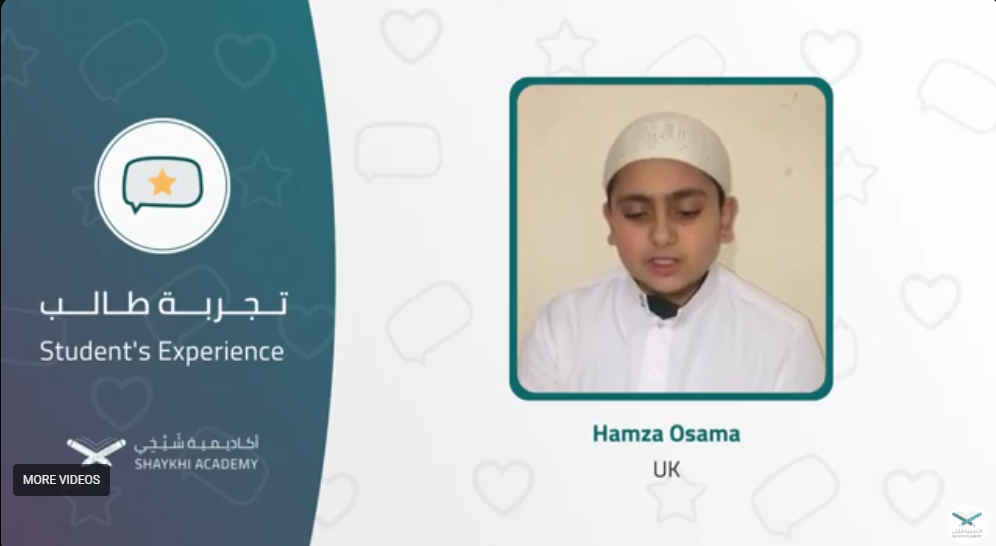
I took a course at Shaykhi Academy, and my name is Hamza Osama from England. During my time there, I learned the Arabic alphabet and Tajweed rules. I have also successfully memorized approximately two Juz of the Quran. My teacher was the best, and I feel I benefited a lot from him. I would advise anyone who wants to learn the Arabic language, Tajweed rules, or the Quran to join Shaykhi Academy.
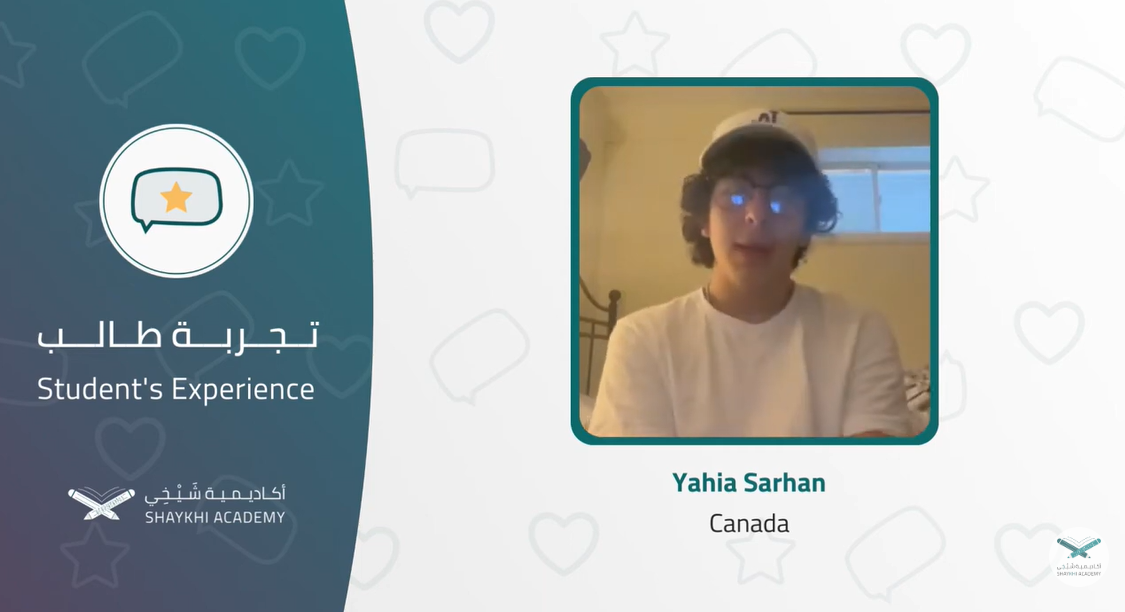
I’m Yahia Sarhan, I’m 15 years old and I’m from Canada. I’ve been a student at Shaykhi Academy since 2019, so about three or four years now. It’s been a great learning opportunity for me and I’ve learned a lot about Islamic studies, the Quran, and Arabic reading. I’d definitely recommend it to anyone who’s trying to learn.
Canadian learners tired of understanding Arabic passively without speaking confidently benefit from The Canadian Quran Academy’s conversation-focused training maximizing speaking practice, correcting pronunciation immediately, and building fluency through realistic scenario-based interactions.
The Canadian Quran Academy answers common questions Canadian students ask about Arabic conversation instruction, speaking anxiety management, pronunciation challenges, and fluency development through structured conversational practice.