 Quran
Quran
| Key Takeaways |
| Children learn Quran most effectively by starting with Arabic letter recognition before moving to full recitation. |
| The Noorani Qaida is the globally recognized foundational text used to teach kids correct Arabic pronunciation before Quran reading. |
| Most children aged 5–7 can begin structured Quran learning; earlier exposure to Arabic sounds accelerates long-term retention. |
| Consistent short daily sessions of 15–20 minutes outperform longer, infrequent practice for young Quran learners. |
| Qualified 1-on-1 online instruction allows Canadian kids to learn Quran from home, fitting around school and family schedules. |
To learn Quran for kids in Canada, start with Arabic letter recognition through the Noorani Qaida, progress to connected reading, then introduce basic Tajweed rules before beginning Quran recitation. This structured sequence — not skipping stages — is what separates children who recite confidently from those who struggle for years with foundational errors.
The full path moves through five clear stages: letter recognition, word-level reading, fluent recitation, Tajweed application, and — for families pursuing it — Hifz memorization. Each stage builds directly on the last. With qualified instruction and consistent daily practice, most children in Canada can read Quran independently within 12 to 18 months of starting from scratch.
Step 1: Start with Arabic Letter Recognition Before Anything Else
Children cannot read Quran without first mastering the Arabic alphabet — all 29 letters, in isolation and in their joined forms. This single step determines everything that follows. A child who knows their letters confidently will progress through Quran reading in a fraction of the time of one who skips this foundation.
At The Canadian Quran Academy, the most consistent pattern we observe is children arriving with partial letter knowledge — they recognize 15 or 20 letters but confuse similar shapes like ع and غ, or ح, ج, and خ. Those gaps compound at every subsequent stage.
What Arabic Letter Learning Looks Like for Kids
Effective letter instruction for children covers three dimensions:
- Letter shape recognition — identifying each letter in isolation
- Letter sounds — producing the correct Arabic phoneme, not an approximated English sound
- Positional forms — recognizing each letter at the beginning, middle, and end of a word
Children aged 5–8 typically need 4–8 weeks of consistent practice to solidify all three dimensions, depending on prior exposure to Arabic at home or in Islamic school.
Shots Videos from Our Courses
Start Your Quranic Journey in Canada
Join our vibrant community and learn with expert tutors through our flexible online platform.
Claim Your Free TrialWhat Age Should a Child Start Learning Quran?
Children can begin structured Arabic and Quran learning from age 4–5, starting with letter sounds and recognition.
Formal reading instruction — working through a Qaida — typically begins at age 5–7. Earlier exposure to Arabic phonemes at home, even informally, makes formal instruction significantly easier when it begins.
Step 2: Work Through the Noorani Qaida Systematically
The Noorani Qaida is the foundational text used across the Muslim world to teach children correct Arabic pronunciation and reading mechanics before they open the Quran. It introduces letters, vowel markings (harakat), tanween, sukoon, shaddah, and the rules of joining letters — in a carefully sequenced progression.
Skipping the Noorani Qaida and going directly to the Quran is the single most common mistake parents make. Children who bypass this stage almost always develop mispronunciation habits that take years to correct.
Our Noorani Qaida for Kids course is taught by qualified instructors who progress each child at their own pace — ensuring no letter or vowel combination is rushed past before the child has genuinely internalized it.
Enroll your child in our Noorani Qaida classes for kids with a FREE session

What the Noorani Qaida Covers
| Stage | Content | Typical Duration |
| Letters in isolation | All 29 Arabic letters, correct makhraj (articulation point) | 2–4 weeks |
| Letters with harakat | Fatha, kasra, damma — short vowel sounds | 2–3 weeks |
| Tanween and sukoon | Nunation and vowel-less letters | 2–3 weeks |
| Madd (elongation) | Long vowels — alif, waw, ya | 1–2 weeks |
| Shaddah and joining | Doubled consonants, connected letter clusters | 2–3 weeks |
| Full word reading | Multi-syllable Arabic words without Quran text | 2–4 weeks |
Total duration: most children complete the Noorani Qaida in 3–6 months with regular sessions. Children who practice 15–20 minutes daily move through it significantly faster than those practicing only once or twice per week.
Read also: HOW TO LEARN ARABIC FOR QURAN IN CANADA?
Step 3: Begin Quran Reading with Short Surahs
Once a child completes the Noorani Qaida, they are ready to begin reading actual Quran text. The correct starting point is Juz Amma (the 30th Juz) — specifically the short Surahs of the last section, beginning with Surah Al-Fatiha and then moving through the shorter Surahs of Juz Amma.
These Surahs appear frequently in daily salah. A child who reads them correctly from the earliest stages builds a direct, felt connection between Quran learning and their prayer — which is one of the most powerful motivators for young learners.
How to Structure Early Quran Reading Sessions for Kids
Short, consistent sessions work far better than long, infrequent ones for children. Recommended structure:
- Daily practice: 15–20 minutes is the optimal session length for ages 5–10
- New content: Introduce 2–4 new lines per session maximum
- Review: Spend at least half of every session reviewing previously read material
- Praise specific progress: “You read that word correctly” lands better than generic encouragement
At The Canadian Quran Academy, our qualified instructors structure Quran Classes for Kids around this exact rhythm — new material introduced gradually, with systematic review built into every session.
Enroll your child in our Quran classes for kids with a FREE session

Step 4: Introduce Basic Tajweed Rules as Recitation Develops
Tajweed is the science of reciting the Quran with correct pronunciation, articulation, and rhythm — exactly as it was revealed and transmitted through the generations. For children, Tajweed is not introduced all at once. It is layered in gradually as their reading fluency develops.
The four foundational Tajweed rules children should learn first are: the rules of Noon Sakinah and Tanween (Izhaar, Idghaam, Iqlaab, Ikhfa), the rules of Meem Sakinah, the Madd (elongation) rules, and Qalqalah (echo letters). These cover the majority of the rules a child will encounter in daily recitation.
When Should Kids Start Formal Tajweed?
Children typically begin structured Tajweed instruction once they can read Quran text fluently without stopping to decode individual letters.
For most children, this is somewhere between 6 months and 1 year after completing the Noorani Qaida. Introducing Tajweed rules before reading is fluent adds cognitive load that slows rather than helps progress.
Our Tajweed for Kids course is designed precisely for this transition point — building on existing reading fluency and layering in rules one category at a time, with practical application in real Quran text at every step.
Enroll your child in our Tajweed classes for kids with a FREE session

The Prophet ﷺ said:
«الْمَاهِرُ بِالْقُرْآنِ مَعَ السَّفَرَةِ الْكِرَامِ الْبَرَرَةِ، وَالَّذِي يَقْرَأُ الْقُرْآنَ وَيَتَتَعْتَعُ فِيهِ وَهُوَ عَلَيْهِ شَاقٌّ لَهُ أَجْرَانِ»
“The one who is proficient in the Quran will be with the noble and righteous scribes, and the one who reads the Quran and falters in it, finding it difficult, will have a double reward.” (Sahih Muslim 798)
This hadith is worth sharing with children old enough to understand it. Struggling is not failure — it is rewarded. That reframe changes how many young learners relate to difficulty.
Read also: IS ARABIC WORTH LEARNING IN CANADA?
Step 5: Build Consistent Review Habits to Retain What Is Learned
Memorization and recitation without review deteriorates quickly — this is one of the most practically important facts about Quran learning that parents overlook. A child who learns 10 Surahs without a systematic review routine will find those Surahs weakening within weeks.
Review should be built into every session from day one — not added later as a separate concern. The ratio that works well in practice: spend roughly 60–70% of each session reviewing previously learned material and 30–40% on new content.
Simple Review Systems That Work for Children
- Daily Surah rotation: Cycle through learned Surahs in salah, making review feel natural rather than academic
- Weekly check-in: Once per week, have the child recite all learned Surahs from memory without prompting
- Instructor-led revision: In a structured course, the instructor should be tracking review as part of the lesson plan — not leaving it entirely to the parent
Step 6: Consider Hifz When Your Child Has a Strong Foundation
Hifz — full Quran memorization — is one of the greatest gifts a Muslim parent can give a child. But it requires a genuine foundation: fluent reading, correct Tajweed, and strong review habits already in place. Rushing a child into Hifz before these are solid creates fragile memorization that breaks down under pressure.
The right age to begin Hifz varies by child, but most qualified instructors assess readiness rather than impose a fixed age.
A child who reads fluently, applies basic Tajweed, and has demonstrated the habit of consistent daily practice is a far stronger Hifz candidate than a child of any particular age who lacks those foundations.
Our Hifz for Kids program at The Canadian Quran Academy structures memorization around each child’s individual pace, with qualified instructors managing both new memorization and revision schedules.
Start your child’s Hifz path with a FREE trial session
Families across Ontario, Alberta, and British Columbia have used this program to support their children’s Hifz alongside full Canadian school schedules.
Allah ﷻ says in the Quran:
﴿وَلَقَدْ يَسَّرْنَا الْقُرْآنَ لِلذِّكْرِ فَهَل مِن مُّدَّكِرٍ﴾
“Wa laqad yassarnā al-Qur’āna lil-dhikri fahal min muddakir.”
“And We have certainly made the Quran easy for remembrance, so is there any who will remember?” (Surah Al-Qamar 54:17)
This verse is not just encouragement — it is a statement about the Quran’s design. It was made to be memorized. Children’s minds, particularly between ages 5 and 12, are neurologically primed for this kind of memorization. The window is real, and it matters.
Step 7: Find Qualified Instruction That Fits Canadian Family Life
Learning Quran with a qualified instructor — not through an app, YouTube playlist, or unverified online teacher — is not optional. It is the difference between a child who develops correct habits from the beginning and one who spends years unlearning errors.
In Canada, finding that instruction used to mean driving to a masjid or Islamic center at a fixed time that rarely fit school and work schedules.
Online learning has changed this entirely. A qualified instructor can now work 1-on-1 with a child from anywhere in Canada, at times that actually work for the family.
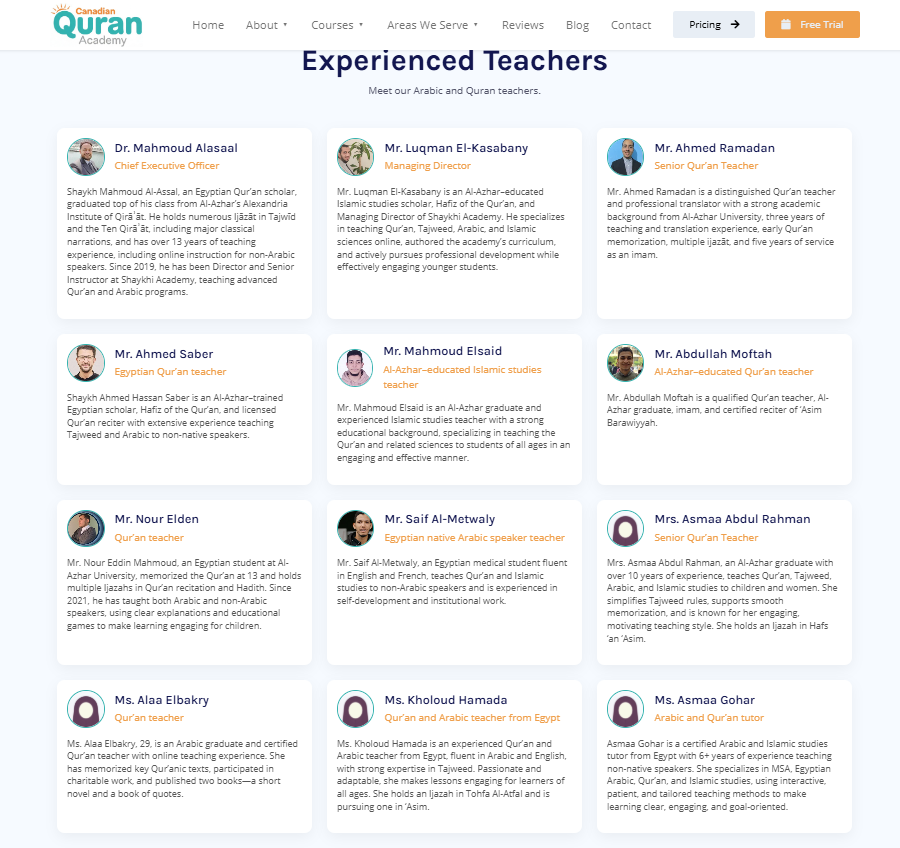
The Canadian Quran Academy connects Canadian families with qualified, experienced instructors for personalized Quran Classes for Kids — with sessions available in morning, evening, and weekend slots across all Canadian time zones.
Book a FREE session with one of our Ijazah-certified teachers
Our Students Reviews
Start Your Quranic Journey in Canada
Join our vibrant community and learn with expert tutors through our flexible online platform.
Claim Your Free TrialStart Your Child’s Quran Learning with Qualified Instruction at The Canadian Quran Academy
Every step in this guide — from Arabic letters to Hifz — produces lasting results only when paired with qualified, personalized instruction. The Canadian Quran Academy delivers exactly that for Canadian families.
- Qualified, experienced Quran instructors
- 1-on-1 personalized sessions at your child’s pace
- Flexible scheduling across Ontario, Quebec, Alberta, and BC
- Programs from Noorani Qaida for Kids through Hifz for Kids
- Free trial lesson — no commitment required
Book your child’s free trial lesson today and start the right way, from the very first session.
Check out our top courses for Quran learning:
- Quran Classes for Adults
- Tajweed Classes
- Hifz Quran
- Noorani Qaida classes
- Quran classes for kids
- Tajweed classes for kids
- Hifz for Kids
- Noorani Qaida classes for kids
Book your FREE trial session today

Read Also: How to Learn Quran in Canada?
Frequently Asked Questions About Learning Quran for Kids in Canada
What is the best age for a child to start learning Quran in Canada?
Children can begin Arabic letter recognition from age 4–5, with structured Quran reading — using the Noorani Qaida — typically starting between ages 5 and 7. Earlier exposure to Arabic sounds at home accelerates formal learning. There is no single correct age; readiness matters more than a fixed number.
How long does it take for a child to learn to read Quran from scratch?
Most children with no prior Arabic knowledge can read Quran independently within 12 to 18 months, given regular sessions with a qualified instructor and consistent daily practice. Children who practice 15–20 minutes daily progress significantly faster than those with infrequent sessions, regardless of age.
Can kids learn Quran online effectively in Canada?
Yes — qualified 1-on-1 online instruction is highly effective for children, provided the instructor is experienced in teaching young learners and sessions are structured and consistent. Online learning also removes the scheduling barriers that make in-person classes difficult for Canadian families with school and work commitments.
Does my child need to learn Arabic to read Quran?
A child needs to learn Arabic script and phonetics — letter recognition and correct pronunciation — to read Quran. Conversational Arabic fluency is not required for Quran recitation. The Noorani Qaida teaches exactly the reading mechanics needed without requiring full Arabic language acquisition first.
What is the difference between Quran reading and Hifz for kids?
Quran reading means the child can recite text correctly with proper Tajweed while looking at the Mushaf. Hifz means committing the Quran to memory. Reading fluency with correct Tajweed is the prerequisite for Hifz — a child should not begin memorization until they read confidently and apply foundational Tajweed rules consistently.





Leave a Reply