 Arabic

| Key Takeaways |
| Arabic is the 5th most spoken language globally, with over 400 million speakers and growing strategic value in Canada’s job market. |
| Canadian Muslims who learn Arabic gain direct access to the Quran, Hadith, and Islamic scholarship without depending on translations. |
| Arabic opens professional doors in diplomacy, international business, healthcare, and government sectors across Ontario, Alberta, and Quebec. |
| Structured online Arabic instruction is now the most practical option for Canadian learners balancing work, family, and community commitments. |
Yes, Arabic is absolutely worth learning in Canada. Arabic gives you direct, unmediated access to the Quran, to Islamic scholarship spanning fourteen centuries, and to a global community of 400 million speakers. For Canadian Muslims, that combination is intellectually and spiritually irreplaceable.
The real question isn’t whether to learn Arabic — it’s why you want to learn it and how you’ll approach it.
Is Arabic Worth Learning in Canada for Muslim Learners?
Arabic is worth learning in Canada for anyone. Whether your goal is Quranic understanding, professional growth, or heritage connection, Arabic delivers a return on investment that few languages can match in Canada’s multicultural, internationally connected society.
The Canadian Quran Academy’s Arabic for Beginners course is built specifically for English-speaking Canadian learners — structured around Modern Standard Arabic, with native instructors who know exactly where English speakers typically get stuck.
Begin learning Arabic with a FREE trial class
What Are the Real Benefits of Learning Arabic in Canada?
The benefits of learning Arabic in Canada extend across religious, professional, and cognitive dimensions — making it one of the highest-value language investments available to Canadian residents. For Muslims, spiritual access is the primary driver. For all learners, professional and cognitive gains are substantial and measurable.
1. Religious and Spiritual Benefits of Learning Arabic in Canada
- Direct Quranic access: You read and understand Allah’s words without any intermediary layer of translation
- Deeper Salah: Every unit of prayer becomes a live conversation rather than a recitation of memorized sounds
- Access to scholarship: Classical texts, Tafsir collections, Hadith commentaries — all opened without translation dependency
- Stronger Hifz retention: Students memorizing the Quran who understand Arabic consistently retain verses more reliably than those who memorize sounds alone
2. Professional Benefits of Learning Arabic in the Canadian Context
Arabic is a strategically significant language in Canada’s professional landscape. Canadian federal government departments — including Global Affairs Canada — actively recruit Arabic speakers for diplomatic, intelligence, and translation roles.
Ontario and Quebec’s growing Arab-Canadian communities create sustained demand for Arabic-speaking professionals in healthcare, social services, and legal interpretation.
Arabic is also an official language of the United Nations, meaning Canadian professionals working in international development, law, or policy gain a genuine competitive advantage.
3 Cognitive Benefits of Learning Arabic in Canada
Learning Arabic — a non-Indo-European language with a root-based morphological system fundamentally different from English — has documented cognitive benefits.
Learning Arabic strengthens pattern recognition, working memory, and metalinguistic awareness. These gains transfer across professional and academic performance.
Read also: WHY LEARN ARABIC IN CANADA?
Shots Videos from Our Courses
Start Your Quranic Journey in Canada
Join our vibrant community and learn with expert tutors through our flexible online platform.
Claim Your Free TrialHow Long Will It Take to Learn Arabic?
How long it takes to learn Arabic depends on your starting point, your goals, and how consistently you study. The U.S. Foreign Service Institute classifies Arabic as a Category IV language — their most demanding category — estimating approximately 2,200 class hours to reach professional working proficiency.
For conversational fluency and Quranic reading comprehension, most structured learners reach functional competence significantly faster.
Here is an honest breakdown based on realistic learning pathways:
| Goal | Estimated Study Time | Notes |
| Read Arabic script fluently | 20–40 hours | Achievable in 4–8 weeks at structured pace |
| Understand basic Quranic vocabulary | 100–150 hours | ~80 roots cover 70% of Quranic text |
| Conversational Modern Standard Arabic | 400–600 hours | With consistent structured instruction |
| Professional working proficiency | 1,500–2,200 hours | Requires sustained multi-year commitment |
| Classical/Quranic Arabic (deep) | 600–1,000 hours | Specialized track, distinct from spoken Arabic |
At The Canadian Quran Academy, adult learners managing full-time jobs in Toronto, Calgary, or Montreal typically begin recognizing Quranic vocabulary meaningfully within three to six months of structured study — when sessions are consistent and instructor-led. Self-study timelines are noticeably longer.
The most important variable is not aptitude — it is consistency and method. Students who work through our Intensive Arabic course with a qualified instructor in structured 1-on-1 sessions progress measurably faster than those using apps or self-study alone.
Book a FREE trial class in the intensive Arabic course
What Is the Goal of Learning Arabic?
The goal of learning Arabic determines everything — the dialect, the curriculum, the pace, and the instructional method. Treating “Arabic” as a single monolithic subject is one of the most common mistakes learners make, and it leads to wasted time and mismatched curricula.
There are three distinct Arabic learning tracks, each with a different goal:
1. Quranic Arabic
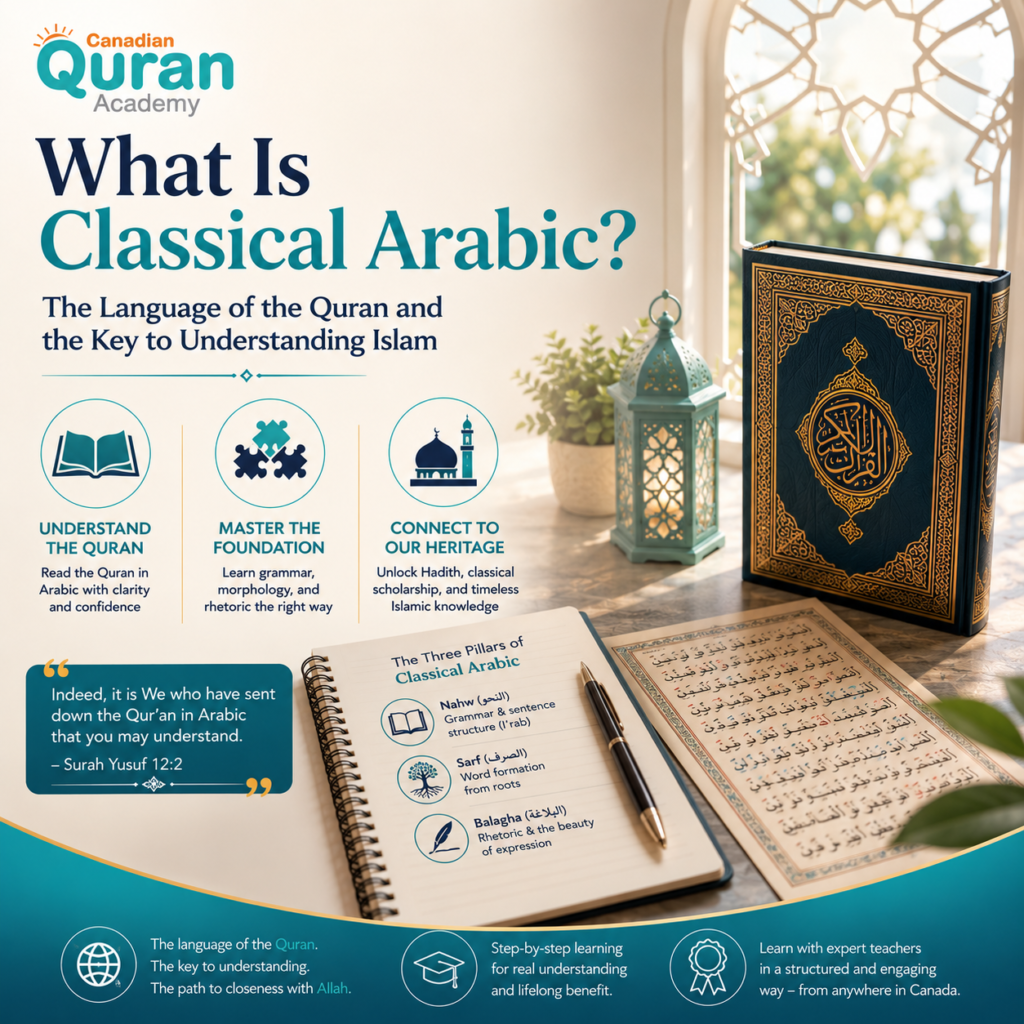
This is the Arabic of the Quran and classical Islamic texts. It has a specific vocabulary set, grammatical structures, and rhetorical patterns.
A learner focused on Quranic Arabic does not need to hold a conversation in a Cairo coffee shop — they need to parse verb forms, recognize roots, and understand grammatical case endings that are absent in spoken dialects.
The Canadian Quran Academy’s Arabic Grammar course addresses this track directly, building the analytical tools needed to navigate Quranic text with confidence.
Begin learning Arabic grammar with a FREE trial class
2. Modern Standard Arabic (MSA)
MSA is the formal, written Arabic used across Arab governments, media, and academic institutions. It is understood across all 22 Arab-majority countries.
For Canadian professionals pursuing government, journalism, international relations, or UN careers, MSA is the target register.
3. Conversational/Colloquial Arabic
Spoken dialects — Egyptian, Levantine, Gulf, Moroccan — differ substantially from MSA and from each other. If your goal is connection with Arab-Canadian community members or travel to a specific region, colloquial instruction matters.
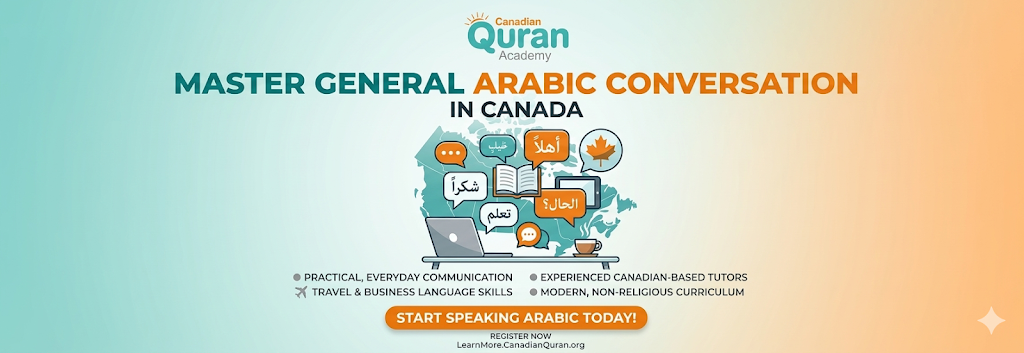
The Canadian Quran Academy’s Conversational Arabic course builds spoken fluency for real-world communication.
Mismatching goal to curriculum — for example, taking a dialect course when your actual need is Quranic comprehension — produces frustration, not progress.
Begin speaking Arabic with a FREE trial class
What Is the Importance of Learning Arabic?
The importance of learning Arabic extends well beyond Muslim communities into Canada’s broader cultural, diplomatic, and economic fabric. Arabic is the sixth most spoken language in the world by native speakers, an official language of the United Nations, and the primary language of 22 countries spanning the Middle East and North Africa — a region of sustained geopolitical and economic significance.
Canada’s Arab-Canadian population has grown substantially across Ontario, Alberta, Quebec, and British Columbia.
Arabic speakers are among the most professionally sought-after in federal government departments, healthcare systems serving immigrant populations, and private sector companies with MENA-region business relationships.
Beyond individual career advantage, Arabic unlocks one of the world’s great literary and scientific traditions.
The classical Arabic intellectual tradition — spanning mathematics, philosophy, medicine, astronomy, and literature — is a formative layer of human civilization. Accessing it in the original language is a qualitatively different experience from reading it in translation.
Read also: WHAT ARE THE BENEFITS OF LEARNING ARABIC IN CANADA?
Our Students Reviews
Start Your Quranic Journey in Canada
Join our vibrant community and learn with expert tutors through our flexible online platform.
Claim Your Free TrialStart Learning Arabic with Qualified Instruction at The Canadian Quran Academy
Arabic is worth learning — for your Deen, your career, and your mind. The only question is whether you learn it with the right support.
The Canadian Quran Academy offers:
- Qualified, experienced Arabic instructors — native speakers with structured pedagogical training
- Personalized 1-on-1 sessions matched to your specific goal (Quranic, MSA, or conversational)
- Flexible scheduling across Canadian time zones — morning, evening, and weekend sessions
- Programs for adults, children, and complete beginners
- Free trial lesson — no commitment required
Book your free trial at The Canadian Quran Academy and take the first structured step toward Arabic that actually delivers.
Check out our top Arabic courses
Book your FREE trial session today
Conclusion
Arabic offers Canadian Muslims something no other language can — a direct line to the Quran, to authentic scholarship, and to 1,400 years of Islamic intellectual tradition. For Canadian professionals, it adds diplomatic, economic, and cognitive value that grows in relevance as Canada’s connections to the Arab world deepen.
The path to Arabic is not short, but it is clear. Defined goals, a matched curriculum, qualified instruction, and consistent practice — these four elements determine outcomes more than natural aptitude ever will.
If you’ve been weighing the decision, the honest answer from someone who has watched this transformation in students week after week is this: start now, start structured, and let a qualified instructor guide the early stages. The returns compound in ways that are difficult to fully anticipate until you’re reading the Quran and understanding it — word by word — in Salah.
Frequently Asked Questions About Learning Arabic in Canada
Is Arabic hard to learn for English speakers?
Arabic is classified as one of the challenging languages for English speakers, primarily due to its script, root-based word system, and grammatical case structure. However, “hard” should not mean “impractical.” With a qualified instructor and realistic timelines, English-speaking Canadian learners consistently make meaningful progress, especially toward Quranic Arabic reading comprehension, within six to twelve months of structured study.
Can I learn Arabic online effectively from Canada?
Yes — and for most Canadian learners, online instruction is actually the superior option. Live 1-on-1 sessions with a qualified instructor eliminate commuting, accommodate Canadian time zones, and deliver immediate pronunciation correction that apps and self-study cannot provide. At The Canadian Quran Academy, learners across Ontario, Quebec, Alberta, and British Columbia access native instructors through flexible scheduling that works around professional and family life.
Should I learn Quranic Arabic or Modern Standard Arabic first?
For Canadian Muslims, Quranic Arabic is the recommended starting point. It provides immediate spiritual return — deeper Salah, direct Quranic understanding — while building a grammatical foundation that transfers into Modern Standard Arabic later. The two tracks share core grammar, so Quranic Arabic study is not a detour from MSA; it is a meaningful entry point into the Arabic language system overall.
How much does it cost to learn Arabic in Canada?
Costs vary significantly by instruction type. Self-study apps are low-cost but slow and unsupervised. Group classes at community centers or universities are moderately priced. Private 1-on-1 instruction with a qualified instructor — the most effective approach — ranges in price but typically produces faster, more measurable progress. The Canadian Quran Academy offers a free trial lesson with no commitment, allowing learners to assess fit before investing in a full program.
Is Arabic useful in the Canadian job market?
Yes — particularly in federal government roles (Global Affairs Canada, CSIS, national security), healthcare serving Arabic-speaking immigrant populations, social services, legal interpretation, and private sector companies operating in MENA markets. As Canada’s Arab-Canadian population grows, the professional value of Arabic fluency in major cities continues to increase.





Leave a Reply