 Quran
Quran

Lying appears throughout the Quran as more than a bad habit — it is treated as a root cause of hypocrisy, disbelief, and spiritual harm. If you have searched for Quran verses about lying in Arabic, you likely want the original text, an accurate translation, and a clear sense of why the Quran treats this sin so seriously.
This article collects the key Quran verses about lying in Arabic with tashkeel, their English translations, the exact surah and ayah reference, and links to read them in context on Quran.com. It also brings in the most relevant hadith on lying from Sunnah.com, so you can see how the Quran and Sunnah work together on this topic.
By the end, you will understand the different forms lying takes in the Quran, how it connects to hypocrisy, and how these teachings can be explained to children in a way that actually sticks.
What you’ll learn in this article
- The main Quran verses about lying in Arabic, with tashkeel and full references
- How the Quran links lying to hypocrisy (nifaq) specifically
- Why fabricating claims against Allah is treated as the most serious form of lying
- What authentic hadith add to the Quran’s teaching on honesty
- The rare exceptions where speaking an untruth is permitted in Islam
- How to introduce these lessons to children in an age-appropriate way
Quran verses about lying in Arabic and the link to hypocrisy
Hypocrisy (nifaq) is defined in Islamic teaching as showing faith outwardly while hiding disbelief or bad intention inwardly. The Quran repeatedly identifies lying as the mechanism that produces this state, not just a symptom of it.
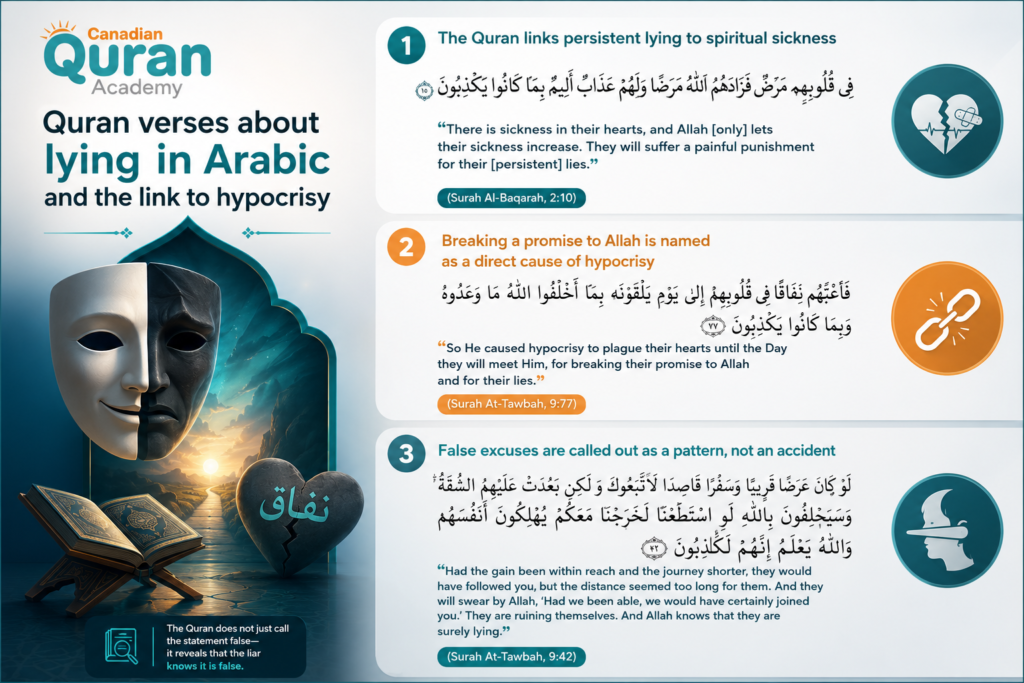
1. The Quran links persistent lying to spiritual sickness
The Quran does not present lying as a harmless habit. Instead, it describes repeated dishonesty as something that gradually damages a person’s spiritual state and hardens the heart.
فِى قُلُوبِهِم مَّرَضٌ فَزَادَهُمُ ٱللَّهُ مَرَضًا وَلَهُمْ عَذَابٌ أَلِيمٌۢ بِمَا كَانُوا۟ يَكْذِبُونَ
“There is sickness in their hearts, and Allah [only] lets their sickness increase. They will suffer a painful punishment for their [persistent] lies.” (Surah Al-Baqarah, 2:10)
This verse describes lying as something that compounds over time. The heart’s condition worsens the more a person repeats falsehood, which is why the Quran treats habitual lying as more dangerous than a single lapse.
2. Breaking a promise to Allah is named as a direct cause of hypocrisy
Keeping one’s word is a fundamental Islamic value. When promises are repeatedly broken and accompanied by deliberate lies, the Quran identifies this behavior as a pathway to hypocrisy.
فَأَعْقَبَهُمْ نِفَاقًا فِى قُلُوبِهِمْ إِلَىٰ يَوْمِ يَلْقَوْنَهُۥ بِمَآ أَخْلَفُوا۟ ٱللَّهَ مَا وَعَدُوهُ وَبِمَا كَانُوا۟ يَكْذِبُونَ
“So He caused hypocrisy to plague their hearts until the Day they will meet Him, for breaking their promise to Allah and for their lies.” (Surah At-Tawbah, 9:77)
Here the Quran gives a cause-and-effect chain: broken promises plus habitual lying produce hypocrisy that lasts “until the Day they will meet Him.” The wording makes clear this is not a temporary state — it is a lasting spiritual condition.
3. False excuses are called out as a pattern, not an accident
The Quran distinguishes between genuine inability and fabricated excuses. It repeatedly exposes intentional deception, showing that knowingly inventing excuses is a serious moral failure rather than a simple mistake.
لَوْ كَانَ عَرَضًا قَرِيبًا وَسَفَرًا قَاصِدًا لَاتَّبَعُوكَ وَلَٰكِن بَعُدَتْ عَلَيْهِمُ ٱلشُّقَّةُ ۚ وَسَيَحْلِفُونَ بِٱللَّهِ لَوِ ٱسْتَطَعْنَا لَخَرَجْنَا مَعَكُمْ يُهْلِكُونَ أَنفُسَهُمْ وَٱللَّهُ يَعْلَمُ إِنَّهُمْ لَكَٰذِبُونَ
“Had the gain been within reach and the journey shorter, they would have followed you, but the distance seemed too long for them. And they will swear by Allah, ‘Had we been able, we would have certainly joined you.’ They are ruining themselves. And Allah knows that they are surely lying.” (Surah At-Tawbah, 9:42)
A recurring detail across these verses is that Allah names the internal knowledge of the liar — the Quran does not simply call the statement false, it states that the speaker knows it is false. This distinction between an honest mistake and a deliberate untruth is what separates ordinary error from the sin of lying in Islamic teaching.
Understanding this distinction matters most when it’s taught early. Canadian Quran Academy’s Islamic Studies Courses for Kids walk children through exactly this kind of nuance — not just memorizing that lying is wrong, but understanding why the Quran treats intention as central to the sin.
Start your child’s Islamic Studies journey with a FREE trial class.

Live Class in Action
Watch how our instructors interact with students in real-time, focusing on interactive methods.
Start Your Quranic Journey in Canada
Join our vibrant community and learn with expert tutors through our flexible online platform.
Claim Your Free TrialRead also: Quran Verses About Love in Arabic: 7 Beautiful Verses
How does the Quran describe lying in beliefs, actions, and fabrication against Allah?
The Quran treats lying as something that can happen through speech, through actions that misrepresent the truth, and through beliefs that are stated without conviction. This broader definition is one reason the topic covers so much ground across the text.
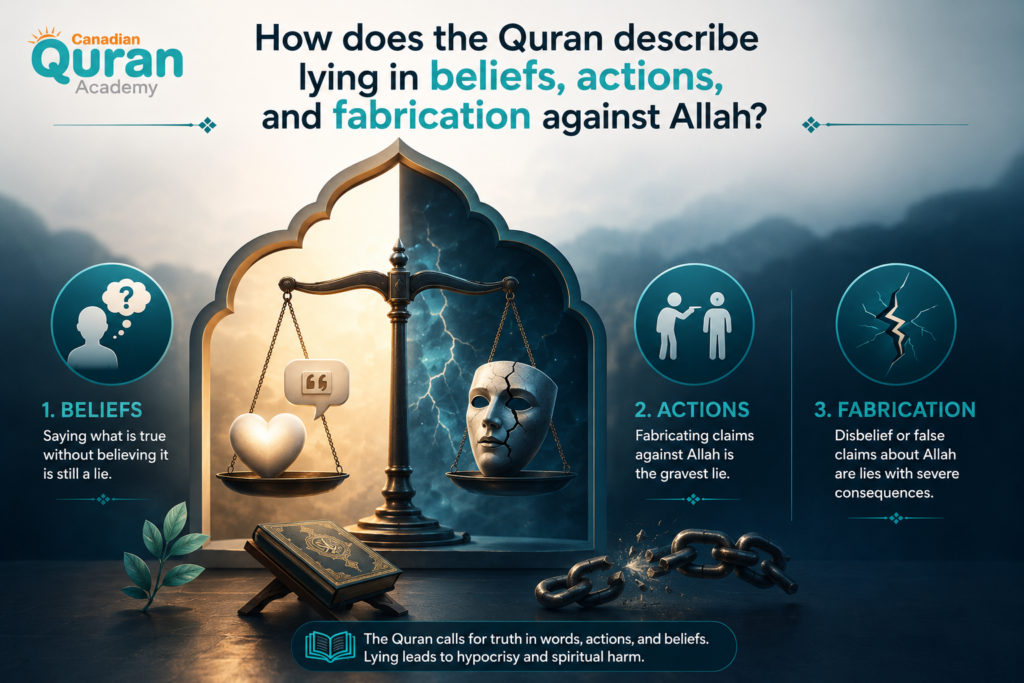
1. Saying something true while not believing it is still counted as lying
The Quran teaches that truthfulness is not measured by words alone. A statement can be factually correct, yet still be considered a lie when it is spoken without sincere belief or honest intention.
إِذَا جَآءَكَ ٱلْمُنَٰفِقُونَ قَالُوا۟ نَشْهَدُ إِنَّكَ لَرَسُولُ ٱللَّهِ ۗ وَٱللَّهُ يَعْلَمُ إِنَّكَ لَرَسُولُهُۥ وَٱللَّهُ يَشْهَدُ إِنَّ ٱلْمُنَٰفِقِينَ لَكَٰذِبُونَ
“When the hypocrites come to you [O Prophet], they say, ‘We bear witness that you are certainly the Messenger of Allah’—and surely Allah knows that you are His Messenger—but Allah bears witness that the hypocrites are truly liars.” (Surah Al-Munafiqun, 63:1)
This is one of the more instructive verses in the Quran on lying, because the statement itself was factually correct — Muhammad ﷺ was indeed the Messenger of Allah. The lie was in the absence of belief behind the words. This is a distinction most surface-level lists of “Quran verses on lying” skip entirely.
2. Fabricating claims against Allah is treated as the most serious form of lying
Not all lies carry the same weight in the Quran. Among the gravest offenses is inventing false claims about Allah, His revelation, or His commands, because such deception misguides both the speaker and others.
فَمَنْ أَظْلَمُ مِمَّنِ ٱفْتَرَىٰ عَلَى ٱللَّهِ كَذِبًا
“Who then does more wrong than those who fabricate lies against Allah?” (Surah Al-Kahf, 18:15)
The Quran escalates the severity of lying based on who or what it targets. Lying to another person is a sin; fabricating a claim about Allah’s nature, rulings, or revelation is described as the worst form of wrongdoing (zulm) a person can commit.
أَلَآ إِنَّهُم مِّنْ إِفْكِهِمْ لَيَقُولُونَ وَلَدَ ٱللَّهُ وَإِنَّهُمْ لَكَٰذِبُونَ
“It is one of their [outrageous] fabrications to say, ‘Allah has children.’ They are simply liars.” (Surah As-Saffat, 37:151-152)
3. Disbelief itself is described as a form of lying against Allah
The Quran repeatedly warns against attributing false beliefs or statements to Allah. In several passages, rejecting revealed truth or inventing religious claims is described as a form of falsehood with profound spiritual consequences.
قَدِ ٱفْتَرَيْنَا عَلَى ٱللَّهِ كَذِبًا إِنْ عُدْنَا فِى مِلَّتِكُم بَعْدَ إِذْ نَجَّىٰنَا ٱللَّهُ مِنْهَا
“We would surely be fabricating a lie against Allah if we were to return to your faith after Allah has saved us from it.” (Surah Al-A’raf, 7:89)
This is Prophet Shu’aib’s response to his people’s threat to expel him. The verse shows that returning to a rejected belief system is not framed as a simple change of opinion — the Quran calls it fabrication against Allah.
Even non-believers who fabricate lies about Allah are given time to repent, which is a recurring theme worth pairing with these verses:
وَمَا ظَنُّ ٱلَّذِينَ يَفْتَرُونَ عَلَى ٱللَّهِ ٱلْكَذِبَ يَوْمَ ٱلْقِيَٰمَةِ
“What do those who fabricate lies against Allah expect on the Day of Judgment? Surely Allah is ever Bountiful to humanity, but most of them are ungrateful.” (Surah Yunus, 10:60)
Read also: Quran Verses About Life in Arabic
Quran verses about lying in the stories of the Prophets
Beyond direct rulings, the Quran uses the stories of the Prophets to show lying’s real-world consequences. This narrative method is often more memorable for young learners than a standalone rule, because the outcome of the lie is shown rather than just stated.
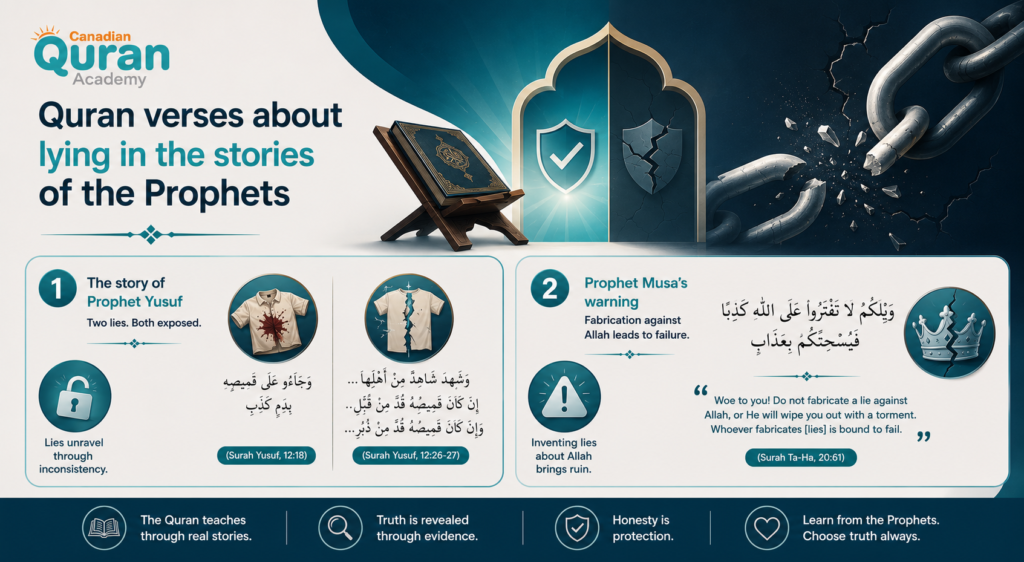
1. The story of Prophet Yusuf shows two separate lies and their unraveling
The story of Prophet Yusuf is one of the clearest Quranic examples of how deception unfolds over time. It presents two different lies and shows that both are ultimately exposed through evidence rather than appearance.
وَجَآءُو عَلَىٰ قَمِيصِهِۦ بِدَمٍ كَذِبٍ
“And they brought his shirt, stained with false blood.” (Surah Yusuf, 12:18)
Yusuf’s brothers fabricate a story about a wolf attack after leaving him in a well. Later in the same surah, a second lie appears — this time from the minister’s wife — and is disproven through a simple piece of physical evidence:
وَشَهِدَ شَاهِدٌ مِّنْ أَهْلِهَآ إِن كَانَ قَمِيصُهُۥ قُدَّ مِن قُبُلٍ فَصَدَقَتْ وَهُوَ مِنَ ٱلْكَٰذِبِينَ وَإِن كَانَ قَمِيصُهُۥ قُدَّ مِن دُبُرٍ فَكَذَبَتْ وَهُوَ مِنَ ٱلصَّٰدِقِينَ
“And a witness from her own family testified: ‘If his shirt is torn from the front, then she has told the truth and he is a liar. But if it is torn from the back, then she has lied and he is truthful.'” (Surah Yusuf, 12:26-27)
Both lies in this surah are eventually exposed. What makes this story useful for teaching is the mechanism of exposure — a physical detail, not a dramatic revelation, is what proves the truth. That is a concrete lesson: lies tend to unravel through inconsistency, not through divine intervention alone.
2. Prophet Musa warned that fabrication against Allah invites swift consequences
The Quran records Prophet Musa’s warning as a direct reminder that inventing falsehood about Allah carries severe consequences. His words emphasize that deception in matters of faith is destined to fail, no matter how convincing it may seem at first.
وَيْلَكُمْ لَا تَفْتَرُوا۟ عَلَى ٱللَّهِ كَذِبًا فَيُسْحِتَكُم بِعَذَابٍ
“Woe to you! Do not fabricate a lie against Allah, or He will wipe you out with a torment. Whoever fabricates [lies] is bound to fail.” (Surah Ta-Ha, 20:61)
This is Musa’s (PBUH) direct warning to Pharaoh’s magicians before their contest, tying fabrication to failure explicitly rather than leaving the consequence implied.
Children understand moral lessons more deeply when they encounter them directly in the Quran with proper Tajweed and age-appropriate explanation, rather than relying only on simplified summaries. The Quran Courses for Kids at Canadian Quran Academy are designed to help young learners connect Islamic values to the actual verses they read and understand.
Begin Online Quran Classes for Kids in Canada with a FREE trial class.

Experience Our Classrooms
Don’t just take our word for it—take a look inside! Watch the videos below to experience our engaging teaching methods and vibrant online classrooms firsthand.
Start Your Quranic Journey in Canada
Join our vibrant community and learn with expert tutors through our flexible online platform.
Claim Your Free TrialLearn Quran Verses About Lying in Arabic with The Canadian Quran Academy
Reading translations can introduce the meaning of the Quran, but studying the Arabic verses themselves helps children develop a deeper connection with Allah’s words. With proper Tajweed and guided explanation, they gain both accurate recitation and a lasting understanding of the lessons each verse teaches.
At The Canadian Quran Academy, experienced teachers help children learn Quran verses about lying in Arabic in a structured and engaging way. Students recite the verses correctly, understand their context and meanings, and discover how the Quran’s guidance on honesty and truthfulness applies to their daily lives.
Book your free trial at The Canadian Quran Academy and help your child build a lifelong connection with the Quran through structured, engaging learning.

Our Quran Courses
- Quran Online Academy
- Quran Recitation Classes
- Quran Reading Classes
- Online Quran Classes for Kids
- Quran Classes for Adults
- Quran Classes for Female/Sisters
- Learn Quran for Beginners
- Quran Memorization (Hifz) Course
- Hifz Classes for Adults
- Quran Memorization and Hifz for Kids
- Quran Hifz for Ladies
- Quran Ijazah Program
- Quran Qirat Learning Course
- Quran Tafsir Course
- Noorani Qaida Course
- Noorani Qaida Course for Kids
- Weekend Quran Classes
- Intensive Quran Course
- Al-Azhar Quran Course
- Online Tajweed Classes
- Tajweed Course for Kids
- Tajweed Course for Adults
- Tajweed Course for Ladies/Sisters
Start Your Quranic Journey in Canada
Join our vibrant community and learn with expert tutors through our flexible online platform.
Claim Your Free TrialConclusion
The Quran verses about lying in Arabic reviewed here show a consistent pattern: lying is treated as a spiritual condition, not an isolated act. It begins with sickness in the heart (2:10), compounds into hypocrisy through broken promises (9:77), and reaches its most serious form when the fabrication is directed at Allah Himself (18:15, 37:151-152).
The stories of Prophet Yusuf demonstrate how these lies play out and unravel in practice, while authentic hadith on truthfulness (Sahih Muslim 2607) and the signs of hypocrisy (Sahih al-Bukhari 33) reinforce the same message from the Sunnah. The one narrow set of exceptions (Sahih Muslim 2605) shows that this is a precise ruling, not a blanket rule with no nuance.
Reading these Quran verses about lying in Arabic alongside their translations, and discussing them with children early, builds an understanding of honesty that goes beyond a simple “don’t lie” rule.
FAQs
What is the main Quran verse about lying?
Surah Al-Baqarah 2:10 is one of the most cited, describing how persistent lying increases the “sickness” in a person’s heart and leads to a painful punishment. Several other verses, including 9:77 and 18:15, expand on different dimensions of the same theme.
Is all lying considered haram in Islam?
Lying is generally prohibited, but Islamic teaching recognizes three narrow exceptions: reconciling between two people, wartime strategy, and a husband and wife speaking kindly to each other (Sahih Muslim 2605). Outside these specific cases, honesty is the required standard.
Why does the Quran connect lying to hypocrisy so strongly?
The Quran describes broken promises and habitual lying as the direct cause of hypocrisy developing in the heart (Surah At-Tawbah, 9:77). This connection is reinforced by the hadith naming lying as one of the three signs of a hypocrite (Sahih al-Bukhari 33).
What does the Quran say about lying against Allah specifically?
Fabricating claims against Allah — such as ascribing an offspring to Him — is described as the most serious form of wrongdoing a person can commit (Surah Al-Kahf, 18:15; Surah As-Saffat, 37:151-152). The Quran treats this as more severe than lying to another person.
How can I teach my child about honesty using the Quran?
Start with a story-based verse, such as the account of Prophet Yusuf in Surah Yusuf, since children connect more easily with narrative consequences than abstract rules. Structured courses that combine Arabic recitation with meaning, like those offered for kids at Canadian Quran Academy, build on this foundation over time.
Does the Quran show any hope for people who lie?
Yes. Even after describing the punishment awaiting hypocrites, the Quran states that those who repent, correct their behavior, and hold firmly to Allah will be counted among the believers (Surah An-Nisa, 4:146). Repentance remains open before death.







Leave a Reply