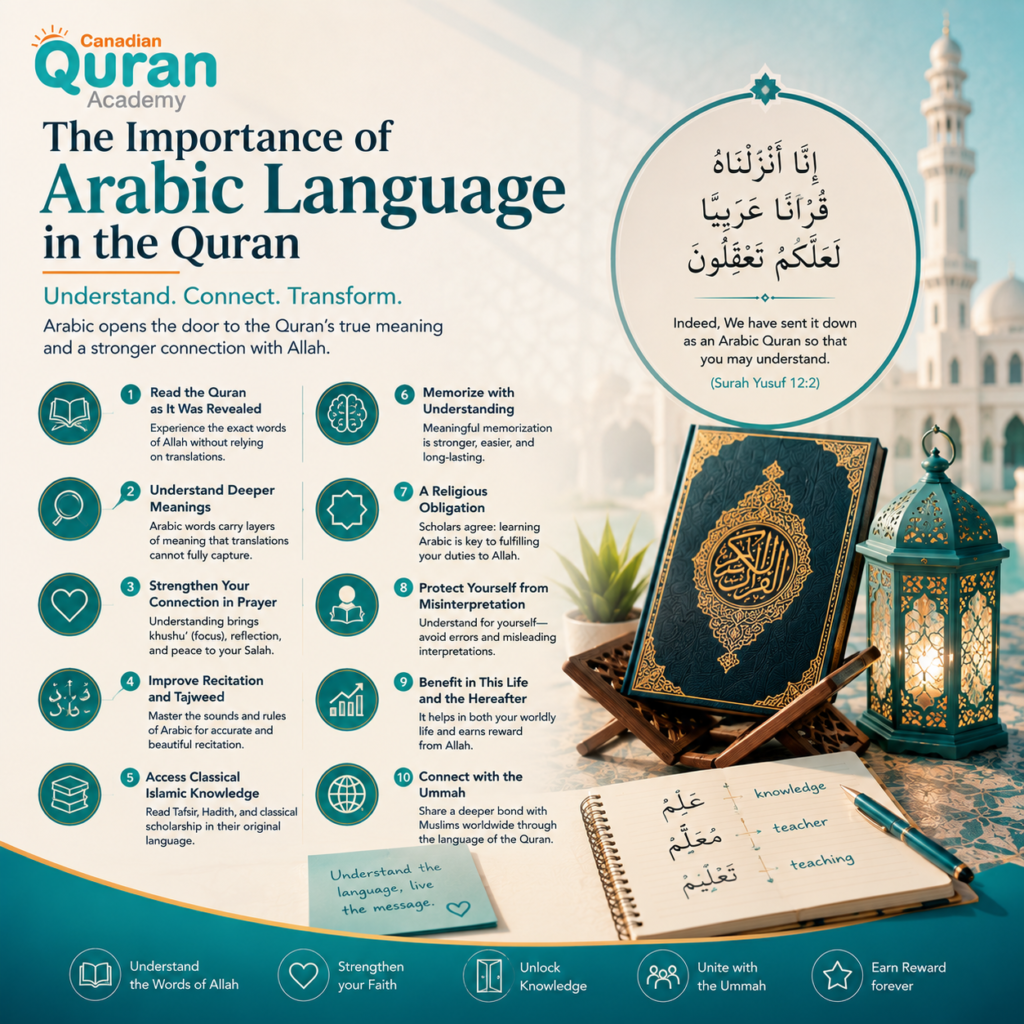
 Arabic
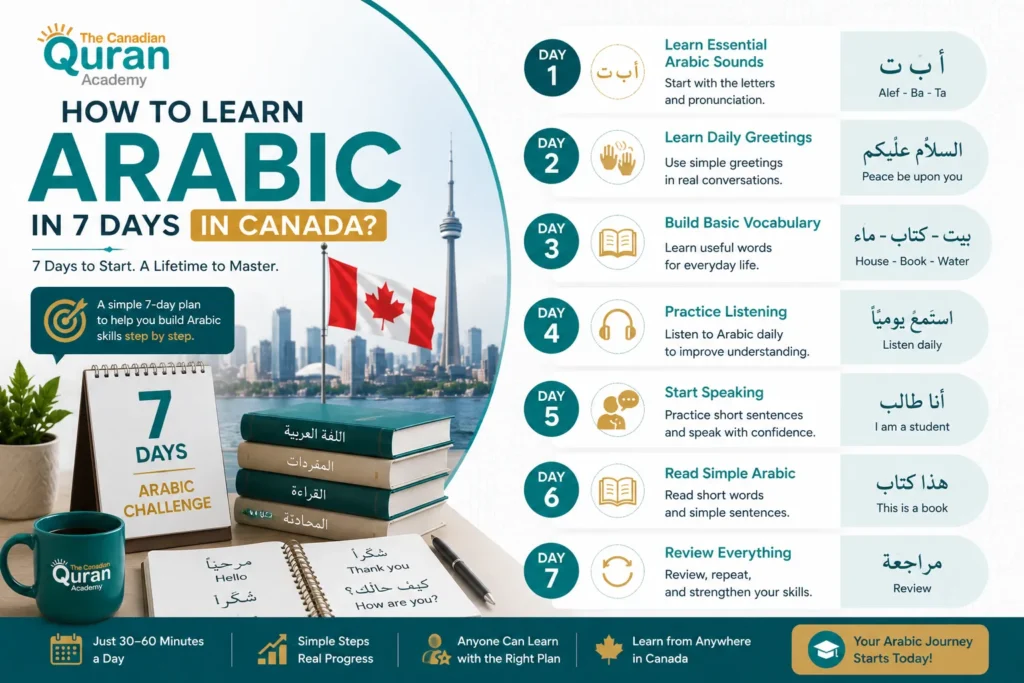
| Key Takeaways |
| Seven days of structured Arabic study can establish pronunciation, core vocabulary, and basic sentence patterns for Canadian beginners. |
| The Arabic alphabet has 28 letters; most adult learners recognize all of them within three focused sessions of 30–45 minutes each. |
| Canadian learners with busy schedules consistently succeed by committing to 45–60 minutes daily rather than irregular long sessions. |
| A qualified instructor accelerates 7-day progress significantly by correcting pronunciation errors before they solidify into habits. |
You can learn the Arabic alphabet, core vocabulary, and simple sentence structure in 7 days in Canada — if you follow a focused, hour-by-hour plan and drop the myth that Arabic is uniquely difficult.
The Arabic language has consistent rules, phonetic spelling, and a grammar logic that becomes clear fast when it is taught correctly.
Seven days will not make you fluent. What they will do is build the foundation every successful Arabic learner stands on: letter recognition, basic sounds, high-frequency words, and the confidence to keep going.
Follow this step-by-step plan, work 45–60 minutes daily, and by Day 7 you will be reading simple Arabic text and forming short sentences.
Day 1: Master the Arabic Alphabet in One Sitting
To learn Arabic in 7 days in Canada, you begin with the alphabet — all 28 letters — on Day 1. This is not as intimidating as it sounds.
Arabic letters are phonetic, meaning each letter represents one consistent sound, and most learners recognize the full alphabet within a single 45–60 minute focused session when they group letters by visual shape.
Arabic is written right-to-left, which takes about 20 minutes to adjust to. The bigger task on Day 1 is grouping the 28 letters by their dot patterns and base shapes.
Seventeen of the 28 letters are variations of just six base forms — once you see this, the alphabet shrinks dramatically.
How to Organize Day 1 Study
Use this grouping approach rather than memorizing letters in linear order:
- Examples of Letters with similar base shapes: ب، ت، ث، ص، ض، ط، ظ، خ، ح، ج— same base, different dots.
- Examples of Letters with no dots: ا، و، ر، م، ل، ه، ع
Write each letter by hand. Motor memory accelerates recognition faster than flashcards alone. At The Canadian Quran Academy, our Arabic for Beginners course covers the entire alphabet in the first session using this shape-grouping method — students consistently leave Day 1 able to identify every letter in isolation.
Begin learning Arabic with a FREE trial class

Day 2: Learn How Arabic Letters Connect and Change Shape
Arabic letters change their written form depending on whether they appear at the beginning, middle, or end of a word — or standing alone. This is called letter connectivity, and it is the concept most Canadian beginners underestimate on Day 2.
Each Arabic letter has up to four forms: initial, medial, final, and isolated.
Six letters — ا، د، ذ، ر، ز، و — never connect to the letter following them, which makes them easier anchor points in any word.
Day 2 Practice Method
Spend the first 20 minutes reviewing yesterday’s isolated letter forms. Then practice connecting:
- Write the word كتب (kataba — he wrote) in three forms slowly
- Write باب (bab — door) to see how ب shifts at start versus end
- Practice reading 10 simple three-letter words written in full connected script
By end of Day 2, you should read a connected word slowly but accurately. Speed comes later — accuracy now is the goal.
Read also: HOW TO LEARN ARABIC IN 6 MONTHS IN CANADA?
Shots Videos from Our Courses
Start Your Quranic Journey in Canada
Join our vibrant community and learn with expert tutors through our flexible online platform.
Claim Your Free TrialDay 3: Train Your Ear and Mouth on Arabic Sounds
Arabic pronunciation has sounds that do not exist in English, and Day 3 is dedicated entirely to phonetics.
Skipping this step is the single most common error we observe at The Canadian Quran Academy in adult self-study learners — they learn letter shapes but develop mispronunciations that take months to correct later.
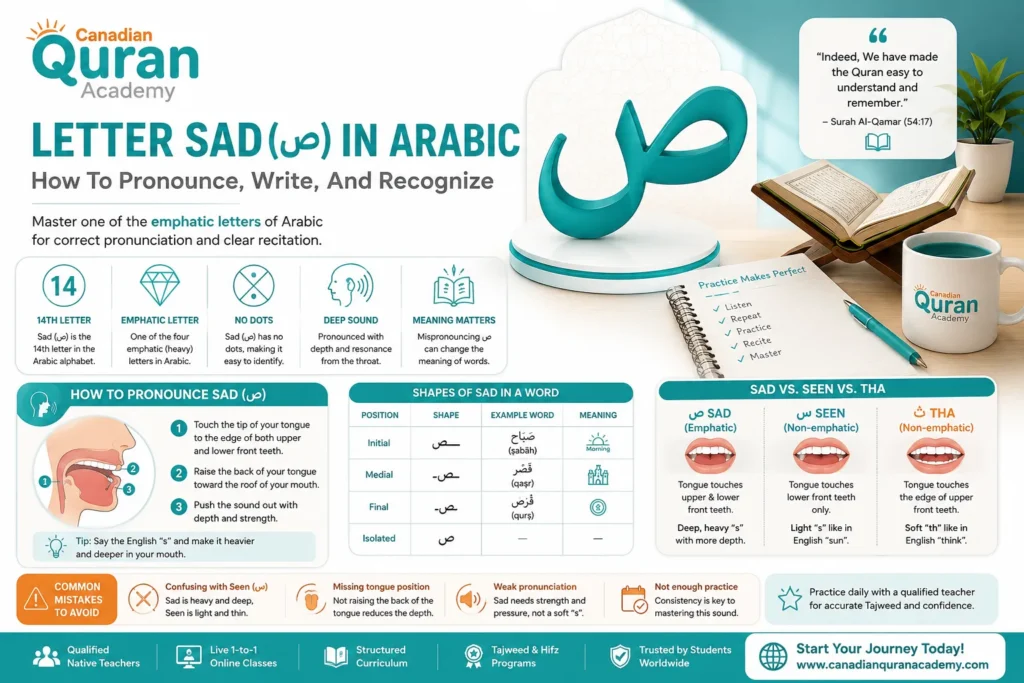
The letters that require deliberate practice are the emphatic consonants: ص، ض، ط، ظ — and the deep throat sounds: ع، غ، ح، خ. These are not hard to produce; they simply require muscle memory your mouth has not built yet.
The Five Sounds Every Canadian Beginner Must Isolate
| Arabic Letter | Sound Description | Common English Error |
| ع (Ayn) | Voiced pharyngeal — from deep in throat | Replaced with plain ‘a’ |
| ح (Ha) | Breathy, whispered ‘h’ — not like English H | Replaced with regular H |
| خ (Kha) | Like clearing the throat gently | Replaced with ‘k’ |
| ص (Sad) | Emphatic S — tongue presses down | Replaced with regular S |
| ق (Qaf) | Deep back-of-throat K | Replaced with regular K |
Record yourself producing each sound. Compare to a native speaker audio source. The gap you hear is your Day 3 work.
Day 4: Build Your First 50 Arabic Words
Arabic vocabulary acquisition on Day 4 should prioritize high-frequency roots rather than random word lists. Arabic is a root-based language: three-letter roots generate families of related words. Learning one root gives you access to multiple words simultaneously.
The root ك-ت-ب (k-t-b) gives you: كتب (kataba — he wrote), كتاب (kitaab — book), كاتب (kaatib — writer), مكتبة (maktaba — library). That is four words from three letters learned once.
50 Words to Learn on Day 4
Focus on these categories:
- Family: أب (father), أم (mother), أخ (brother), أخت (sister), بيت (house)
- Actions: ذهب (went), أكل (ate), شرب (drank), قرأ (read), كتب (wrote)
- Objects: كتاب (book), ماء (water), طعام (food), باب (door), سيارة (car)
- Descriptions: كبير (big), صغير (small), جديد (new), قديم (old)
- Greetings/phrases: السلام عليكم، شكراً، نعم، لا، من فضلك
Write each word, say it aloud, and write a short sentence using it before moving on. Passive recognition is not enough — active production locks vocabulary into memory.
Read also: CAN I LEARN ARABIC IN 3 MONTHS IN CANADA?
Day 5: Understand Basic Arabic Sentence Structure
Arabic sentence structure on Day 5 is where most Canadian learners either accelerate or stall. The core pattern is straightforward: Arabic has two main sentence types — nominal sentences (جملة اسمية) beginning with a noun, and verbal sentences (جملة فعلية) beginning with a verb.
A basic nominal sentence: البيتُ كبيرٌ — “The house is big.” There is no verb “to be” in present tense Arabic.
A basic verbal sentence: ذهبَ الولدُ — “The boy went.” The verb comes first.
The Three Patterns You Need on Day 5
Master these three patterns and you can build hundreds of sentences:
- [Noun] + [Adjective]: البيتُ الكبير — The big house
- [Verb] + [Subject]: ذهبَ الرجلُ — The man went
- [Noun] + [Noun in possession]: كتابُ الطالبِ — The student’s book
Arabic also marks gender (masculine and feminine) on nouns and adjectives. Feminine nouns almost always end in ة (taa marbuta). This rule covers the majority of feminine nouns — learn it once and it becomes automatic.
At The Canadian Quran Academy, our Arabic Grammar course builds precisely on these patterns, expanding them into full conversational and Quranic competence through structured 1-on-1 sessions.
Begin learning Arabic grammar with a FREE trial class
Day 6: Read Short Arabic Texts Aloud
Day 6 is integration day. You now have the alphabet, letter forms, sounds, 50 words, and basic sentence structure. The goal is to read connected Arabic text — slowly, accurately, and aloud.
Reading aloud is not optional. Silent reading in Arabic at the beginner stage allows mispronunciation to go unnoticed.
Vocalization forces you to confirm that your sound knowledge matches your letter recognition. This is where the two tracks of your week-long study merge.
What to Read on Day 6?
Start with short, voweled (harakat-marked) Arabic texts. Voweled text includes the short vowel markers — فتحة، كسرة، ضمة — that tell you exactly how to pronounce every letter. Unvoweled text comes later.
Good Day 6 reading sources:
- Simple Quranic verses with full tashkeel (vowel marks) — Surah Al-Ikhlas is four short verses and uses only letters and sounds you have already studied
- Short children’s Arabic readers available through your instructor
- Voweled word lists from your Day 4 vocabulary
بِسْمِ اللَّهِ الرَّحْمَٰنِ الرَّحِيمِ
Bismi llāhi r-raḥmāni r-raḥīm
In the name of Allah, the Most Gracious, the Most Merciful
This phrase alone uses 12 of the 28 Arabic letters in connected form. If you can read it slowly and accurately on Day 6, your alphabet and connectivity work is solid.
Day 7: Speak Arabic, Review, and Build Your Continuation Plan
Day 7 is not a rest day — it is a consolidation and output day. Everything you have studied this week needs to be activated through speaking, writing from memory, and honest self-assessment against a clear continuation plan.
The goal of Day 7 is to answer one question honestly: What do I now know with confidence, and what needs more work?
This assessment determines whether your next 30 days build on a solid foundation or patch over gaps that will slow you down later.
Day 7 Activities
- Write the full alphabet from memory — no reference
- Speak 20 sentences from your Day 5 patterns aloud, using Day 4 vocabulary
- Record yourself reading Surah Al-Ikhlas and compare to a qualified reciter
- List 10 words you consistently mispronounce — these are your Week 2 priorities
The Canadian Quran Academy’s Arabic Conversation Course in Canada — including conversational Arabic and intensive programs — are designed for exactly this point: learners who have a base and need structured progression with a qualified instructor to move forward correctly.
Begin speaking Arabic with a FREE trial class
Adult learners across Toronto, Calgary, and Vancouver consistently find that 7 days of self-directed study followed by structured instruction with a qualified teacher produces the fastest long-term results.
The self-study builds familiarity; the instructor corrects the errors you cannot hear in yourself.
Our Students Reviews
Start Your Quranic Journey in Canada
Join our vibrant community and learn with expert tutors through our flexible online platform.
Claim Your Free TrialStart Your Arabic Learning with Qualified Instruction at The Canadian Quran Academy
Seven days builds your foundation — a qualified instructor builds everything after it. The Canadian Quran Academy offers personalized 1-on-1 Arabic for Beginners courses designed for English-speaking Canadian learners at every level.
Why Canadian learners choose The Canadian Quran Academy:
- Qualified, experienced Arabic and Quran instructors
- Personalized 1-on-1 sessions at your own pace
- Flexible scheduling across Canadian time zones — morning, evening, and weekends
- Programs for adults, children, women, and new reverts
- Beginner through advanced Arabic, Quranic Arabic, grammar, and conversation tracks
- Free trial lesson available — no commitment required
Check out our top Arabic courses
Book your FREE trial session today

Conclusion
Consistent daily practice over 7 days creates recognizable letter recognition, foundational vocabulary, and basic sentence structure. These are not small achievements — they are the exact tools you need to read Quranic Arabic, continue to conversational fluency, or both.
The gap between knowing Arabic is possible and actually learning it is closed by one decision: starting with a structured plan rather than scattered resources. A qualified instructor who understands exactly where English-speaking Canadian learners get stuck will accelerate your progress beyond anything a 7-day self-study plan alone can accomplish.
Your 7-day foundation is ready to build on. What comes next depends entirely on whether you choose to build it with guidance or without it — and that choice, more than any other, determines your results.
Frequently Asked Questions About Learning Arabic in 7 Days in Canada
Can a complete beginner really learn Arabic in 7 days?
A complete beginner can learn the Arabic alphabet, basic letter connectivity, foundational vocabulary, and simple sentence structure in 7 days with 45–60 minutes of daily focused study. Fluency takes longer, but the core recognition and reading framework — the foundation everything else builds on — is genuinely achievable in one week.
How many hours per day do I need to study Arabic in 7 days?
Forty-five to sixty minutes of focused, structured study per day is sufficient for this 7-day plan. More time is not always better — cognitive retention drops sharply after 90 minutes of language study. Two focused 30-minute sessions with a break between them often outperform one unbroken 75-minute session.
Is Arabic hard to learn for English speakers in Canada?
Arabic is classified as a Category IV language by the U.S. Foreign Service Institute, meaning it requires more study hours to reach fluency than European languages. However, the Arabic alphabet is phonetically consistent — once learned, pronunciation is far more predictable than English spelling. Most Canadian adult beginners overestimate the difficulty of the alphabet specifically.
Can I learn Arabic online as a Canadian learner?
Online Arabic instruction is fully effective for Canadian learners, and for most adults with work and family commitments, it is more practical than in-person alternatives. Qualified 1-on-1 instruction delivers real-time pronunciation correction — the most important variable in early Arabic learning — regardless of whether the session happens in-person or through a secure online platform.The Canadian Quran Academy serves learners across Ontario, Quebec, Alberta, and British Columbia through flexible online sessions.





Leave a Reply