 Arabic
| Key Takeaways |
| Learning Arabic in 6 months in Canada is achievable with 45–60 minutes of daily structured practice and a clear goal. |
| Choosing between Quranic Arabic, Modern Standard Arabic, or conversational Arabic first is the single most important starting decision. |
| Months 1–2 must focus exclusively on the Arabic alphabet and root-word logic before any grammar or vocabulary building begins. |
| Adult learners in Canada consistently progress faster with live 1-on-1 instruction than with self-study apps alone. |
| A 6-month plan requires weekly milestones — not just a monthly goal — to maintain accuracy and prevent fossilized errors. |
Learning Arabic in 6 months in Canada is realistic — not easy, but genuinely achievable — if you commit to a structured plan, set a specific Arabic goal, and practice daily. The learners who fail at this timeline almost always share one mistake: they try to learn “all of Arabic” at once instead of choosing one clear track and going deep.
The 6-month window works for reaching functional literacy and beginner-to-intermediate proficiency in either Quranic Arabic or Modern Standard Arabic.
1. Decide Which Arabic You Are Actually Learning Before Day One
To learn Arabic in 6 months in Canada, you must first choose your Arabic track — and that choice determines your entire 6-month plan. Quranic Arabic, Modern Standard Arabic (MSA), and spoken dialects are related but meaningfully different.
Trying to study all three simultaneously in six months is the fastest path to fluency in none of them.
Here is how to choose:
- Quranic Arabic — the right choice if your primary goal is understanding the Quran, performing Salah with comprehension, or building an Islamic studies foundation
- Modern Standard Arabic (MSA / Fusha) — the right choice if you want to read Arabic literature, news media, or formal writing across the Arab world
- Conversational Arabic — the right choice if you plan to communicate with Arabic-speaking family, travel to an Arab country, or work in Arabic-speaking professional contexts
Most Canadian Muslim learners at The Canadian Quran Academy come in wanting Quranic Arabic specifically.
The good news: Quranic Arabic has a smaller active vocabulary than MSA — approximately 1,750 root words cover the vast majority of Quranic text — which makes the 6-month target more manageable than people expect.
If you are still undecided, our Arabic for Beginners course is designed to help new learners build the foundational literacy that applies across all three tracks before they specialize.
Begin learning Arabic with a FREE trial class

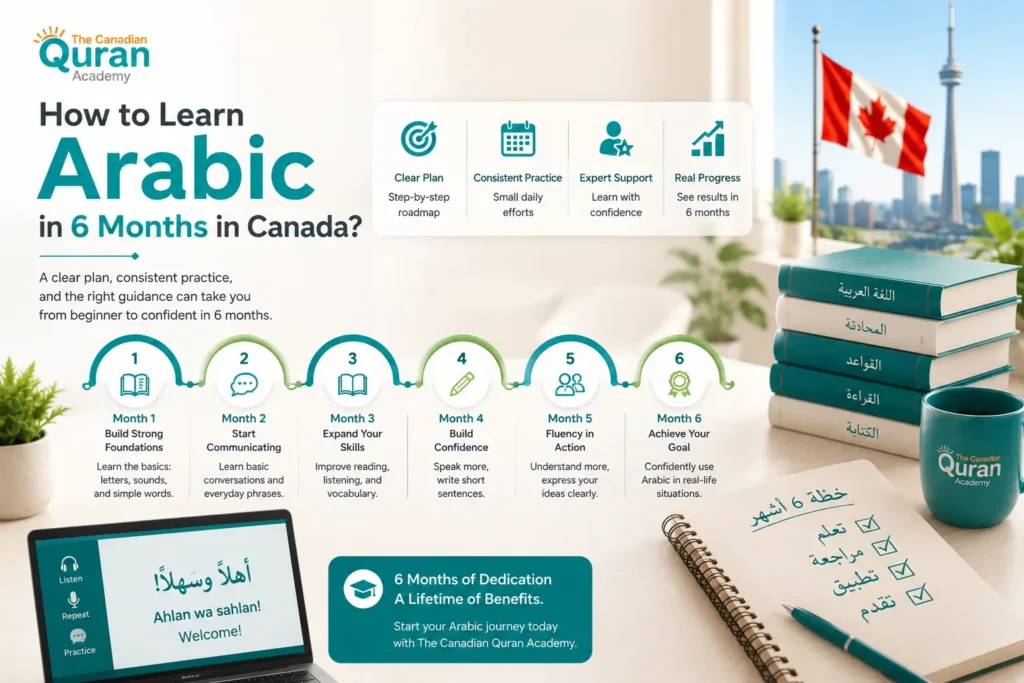
2. Master the Arabic Alphabet and Short Vowels in the First Four Weeks
The first month of your 6-month plan has one job: the Arabic alphabet in all its forms, plus the short vowel system (Fathah, Kasrah, Dammah). No grammar, no vocabulary lists, no sentences. Just letters. Learners who rush past this stage spend months correcting errors that never needed to exist.
Arabic has 28 letters, most of which change shape depending on their position in a word — initial, medial, final, or isolated. That is four forms per letter.
Add the six short and long vowels, plus Sukoon and Shadda, and a new learner is handling approximately 120 character variations before they read a single word.
What Week-by-Week Progress Looks Like
- Week 1: Letters 1–14 in isolated form, Fathah only
- Week 2: Letters 15–28 in isolated form, add Kasrah and Dammah
- Week 3: All 28 letters in connected (word-position) forms
- Week 4: Short reading practice with fully voweled text — the Noorani Qaida or equivalent structured reader
At The Canadian Quran Academy, our instructors consistently observe that adult learners who spend a full month on letter recognition — before moving to any other content — read Arabic syllables accurately and independently by week five.
Learners who skip to vocabulary in week two typically plateau at slow, sounding-out reading for months longer than necessary.
Practice for 20 minutes minimum per day during this phase. Handwriting practice accelerates letter recognition significantly — writing by hand forces your brain to process letter shapes more deeply than passive recognition drills.
Read also: HOW TO LEARN ARABIC IN 5 MINUTES IN CANADA?
3. Build Your Root-Word Foundation in Months Two and Three
Arabic operates on a root-word system where three-letter roots carry core meanings, and patterns of prefixes, suffixes, and vowel changes generate related words. Understanding this system — not memorizing isolated vocabulary — is what separates learners who plateau from those who accelerate.
In Quranic Arabic, for example, the root ك – ت – ب (K-T-B) generates: كَتَبَ (he wrote), كِتَاب (book), مَكْتُوب (written, a letter), كَاتِب (writer). Learning the root gives you four words simultaneously.
Your Month Two and Three Focus Areas
- Root recognition: Identify the three-letter root in unfamiliar words — this is a trainable skill, not an innate talent
- Verb patterns: The ten Arabic verb forms (Awzaan) — focus on Forms I, II, and IV first, as they cover the largest portion of Quranic vocabulary
- Common Quranic vocabulary: Target the 300 most frequently occurring Quranic words, which collectively account for approximately 70% of the Quran’s text
- Basic sentence structure: Subject-verb-object in Arabic vs. verb-subject-object in formal Arabic — the two dominant patterns
This is where a qualified instructor adds irreplaceable value. The root system has exceptions, irregular verbs, and weak roots (containing Alif, Waw, or Ya) that behave differently. Self-study apps cannot adapt explanations to your specific error patterns the way a trained Arabic teacher can.
The Canadian Quran Academy’s Arabic Classes for Kids use age-appropriate methods distinct from adult instruction to account for these differences.
Get your child a FREE trial class in our Arabic course for kids
4. Study Arabic Grammar in Focused, Targeted Units — Not All at Once
Arabic grammar is not something you study in full before you practice — it is something you learn in units as each unit becomes relevant to your reading and comprehension. Month three is when you begin grammar, not month one.
Attempting Arabic grammar without a functioning alphabet and basic vocabulary is one of the most common reasons Canadian adult learners abandon their studies.
The three grammar units that give you the highest return on investment in months three and four:
Arabic Noun Cases (I’raab) — The Foundation of Sentence Reading
Arabic marks the grammatical role of every noun through short vowel endings. The same noun reads differently depending on whether it is the subject (Raf’), object (Nasb), or possessive (Jarr). Without I’raab, you cannot reliably determine who is doing what in an Arabic sentence.
Focus here for two weeks minimum before adding more grammar content. Our Arabic Grammar course walks through I’raab with Quranic examples at every step.
Definite and Indefinite Articles — Simpler Than English Equivalents
Arabic uses ال (Al-) as the sole definite article. Indefinite nouns are marked by Tanwin (double vowel endings). This system is consistent and learnable in a single focused week.
Verb Conjugation by Person, Gender, and Number
Arabic verbs conjugate for first, second, and third person — and for masculine and feminine across all persons. There are 13 distinct conjugation patterns for a single verb. Study present tense (Mudaari’) first, past tense (Maadi) second.
Begin learning Arabic grammar with a FREE trial class
5. Read Quranic or Arabic Text Aloud Every Day Starting in Month Three
Reading comprehension and oral production must run in parallel from month three onward. Passive vocabulary — words you recognize when you see them — does not automatically become active reading fluency. You need daily oral practice with actual Arabic text.
For Quranic Arabic learners, this means reading directly from the Mushaf with Tashkeel (full vowel markings) for 10–15 minutes daily.
For MSA learners, graded Arabic readers — texts specifically written for non-native learners at beginner and intermediate levels — are the correct tool at this stage.
How to Structure Daily Reading Practice?
| Practice Type | Daily Time | Purpose |
| Oral reading with full vowels | 10–15 min | Fluency and letter-connection recognition |
| Vocabulary review (root-based) | 10 min | Active recall, not passive review |
| Grammar application exercise | 10 min | Apply the week’s grammar unit to real text |
| Listening (native speaker audio) | 10 min | Ear training and natural rhythm |
The listening component is frequently skipped by self-study learners and consistently underestimated.
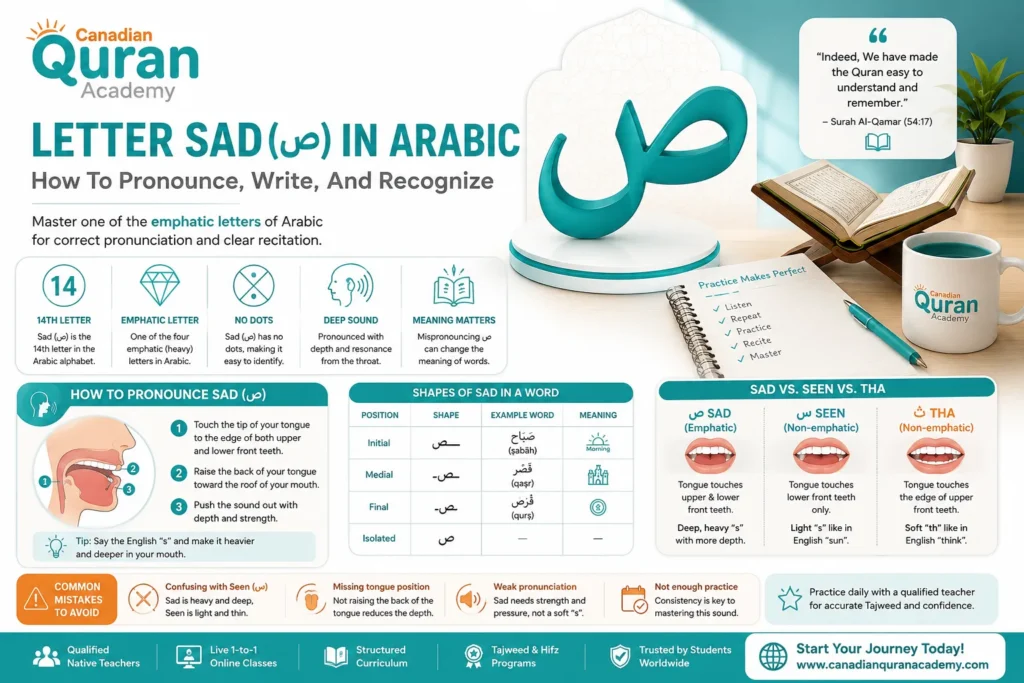
Arabic has sounds — the ع, غ, ح, خ, ص, ض, ط, ظ — that do not exist in English. Your ear needs training to distinguish them reliably before your mouth can produce them.
Read also: HOW TO LEARN ARABIC IN ONE MONTH IN CANADA?
Shots Videos from Our Courses
Start Your Quranic Journey in Canada
Join our vibrant community and learn with expert tutors through our flexible online platform.
Claim Your Free Trial6. Enter an Intensive Vocabulary and Comprehension Phase in Months Four and Five
By month four, you have your alphabet, your root system, your core grammar units, and a daily reading habit. Month four and five are where you expand vocabulary to reach functional reading comprehension — the point where you can read a short Arabic text and extract meaning without translating every word individually.
The vocabulary target for functional Quranic Arabic comprehension is approximately 500–750 root-based words.
For MSA functional literacy, the target is closer to 1,200–1,500 words. These are achievable in 6 months when learned through root families rather than isolated word lists.
The Spaced Repetition Principle Applied to Arabic
Spaced repetition — reviewing new vocabulary at increasing intervals before forgetting occurs — is the most research-supported memorization method for language acquisition. Use it specifically for Arabic root families, not individual words.
When you know the root ع – ل – م (knowledge), you learn عَلِمَ (he knew), عِلْم (knowledge), عَالِم (scholar), مَعْلُوم (known) — four vocabulary entries for one review session.
At The Canadian Quran Academy, instructors in our Intensive Arabic course use this root-family vocabulary method with students in our accelerated programs.
The efficiency gain compared to isolated word memorization is significant — especially for adult learners managing limited daily study time.
Book a FREE trial class in the intensive Arabic course
7. Assess and Consolidate Your Progress in Month Six
Month six is not a continuation of month five — it is a deliberate consolidation and assessment phase.
Many learners skip this step entirely and finish their 6-month period having covered a large volume of content but retained only a fraction of it. Consolidation is what converts covered material into durable knowledge.
What Month Six Consolidation Looks Like
- Reading test: Attempt a page of fully voweled Quranic text or a graded Arabic reader passage without any preparation — then assess where you rely on guessing versus genuine recognition
- Grammar review: Return to I’raab and verb conjugation with fresh text — apply rules to sentences you have never seen before
- Vocabulary audit: Test yourself on your 500-word root list — identify roots below 80% recall and dedicate targeted review sessions
- Speaking or recitation assessment: Record yourself reading a full passage aloud and compare to a native or qualified speaker recording
This assessment process is where a qualified instructor adds value that no app or self-study tool can replicate.
A teacher can hear a mispronounced ص that you genuinely cannot hear in your own recording. They can identify a grammar pattern you are applying incorrectly but consistently — meaning you do not register it as an error.
The Canadian Quran Academy offers a free trial lesson where a qualified Arabic instructor can assess your current level and guide your month-six consolidation plan specifically.
8. Use Qualified 1-on-1 Instruction as Your Acceleration Engine Throughout
Structured self-study, apps, and YouTube can support your Arabic learning — but they cannot replace qualified instruction as the primary driver of your 6-month plan. The learners at The Canadian Quran Academy who reach functional proficiency in 6 months consistently share one characteristic: they have a qualified instructor giving them real-time correction at least twice per week.
Here is why live instruction accelerates the 6-month timeline specifically:
A. Error correction happens before errors become habits
A mispronounced letter or misapplied grammar rule, uncorrected for 3 months, takes significantly longer to fix than it does to prevent.
B. Instruction adapts to your specific gaps
An app teaches the same curriculum to every user. An instructor adjusts pace, focus, and explanation based on exactly where you are.
C. Accountability shortens the learning timeline
Students with scheduled sessions consistently outperform self-directed learners on measurable outcomes — not because the instruction is magical, but because scheduled sessions create non-negotiable practice time.
Adult learners across Toronto, Calgary, and Vancouver managing full-time work and family schedules consistently find that two 45-minute sessions per week with a qualified instructor — supplemented by 30 minutes of daily independent practice — outperforms 90 minutes of unsupported daily self-study. The quality of the practice hour matters more than the quantity of study hours.
The Canadian Quran Academy connects learners with experienced Arabic instructors for personalized 1-on-1 sessions, scheduled around Canadian time zones. Morning, evening, and weekend slots are available for learners across all provinces.
Our Students Reviews
Start Your Quranic Journey in Canada
Join our vibrant community and learn with expert tutors through our flexible online platform.
Claim Your Free TrialBegin Your Arabic Learning Journey with Qualified Instruction at The Canadian Quran Academy
A 6-month Arabic plan works when you have the right structure and the right instruction — not just motivation. The Canadian Quran Academy pairs Canadian and international learners with qualified, experienced Arabic instructors for personalized 1-on-1 sessions that fit your schedule and your specific goal.
- Qualified, experienced Quran and Arabic instructors
- Personalized sessions for adults, children, women, and new reverts
- Flexible morning, evening, and weekend scheduling across Canadian time zones
- Free trial lesson — no commitment required
Book your free trial lesson and start your 6-month Arabic plan with a qualified instructor this week.
Check out our top Arabic courses
Book your FREE trial session today

Conclusion
Arabic proficiency in 6 months in Canada demands a clear track, a month-by-month structure, and daily practice built around root-word logic — not rote vocabulary lists or unfocused app sessions. The learners who reach functional reading and comprehension within six months treat the plan as a serious daily commitment, not a casual hobby.
Structured instruction is the single largest variable separating learners who achieve their 6-month target from those who extend indefinitely. Two qualified sessions per week transform what is possible within this timeline.
The method is proven — what it requires is your consistent, deliberate effort applied in the right sequence, starting today, Insha’Allah.
Frequently Asked Questions About Learning Arabic in 6 Months in Canada
Is 6 months enough to learn Arabic fluently in Canada?
Six months is enough to reach beginner-to-intermediate functional proficiency — not full fluency. With 45–60 minutes of daily practice, you can read Quranic Arabic with basic comprehension, handle simple MSA texts, or hold short conversations. Full fluency in Arabic typically requires 2–3 years of consistent structured study.
How many hours per day do I need to study Arabic to reach my 6-month goal?
Forty-five to sixty minutes of focused daily practice is the minimum effective dose for a 6-month Arabic plan. This assumes structured practice — not passive app use. Two live instruction sessions per week plus 30 minutes of daily independent practice is the model The Canadian Quran Academy recommends for adult Canadian learners.
What is the hardest part of learning Arabic as an English speaker in Canada?
The three consistent difficulty areas for English-speaking Canadians are: the Arabic sound system (particularly ع, غ, ح, خ and the emphatic consonants), the verb conjugation system that marks gender and number simultaneously, and maintaining daily consistency around Canadian professional and family schedules.
Can children learn Arabic in 6 months faster than adults?
Children acquire language differently — they absorb sounds and patterns more naturally over time but typically need more repetition to retain formal grammar. Adults in structured programs often reach reading literacy faster than children because they can engage with explicit grammar rules. The Canadian Quran Academy’s Arabic Classes for Kids use age-appropriate methods distinct from adult instruction to account for these differences.





Leave a Reply