 Arabic
| Key Takeaways |
| Self-directed Arabic learners in Canada should begin with the Arabic alphabet and short vowel system before tackling vocabulary or grammar. |
| Quranic Arabic and Modern Standard Arabic have different goals; choosing the wrong track wastes months of study time. |
| Consistent daily practice of 20–30 minutes outperforms long, infrequent sessions for building Arabic reading and listening skills. |
| Canadian learners benefit from combining structured online courses with local mosque circles and digital immersion tools. |
| Adult beginners who add a qualified instructor — even once weekly — correct fossilized errors that solo study cannot catch. |
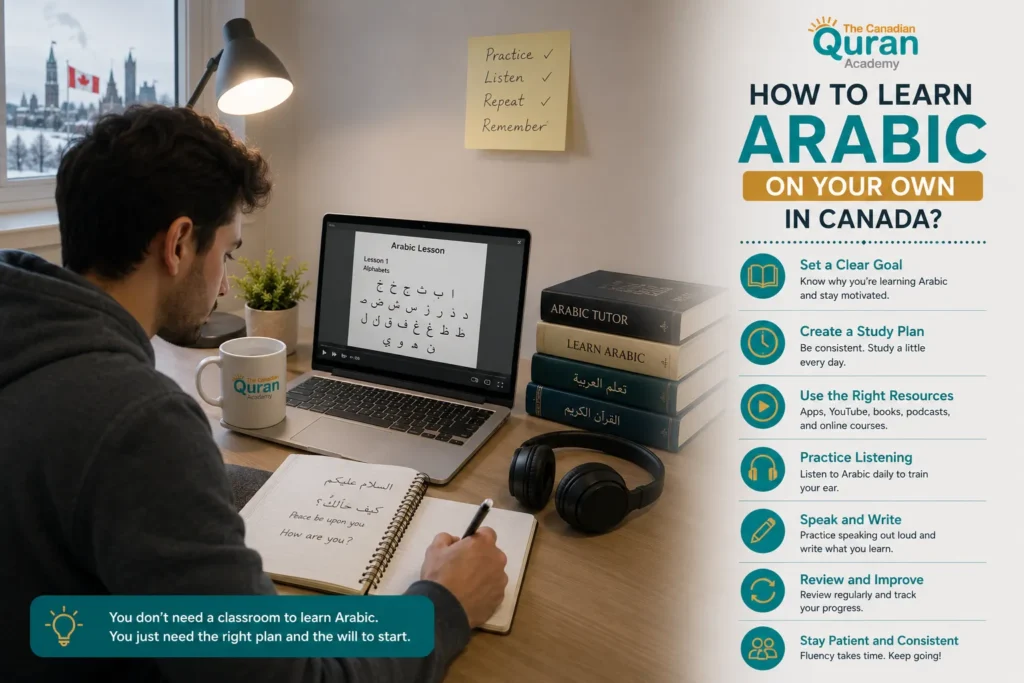
You can learn Arabic on your own in Canada — but only if you start with the right track and build your foundation in the correct sequence. Most self-directed learners stall not because Arabic is too difficult, but because they skip steps or confuse Quranic Arabic with Modern Standard Arabic from the beginning. Choosing your goal first changes everything that follows.
The self-study path that actually works involves: selecting the right Arabic track for your goal, mastering the alphabet before anything else, building vocabulary systematically, developing listening discipline, and knowing exactly when solo study needs qualified feedback. Each of these steps is addressed directly below.
1. Decide Whether You Want Quranic Arabic or Modern Standard Arabic
To learn Arabic on your own in Canada, you must choose your track before opening a single resource. Quranic Arabic is the classical language of the Quran — it uses a specific grammatical structure and vocabulary that differs meaningfully from everyday speech. Modern Standard Arabic (MSA) is the formal written language used in news, literature, and pan-Arab communication.
These two tracks share a script and overlap in grammar, but their vocabulary, pronunciation emphasis, and learning resources are distinct. Mixing them without intention produces confusion, not fluency.
If your primary goal is to understand the Quran, recite with comprehension, or deepen your Islamic practice, focus on Quranic Arabic from day one.
If you want to read Arabic newspapers, communicate with Arabic speakers from multiple countries, or travel professionally, MSA is your track.
Conversational spoken Arabic — Egyptian, Levantine, Gulf — is a third track entirely, with its own resources and methods.
At The Canadian Quran Academy, students who enroll in the Arabic for Beginners course with a clear goal are consistently further ahead after eight weeks than those who studied alone without a defined track. The goal shapes the resource, the method, and the pace.
Begin learning Arabic with a FREE trial class

2. Master the Arabic Alphabet
Skipping or rushing the Arabic alphabet is the single most common reason self-directed learners plateau early. Arabic has 28 letters, each with up to four written forms depending on its position in a word. Short vowels — fatha, kasra, damma — are not written in most adult texts, meaning you must internalize them through reading practice, not visual scanning.
Do not move to vocabulary or phrases until you can:
- Write every letter in its isolated, initial, medial, and final form
- Read basic short-voweled text at a slow but continuous pace
- Distinguish visually similar letters: ب, ت, ث / ح, خ, ج / ع, غ
This foundation stage takes most adult beginners two to four weeks of 20–30 minutes of daily practice. Do not rush it. Every grammar concept and vocabulary word you encounter later depends entirely on accurate letter recognition.
Which Resources Work for the Alphabet Stage
Use resources that include audio alongside visual instruction. Written-only alphabet charts produce silent readers who cannot connect letters to sound. Good free options include:
- Arabic Pod 101 (basic alphabet series)
- Madinah Arabic Reader Book 1 (for Quranic-track learners)
- Hans Wehr transliteration chart for cross-referencing sounds
For children learning alongside parents, The Canadian Quran Academy’s Arabic course for kids uses age-appropriate letter sequencing that connects directly to Quranic reading — a more efficient entry point for young learners than general MSA materials.
Get your child a FREE trial class in our Arabic course for kids
3. Build Your Core Arabic Vocabulary with a Structured System
Once you read letters reliably, vocabulary acquisition must become systematic — not random. Arabic vocabulary learned without a system produces learners who recognize isolated words but cannot construct meaning in connected text.
The most effective self-study approach for Quranic Arabic vocabulary is frequency-based learning: prioritizing the words that appear most often in the Quran first.
Research in Quranic linguistics shows that knowing the 125 most frequent Quranic roots gives a learner recognition access to roughly 50% of Quranic word occurrences.
For MSA learners, use a spaced repetition system (SRS) — applications like Anki with a vetted Arabic deck. Spaced repetition surfaces words at the precise interval your memory needs reinforcement, making vocabulary retention significantly more efficient than rereading word lists.
A Practical Vocabulary Schedule for Canadian Self-Learners
| Week | Daily Goal | Cumulative Words |
| Week 1–2 | 5 new words per day | ~70 words |
| Week 3–4 | 7 new words per day | ~168 words |
| Month 2 | 10 new words per day | ~448 words |
| Month 3 | 10 new + full review | ~748 words |
This pace is realistic alongside a full-time job or school schedule — the primary reality for most Canadian Muslim learners managing work in Toronto, Calgary, or Vancouver.
Read also: HOW TO LEARN ARABIC IN 7 DAYS IN CANADA?
Shots Videos from Our Courses
Start Your Quranic Journey in Canada
Join our vibrant community and learn with expert tutors through our flexible online platform.
Claim Your Free Trial4. Learn Arabic Grammar in the Correct Sequence
Arabic grammar is logical, but the sequencing of concepts is everything. Self-directed learners who study grammar in the wrong order waste significant time — particularly adult learners who approach Arabic grammar through the lens of English grammatical categories.
Arabic grammar is built on a root-and-pattern system. Most Arabic words derive from three-letter roots. Understanding this system — even at a basic level — accelerates both vocabulary acquisition and reading comprehension simultaneously.
For Quranic Arabic grammar, the most trusted self-study resource among international learners is Madinah Arabic (Books 1–3 by Dr. V. Abdur Rahim). The sequence it follows — nouns before verbs, definite before indefinite, then case endings — reflects the traditional Arabic grammatical pedagogy used in Islamic institutions globally.
The Canadian Quran Academy’s Arabic Grammar course covers this exact sequence with a qualified instructor guiding the process — which matters because grammar errors in Arabic are silent. A self-directed learner can practice a grammatical pattern incorrectly for weeks without knowing it.
The Three Grammar Concepts Every Beginner Must Internalize First
- Grammatical gender (Mudhakkar / Mu’annath): Every Arabic noun is masculine or feminine, and this affects every adjective, verb, and pronoun connected to it
- Definiteness (Al + indefinite Tanwin): Understanding the definite article ال and its sun/moon letter interaction
- Basic sentence structure (Nominal vs. Verbal sentences): Arabic sentence types follow patterns distinct from English Subject-Verb-Object order
Begin learning Arabic grammar with a FREE trial class
5. Develop Arabic Listening Skills with Daily Immersion
Reading Arabic and understanding spoken Arabic are separate skills that must be trained separately. Many self-directed learners in Canada build strong reading ability while remaining unable to process natural Arabic audio — a gap that closes only through consistent, structured listening practice.
For Quranic Arabic learners, the most practical listening resource is Quran audio recited by a master reciter. Listening with the text in front of you — following word by word — builds the connection between written and spoken form more efficiently than passive background listening.
Recommended reciters for learning purposes (clear, measured pace, standard Tajweed):
- Sheikh Mahmoud Khalil Al-Husary — widely used in Arabic schools for his deliberate, clear recitation
- Sheikh Abdul Basit Abdul Samad — Mujawwad style, excellent for ear training
For MSA learners, Al-Jazeera Arabic provides consistent, formal spoken MSA. Even 10 minutes of daily listening — not for full comprehension, but for sound pattern recognition — produces measurable improvement over 4–6 weeks.
In our experience at The Canadian Quran Academy, adult learners who add 15 minutes of Quran audio listening to their daily routine — even during their commute — develop significantly faster phonetic recognition than those who practice reading alone. The ear and the eye train each other.
6. Use Arabic Writing Practice to Accelerate Reading Fluency
Writing Arabic by hand is not optional — it is one of the most effective tools for internalizing letter forms and building reading speed. The physical act of constructing letters in sequence cements visual memory in a way that typing and tracing do not replicate.
A minimal but consistent writing practice — 10 minutes per day — produces rapid improvement in letter recognition speed. The goal is not calligraphy. The goal is automaticity: recognizing letter forms without conscious effort so your cognitive resources are available for meaning.
A structured writing progression:
- Write each letter 10 times in all four positional forms (isolated, initial, medial, final)
- Write short words from your current vocabulary list
- Copy short Quranic verses you are learning — this links writing, reading, and memorization simultaneously
The Quran itself encourages reflection on its written form:
وَرَتِّلِ ٱلْقُرْءَانَ تَرْتِيلًا
Wa rattili l-qur’āna tartīlā
“And recite the Quran with measured recitation.” (Surah Al-Muzzammil 73:4)
The concept of tarteel — measured, deliberate recitation — applies equally to the deliberate, measured practice of written Arabic.
Read also: CAN I LEARN ARABIC IN 3 MONTHS IN CANADA?
7. Build a Weekly Study Structure That Fits Canadian Life
The most effective Arabic self-study schedule for adult learners in Canada is one that distributes practice across seven days — not concentrated into two or three longer sessions. Arabic is a pattern-recognition language. The brain consolidates patterns during sleep and rest. Daily short exposure outperforms weekly cramming.
A realistic weekly structure for working adults:
| Day | Focus | Time |
| Monday | New vocabulary (10 words) + writing | 25 min |
| Tuesday | Grammar concept or review | 20 min |
| Wednesday | Listening practice + Quran audio | 20 min |
| Thursday | Reading practice (short text) | 25 min |
| Friday | Review vocabulary + write sentences | 20 min |
| Saturday | Extended study or conversation practice | 40 min |
| Sunday | Light review — no new material | 15 min |
This structure totals approximately three hours per week — manageable alongside professional and family responsibilities. Progress at this pace is real but gradual: expect functional Quranic word recognition within six to nine months, not six to nine weeks.
8. Know When Self-Study Needs Qualified Feedback
Self-directed Arabic study has a structural limitation: it cannot catch errors you are unaware you are making. Pronunciation errors, grammatical pattern misapplication, and incorrect voweling can fossilize over months of solo practice — meaning they become habitual and increasingly difficult to correct.
The critical checkpoints where a qualified instructor’s feedback is not optional:
- Pronunciation of emphatic letters: ص, ض, ط, ظ — these require accurate articulation point knowledge (Makhraj) that audio alone rarely teaches reliably
- Grammar application in sentences: Writing a correct sentence from a rule is different from understanding the rule in isolation
- Tajweed in Quranic recitation: Rules of Noon Sakinah, Madd, and Qalqalah have conditions and exceptions that require real-time correction
The Canadian Quran Academy’s Online Arabic Conversation course and Intensive Arabic course both offer 1-on-1 sessions with qualified instructors — meaning feedback is personalized to your specific errors, not generalized instruction delivered to a class of thirty.
Even one session per week with a qualified instructor while continuing self-study on your other days produces dramatically better outcomes than solo study alone.
Book a FREE trial class in the intensive Arabic course
9. Connect with Arabic Learning Communities in Canada
Isolation is the enemy of language acquisition. Learners who connect with Arabic-speaking communities — even informally — develop faster than those who study entirely alone. Canada’s Muslim community provides multiple genuine opportunities for Arabic exposure outside the classroom.
Practical community-based Arabic exposure available across Canadian cities:
A. Mosque Quranic circles (halaqas):
Weekly group Quran reading sessions provide both listening exposure and low-pressure recitation practice
B. Islamic school weekend programs:
Even observing children’s Arabic instruction exposes adult learners to structured vocabulary and grammar in use
C. Arabic-speaking community events:
Eid gatherings, community dinners, and cultural events in cities with large Arabic-speaking populations (Mississauga, Edmonton, Montreal) provide natural spoken Arabic environments
D. Online Canadian Muslim learning communities:
Multiple Facebook groups and WhatsApp circles connect Canadian Arabic learners for accountability and resource sharing
The goal at this stage is comprehensible input — Arabic you encounter in natural contexts where meaning is accessible through context, gesture, or partial comprehension. This is how language acquisition works at every level.
Our Students Reviews
Start Your Quranic Journey in Canada
Join our vibrant community and learn with expert tutors through our flexible online platform.
Claim Your Free TrialStart Your Arabic Learning with Qualified Instruction at The Canadian Quran Academy
Self-directed Arabic study works best when it runs alongside expert guidance — not as a replacement for it.
The Canadian Quran Academy connects Canadian and global learners with qualified Arabic instructors for personalized 1-on-1 sessions across all levels and goals.
What sets the Academy apart:
- Qualified, experienced Arabic and Quran instructors
- Personalized sessions tailored to your track — Quranic Arabic, MSA, or conversational
- Flexible scheduling across Canadian time zones — morning, evening, and weekend
- Programs for adults, children, women, and new reverts
- Free trial lesson — no commitment required
Book your free trial lesson and start your Arabic learning with the right foundation from day one.
Check out our top Arabic courses
Book your FREE trial session today

Conclusion
Building Arabic competence independently in Canada is realistic — learners who follow the correct sequence, maintain daily practice, and understand their track’s specific demands make genuine progress within months. The alphabet comes first, vocabulary second, grammar third, and listening woven throughout every stage.
The learners who plateau are almost always those who skip the alphabet stage, mix learning tracks without intention, or practice without any external feedback checkpoint. Correcting those three patterns changes outcomes dramatically.
Frequently Asked Questions About Learning Arabic on Your Own in Canada
How long does it take to learn Arabic independently in Canada?
Learning Arabic independently in Canada to a functional reading level takes most adults 12–18 months of consistent daily practice of 20–30 minutes. Reaching conversational MSA fluency takes considerably longer — typically 3–5 years without immersion. Quranic Arabic comprehension at a working level is achievable within 12 months with the right resources and structured vocabulary acquisition.
Is it possible to learn Arabic without a teacher in Canada?
You can build a strong Arabic foundation independently — alphabet, vocabulary, grammar patterns, and reading fluency are all teachable through quality self-study resources. However, pronunciation accuracy and Tajweed correctness require instructor feedback at specific checkpoints. The most effective approach is structured self-study supported by periodic sessions with a qualified instructor, even monthly.
Can children learn Arabic on their own in Canada?
Children benefit from structured, instructor-led instruction far more than adults do in self-study contexts. Unsupported self-study is not developmentally appropriate for children learning Arabic. A qualified instructor — or a structured program like The Canadian Quran Academy’s Arabic course for kids — provides the structured repetition, engagement methods, and immediate correction children need.
How is learning Arabic in Canada different from learning in an Arab country?
The primary difference is immersion: learners in Arabic-speaking countries encounter the language constantly in signage, conversation, and media. Canadian learners must deliberately construct that exposure through audio, community connection, and structured practice. The linguistic content to be learned is identical — the environmental support is not. This is why daily practice discipline and community connection matter more for Canadian self-directed learners than for those studying abroad.







Leave a Reply