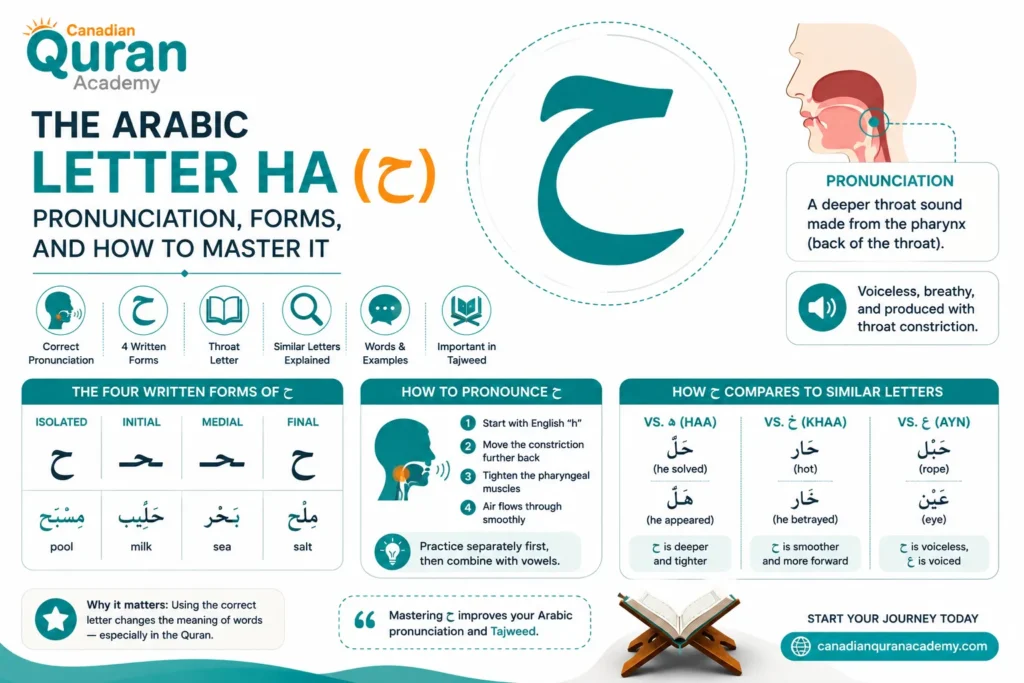
 Arabic

| Key Takeaways |
| Quranic Arabic is the best starting point for Canadian Muslims whose primary goal is understanding and reciting the Quran correctly. |
| Modern Standard Arabic (MSA) enables reading news, formal writing, and communicating across all 22 Arabic-speaking countries. |
| Egyptian and Levantine dialects are the most widely understood spoken varieties, making either a practical conversational choice in Canada. |
| Heritage Arabic speakers in Canada often need structured Quranic Arabic study to correct pronunciation despite speaking a dialect at home. |
| Most Canadian Muslim learners benefit from starting with Quranic Arabic, then layering MSA or a dialect based on their specific goals. |
If you are a Canadian Muslim asking which Arabic to learn, the honest answer is: Quranic Arabic first, unless you have a specific professional or social need that requires spoken dialect or Modern Standard Arabic.
The variety you choose determines not just what you can read or say — it determines whether your Salah deepens, whether you can hold a conversation in Dubai, or whether you can read an Arabic newspaper. These are genuinely different skills, built on overlapping but distinct foundations.
The three main paths available to you are Quranic Arabic, Modern Standard Arabic (MSA), and spoken dialects — primarily Egyptian, Levantine, or Gulf. Each serves a different purpose.
Which Arabic Should I Learn in Canada?
For the vast majority of Canadian Muslims, Quranic Arabic is the right starting point. It is the Arabic of the Quran, Sunnah, and classical Islamic scholarship — meaning it directly improves your understanding of Salah, Quran recitation, and Islamic texts you will engage with for life. Quranic Arabic is not a dialect and does not go out of fashion. Every hour invested in it compounds across your entire practice as a Muslim.
That said, “Arabic” is a family of related varieties that share a grammatical skeleton but differ significantly in vocabulary, pronunciation, and practical use.
Choosing blindly wastes months.
Choosing intentionally can transform your connection to the Quran or open doors professionally and socially.
Our Quranic Arabic course in Canada at The Canadian Quran Academy is specifically designed to build this foundation — starting with Quranic vocabulary and root-word patterns so learners access meaning quickly, not after years of abstract grammar study.
Book a FREE trial class in the Quranic Arabic course in Canada

What Is the Difference Between Quranic Arabic, MSA, and Spoken Dialects?
Quranic Arabic is the Arabic of the Quran and the classical Arabic is the literary tradition of early Islamic civilization. Modern Standard Arabic (MSA) is the standardized, formal written and broadcast Arabic used across Arab countries today — closer to Classical Arabic than any dialect, but distinct from it. Spoken dialects — Egyptian, Levantine, Gulf, Moroccan — are the native spoken varieties that no Arab country officially teaches in school but that every Arab uses daily.
Understanding these differences prevents the most common mistake Canadian learners make: studying one variety assuming it will give them all three.
1. Quranic Arabic
Quranic Arabic gives you direct access to the Quran, Hadith literature, classical Fiqh texts, and centuries of Islamic scholarship. When you understand Quranic Arabic, your Salah changes. Words you have recited phonetically for years begin to carry meaning. Masha’Allah, this is the transformation most of our students describe after their first few months of structured study.
It does not automatically give you the ability to chat with an Arab shopkeeper or watch a Syrian drama and follow the dialogue. That requires dialect exposure on top of your Classical foundation.
2. Modern Standard Arabic
MSA gives you formal literacy: the ability to read Arabic newspapers, write formal emails, understand news broadcasts, and communicate in educated formal settings across all Arabic-speaking countries. It is the medium of Arab academia, government, and most published books.
MSA is mutually intelligible with Quranic Arabic at the structural level, so learners with a strong Quranic Arabic foundation find MSA significantly easier to acquire. If your goals are professional — journalism, translation, diplomacy, international business — MSA is the path.
3. Spoken Dialects
Dialects give you real conversational fluency with actual people. Egyptian Arabic is the most widely understood dialect globally due to Egypt’s cultural reach through cinema and music. Levantine Arabic (spoken in Syria, Lebanon, Jordan, Palestine) is the second most recognized. Gulf Arabic is relevant if your community or family connections are in the Gulf region.
No dialect is “officially” taught — grammar resources exist but formal curricula are limited compared to MSA or Quranic Arabic.
At The Canadian Quran Academy, our Arabic for Beginners course is structured specifically for English-speaking learners who want to build that Arabic foundation efficiently — with native-speaker instructors who know exactly where English speakers typically struggle with Arabic’s root-based grammar system.
Begin learning Arabic with a FREE trial class
Which Arabic Variety Is Most Useful for Canadian Muslims?
For Canadian Muslims whose primary connection to Arabic is religious, Quranic Arabic is both the most useful and the most spiritually rewarding choice. It directly enhances Salah, Quran recitation, and the ability to engage with Islamic scholarship independently.
For Canadian Muslims with professional goals — working with Arab clients, NGO work in the Arab world, journalism, translation — pairing Quranic Arabic with an MSA track is the right combination.
For heritage Arabic speakers — Canadians whose families speak Arabic at home — the situation is more nuanced. Heritage speakers often have strong spoken dialect fluency but significant gaps in Quranic recitation accuracy and formal grammar.
At The Canadian Quran Academy, this is one of the most consistent patterns our instructors observe: a learner who grew up speaking Lebanese Arabic at home confidently, but whose Quranic recitation carries dialect interference — particularly in letters like ض, ث, and ذ — that requires specific Tajweed correction to address.
If you are a heritage speaker, structured Quranic Arabic study is not redundant. It fills the gaps your dialect left.
Read also: HOW TO LEARN ARABIC ON YOUR OWN IN CANADA?
Shots Videos from Our Courses
Start Your Quranic Journey in Canada
Join our vibrant community and learn with expert tutors through our flexible online platform.
Claim Your Free TrialShould Children in Canada Learn Quranic Arabic or Conversational Arabic?
For children, Quranic Arabic comes first. A child’s first connection to Arabic should be through the Quran: learning to recognize letters, develop correct pronunciation through Tajweed, and begin building the vocabulary of Salah and Quran recitation. This foundation is irreplaceable and best built young.
Conversational Arabic for children makes sense as a complementary addition once Quranic literacy is established, or if the family speaks a dialect at home and wants to maintain it alongside Quranic study.
The Canadian Quran Academy’s Arabic for Kids course uses age-appropriate methods and qualified instructors to build Quranic Arabic literacy in a way that feels engaging — not a chore. Sessions are timed around Canadian school schedules, making consistent practice realistic for busy families.
Get your child a FREE trial class in our Arabic course for kids
Does Learning Quranic Arabic Help You Speak Arabic with Arab People?
Quranic Arabic will not make you conversationally fluent with native speakers on its own — but it provides a grammatical and vocabulary base that makes picking up a dialect or MSA significantly faster. Think of it as building the skeleton that other Arabic varieties attach to.
Many Canadian Muslims who invest seriously in Quranic Arabic find that after 12 to 18 months of study, they can follow formal Arabic broadcasts, read Arabic news headlines, and pick up dialect conversation much faster than peers who started with a dialect directly.
The grammatical logic of Arabic — its root system, verb conjugation, case endings — is best understood through Quranic Arabic, which preserves the full classical structure.
Quranic Arabic also gives you something no dialect gives you: access to 1,400 years of written Islamic thought. That is a permanent, compounding asset.
Read also: HOW TO LEARN ARABIC IN 7 DAYS IN CANADA?
How Long Does It Take to Learn Quranic Arabic in Canada?
Reaching functional Quranic comprehension — meaning you understand the general meaning of the most-recited Surahs and portions of Salah without translation — typically takes 6 to 12 months of consistent study for an adult beginner dedicating 3 to 4 hours per week. This is based on structured instruction, not passive listening.
Full reading fluency, where you can work through an Arabic Quran with reasonable comprehension, typically requires 2 to 3 years of committed study.
Adults managing full-time work across Ontario and Alberta consistently find that two focused sessions per week — 45 to 60 minutes each — produce measurable progress without overwhelming a busy schedule.
This is why structured 1-on-1 instruction makes a meaningful difference over self-study. Our Arabic Grammar course at The Canadian Quran Academy is built specifically for this pace — systematic, instructor-guided, and adapted to each student’s starting point.
Begin learning Arabic grammar with a FREE trial class
What If You Want to Learn Conversational Arabic in Canada?
If conversational Arabic is your goal — whether for travel, professional use, or connecting with Arab colleagues or community members — Egyptian Arabic is the strongest practical choice for Canadian learners. It is the most widely understood spoken variety across the Arab world, and the most resourced in terms of learning materials and qualified teachers.
Levantine Arabic is an equally strong choice if your community connections are primarily Syrian, Lebanese, Jordanian, or Palestinian.
Starting with MSA before adding a dialect is the classical formal route — it builds structural grammar first, making dialect acquisition more systematic. Starting directly with dialect is faster for conversational fluency but leaves formal literacy gaps.
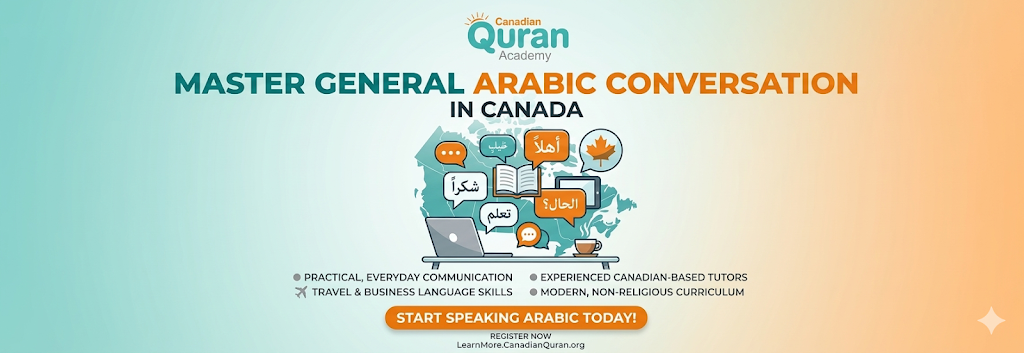
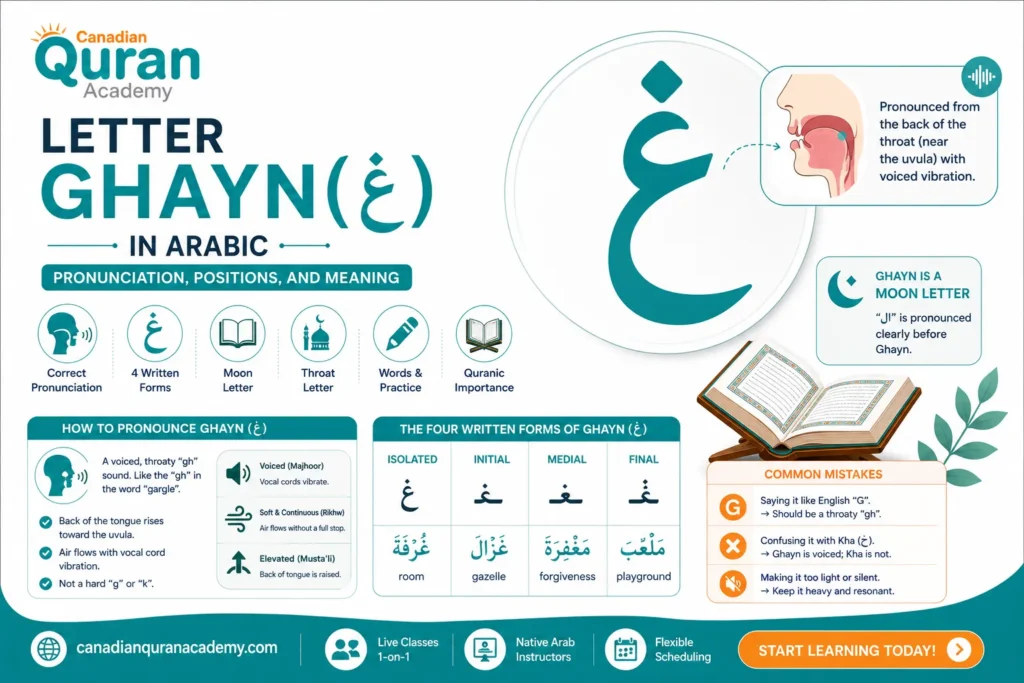
The Canadian Quran Academy’s Conversational Arabic course is designed for English-speaking learners who want real spoken fluency, with instructors who understand where Canadian learners most commonly struggle — particularly with Arabic sounds that have no English equivalent, like غ, ع, and the emphatic consonants.
Begin speaking Arabic with a FREE trial class
Our Students Reviews
Start Your Quranic Journey in Canada
Join our vibrant community and learn with expert tutors through our flexible online platform.
Claim Your Free TrialStarting Your Arabic Learning at The Canadian Quran Academy
Choosing the right Arabic variety is the first decision. Finding qualified instruction that fits a real Canadian schedule is the second.
The Canadian Quran Academy connects Canadian and global learners with qualified, experienced Arabic instructors for personalized 1-on-1 online sessions.
- Qualified, experienced instructors in Quranic Arabic, MSA, and conversational Arabic
- Personalized sessions adapted to your pace, goals, and current level
- Flexible scheduling — mornings, evenings, and weekends across Canadian time zones
- Programs for adults, children, women, and new reverts
- Free trial lesson available — no commitment required
Check out our top Arabic courses
Book your FREE trial session today
Conclusion
The question of which Arabic to learn in Canada is genuinely worth pausing on — because the answer shapes years of study. For most Canadian Muslims, Quranic Arabic is not just the religious choice, it is the strategically sound one: the foundation that makes every other Arabic variety more accessible.
MSA and conversational dialect are real, valuable skills with their own practical returns. But they are best built on top of a Quranic Arabic foundation — not instead of it. Adult learners who try to skip straight to dialect often find themselves fluent in small talk but unable to read a single verse of the Quran with comprehension.
Frequently Asked Questions About Learning Arabic in Canada
Which Arabic dialect is most useful to learn in Canada?
Egyptian Arabic is the most widely understood spoken dialect in Canada and globally, making it the strongest conversational choice for Canadian learners without a specific regional connection. Levantine Arabic is equally practical if your personal or professional network is Syrian, Lebanese, or Jordanian. For religious purposes, neither dialect replaces Quranic Arabic.
Can I learn Arabic online in Canada with a qualified teacher?
Yes — and for most Canadian learners, online instruction is the most realistic and effective format. Flexible scheduling across morning, evening, and weekend slots makes it compatible with Canadian work and school schedules. The Canadian Quran Academy offers 1-on-1 online Arabic sessions with qualified instructors, available to learners across Ontario, Quebec, Alberta, and British Columbia.
Is Quranic Arabic the same as the Arabic spoken in Arab countries today?
No. Quranic Arabic is Classical Arabic — the formal literary language of the Quran and Islamic scholarship. It is not spoken as a native tongue today. Modern Standard Arabic (MSA) is the closest living formal variety. Spoken dialects are what Arab people use daily. All three share Arabic’s grammatical roots, but they differ in vocabulary, grammar details, and pronunciation.
Should I learn Quranic Arabic or MSA first?
For Canadian Muslims whose primary goal is religious — improving Salah, understanding the Quran, engaging with Islamic texts — Quranic Arabic first is the clear answer. For learners with professional goals in the Arab world or formal literacy goals, MSA is equally valid as a starting point. Quranic Arabic study significantly accelerates MSA acquisition for anyone who pursues both.
How much does it cost to learn Arabic online in Canada?
Costs vary based on instructor qualifications, session frequency, and program structure. The Canadian Quran Academy offers a free trial lesson — no commitment required — so you can assess the instruction quality and fit before enrolling. Visit thefree trial page to book your session.





Leave a Reply