 Arabic
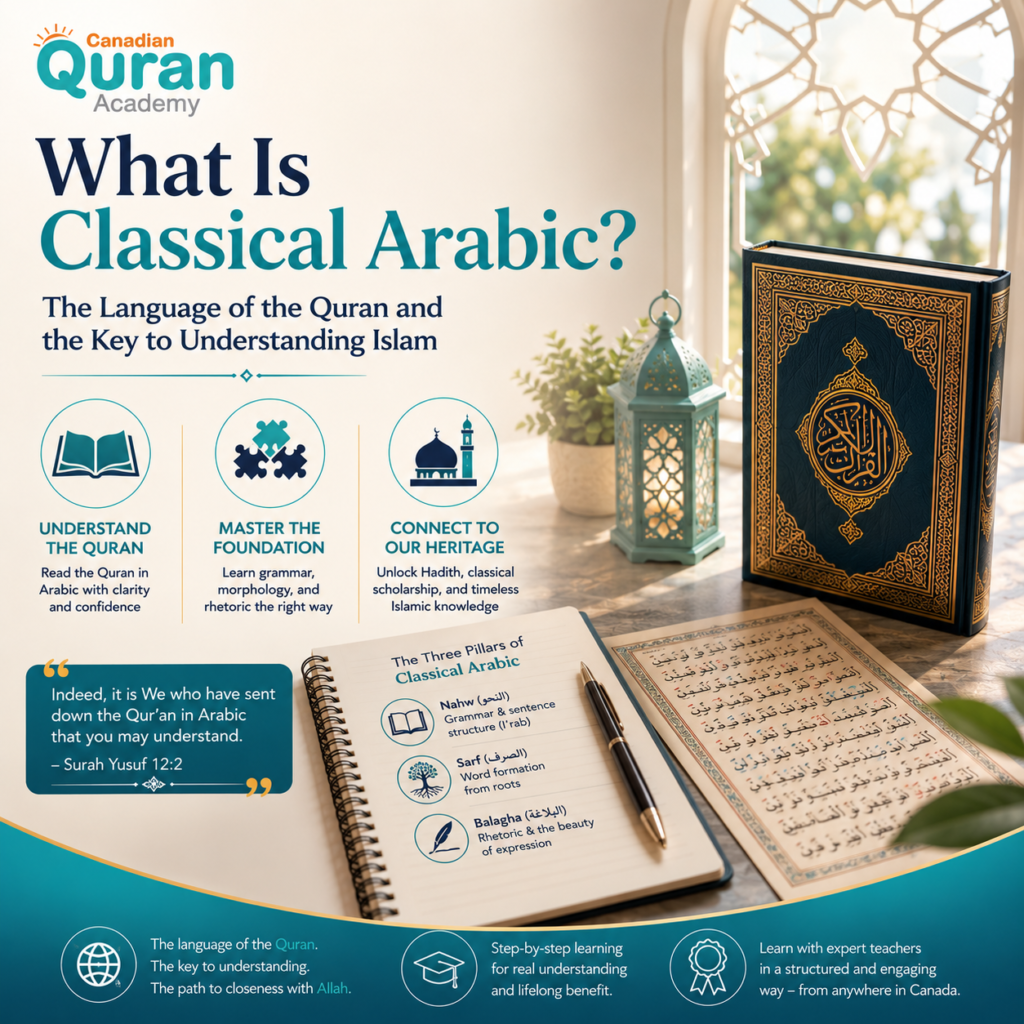
Classical Arabic is the language behind the Quran, and understanding what separates it from everyday spoken Arabic is the first real step toward reading scripture directly. Anyone who has tried to follow a Quranic verse in Arabic and found themselves lost between unfamiliar case endings and unfamiliar vocabulary has already encountered Classical Arabic without a name for it.
This guide defines Classical Arabic clearly, explains what a genuine course in it should cover, and lays out a realistic path — with timelines and common mistakes — for anyone serious about reading the Quran and Hadith in their original language.
What Is Classical Arabic?
Classical Arabic — الفصحى (al-Fuṣḥā) — is the grammatically complete form of Arabic used in the Quran, the Hadith corpus, and pre-modern Islamic scholarship. It retains full case-ending grammar (I’rab), a wider classical vocabulary, and sentence structures that later forms of Arabic simplified for everyday use.
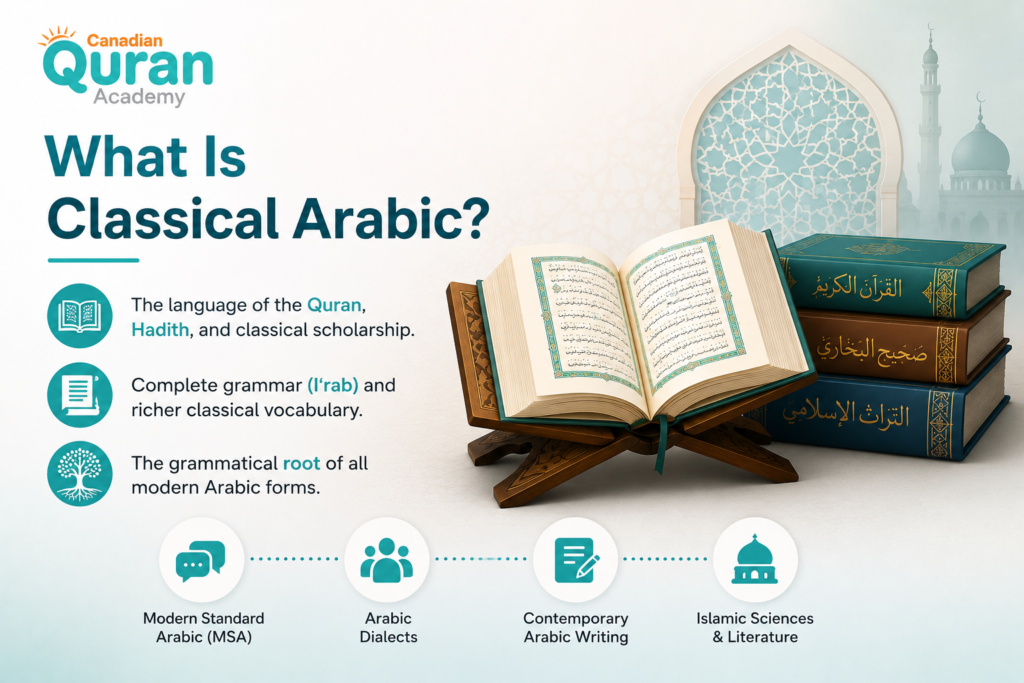
Classical Arabic is not a separate or dead language sitting apart from modern Arabic. It is the grammatical root every dialect and every modern written form of Arabic grew from, which is why students who study it first often find Modern Standard Arabic comparatively easy afterward.
Read also: Why Is the Quran in Arabic?
Classical Arabic vs. Modern Standard Arabic and Spoken Dialects
Classical Arabic sits at the root of two other forms of the language, and confusing it with either one is the single most common reason learners pick the wrong course. The table below lays out exactly where the three forms diverge.
| Feature | Classical Arabic | Modern Standard Arabic (MSA) | Spoken Dialects |
| Case endings (I’rab) | Fully applied, mandatory | Kept in writing, dropped in speech | Dropped almost entirely |
| Vocabulary | Quranic and classical terms | Modern terms for news, tech, official use | Regional, absorbs foreign loanwords |
| Where it’s used | Quran, Hadith, classical scholarship | News broadcasts, official documents, contemporary books | Everyday conversation at home and in the street |
| Grammar complexity | Full sentence-role marking, all 10 verb forms | Simplified skeleton of Classical Arabic grammar | Simplified verb conjugation, no case marking |
| What it gets you as a learner | Reading Quran, Hadith, and tafsir with the grammar intact | Reading a newspaper or following a news broadcast | Holding a conversation in a specific region |
The difference matters practically: a course built around MSA gets a student reading a newspaper. A course built around Classical Arabic gets a student reading a hadith collection or a tafsir with the grammatical reasoning still intact — nothing simplified away. Many programs marketed generally as “Arabic courses” are actually MSA courses, which is one reason learners end up disappointed when they still can’t parse a Quranic sentence after a year of study.
This also explains a common blind spot for heritage speakers: someone raised speaking a dialect at home can often hold a full conversation, yet still be unable to follow the grammar of a Quranic verse — because dialect fluency and Classical Arabic literacy are two different skill sets that don’t automatically transfer. This is exactly the gap a structured Arabic course for adults is built to close, since it starts from grammar rather than assuming conversational fluency equals reading fluency.
Book a FREE trial class in the Arabic course for adults

The Three Core Disciplines of Classical Arabic
A genuine Classical Arabic curriculum is not vocabulary memorization with an Islamic theme attached. It’s built on three interlocking fields, and skipping any one of them creates a gap that surfaces later, usually right when a student starts trying to read real text.
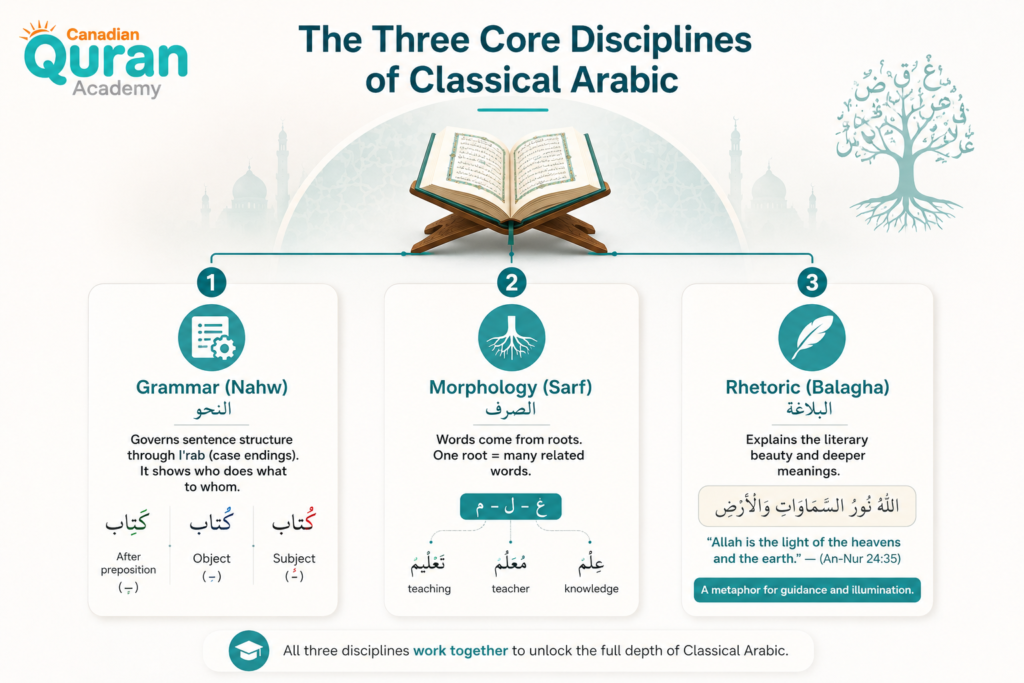
The order below reflects how these disciplines typically build on each other in a structured program.
1. Grammar (Nahw – النحو)
Nahw governs sentence structure, and its central feature is I’rab — the system of case endings that changes a word’s final vowel depending on its grammatical role in the sentence. The same noun can end in a damma (ـُ) as a subject, a fatha (ـَ) as an object, or a kasra (ـِ) after a preposition, and each ending carries real grammatical weight.
Classical grammar primers such as Al-Ajurrumiyyah have taught this system for centuries because I’rab is the tool that lets a reader determine exactly who is doing what to whom in a Quranic sentence — a layer of precision that translation alone cannot fully carry across.
2. Morphology (Sarf – الصرف)
Sarf teaches how Arabic words are generated from three-letter roots. Once a student recognizes a root, dozens of related words become recognizable without separate memorization — the root ع-ل-م (related to knowledge), for example, produces عِلْم (knowledge), مُعَلِّم (teacher), and تَعْلِيم (teaching).
This is where vocabulary growth stops being linear. Students who study Sarf systematically typically expand their reading vocabulary far faster than those relying on memorizing individual words one at a time, because each new root unlocks a small family of words at once.
3. Rhetoric (Balagha – البلاغة)
Balagha covers the literary devices — metaphor, simile, and figurative structure — that give Classical Arabic its expressive force. This is the layer that explains why a verse is considered eloquent, not just what it literally says.
A well-known example appears in Surah An-Nur:
اللَّهُ نُورُ السَّمَاوَاتِ وَالْأَرْضِ
“Allah is the light of the heavens and the earth” — Surah An-Nur (24:35).
Read only literally, this phrase describes Allah as light. Read through Balagha, it is understood as a metaphor (isti’ara – استعارة) for guidance and illumination — a meaning that only becomes visible once the rhetorical device itself is understood, not just the individual words.
A structured course that treats Classical Arabic seriously will teach all three of these disciplines in sequence rather than compressing grammar and skipping rhetoric to save time — a shortcut that shows up later as a comprehension ceiling students can’t get past on their own.
Experience Our Classrooms
Don’t just take our word for it—take a look inside! Watch the videos below to experience our engaging teaching methods and vibrant online classrooms firsthand.
Start Your Quranic Journey in Canada
Join our vibrant community and learn with expert tutors through our flexible online platform.
Claim Your Free TrialRead also: The Importance of Arabic Language in the Quran
Why Is Classical Arabic Grammar Essential for Understanding the Quran?
The Quran was revealed in Classical Arabic, and its meaning is often tied directly to grammatical detail — the placement of a particle, the specific verb form chosen, or a shift in case ending can carry interpretive weight a translation has to simplify or push into a footnote.
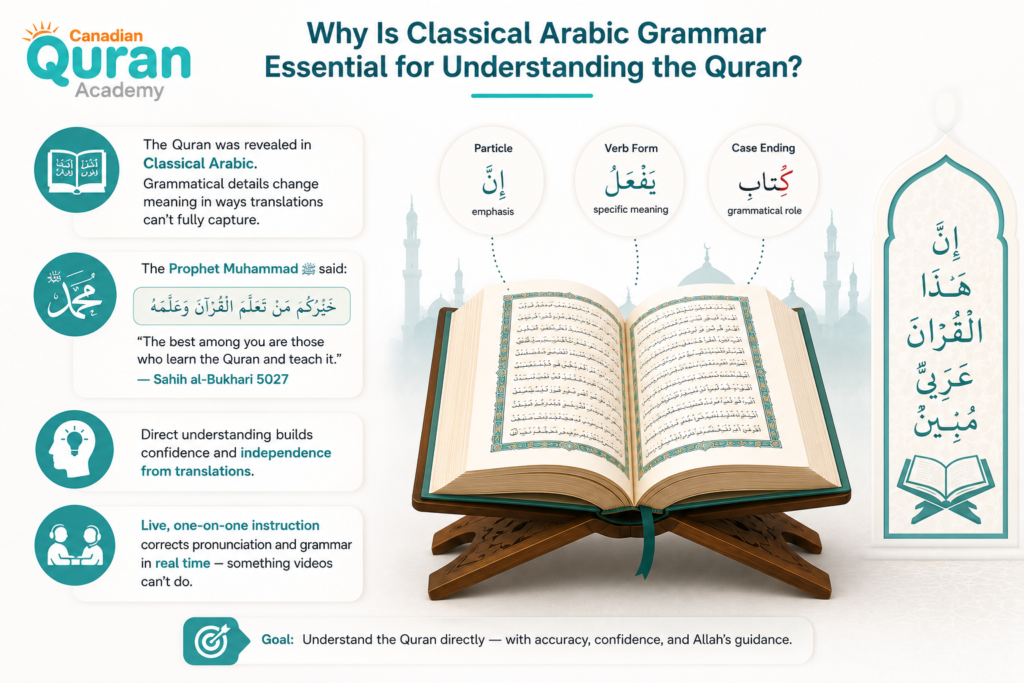
Understanding this grammar directly is also framed in Islamic tradition as a matter of virtue, not only linguistic skill. The Prophet Muhammad ﷺ is reported to have said:
خَيْرُكُمْ مَنْ تَعَلَّمَ الْقُرْآنَ وَعَلَّمَهُ
“The best among you are those who learn the Quran and teach it.” — Sahih al-Bukhari 5027.
Reaching the point where a student can follow this kind of grammatical reasoning directly — instead of depending entirely on a translator’s interpretation — is one of the clearest practical outcomes of studying Classical Arabic seriously, and it’s the specific outcome a well-structured program should be measured against.
A course built around live, one-on-one instruction makes this outcome realistic faster than self-study, because pronunciation errors and grammatical misreadings both need real-time correction — something a pre-recorded video course structurally cannot provide.
What You’ll Learn in a Complete Classical Arabic Course?
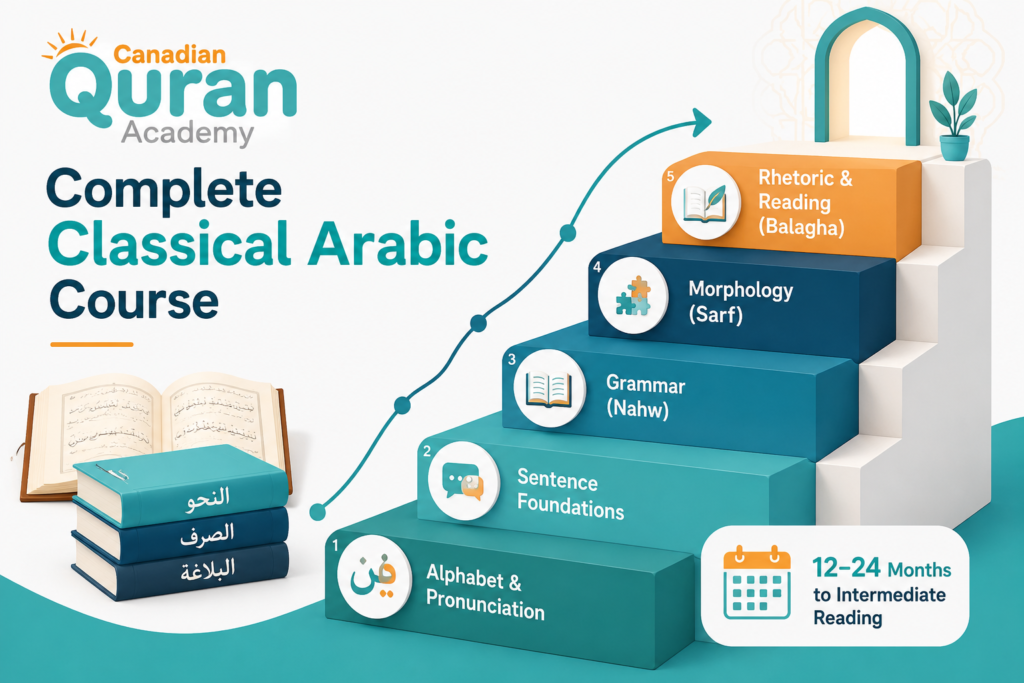
Programs differ in their specific textbooks, but most complete Classical Arabic curricula move through the same broad stages.
The table below reflects realistic progression at 3–5 hours of weekly study.
| Stage | What’s covered | Typical duration |
| Alphabet & pronunciation | Letter forms, articulation points (makharij), vowel marks (tashkeel) | 2–4 months |
| Sentence foundations | Nouns, verbs, particles, basic sentence structure | 3–5 months |
| Grammar (Nahw) | I’rab, case endings, parsing sentence roles | 4–8 months |
| Morphology (Sarf) | Root-and-pattern system, verb conjugation | 4–6 months |
| Rhetoric & reading (Balagha) | Literary devices, guided reading of classical texts | 4–8 months |
Reaching intermediate reading proficiency — enough to follow basic tafsir and parse the grammar of straightforward verses — typically takes 12 to 24 months of consistent study. Advanced, independent reading of scholarly texts generally takes several additional years beyond that.
Students with prior exposure to a dialect or to MSA usually move faster through the first two stages, since phonetic familiarity and some passive vocabulary already exist. The grammar and rhetoric stages, however, take roughly the same time for everyone, since I’rab and Balagha are rarely covered anywhere outside a dedicated Classical Arabic program.
If you’re weighing how much time this actually requires against your schedule, a placement test before starting is worth insisting on — it tells you honestly where you’re starting from rather than assuming beginner status by default. For children specifically, starting the alphabet and pronunciation stage early through a dedicated Arabic course for kids tends to make the later grammar stages easier, since young learners absorb articulation points faster with consistent, age-appropriate practice.
Get your child a FREE trial class in our Arabic course for kids
Common Mistakes Learners Make When Choosing a Course
Most lost progress in Classical Arabic study isn’t caused by the language being unusually difficult — it comes from avoidable decisions made early on, often before a student has enough context to spot the problem.
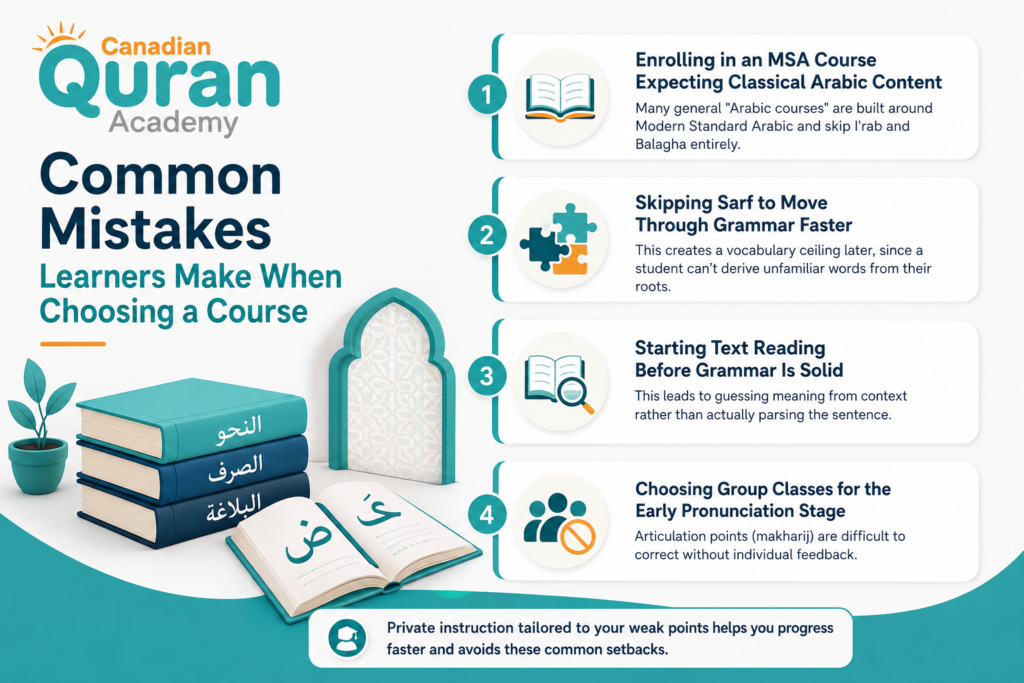
1. Enrolling in an MSA Course Expecting Classical Arabic Content
Many general “Arabic courses” are built around Modern Standard Arabic and skip I’rab and Balagha entirely — the two elements most relevant to reading the Quran directly.
2. Skipping Sarf to Move Through Grammar Faster
This creates a vocabulary ceiling later, since a student can’t derive unfamiliar words from their roots and has to memorize everything individually instead.
3. Starting Text Reading Before Grammar Is Solid
This leads to guessing meaning from context rather than actually parsing the sentence, and it stalls progress at an intermediate plateau that’s hard to notice from the inside.
4. Choosing Group Classes for the Early Pronunciation Stage
Articulation points (makharij) are difficult to correct without individual feedback, and pronunciation habits formed early are notably hard to unlearn later.
Working with an instructor who tailors pace to your specific weak points — rather than a fixed group syllabus — avoids most of these mistakes by design, since a private instructor can slow down exactly where you personally need it.
How to choose the right Classical Arabic course?
A useful way to check any Classical Arabic course — including your own progress inside one — is against four pillars, each building directly on the one before it.
The Four-Pillar Path
- Foundation — alphabet, pronunciation, and vowel marks
- Structure — recognizing nouns, verbs, and particles inside a sentence
- System — grammar (Nahw) and morphology (Sarf) taught together, since I’rab and root-formation actually reinforce each other
- Style — rhetoric (Balagha) and guided reading of real classical texts
If a course compresses or skips one of these pillars — most often Sarf or Balagha, since both take real time to teach properly — expect a specific comprehension gap later, even if early progress feels encouragingly fast. A program that maps clearly onto all four pillars, with defined benchmarks at each stage, gives both the student and the instructor a shared, measurable sense of where the gaps actually are.
This kind of structured, personalized approach — a dedicated native instructor working through grammar, morphology, and rhetoric in sequence, with real-time correction at every stage — is exactly what turns years of guesswork into steady, visible progress toward reading the Quran directly. For students who want to move through all four pillars faster than the standard weekly pace allows, an intensive Arabic course compresses the same sequence into a shorter, more concentrated timeline.
Book a FREE trial class in the Intensive Arabic Course in Canada
Live Class in Action
Watch how our instructors interact with students in real-time, focusing on interactive methods.
Start Your Quranic Journey in Canada
Join our vibrant community and learn with expert tutors through our flexible online platform.
Claim Your Free TrialLearn Classical Arabic with expert guidance at Canadian Quran Academy
Learning Classical Arabic is much easier when you follow a structured curriculum with experienced instructors who understand both the language and its Islamic context. At Canadian Quran Academy, you’ll progress through grammar (Nahw), morphology (Sarf), and Quranic vocabulary in a logical sequence, building the skills needed to read and understand authentic Islamic texts with confidence.
Whether you’re starting from the Arabic alphabet or looking to strengthen your existing knowledge, every lesson is tailored to your current level and learning pace. With live one-on-one classes, personalized feedback, and a clear roadmap, Canadian Quran Academy helps you move beyond memorization toward genuine comprehension of the Quran in its original language.
Our Arabic Courses
- Online Arabic Academy
- Online Arabic Course
- Classical Arabic Course
- Arabic Course for Beginners
- Advanced Arabic Course
- Quranic Arabic Course
- Arabic Grammar Course
- Modern Standard Arabic Course
- Arabic Conversation / Speaking Course
- Intensive Arabic Course
- Online Arabic Classes for Kids
- Arabic Classes for Adults
- Arabic Classes for Ladies
- Fusha Arabic Course
- Business Arabic Course
- Al-Azhar Arabic Course
- Madinah Arabic Course
- Learning Arabic for Non-Arabic Speakers
- Arabic Elementary School
- Arabic Intermediate School
- Arabic Lessons for Kindergarten
Start Your Quranic Journey in Canada
Join our vibrant community and learn with expert tutors through our flexible online platform.
Claim Your Free TrialConclusion
Classical Arabic is the grammatically complete language behind the Quran, Hadith, and centuries of Islamic scholarship — distinct from both Modern Standard Arabic and the dialects spoken day to day across the Arab world. A genuine course in it rests on three disciplines taught in sequence: grammar (Nahw), morphology (Sarf), and rhetoric (Balagha), all built on a solid foundation in the alphabet and basic sentence structure.
The payoff isn’t abstract. It’s the ability to follow the grammatical reasoning behind a specific Quranic verse, recognize the rhetorical device that makes it eloquent, and engage with hadith and tafsir directly rather than through someone else’s interpretation alone. Choosing a course that actually teaches Classical Arabic — rather than a simplified MSA substitute wearing an Islamic label — is the difference between years of guesswork and steady, measurable progress toward reading the Quran in the language it was revealed in.
FAQs About Classical Arabic
What is the difference between Classical Arabic and Modern Standard Arabic?
Classical Arabic is the fully inflected language of the Quran and Hadith, including complete case endings (I’rab) and classical vocabulary. Modern Standard Arabic simplifies much of this system for use in news, education, and modern writing, dropping most case endings in daily use.
Do I need any prior Arabic knowledge to start learning Classical Arabic?
No. Beginner-level courses start from the alphabet and basic pronunciation, assuming zero prior knowledge. Learners with some dialect or MSA background typically move faster through the early stages but still need dedicated study of I’rab and Balagha, since neither is usually covered outside a Classical Arabic program specifically.
How long does it take to learn Classical Arabic?
Reaching intermediate reading proficiency — enough to follow basic tafsir and parse the grammar of simple verses — typically takes 12 to 24 months of consistent study at 3–5 hours per week. Advanced, independent reading of complex scholarly texts generally takes several additional years.
Can Classical Arabic be learned effectively online?
Yes. Live one-on-one instruction with a native Arabic-speaking teacher is generally the most effective online format, since pronunciation correction and grammar feedback both benefit from real-time interaction that pre-recorded courses structurally can’t offer.
Why does Classical Arabic grammar matter for understanding the Quran?
The Quran’s meaning is often tied closely to its grammatical structure — case endings, verb forms, and rhetorical devices all carry interpretive weight. Classical Arabic training lets a reader follow this reasoning directly instead of relying entirely on a translator’s necessarily simplified rendering.




Leave a Reply