 Arabic
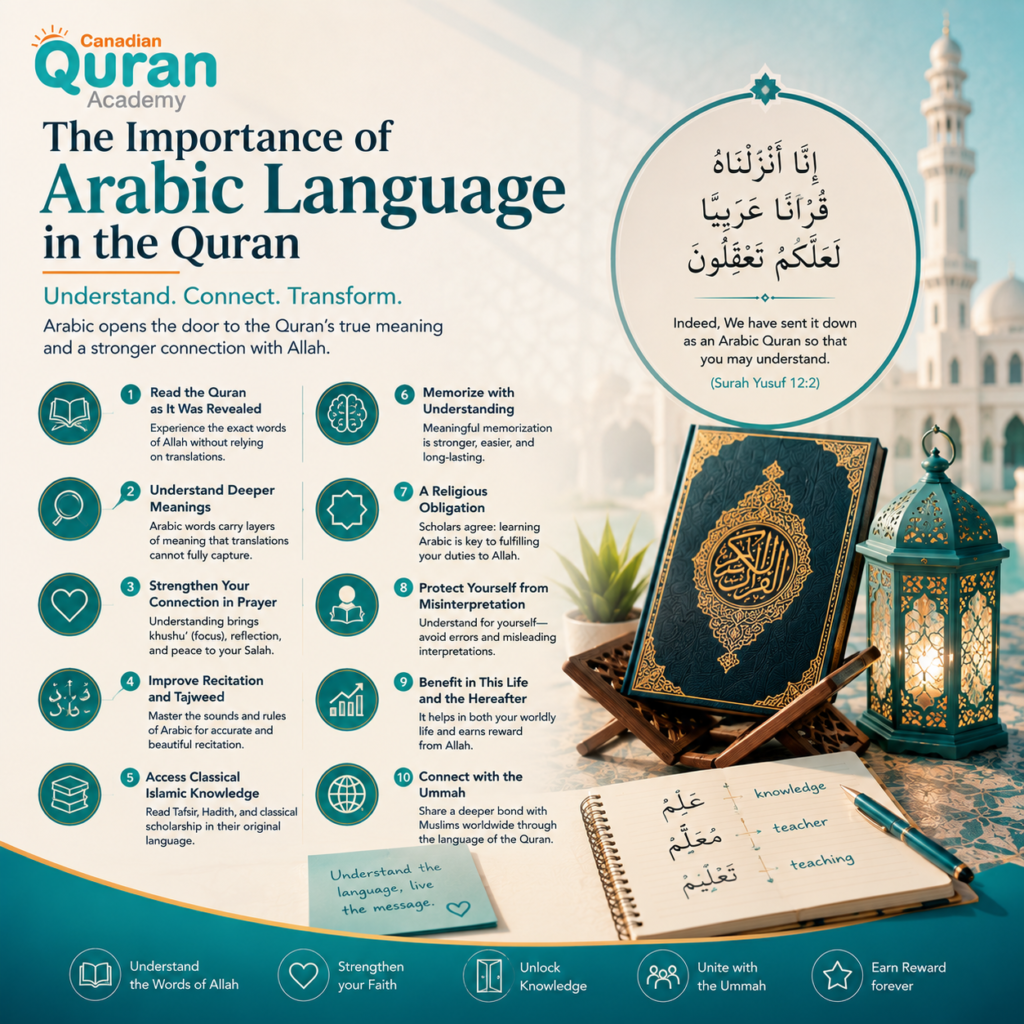
Every year, more Muslims search for ways to read the Quran without depending entirely on a translation. This growing interest points to something scholars have said for centuries: the importance of Arabic language in the Quran goes beyond vocabulary — it shapes how deeply a believer can understand, recite, and live by the words of Allah.
Translations open a door. They do not open the whole house. The Quran was revealed in Arabic, and its grammar, word choice, and rhythm carry meaning that no translation fully preserves. This article walks through ten specific reasons Arabic matters for understanding the Quran, drawing on scholarly opinion, Quranic verses, and authentic hadith.
1. Learn to Read the Quran as It Was Revealed
Every Quran reader eventually reaches the same question: is a translation ever really enough? The answer starts with a verse that speaks about its own language.
Allah describes the Quran’s language directly in the text itself.
إِنَّآ أَنزَلْنَـٰهُ قُرْءَٰنًا عَرَبِيًّا لَّعَلَّكُمْ تَعْقِلُونَ
“Indeed, We have sent it down as an Arabic Quran so that you may understand.” — Surah Yusuf, 12:2
The verse links the Arabic language directly to comprehension — “so that you may understand.” This is not incidental. A translated Quran gives you the translator’s best interpretation of a verse, filtered through their own reading of grammar, context, and intent. Reading the Arabic directly removes that filter. You engage with the exact word Allah chose, not someone’s rendering of it.
This is one reason students often begin with a Quranic Arabic course rather than jumping straight into tafsir books — the goal is to build the ability to sit with the verse itself before relying on anyone else’s explanation of it.

2. Understand Meanings Beyond Translation
Some Quranic words carry a weight that a single English word cannot hold.
Take the word تقوى (taqwa). It gets translated as “fear,” sometimes as “piety,” sometimes as “God-consciousness.” None of these alone is complete. Taqwa combines awareness of Allah, caution against displeasing Him, and active righteousness — a mental and spiritual state, not a single emotion.
This is why grammar and vocabulary study matter before deeper reflection. Students building this foundation typically start with core grammar structures — the kind covered in a Modern Standard Arabic course — before moving into Quranic vocabulary specifically, since sentence structure changes how a word’s meaning is shaped in context.
Book a FREE trial class in the Modern Standard Arabic Course in Canada

3. Strengthens Your Concentration and Presence in Prayer
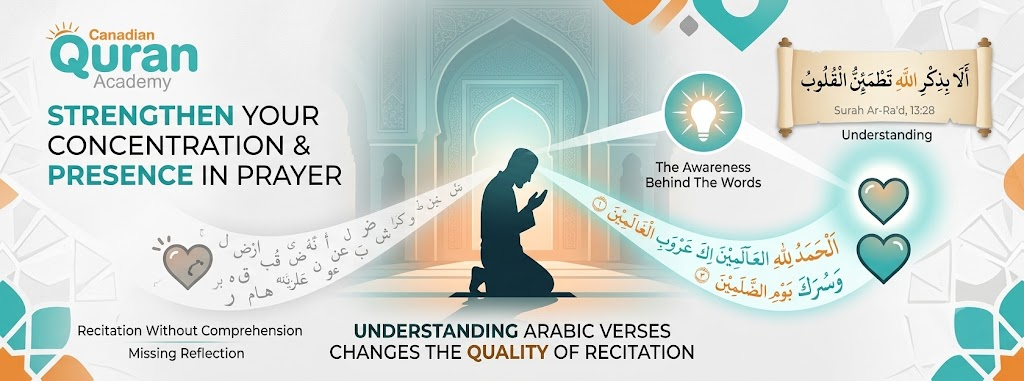
Every Muslim recites Arabic verses in Salah, whether or not they understand them. Understanding what is being said changes the quality of that recitation.
أَلَا بِذِكْرِ ٱللَّهِ تَطْمَئِنُّ ٱلْقُلُوبُ
“Surely in the remembrance of Allah do hearts find comfort.” —Surah Ar-Ra’d, 13:28
The verse ties tranquility of the heart directly to remembrance of Allah — not just the act of speaking words, but the awareness behind them. A reader who understands Surah Al-Fatihah while praying is engaging in exactly that kind of remembrance. A reader reciting without comprehension is performing the words correctly but missing the reflection the verse describes.
Read also: How to Write Quran in Arabic?
4. Improves Your Quran Recitation and Tajweed
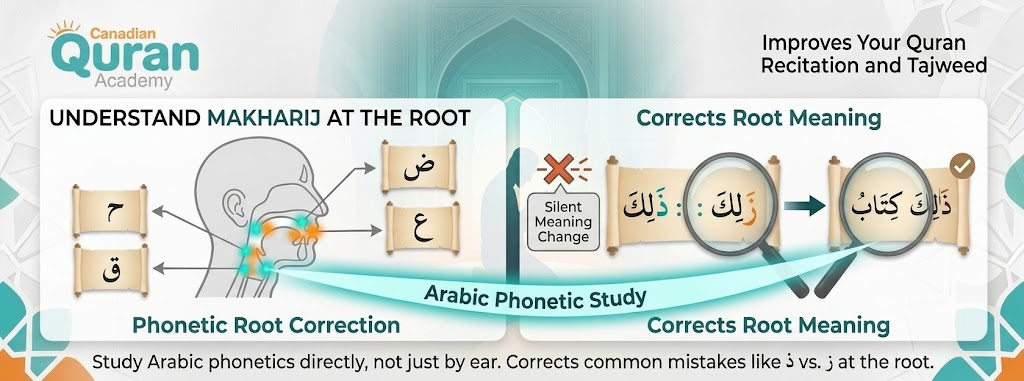
Arabic contains sounds that don’t exist in English, French, or most other languages — letters like ض, ع, ح, and ق each require a distinct point of articulation (makhraj) that changes the meaning of a word if pronounced incorrectly.
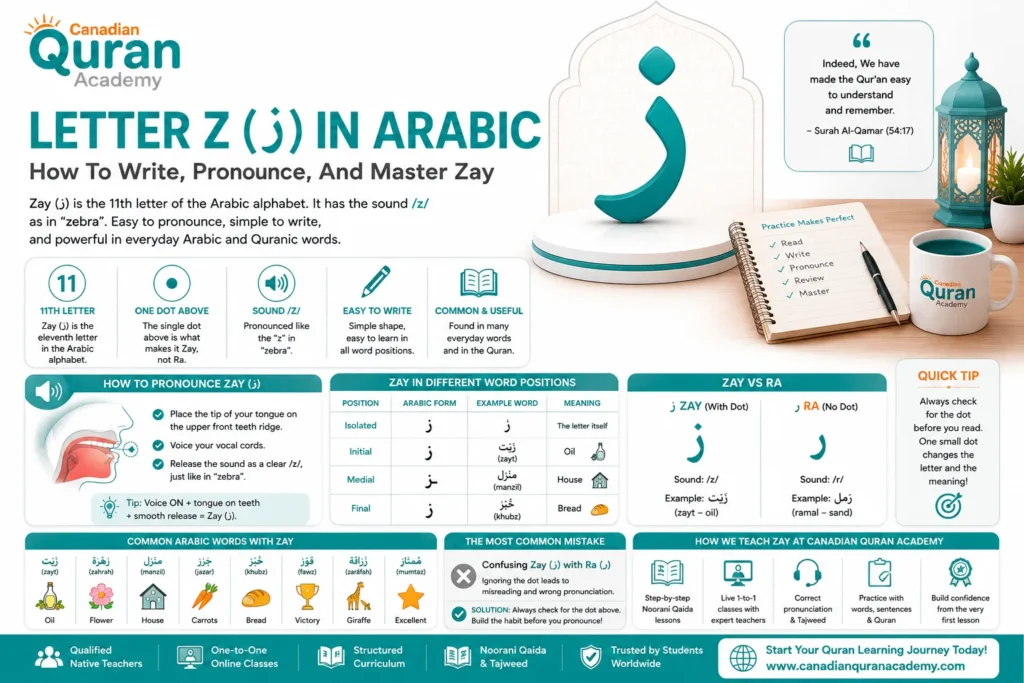
A common recitation mistake among non-Arabic speakers is substituting ذ (a soft “th” sound) for ز (a hard “z” sound), which can quietly change the meaning of a word without the reader realizing it. Studying Arabic phonetics directly — not just memorizing Tajweed rules by ear — is what corrects this at the root, rather than papering over it with repetition.
5. Gives You Direct Access to Tafsir, Hadith, and Classical Scholarship
Almost every major work of Tafsir, Hadith commentary, and classical Islamic scholarship was written in Arabic — Ibn Kathir’s tafsir, Sahih al-Bukhari, Sahih Muslim, and the commentaries built on top of them over the past thousand years.
Translations of these works exist, but they are secondary sources — one more layer of interpretation between you and the original scholarship. Reading a hadith commentary in its original Arabic means engaging with the scholar’s actual reasoning, including the grammatical arguments many rulings depend on. Students working toward this level of reading typically study Classical Arabic (Fusha), since Classical texts use sentence structures and vocabulary that differ noticeably from everyday spoken Arabic.
Book a FREE trial class in the Fusha Arabic Course in Canada

6. Makes Quran Memorization More Meaningful and Lasting
Hifz (Quran memorization) built purely on repetition without understanding is fragile — a student can memorize the sound of a verse without retaining it long-term, because there’s no meaning anchoring the words in memory.
When a student understands what a verse says, memorization shifts from rote sound-matching to meaning-based recall. This is why many Hifz programs today pair memorization schedules with parallel Arabic instruction: understanding the theme of a Surah, or the grammatical role of a repeated word, gives the brain more than one way to retrieve it later.
Experience Our Classrooms
Don’t just take our word for it—take a look inside! Watch the videos below to experience our engaging teaching methods and vibrant online classrooms firsthand.
Start Your Quranic Journey in Canada
Join our vibrant community and learn with expert tutors through our flexible online platform.
Claim Your Free TrialRead also: Quran Verses About Death in Arabic
7. Many Scholars Consider It a Religious Obligation
The importance of Arabic in Islam isn’t only practical — it has been discussed as a matter of religious obligation.
Imam al-Shafi’i held that every Muslim is required to learn enough Arabic to fulfil their basic religious duties (Irshad al-Fuhul, p. 421). Ibn Taymiyyah took the position further, arguing that since Arabic is the language of the Quran and Sunnah, understanding the religion correctly cannot happen without it — making deep study of the language a communal obligation (fard al-kifayah), even if a baseline level remains an individual obligation (fard al-ain) for every believer.
This scholarly framing connects directly to a well-known hadith on the value of engaging with the Quran itself:
عَنْ مُعَاوِيَةَ قَالَ: قَالَ رَسُولُ اللَّهِ ﷺ: «مَنْ يُرِدِ اللَّهُ بِهِ خَيْرًا يُفَقِّهْهُ فِي الدِّينِ»
“When Allah intends good for someone, He grants him understanding of the religion.” — Sahih al-Bukhari 71, agreed upon by Bukhari and Muslim, sunnah.com/bukhari:71
The hadith links divine favor to religious understanding (fiqh) specifically — and understanding the religion at its source depends on understanding the language it was revealed and explained in.
Read also: HOW TO IMPROVE YOUR ARABIC LANGUAGE SKILLS IN CANADA?
8. Opens the Door to Advanced Islamic Studies
Most Islamic universities and seminaries — from Al-Azhar to smaller regional institutes — teach their core curriculum in Arabic. A student without Arabic reading ability is limited to whatever has already been translated, which is a small fraction of the total body of Islamic scholarship.
Arabic proficiency is the entry requirement for specializing in fields like Tafsir studies, Hadith sciences, Usul al-Fiqh (principles of jurisprudence), and Arabic literature connected to the Quran. Students who plan to pursue any of these later find it far easier to have built strong reading and grammar skills early, rather than trying to learn Arabic and a specialized field at the same time.
9. Deepens Personal Reflection and Spiritual Growth
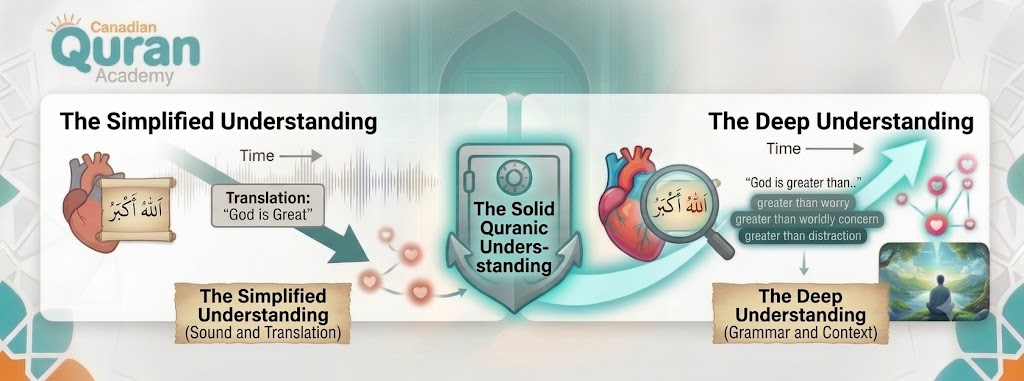
Beyond formal study, understanding Arabic changes the day-to-day experience of practicing Islam. Duas (supplications), the adhan, and everyday Islamic phrases carry more weight when their meaning is clear rather than memorized as sound.
A practical example: the word اللَّهُ أَكْبَرُ (Allahu Akbar) is often translated simply as “God is great.” The more accurate sense is “Allah is greater” — greater than anything else the person might be focused on in that moment, whether worry, distraction, or worldly concern. That distinction only becomes visible once you’re reading the grammar directly rather than a fixed English phrase.
10. Connects You to the Language the Prophet ﷺ Spoke and Taught
The Prophet Muhammad ﷺ spoke Arabic, taught Islam in Arabic, and placed direct value on learning and teaching the Quran in its own language.
عَنْ عُثْمَانَ رضي الله عنه أَنَّ النَّبِيَّ ﷺ قَالَ: «خَيْرُكُمْ مَنْ تَعَلَّمَ الْقُرْآنَ وَعَلَّمَهُ»
“The best among you are those who learn the Quran and teach it.” — Sahih al-Bukhari 5027, sunnah.com/bukhari:5027
The hadith doesn’t separate learning the Quran from learning its language — in the Prophet’s ﷺ time, learning the Quran meant learning Arabic, because there was no other way to access it. That connection hasn’t changed. Choosing to study Arabic today is, in a real sense, choosing to take up that same instruction.
Live Class in Action
Watch how our instructors interact with students in real-time, focusing on interactive methods.
Start Your Quranic Journey in Canada
Join our vibrant community and learn with expert tutors through our flexible online platform.
Claim Your Free TrialUnderstand the Quran Through Arabic with Canadian Quran Academy
Understanding these ten reasons is one thing. Acting on them is another. If you’ve been reciting the Quran without fully grasping its meaning, or relying on translations that leave you with questions, the next step is straightforward: structured Arabic study built specifically around the Quran.
Canadian Quran Academy’s Quranic Arabic course is built for exactly this goal — reading the Quran directly, understanding its grammar, and correcting recitation at the source, with a clear path from your first lesson to independent reading.
Book your FREE trial session today
Our Quran Courses
- Quran Online Academy
- Quran Recitation Classes
- Quran Reading Classes
- Online Quran Classes for Kids
- Quran Classes for Adults
- Quran Classes for Female/Sisters
- Learn Quran for Beginners
- Quran Memorization (Hifz) Course
- Hifz Classes for Adults
- Quran Memorization and Hifz for Kids
- Quran Hifz for Ladies
- Quran Ijazah Program
- Quran Qirat Learning Course
- Quran Tafsir Course
- Noorani Qaida Course
- Noorani Qaida Course for Kids
- Weekend Quran Classes
- Intensive Quran Course
- Al-Azhar Quran Course
- Online Tajweed Classes
- Tajweed Course for Kids
- Tajweed Course for Adults
- Tajweed Course for Ladies/Sisters
Start Your Quranic Journey in Canada
Join our vibrant community and learn with expert tutors through our flexible online platform.
Claim Your Free TrialConclusion
The importance of Arabic language in the Quran is not a matter of tradition alone — it touches how clearly you understand the text, how present you are in prayer, how accurately you memorize, and how much of Islamic scholarship remains open to you. Translations will always have a place, but they are a starting point, not a destination.
Learning Arabic — whether you begin with Modern Standard Arabic, move into Classical Arabic, or go directly into Quranic Arabic — is one of the most direct investments a Muslim can make in their relationship with the Quran. The verses, the hadith, and thirteen centuries of scholarship all point to the same conclusion: understanding the Quran fully means understanding the language it was revealed in.
Frequently Asked Questions
Why is the Quran written in Arabic?
The Quran was revealed in Arabic because Allah states this directly in the text itself, in verses such as Surah Yusuf 12:2. Arabic was also the language of the Prophet ﷺ and his community, making it the language through which the message could be delivered and preserved without translation loss from the very start.
Do I need to learn Arabic to understand the Quran?
You don’t strictly need Arabic to grasp the general message, since translations convey the core meaning of most verses. But full understanding — including grammar, word choice, and the exact sense of words like taqwa — only comes through the original Arabic text.
Can I understand the Quran through translation alone?
Translation alone gives you the translator’s interpretation, not the verse itself, so nuance and multiple layers of meaning are often lost. This is why scholars treat translations as a starting point for understanding, not a substitute for reading the Arabic directly.
How long does it take to learn enough Arabic to read the Quran?
Basic reading fluency for Quranic verses can develop within a few months of consistent study, while deeper comprehension of grammar and vocabulary takes longer and depends on practice frequency. Progress is faster when grammar study is paired directly with Quranic text rather than general conversation practice.
What is the difference between Modern Standard Arabic and Quranic Arabic?
Modern Standard Arabic covers the grammar and vocabulary used in news, formal writing, and everyday structured communication today. Quranic Arabic uses the specific vocabulary, sentence patterns, and classical grammar found in the Quran itself, which is why students usually build MSA foundations first before specializing in Quranic study.
Is learning Arabic obligatory in Islam?
Scholars such as Imam al-Shafi’i held that every Muslim must learn enough Arabic to fulfil their basic religious obligations, making a baseline level an individual duty (fard al-ain). Ibn Taymiyyah went further, arguing that deeper study of the language is a communal obligation (fard al-kifayah), since understanding the Quran and Sunnah correctly depends on it.





Leave a Reply