 Quran
Quran
Reading quran verses about justice in arabic puts you closer to the exact words the Prophet ﷺ and the earliest Muslims heard — the vocabulary of balance, testimony, and fairness that a translation can only approximate. Every root in these verses is chosen with precision, and that precision is often the first thing lost when justice is read only in English.
This guide collects the Quran’s clearest verses on justice in their original Arabic, with transliteration, meaning, and a short note on what each verse is actually doing linguistically. One authentic hadith is included as well, since the Quran’s command to judge fairly is carried directly into the Prophet’s ﷺ own words about rulers and judges.
Verses Establishing Justice as a Command From Allah
Before describing justice as a personal duty, the Quran states it plainly as an instruction from Allah Himself — paired, in both verses below, with something else entrusted to believers.
1. The Most Comprehensive Command
The Quran does not introduce justice alone. It places it beside good conduct and family obligation, then names exactly what it forbids in the same breath.
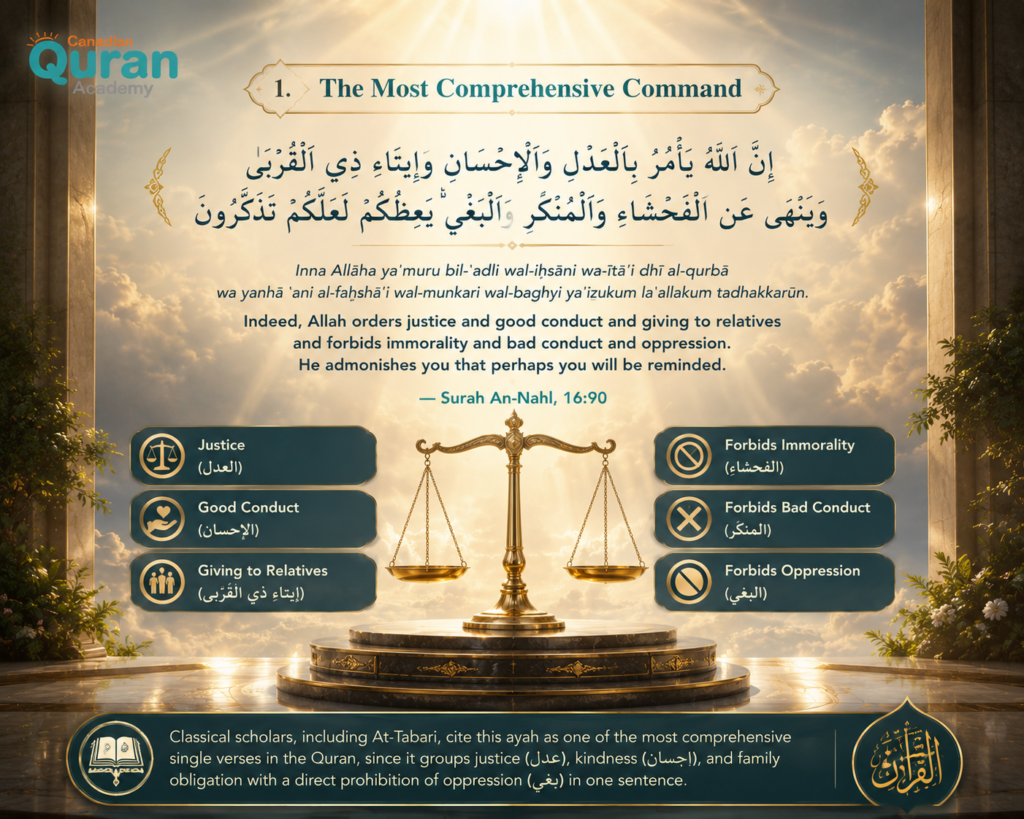
إِنَّ اللَّهَ يَأْمُرُ بِالْعَدْلِ وَالْإِحْسَانِ وَإِيتَاءِ ذِي الْقُرْبَىٰ وَيَنْهَىٰ عَنِ الْفَحْشَاءِ وَالْمُنكَرِ وَالْبَغْيِ ۚ يَعِظُكُمْ لَعَلَّكُمْ تَذَكَّرُونَ
Inna Allāha yaʾmuru bil-ʿadli wal-iḥsāni wa-ītāʾi dhī al-qurbā wa yanhā ʿani al-faḥshāʾi wal-munkari wal-baghyi yaʿiẓukum laʿallakum tadhakkarūn.
“Indeed, Allah orders justice and good conduct and giving to relatives and forbids immorality and bad conduct and oppression. He admonishes you that perhaps you will be reminded.” — Surah An-Nahl, 16:90
Classical scholars, including At-Tabari, cite this ayah as one of the most comprehensive single verses in the Quran, since it groups justice (عدل), kindness (إحسان), and family obligation with a direct prohibition of oppression (بغي) in one sentence — a density of instruction that a single English sentence struggles to reproduce.
2. Justice Paired With Trust
Here justice is not stated alone either. It is placed directly beside amanah — the trusts owed to other people — as if one cannot be commanded without the other.
إِنَّ اللَّهَ يَأْمُرُكُمْ أَنْ تُؤَدُّوا الْأَمَانَاتِ إِلَىٰ أَهْلِهَا وَإِذَا حَكَمْتُم بَيْنَ النَّاسِ أَن تَحْكُمُوا بِالْعَدْلِ ۚ إِنَّ اللَّهَ نِعِمَّا يَعِظُكُم بِهِ ۗ إِنَّ اللَّهَ كَانَ سَمِيعًا بَصِيرًا
Inna Allāha yaʾmurukum an tuʾaddū al-amānāti ilā ahlihā wa-idhā ḥakamtum bayna an-nāsi an taḥkumū bil-ʿadli inna Allāha niʿimmā yaʿiẓukum bihī inna Allāha kāna samīʿan baṣīrā.
“Indeed, Allah commands you to render trusts to whom they are due and when you judge between people to judge with justice. Excellent is that which Allah instructs you. Indeed, Allah is ever Hearing and Seeing.” — Surah An-Nisa, 4:58
Tafsir al-Jalalayn treats this pairing as deliberate: fair judgment (حكم بالعدل) is framed as a trust (أمانة) owed to the people being judged, not a personal preference a judge is free to weigh against his own interest.
If a learner wants to see exactly how this vocabulary of trust and justice works in the original Arabic grammar, that kind of close reading is what the Intensive Arabic Course at Canadian Quran Academy is built around — going beyond translation into the structure of the language itself.

Begin your Intensive Quran Course in Canada with a FREE trial class.
Verses on Justice as Personal Testimony
Beyond commanding justice in general, the Quran addresses the moment testimony is actually given — including the exact people a person is tempted to favor.
1. Justice Toward Those You Dislike
The Quran anticipates the one honest obstacle to fairness: personal hatred. It names that obstacle directly, then instructs believers to override it.
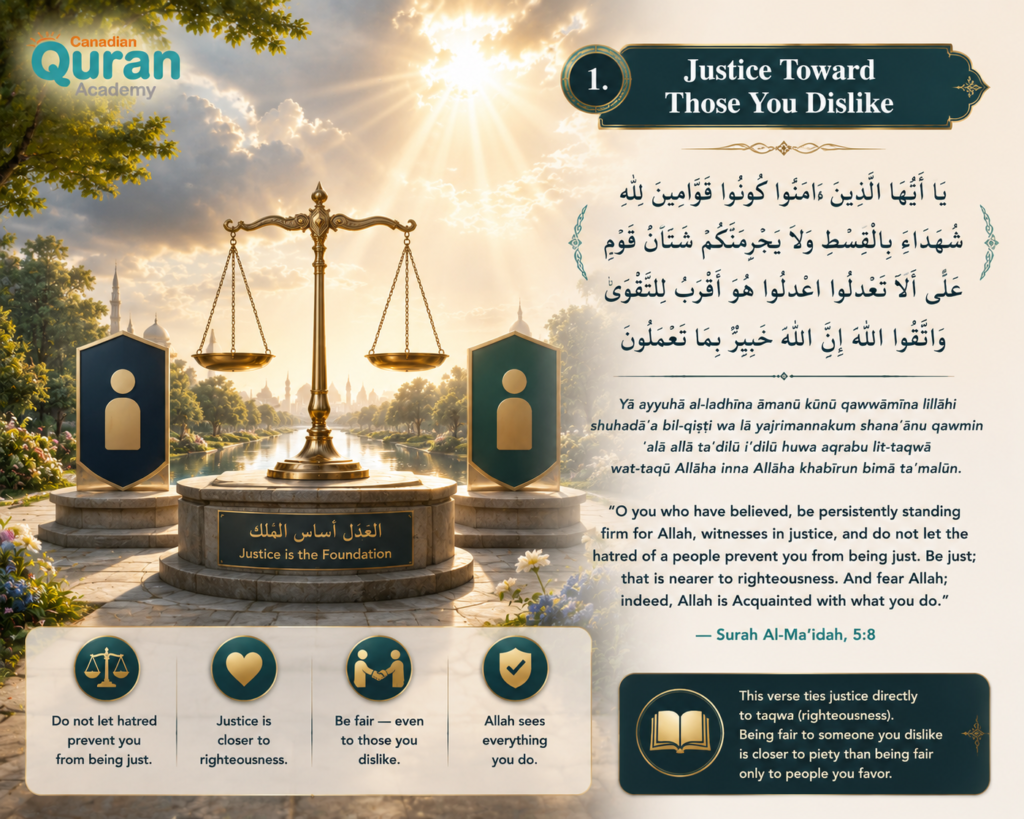
يَا أَيُّهَا الَّذِينَ آمَنُوا كُونُوا قَوَّامِينَ لِلَّهِ شُهَدَاءَ بِالْقِسْطِ ۖ وَلَا يَجْرِمَنَّكُمْ شَنَآنُ قَوْمٍ عَلَىٰ أَلَّا تَعْدِلُوا ۚ اعْدِلُوا هُوَ أَقْرَبُ لِلتَّقْوَىٰ ۖ وَاتَّقُوا اللَّهَ ۚ إِنَّ اللَّهَ خَبِيرٌ بِمَا تَعْمَلُونَ
Yā ayyuhā al-ladhīna āmanū kūnū qawwāmīna lillāhi shuhadāʾa bil-qisṭi wa lā yajrimannakum shanaʾānu qawmin ʿalā allā taʿdilū iʿdilū huwa aqrabu lit-taqwā wat-taqū Allāha inna Allāha khabīrun bimā taʿmalūn.
“O you who have believed, be persistently standing firm for Allah, witnesses in justice, and do not let the hatred of a people prevent you from being just. Be just; that is nearer to righteousness. And fear Allah; indeed, Allah is Acquainted with what you do.” Surah Al-Ma’idah, 5:8
This verse ties justice directly to taqwa (righteousness). Being fair to someone you dislike is named here as closer to piety than being fair only to people you favor — a distinction most modern commentary on justice leaves out entirely.
2. Justice Against Yourself or Family
This is the verse most commentators point to when they explain that Islamic justice is not conditional on convenience — wealth, poverty, and blood ties are all named as factors that must not bend a person’s testimony.
يَا أَيُّهَا الَّذِينَ آمَنُوا كُونُوا قَوَّامِينَ بِالْقِسْطِ شُهَدَاءَ لِلَّهِ وَلَوْ عَلَىٰ أَنفُسِكُمْ أَوِ الْوَالِدَيْنِ وَالْأَقْرَبِينَ ۚ إِن يَكُنْ غَنِيًّا أَوْ فَقِيرًا فَاللَّهُ أَوْلَىٰ بِهِمَا ۖ فَلَا تَتَّبِعُوا الْهَوَىٰ أَن تَعْدِلُوا ۚ وَإِن تَلْوُوا أَوْ تُعْرِضُوا فَإِنَّ اللَّهَ كَانَ بِمَا تَعْمَلُونَ خَبِيرًا
Yā ayyuhā al-ladhīna āmanū kūnū qawwāmīna bil-qisṭi shuhadāʾa lillāhi wa law ʿalā anfusikum awi al-wālidayni wal-aqrabīn…
“O you who have believed, be persistently standing firm in justice, witnesses for Allah, even if it be against yourselves or parents and relatives. Whether one is rich or poor, Allah is more worthy of both. So follow not personal inclination, lest you not be just.” Surah An-Nisa, 4:135
Note the repeated root ق-س-ط (qisṭ) shared with 5:8 above — the same command word appears in both verses, once against enemies and once against one’s own family, as if the Quran is closing off every excuse a person could reach for in either direction.
3. Justice in Speech, Not Only in Court
Justice is not confined here to formal judgment. The Quran extends the same command to ordinary speech, including speech about relatives.
…وَإِذَا قُلْتُمْ فَاعْدِلُوا وَلَوْ كَانَ ذَا قُرْبَىٰ…
…wa-idhā qultum faʿdilū wa law kāna dhā qurbā…
“…And when you speak, be just, even if [it concerns] a near relative…” Surah Al-An’am, 6:152
This is one of the few justice verses that leaves the courtroom entirely.
عدل here governs everyday testimony and speech, not a judge’s ruling — a scope that is easy to miss if the verse is only skimmed in translation as “be fair.”
The Canadian Quran Academy’s Quran Tafsir Course helps you understand Quran verses about justice in Arabic through authentic Tafsir, contextual analysis, and classical scholarly explanations—so you can appreciate not only what the verses say, but why they were revealed and how they guide justice in everyday life.

Start your Quran Tafsir Course in Canada with a FREE trial class.
Live Class in Action
Watch how our instructors interact with students in real-time, focusing on interactive methods.
Start Your Quranic Journey in Canada
Join our vibrant community and learn with expert tutors through our flexible online platform.
Claim Your Free TrialVerses on Justice as a Universal, Cosmic Law
Some justice verses go past courts and speech entirely and describe something closer to a structural law built into creation itself.
1. The Balance of the Heavens
Here justice is not framed as a social rule but as a law of creation — the same balance that governs the heavens is the standard humans are told to uphold in their own dealings.
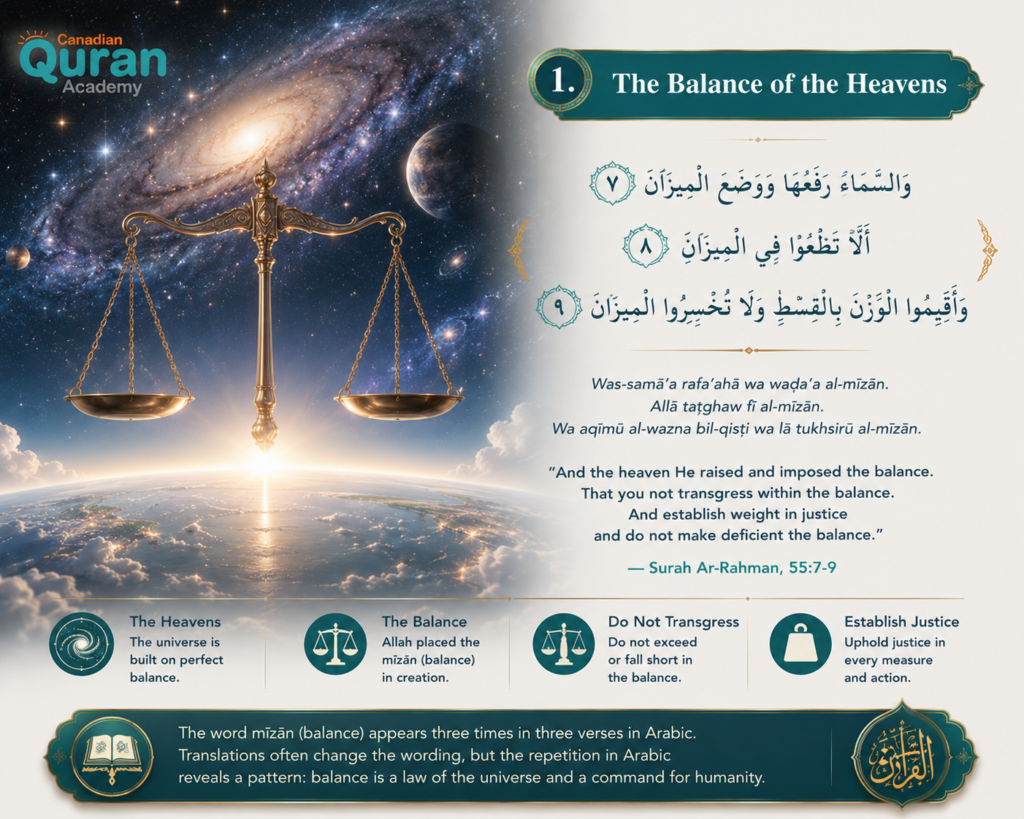
وَالسَّمَاءَ رَفَعَهَا وَوَضَعَ الْمِيزَانَ ﴿٧﴾ أَلَّا تَطْغَوْا فِي الْمِيزَانِ ﴿٨﴾ وَأَقِيمُوا الْوَزْنَ بِالْقِسْطِ وَلَا تُخْسِرُوا الْمِيزَانَ ﴿٩﴾
Was-samāʾa rafaʿahā wa waḍaʿa al-mīzān. Allā taṭghaw fī al-mīzān. Wa aqīmū al-wazna bil-qisṭi wa lā tukhsirū al-mīzān.
“And the heaven He raised and imposed the balance. That you not transgress within the balance. And establish weight in justice and do not make deficient the balance.” Surah Ar-Rahman, 55:7
مِيزَان (mīzān, balance) appears three times across these three ayat — a repetition that is easy to miss unless you’re reading the Arabic directly, since a translation will often vary the word to avoid sounding repetitive in English and, in doing so, hides the pattern the Quran is deliberately building.
2. The Purpose of Every Messenger
This is arguably the widest-angle justice verse in the Quran. It does not describe justice as one command among others — it names it as the reason every messenger, across every nation, was sent at all.
لَقَدْ أَرْسَلْنَا رُسُلَنَا بِالْبَيِّنَاتِ وَأَنزَلْنَا مَعَهُمُ الْكِتَابَ وَالْمِيزَانَ لِيَقُومَ النَّاسُ بِالْقِسْطِ…
Laqad arsalnā rusulanā bil-bayyināti wa anzalnā maʿahumu al-kitāba wal-mīzāna li-yaqūma an-nāsu bil-qisṭ…
“We have already sent Our messengers with clear evidences and sent down with them the Scripture and the balance, that the people may maintain [their affairs] in justice…” Surah Al-Hadid, 57:25
Note that مِيزَان reappears here, tying this verse directly back to 55:7-9 — the same word used for the balance of the heavens is used for the purpose of revelation itself, linking cosmic order and human justice as two expressions of one root idea.
Read also: Quran Verses About Humanity in Arabic (With English Translation and Meaning)
Verses on Justice Between Disputing Parties
Principles of justice find their true test when disagreement turns into conflict. In this final group of verses, the Quran explains how justice should govern reconciliation, judicial decisions, and leadership, ensuring that peace is established on fairness rather than compromise alone.
1. Reconciling Two Believing Factions
The Quran does not leave reconciliation vague. It specifies exactly how peace between two fighting groups must be restored — with justice, not merely a ceasefire.
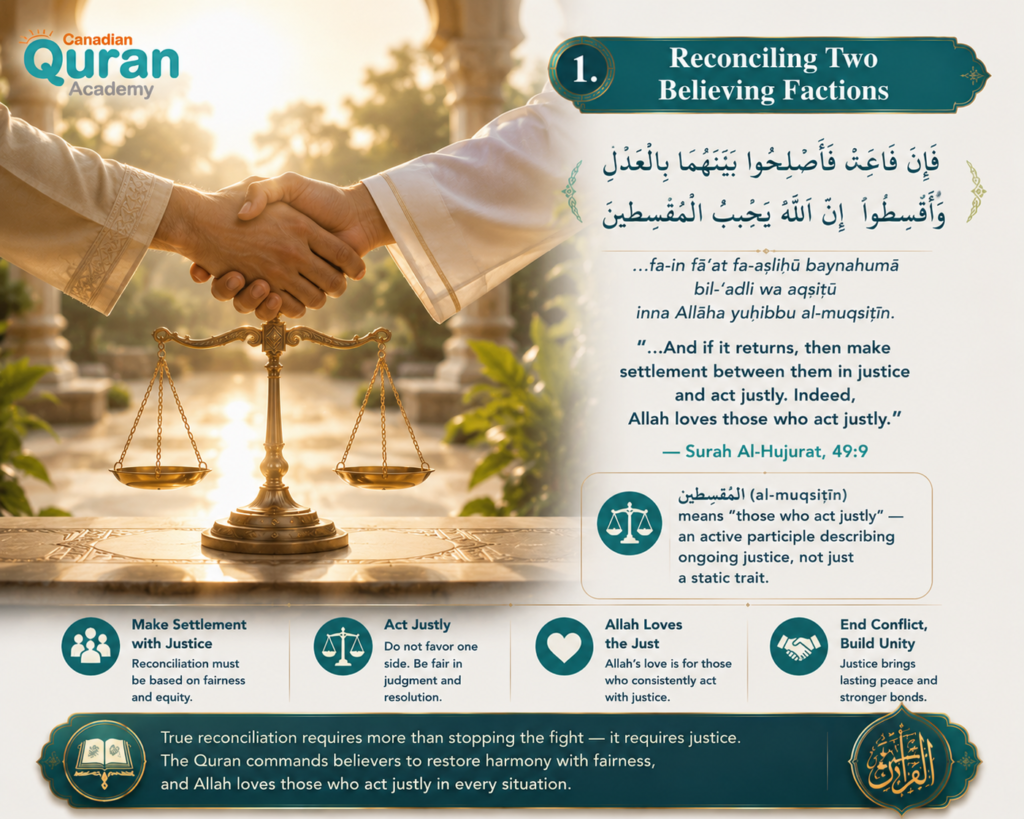
…فَإِن فَاءَتْ فَأَصْلِحُوا بَيْنَهُمَا بِالْعَدْلِ وَأَقْسِطُوا ۖ إِنَّ اللَّهَ يُحِبُّ الْمُقْسِطِينَ
…fa-in fāʾat fa-aṣliḥū baynahumā bil-ʿadli wa aqsiṭū inna Allāha yuḥibbu al-muqsiṭīn.
“…And if it returns, then make settlement between them in justice and act justly. Indeed, Allah loves those who act justly.” Surah Al-Hujurat, 49:9
الْمُقْسِطِينَ (al-muqsiṭīn, “those who act justly”) is not simply “the just” — it’s an active participle describing people actively doing qisṭ, not merely possessing the trait. Allah’s love is directed at the ongoing act, not a static description of character.
2. Judging Between People With Justice
Justice becomes even more critical when someone is entrusted with deciding between others. The Quran teaches that a judge’s responsibility is not merely to resolve disputes quickly but to deliver judgments founded on complete fairness and impartiality.
…وَإِنْ حَكَمْتَ فَاحْكُم بَيْنَهُم بِالْقِسْطِ ۚ إِنَّ اللَّهَ يُحِبُّ الْمُقْسِطِينَ
…wa-in ḥakamta faḥkum baynahum bil-qisṭi inna Allāha yuḥibbu al-muqsiṭīn.
“…And if you judge, judge between them with justice. Indeed, Allah loves those who act justly.” Surah Al-Ma’idah, 5:42
This ayah closes with the exact same phrase as 49:9 above — إِنَّ اللَّهَ يُحِبُّ الْمُقْسِطِينَ. The Quran repeats this precise sentence across two different surahs, in two different contexts (a personal dispute and formal judgment), which is the kind of cross-surah pattern only visible when the verses are read in Arabic side by side rather than in separate translated excerpts.
3. A Personal Command to the Prophet ﷺ
Justice is not only commanded of the community here — it is commanded of the Prophet ﷺ himself, in his own voice.
…وَأُمِرْتُ لِأَعْدِلَ بَيْنَكُمُ ۖ اللَّهُ رَبُّنَا وَرَبُّكُمْ…
…wa-umirtu li-aʿdila baynakum Allāhu rabbunā wa rabbukum…
“…And I have been commanded to do justice among you. Allah is our Lord and your Lord…” Surah Ash-Shura, 42:15
The first-person verb أُمِرْتُ (“I have been commanded”) sets this verse apart from every other justice ayah in this list — it is the Prophet ﷺ speaking about his own duty, not a general instruction to “you” (plural). Scholars point to this as the clearest textual basis for justice as a requirement of leadership specifically, not only of ordinary believers.
Read also: Quran Verses About Jannah in Arabic
How to Read These Verses Correctly in Arabic?
Reading justice verses in Arabic is not the same as reading them aloud from a transliteration. Two roots carry almost the entire weight of this topic — ع-د-ل (ʿadl) and ق-س-ط (qisṭ) — and both require attention to short vowels and case endings to be read correctly, since a dropped ḍammah or a shortened madd changes not just the sound but the grammatical role of the word in the sentence.
Words like الْمُقْسِطِينَ carry a doubled letter (shaddah-adjacent pattern) and case ending that shift meaning if rushed, while اعْدِلُوا in 5:8 is an imperative form that a flattened, un-tashkeel reading can easily mistake for a different verb form entirely. Learning tajweed and basic Arabic grammar is what makes the difference between reading these words correctly and only approximating their sound.
Learning tajweed and basic Arabic grammar is what makes the difference between reading these words correctly and only approximating their sound — this precision is exactly what a structured Qira’at course is built to develop, since accurate recitation depends on hearing and correcting these details letter by letter, not just reading them silently.

Experience Our Classrooms
Don’t just take our word for it—take a look inside! Watch the videos below to experience our engaging teaching methods and vibrant online classrooms firsthand.
Start Your Quranic Journey in Canada
Join our vibrant community and learn with expert tutors through our flexible online platform.
Claim Your Free TrialStart Learning Quran Verses About Justice in Arabic With The Canadian Quran Academy
Reading a translation introduces the meaning of the Quran verses about justice in Arabic, but studying the original Arabic at Canadian Quran Academy allows you to discover the repeated roots, precise grammar, and linguistic depth that translations alone cannot fully convey. Through personalized instruction, you’ll learn not only what these verses mean, but also how their wording highlights Allah’s emphasis on justice throughout the Quran.
- Qualified Quran and Arabic instructors providing personalized 1-on-1 lessons
- Learn Quran verses about justice in Arabic while building your Quranic Arabic, Tajweed, and Quran understanding in one structured program
- Flexible morning, evening, and weekend classes designed for Canadian time zones
- Courses for adults, children, women, new Muslims, and complete beginners
- Step-by-step instruction combining Arabic reading, grammar, and accurate Quran recitation
- Free trial lesson with no obligation
Book your FREE trial session today and begin understanding the Quran verses about justice in Arabic with confidence.

Our Quran Courses
- Quran Online Academy
- Quran Recitation Classes
- Quran Reading Classes
- Online Quran Classes for Kids
- Quran Classes for Adults
- Quran Classes for Female/Sisters
- Learn Quran for Beginners
- Quran Memorization (Hifz) Course
- Hifz Classes for Adults
- Quran Memorization and Hifz for Kids
- Quran Hifz for Ladies
- Quran Ijazah Program
- Quran Qirat Learning Course
- Quran Tafsir Course
- Noorani Qaida Course
- Noorani Qaida Course for Kids
- Weekend Quran Classes
- Intensive Quran Course
- Al-Azhar Quran Course
- Online Tajweed Classes
- Tajweed Course for Kids
- Tajweed Course for Adults
- Tajweed Course for Ladies/Sisters
Start Your Quranic Journey in Canada
Join our vibrant community and learn with expert tutors through our flexible online platform.
Claim Your Free TrialConclusion
Justice is one of the Quran’s most consistent themes, appearing across different surahs and situations to show that it is a universal principle rather than a context-specific command. Some verses establish justice as a direct command from Allah, others require believers to uphold it in their testimony, speech, and decisions, while others present it as part of the divine order upon which the heavens, the earth, and human society are built. The Quran also demonstrates how justice should be practiced in real life by applying it to reconciliation, leadership, and the resolution of disputes. This message is further reinforced by the authentic hadith of Sahih al-Bukhari 660, which highlights fairness as an essential responsibility for those entrusted with authority and judgment.
Studying these Quran verses about justice in Arabic reveals patterns that are often hidden in translation alone. The repeated use of key words such as ʿadl (justice), qisṭ (equity), and mīzān (balance) creates thematic connections between verses revealed in different contexts, showing that justice is presented throughout the Quran as a continuous obligation woven into faith, worship, leadership, and everyday interactions.
Frequently Asked Questions
What is the main Quran verse about justice?
Surah An-Nahl 16:90 is often cited as the most comprehensive single verse on justice, since it commands justice and good conduct while forbidding oppression in one sentence.
Does the Quran say to be just even to your enemies?
Yes. Surah Al-Ma’idah 5:8 states that hatred toward a people must not prevent a believer from being just, since justice is described as closer to righteousness (taqwa).
What Arabic word does the Quran use for justice?
The Quran uses two words: عدل (ʿadl), meaning balanced fairness, and قسط (qisṭ), meaning giving each person their due right. Both appear across the verses discussed above.
Does the Quran connect justice to the natural world, not just human behavior?
Yes. Surah Ar-Rahman 55:7-9 and Surah Al-Hadid 57:25 both use the word مِيزَان (balance) — once for the balance governing the heavens, and once for the balance revelation itself was sent to establish among people.
Is there a hadith about justice besides these Quran verses?
Why read these verses in Arabic instead of translation?
The repeated Arabic roots for justice (ع-د-ل، ق-س-ط) and balance (م-ي-ز-ن) connect verses across different surahs in a way that is not visible in English translation alone, which is why direct Arabic reading gives a fuller picture of the Quran’s teaching on justice.






Leave a Reply