 Quran
Quran
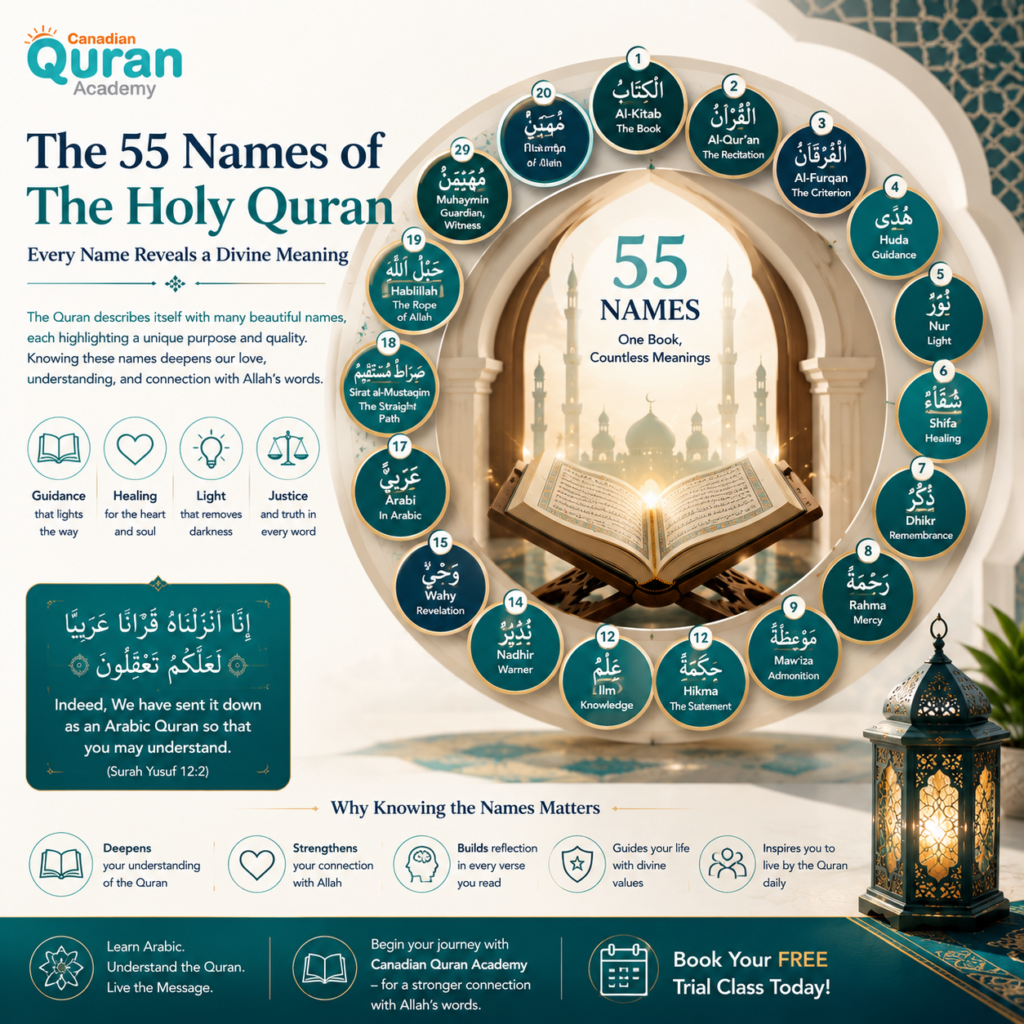
Most readers know the Quran by one name. Few realize the text refers to itself using dozens of different titles, each highlighting a different quality — guidance, healing, light, criterion, mercy. Understanding the 55 names of the Holy Quran in Arabic opens a door into how the Quran describes its own purpose, in its own words.
This guide lists all 55 names as recorded across the Quran’s verses, gives you the Arabic script and transliteration for each, and explains the meaning and scriptural basis of the six most significant ones — with the original Arabic text, English translation, and exact verse reference for every ayah cited.
How Many Names Does the Quran Have?
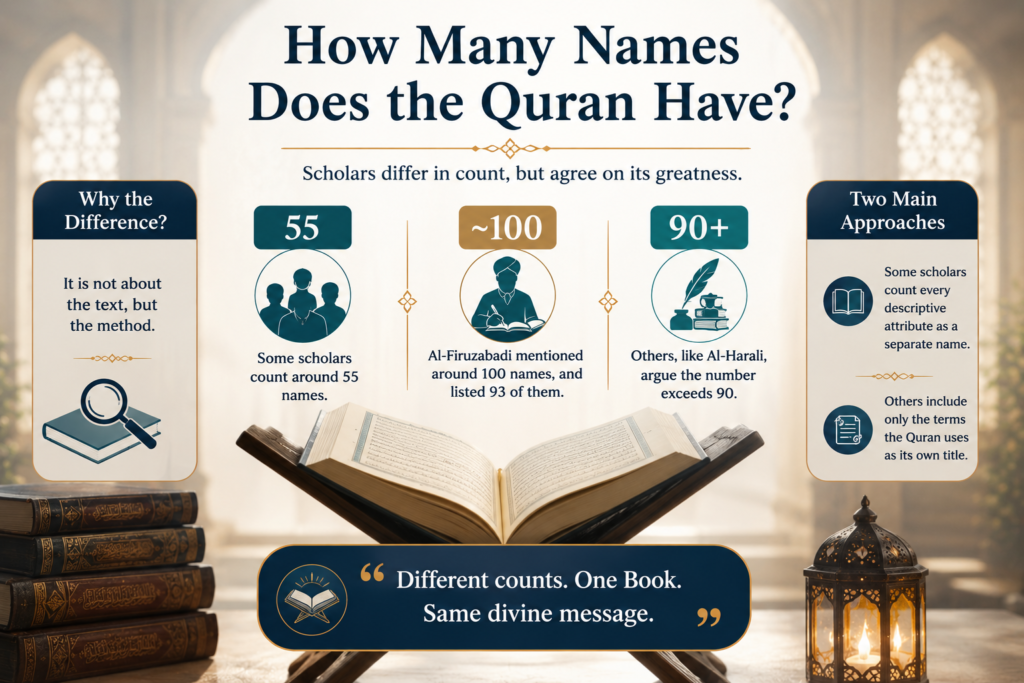
Islamic scholars have never fully agreed on a single count. Classical scholar Al-Firuzabadi, in his book Basa’ir Dhawi al-Tamyiz, stated that Allah gave the Quran around 100 names, though he documented only 93 of them by name. Other scholars count closer to 55, and a smaller group — including the scholar Al-Harali — argue the number exceeds 90 once every quality attributed to the Quran is treated as a name in its own right.
The disagreement is not really about the text — it is about method. A handful of scholars, such as Al-Zarkashi, counted every descriptive attribute of the Quran (such as Karim, “Noble”) as a separate name. Others restrict the list to terms the Quran uses as a direct title for itself. That single methodological choice is why one respected source lists four names, another lists 55, and another lists more than 90.
The Four Names Scholars Agree the Quran Has
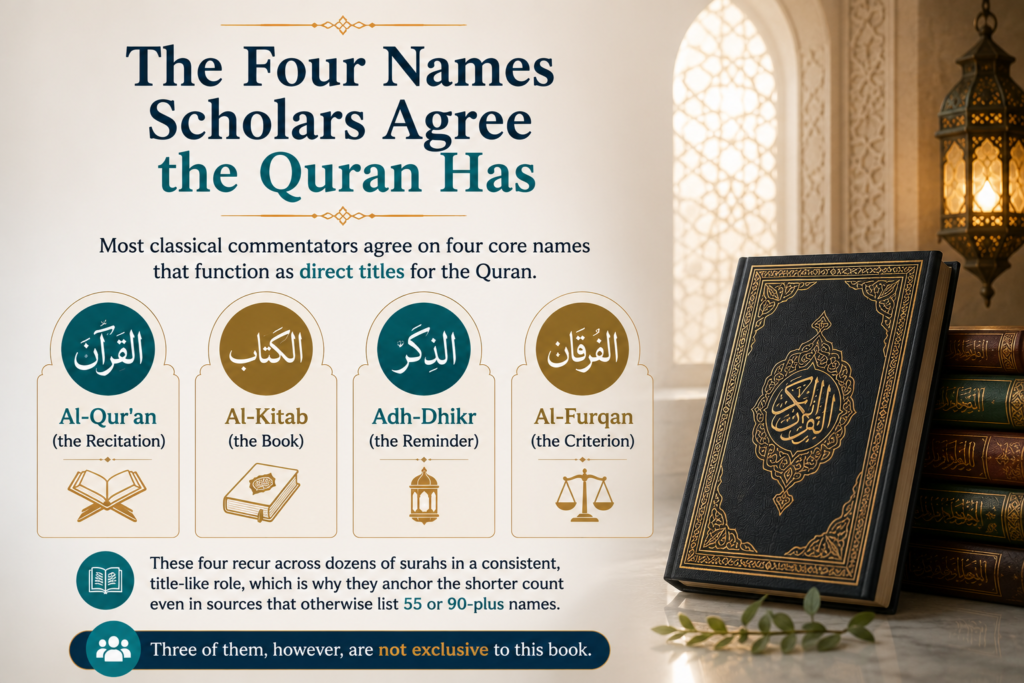
Most classical commentators, including Al-Tabari and Al-Mawardi, agree on four core names that function as direct titles for the Quran rather than descriptive attributes:
- Al-Qur’an (the Recitation)
- Al-Kitab (the Book)
- Adh-Dhikr (the Reminder)
- Al-Furqan (the Criterion)
These four recur across dozens of surahs in a consistent, title-like role, which is why they anchor the shorter count even in sources that otherwise list 55 or 90-plus names. Three of them, however, are not exclusive to this book.
Read also: What Is Classical Arabic?
Why Do Scholars Disagree on the Exact Count?
The 55-name list, which this article follows, sits between the narrow four-name view and the expansive 90-plus view. It includes both direct titles (Al-Kitab, Al-Furqan) and functional descriptions the Quran applies to itself (Shifa, “Healing”; Nur, “Light”). A practical rule of thumb: if you see a name repeated across very different surahs in a consistent, title-like role, it belongs on the shorter list. If it appears once, describing a quality rather than naming the book, it belongs to the longer, 90-plus count.
Learning to read these distinctions in the original Arabic is exactly the kind of skill built inside a structured Quran learning program, where a qualified teacher walks you through the text verse by verse rather than leaving you to piece it together from articles.
Book a FREE trial class Quran Online Academy in Canada

The Complete List of the 55 Names of the Quran in Arabic
Below is the full list of 55 names, each shown with its Arabic script, transliteration, English meaning, and a sample of the verses where it appears.
| Arabic | Transliteration | Meaning | Selected Verses | |
| 1 | الكتاب | Al-Kitab | The Book | 2:1–2, 2:129, 6:114, 18:1 |
| 2 | مبين | Mubin | Luminous | 4:174, 5:15, 12:1–2, 27:1 |
| 3 | القرآن | Al-Qur’an | The Recitation | 2:185, 9:111, 17:9, 20:1–2 |
| 4 | كريم | Karim | Honourable, Noble | 56:77 |
| 5 | كلام الله | Kalamullah | The Word of Allah | 9:6 |
| 6 | نور | Nur | Sacred Light | 4:174, 7:157, 64:8 |
| 7 | هدى | Huda | Right Guidance | 2:1–2, 2:97, 3:138, 27:77 |
| 8 | رحمة | Rahma | Mercy | 7:52, 16:64, 27:77, 31:3 |
| 9 | الفرقان | Al-Furqan | The Criterion | 2:185, 3:4, 25:1 |
| 10 | شفاء | Shifa | A Healing, A Cure | 10:57, 17:82, 41:44 |
| 11 | موعظة | Maw’iza | Admonition | 3:138, 10:57, 24:34 |
| 12 | ذكر | Dhikr | Remembrance, Reminder | 3:58, 15:9, 21:50, 36:69 |
| 13 | مبارك | Mubarak | Blessed | 6:92, 6:155, 21:50, 38:29 |
| 14 | علي | Aliy | Exalted | 43:4 |
| 15 | حكمة | Hikma | Perfect Wisdom | 54:5 |
| 16 | حكيم | Hakim | Full of Wisdom | 10:1, 31:1–2, 36:1–2, 43:4 |
| 17 | مهيمن | Muhaymin | Guardian, Witness | 5:48 |
| 18 | مصدق | Musaddiq | Confirming Scripture | 2:91, 3:3, 5:48, 46:12 |
| 19 | حبل الله | Hablillah | The Rope of Allah | 3:103 |
| 20 | صراط مستقيم | Sirat al-Mustaqim | The Straight Path | 6:153 |
| 21 | قيّم | Qayyim | Straight Guidance | 18:2 |
| 22 | قول | Qawl | Word of Allah | 28:51, 86:13 |
| 23 | فصل | Fasl | Decisive | 86:13 |
| 24 | نبأ عظيم | Naba’un Azim | Supreme Message | 38:67, 78:1–2 |
| 25 | أحسن الحديث | Ahsan al-Hadith | The Best Message | 39:23 |
| 26 | مثاني | Mathani | Oft-Repeated | 39:23 |
| 27 | متشابه | Mutashabih | Consistent in Itself | 39:23 |
| 28 | تنزيل | Tanzil | The Revelation Sent Down | 2:4, 3:84, 26:192–194, 41:1–2 |
| 29 | روح | Ruh | The Book That Gives Life to Faith | 42:52 |
| 30 | وحي | Wahy | The Final Revelation | 4:163, 10:109, 21:45, 53:4 |
| 31 | عربي | Arabi | In Arabic | 12:2, 13:37, 26:195, 41:3 |
| 32 | بصائر | Basa’ir | Eye-Opening Evidences | 7:203, 45:20 |
| 33 | بيان | Bayan | The Final Statement | 3:138 |
| 34 | علم | Ilm | Ultimate Knowledge | 2:120, 2:145 |
| 35 | حق | Haqq | Truth, True | 3:62, 10:108, 13:1, 47:2 |
| 36 | هادٍ | Hadi | Guide | 17:9, 46:30, 72:2 |
| 37 | عجب | Ajab | Wonderful | 72:1 |
| 38 | تذكرة | Tadhkira | Admonition, Reminder | 20:3, 69:48, 74:54 |
| 39 | العروة الوثقى | Urwatul Wuthqa | The Firm Handhold | 2:256 |
| 40 | صدق | Sidq | Truth | 39:32–33 |
| 41 | عدل | Adl | Justice | 6:115 |
| 42 | أمر الله | Amrullah | The Commandment of Allah | 65:5 |
| 43 | مناد | Munadi | Inviter to Faith | 3:193 |
| 44 | بشرى | Bushra | Glad Tidings | 2:97, 16:102, 27:2, 46:12 |
| 45 | مجيد | Majid | Glorious | 50:1, 85:21–22 |
| 46 | زبور | Zabur | The Scripture | 21:105 |
| 47 | بشير | Bashir | Herald of Glad Tidings | 17:9, 41:4 |
| 48 | نذير | Nadhir | Warner | 41:4 |
| 49 | عزيز | Aziz | Mighty | 41:41 |
| 50 | بلاغ | Balagh | Sufficient Message | 14:52, 21:106 |
| 51 | قصص | Qasas | Narratives | 12:3 |
| 52 | صحف | Suhuf | Scriptures | 80:13, 98:2 |
| 53 | مكرّمة | Mukarrama | Honoured | 80:13 |
| 54 | مرفوعة | Marfu’a | Exalted | 80:14 |
| 55 | مطهّرة | Mutahhara | Kept Pure | 80:14, 98:2 |
Three names appear far more often across this list than any other: Al-Kitab, Al-Qur’an, and Adh-Dhikr each recur in more than 20 separate verses, which is the main reason classical scholars treated them as the Quran’s primary titles rather than descriptive attributes.
Read also: HOW TO LEARN ARABIC FOR QURAN IN CANADA?
Live Class in Action
Watch how our instructors interact with students in real-time, focusing on interactive methods.
Start Your Quranic Journey in Canada
Join our vibrant community and learn with expert tutors through our flexible online platform.
Claim Your Free TrialThe Meanings Behind Six Key Names of the Quran
Each name below carries its Arabic verse text with full diacritics (tashkeel), the English translation, and the exact chapter and verse reference — linked directly to the verse on Quran.com so you can read it in full context.
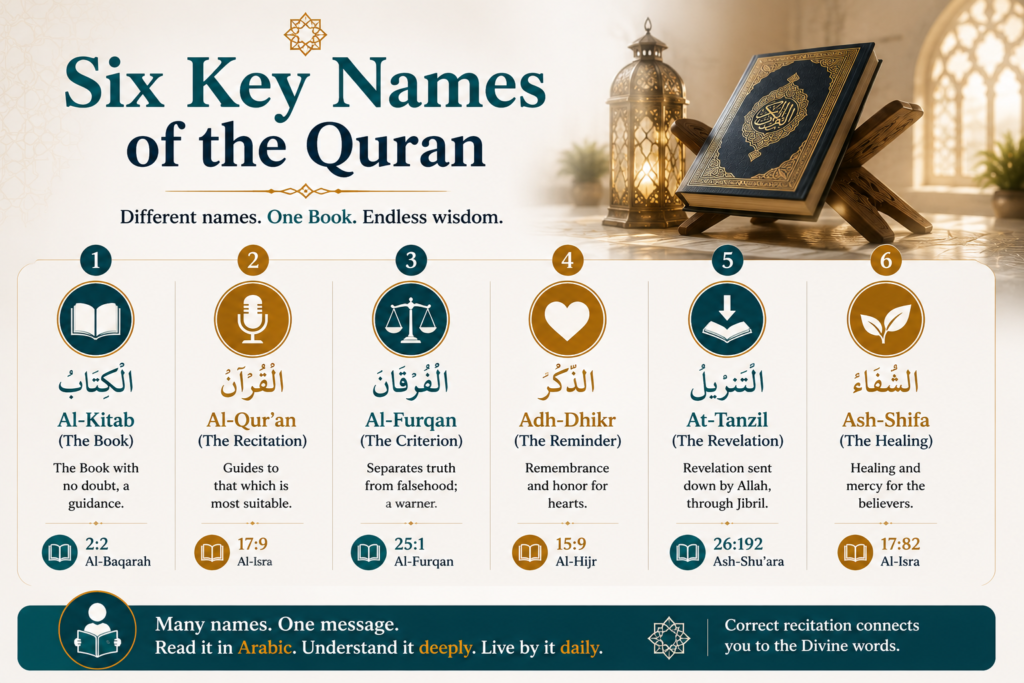
1. Al-Kitab (The Book)
Al-Kitab is Arabic for “the Book,” from the root k-t-b, meaning to gather or bind letters together into words. The Quran uses this name to describe how it collects rulings, stories, and guidance for past and present nations into a single, unified text.
ذَٰلِكَ الْكِتَابُ لَا رَيْبَ فِيهِ ۛ هُدًى لِّلْمُتَّقِينَ
“This is the Book about which there is no doubt, a guidance for those conscious of Allah.” — Surah Al-Baqarah, 2:2
2. Al-Qur’an (The Recitation)
Al-Qur’an comes from the root q-r-a, “to read” or “to recite.” The name emphasizes that the text is meant to be recited aloud, memorized, and carried in the heart — not only read silently from a page.
إِنَّ هَٰذَا الْقُرْآنَ يَهْدِي لِلَّتِي هِيَ أَقْوَمُ
“Indeed, this Quran guides to that which is most suitable.” — Surah Al-Isra, 17:9
3. Al-Furqan (The Criterion)
Al-Furqan means “the one that separates” — specifically, the one that separates truth from falsehood. Commentators including Al-Tabari note this name marks the Quran’s role as a standard for judgement, not just a source of stories.
تَبَارَكَ الَّذِي نَزَّلَ الْفُرْقَانَ عَلَىٰ عَبْدِهِ لِيَكُونَ لِلْعَالَمِينَ نَذِيرًا
“Blessed is He who sent down the Criterion upon His Servant that he may be to the worlds a warner.” — Surah Al-Furqan, 25:1
4. Adh-Dhikr (The Reminder)
Adh-Dhikr means “remembrance” or “honour.” Fakhr al-Din al-Razi explained this name in two ways: the Quran reminds people of guidance they already know at a deep level, and it is itself a source of honour for the Prophet and his community.
إِنَّا نَحْنُ نَزَّلْنَا الذِّكْرَ وَإِنَّا لَهُ لَحَافِظُونَ
“Indeed, it is We who sent down the Reminder, and indeed, We will be its guardian.” — Surah Al-Hijr, 15:9
5. At-Tanzil (The Sent-Down Revelation)
Tanzil is the noun form of “to send down,” referring specifically to the Quran’s method of arrival — revealed by Allah to the Prophet Muhammad ﷺ through the angel Jibril, in stages, over 23 years.
وَإِنَّهُ لَتَنزِيلُ رَبِّ الْعَالَمِينَ
“And indeed, it is a revelation from the Lord of the worlds.” — Surah Ash-Shu’ara, 26:192
6. Ash-Shifa (The Healing)
Ash-Shifa means “cure” or “healing.” Classical commentators, including those cited in Tafsir Ma’arif al-Quran, read this name on two levels: the Quran heals spiritual conditions like doubt and arrogance directly, and its recitation is also used as a means of seeking physical relief.
وَنُنَزِّلُ مِنَ الْقُرْآنِ مَا هُوَ شِفَاءٌ وَرَحْمَةٌ لِّلْمُؤْمِنِينَ
“And We send down of the Quran that which is healing and mercy for the believers.” — Surah Al-Isra, 17:82
Recognizing these names in a translation is one thing — reading them correctly in the original Arabic, with proper tajweed, is another. This is precisely the gap that structured, teacher-led Quran classes are built to close, whether you’re starting from scratch or refining recitation you already have.
Book a FREE trial class in Quran Online Academy in Canada
What These Names Teach About the Quran’s Purpose
A close look at the list shows the 55 names fall into two working categories: identity names and function names. Identity names state what the Quran is — Al-Kitab (a Book), Al-Qur’an (a Recitation), Zabur (a Scripture). Function names state what the Quran does — Shifa (heals), Huda (guides), Nur (illuminates), Furqan (distinguishes truth from falsehood). A useful reading rule: whenever you encounter an unfamiliar name on this list, ask first whether it’s naming what the text is or what it does — that single question resolves most of the apparent overlap between names like Dhikr, Tadhkira, and Maw’iza, which look similar in English translation but serve slightly different functions in Arabic.
Read also: Why Is the Quran in Arabic?
Names Shared With Earlier Scriptures
Three of these names — Al-Kitab, Adh-Dhikr, and Al-Furqan — are also applied in the Quran to the Torah given to Musa (Moses) and the Gospel given to Isa (Jesus). This shared vocabulary is a deliberate signal of continuity between the Quran and earlier revelation, not a coincidence of translation, and it’s a detail most surface-level lists of these names leave out entirely.
Studying the Quran’s own vocabulary for itself — Kitab, Furqan, Dhikr, Tanzil — is a natural extension of learning Quranic Arabic grammar more broadly, the kind of foundation built inside dedicated Islamic studies courses for adults.
Experience Our Classrooms
Don’t just take our word for it—take a look inside! Watch the videos below to experience our engaging teaching methods and vibrant online classrooms firsthand.
Start Your Quranic Journey in Canada
Join our vibrant community and learn with expert tutors through our flexible online platform.
Claim Your Free TrialStart Learning the Quran’s Names and the Quran Itself With Canadian Quran Academy
Five minutes gets you started. Qualified instruction takes you the rest of the way. Canadian Quran Academy connects learners with experienced, native Arabic-speaking teachers for personalized 1-on-1 Quran sessions.
Why learners across Canada choose Canadian Quran Academy:
- Native Arabic instructors who explain terms like Al-Furqan and Adh-Dhikr in their full verse context, not just as translated labels
- Personalized sessions tailored to your pace and goal — recitation, tajweed, memorization, or Quranic Arabic
- Flexible scheduling across Canadian time zones — mornings, evenings, weekends
- Programs for all ages: adults, children, women, and new Muslims
- Accessible from anywhere in Canada or internationally

Our Quran Courses
- Quran Online Academy
- Quran Recitation Classes
- Quran Reading Classes
- Online Quran Classes for Kids
- Quran Classes for Adults
- Quran Classes for Female/Sisters
- Learn Quran for Beginners
- Quran Memorization (Hifz) Course
- Hifz Classes for Adults
- Quran Memorization and Hifz for Kids
- Quran Hifz for Ladies
- Quran Ijazah Program
- Quran Qirat Learning Course
- Quran Tafsir Course
- Noorani Qaida Course
- Noorani Qaida Course for Kids
- Weekend Quran Classes
- Intensive Quran Course
- Al-Azhar Quran Course
- Online Tajweed Classes
- Tajweed Course for Kids
- Tajweed Course for Adults
- Tajweed Course for Ladies/Sisters
Start Your Quranic Journey in Canada
Join our vibrant community and learn with expert tutors through our flexible online platform.
Claim Your Free TrialConclusion
The Quran’s 55 names in Arabic are not decoration — each one describes a distinct function the text performs, from guiding (Huda) and healing (Shifa) to distinguishing truth from falsehood (Al-Furqan). Four names — Al-Qur’an, Al-Kitab, Adh-Dhikr, and Al-Furqan — form the historical core that most scholars agree on, while the fuller 55-name and 90-plus-name lists layer in the Quran’s descriptive self-references. Understanding this vocabulary, in the original Arabic and its verse context, is one of the clearest ways to deepen your reading of the Quran beyond a single translation.
FAQs
How many names does the Quran have?
Scholars disagree: some count four core names (Al-Quran, Al-Kitab, Adh-Dhikr, Al-Furqan), others count 55, and a smaller group counts more than 90. Al-Firuzabadi documented 93 names in his classical work Basa’ir Dhawi al-Tamyiz.
What is the most common name of the Quran?
Al-Qur’an, Al-Kitab, and Adh-Dhikr appear most frequently, each in more than 20 separate verses across the Quran. Most classical commentators treat these three, along with Al-Furqan, as the Quran’s primary titles.
Why is the Quran called Al-Furqan?
Al-Furqan means “the Criterion” because the Quran describes itself as the standard that separates truth from falsehood. The name appears directly in Surah Al-Furqan, 25:1: “Blessed is He who sent down the Criterion upon His Servant.”
Are Al-Kitab and Adh-Dhikr used only for the Quran?
No. The Quran also applies Al-Kitab, Adh-Dhikr, and Al-Furqan to the Torah and the Gospel, marking these as names shared across earlier scriptures rather than titles unique to the Quran alone.
What is the difference between an identity name and a function name?
Identity names state what the Quran is, such as Al-Kitab (“the Book”). Function names state what the Quran does, such as Ash-Shifa (“the Healing”) or Huda (“Guidance”). Most of the 55 names fall into one of these two categories.
Where can I read the full Arabic text of these verses?
Each verse cited in this article links directly to Quran.com, where you can read the full surah in Arabic with side-by-side English translation and audio recitation.






Leave a Reply