 Arabic
You’ve probably already heard the letter m in Arabic without realizing it, even if you’re brand new to the language. It shows up in words that cross straight over from English, like mom (māmā, ماما), music (mūsīqā, موسيقى), and mobile (mōbāyl, موبايل).
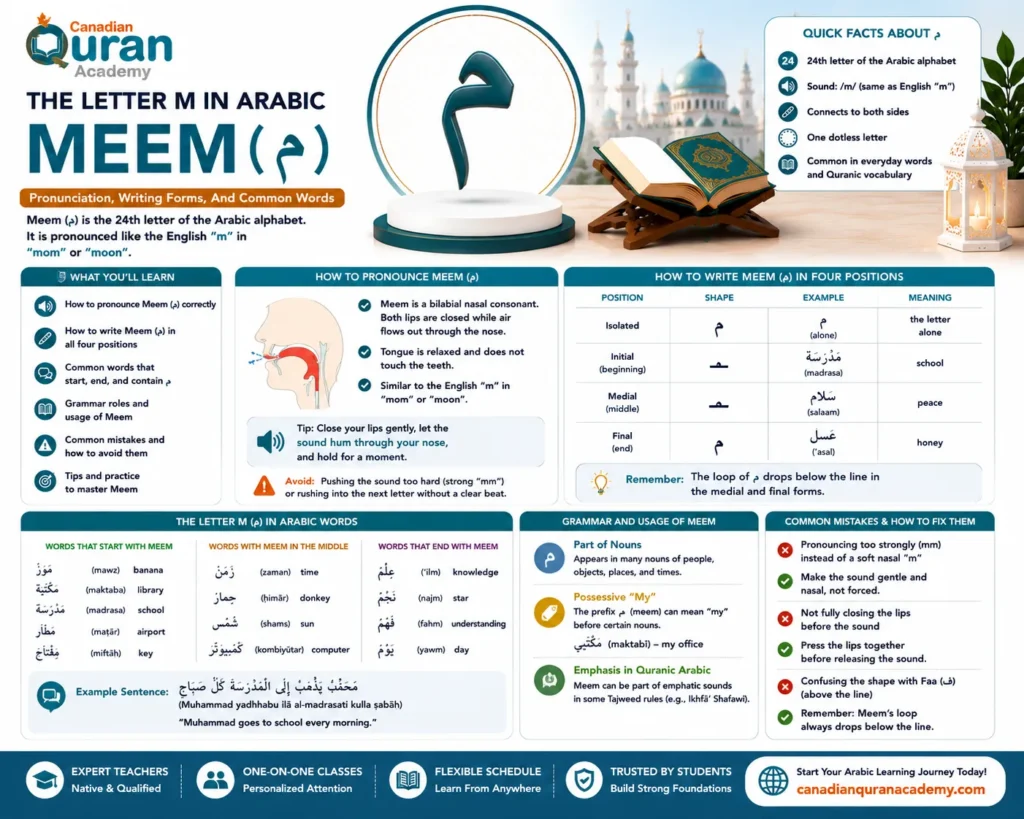
In Arabic, this letter is called Meem (م – Arabic letter m), and it’s the twenty-fourth letter of the Arabic alphabet. At Canadian Quran Academy, new students usually pick up Meem faster than most other letters, because the sound needs no adjustment for English speakers — only the shape does.
This guide covers how to pronounce and write the letter m in Arabic, how its shape shifts across four positions in a word, and where it appears in everyday vocabulary and Arabic grammar.
How To Pronounce The Arabic Letter M (Meem)?
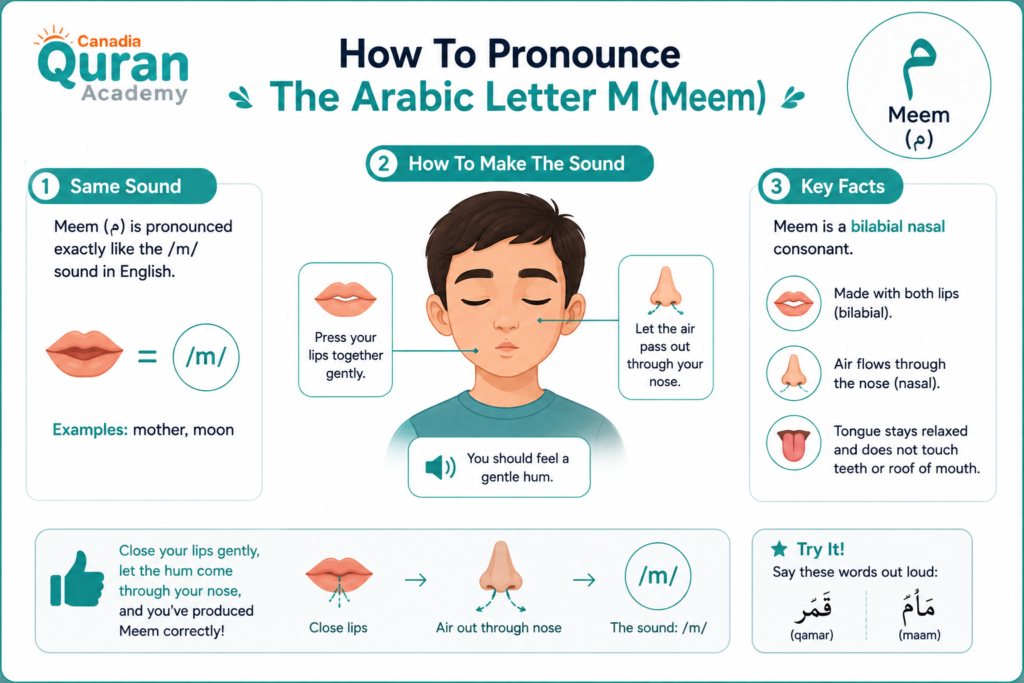
The Arabic letter Meem (م) is pronounced exactly like the /m/ sound in English, so your ear already knows this sound. What takes practice is connecting that familiar sound to an unfamiliar shape, which is where most learners actually slow down.
Meem is a bilabial nasal consonant. You produce it by pressing your two lips together while the air passes out through your nose instead of your mouth, the same physical motion as the English “m” in “mother” or “moon.”
Your tongue stays relaxed and doesn’t touch your teeth or the roof of your mouth during the sound. Close your lips gently, let the hum come through your nose, and you’ve produced Meem correctly.
Common Pronunciation Mistakes
New learners often push the sound too hard, turning a soft nasal hum into a strained, forced “mm.” Others rush the lip closure and blend Meem straight into the next letter instead of giving it its own clear beat.
The fix is slowing down: close your lips fully before releasing the sound, and hold the hum for half a second before moving on.
This is exactly the kind of correction a live instructor catches instantly, which is why Canadian Quran Academy pairs every beginner with a tutor for real-time feedback rather than relying on recorded videos alone.
Read Also: The Arabic Letter Lam (ل)
Read Also: Letter Kh خ In Arabic
How To Write The Letter M In Arabic?
Like most Arabic letters, Meem changes shape depending on where it sits in a word — alone, at the start, in the middle, or at the end. All four forms share one signature feature, a small closed loop, but the loop’s position and length shift with each form.
| Position | Shape | Writing detail |
| Isolated | م | Small closed loop with a tail dropping below the line |
| Initial | مـ | Loop sits flat on the line and connects forward |
| Medial | ـمـ | Loop connects on both sides and drops below the line |
| Final | ـم | Connects to the previous letter, then drops below the line |
Start with a small loop at the top right, curve it slightly left, then extend a line down along the writing line. This form is used only when Meem stands completely alone, unconnected to any other letter.
Initial Form of Meem
Begin with the same small loop as the isolated form, then extend a horizontal line to the left so the letter connects to the one that follows. You’ll see this shape at the start of words like مَدْرَسَة (madrasa, “school”).
Medial and Final Forms of Meem
For the medial form, draw a connecting line in from the previous letter, then add the loop. The loop must drop below that connecting line — this is what separates Meem from the letter Faa, whose loop sits above the line instead.
The final form connects to the previous letter the same way, then finishes with a long tail dropping below the line, similar to the isolated form.
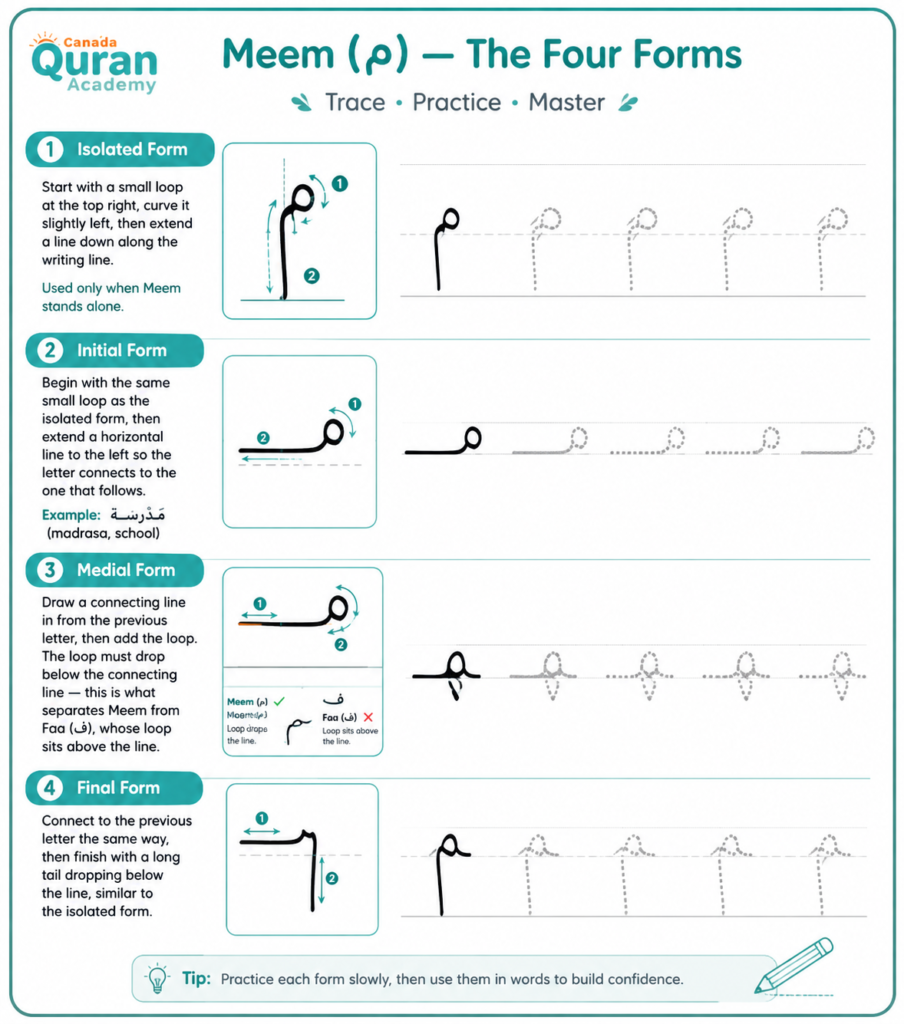
Getting this loop placement right by eye alone is genuinely difficult from a book. In Canadian Quran Academy’s Arabic Course for Beginners, instructors correct your stroke direction and loop placement letter by letter, before the wrong habit has a chance to set in.
Read Also: The Letter Qaf In Arabic ق
Live Class in Action
Watch how our instructors interact with students in real-time, focusing on interactive methods.
Start Your Quranic Journey in Canada
Join our vibrant community and learn with expert tutors through our flexible online platform.
Claim Your Free TrialThe Letter M in Arabic Words
Seeing Meem inside real words is the fastest way to start recognizing it automatically instead of sounding it out letter by letter. Below are examples grouped by where the letter falls in the word.
Words That Start With Meem:
- مَوز (mawz) — banana
- مَكْتَبَة (maktaba) — library
- مَدْرَسَة (madrasa) — school
- مَطَار (maṭār) — airport
- مِفْتَاح (miftāḥ) — key
Words With Meem in the Middle:
- زَمَن (zaman) — time
- حِمار (ḥimār) — donkey
- شَمْس (shams) — sun
- كَمْبِيُوتَر (kombiyūtar) — computer
Words That End With Meem:
- عِلْم (ʿilm) — knowledge
- نَجْم (najm) — star
- فَهْم (fahm) — understanding
- يَوْم (yawm) — day
Put together in a sentence: مُحَمَّد يَذْهَبُ إِلَى الْمَدْرَسَةِ كُلَّ صَبَاح (Muhammad yadhhabu ilā al-madrasati kulla ṣabāḥ) — “Muhammad goes to school every morning.” Notice how Meem appears twice here, once at the start of a name and once in the middle of a word, without changing its sound.
The Letter M in Arabic With Vowels (Harakat)
The sound of Meem stays consistent, but Arabic marks short vowels with small symbols called harakat, placed above or below the letter. These symbols tell you exactly how to pronounce Meem in that instance.
A. Short Vowels With Meem
Fatha (مَ) sounds like “ma,” as in مَطَار (maṭār, “airport”). Damma (مُ) sounds like “mu,” as in مُعَلِّم (mu’allim, “teacher”). Kasra (مِ) sounds like “mi,” as in مِفْتَاح (miftāḥ, “key”). Sukoon (مْ) means no vowel follows, as in شَمْس (shams, “sun”), where the Meem is pronounced with a clipped stop.
B. Long Vowels With Meem
Combine Meem with alif for a long “mā,” as in مَاء (mā’, “water”). Combine it with waw for a long “mū,” as in مَوْزُون (mawzūn, “balanced”). Combine it with yaa for a long “mī,” as in مِيزَان (mīzān, “scale”).
Holding these long vowels for their full length is one of the details Arabic learners tend to skip early on, which changes the meaning of the word.
The Grammatical Role of Meem in Arabic Word Patterns
Beyond individual words, Meem does structural work in Arabic grammar. It’s one of the most common prefixes used to build entire categories of nouns out of a three-letter root, which is why recognizing it pays off well beyond simply reading the alphabet.
A مَـ (ma-) prefix on a root often builds a place noun — the word for where an action happens. The root ج-ل-س (“to sit”) becomes مَجْلِس (majlis, “sitting room”), and ط-ي-ر (“to fly”) becomes مَطَار (maṭār, “airport”).
A مُـ (mu-) prefix typically builds an active participle, the person doing the action: ع-ل-م (“to know”) becomes مُعَلِّم (mu’allim, “teacher”).
A مَـ (ma-) prefix can also form a passive participle, the thing receiving the action, as in ك-ت-ب (“to write”) becoming مَكْتُوب (maktūb, “a written thing”). A مِـ (mi-) prefix usually marks an instrument noun, the tool used to perform the action: ف-ت-ح (“to open”) becomes مِفْتَاح (miftāḥ, “key”).
Once you can spot a word opening with مَـ or مُـ, you can often guess its grammatical role before ever reaching for a dictionary — a shortcut that experienced Arabic students lean on constantly once the pattern clicks.
Recognizing these patterns is where an Advanced Arabic Course becomes genuinely useful, since instructors expand this single-letter rule into full families of related verbs and nouns.
Read Also: Letter Dha In Arabic ظ
Common Mistakes When Learning The Letter M In Arabic
A few errors show up repeatedly, even among motivated learners. The most frequent is confusing Meem’s medial loop with the letter Faa’s loop, since the two shapes are nearly identical except for whether the loop sits above or below the connecting line.
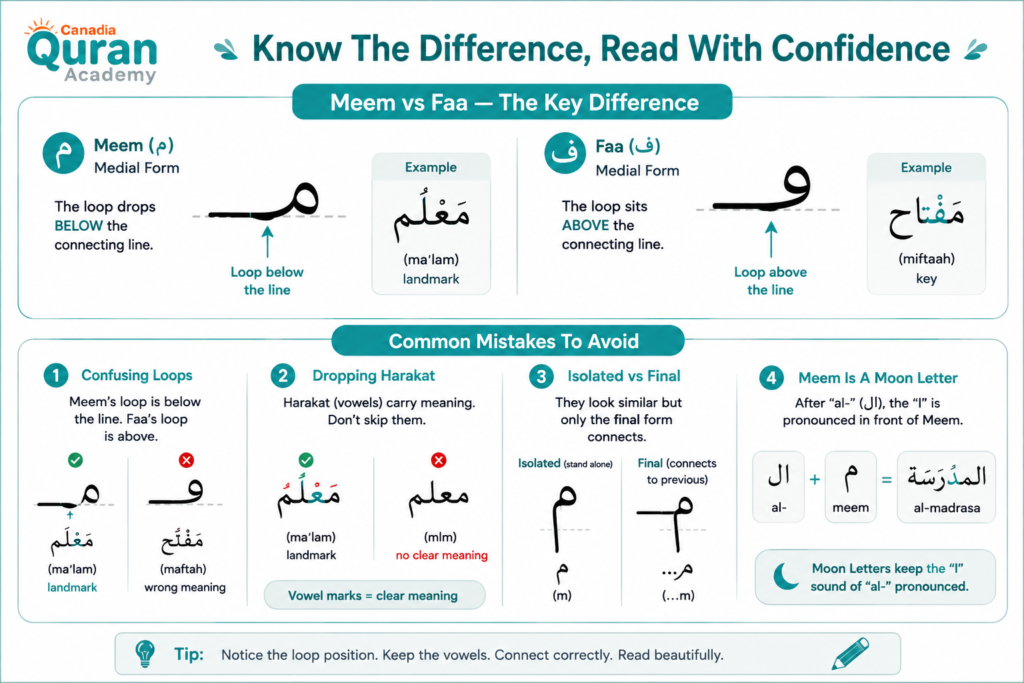
Another common slip is dropping the harakat entirely once a learner feels confident, which quietly changes مَعْلَم (ma’lam, “landmark”) into an unrecognizable string of consonants without the vowel cues that carry its meaning.
A third mistake is treating the isolated and final forms as identical — they look alike, but only the final form connects to a preceding letter.
Meem is also worth knowing as what Arabic grammar calls a “moon letter”: when it follows the definite article “al-” (ال), the “l” sound stays pronounced instead of merging into the next letter, as in “al-madrasa” rather than an assimilated sound.
This distinction matters for reading fluency later on, even though it isn’t something most beginners notice on their own.
Read Also: The Arabic Letter Ha (ح)
Experience Our Classrooms
Don’t just take our word for it—take a look inside! Watch the videos below to experience our engaging teaching methods and vibrant online classrooms firsthand.
Start Your Quranic Journey in Canada
Join our vibrant community and learn with expert tutors through our flexible online platform.
Claim Your Free TrialStart Learning Arabic With Canadian Quran Academy Today
Reading about Meem’s shapes and sounds only gets you so far — real progress comes from a tutor watching your pronunciation and correcting your handwriting in real time.
Canadian Quran Academy’s certified instructors teach the Arabic alphabet from the very first session, catching the small habits that turn into bigger obstacles later.

Our Arabic Courses:
- Online Arabic Academy
- Online Arabic Course
- Classical Arabic Course
- Arabic Course for Beginners
- Advanced Arabic Course
- Quranic Arabic Course
- Arabic Grammar Course
- Modern Standard Arabic Course
- Arabic Conversation / Speaking Course
- Intensive Arabic Course
- Online Arabic Classes for Kids
- Arabic Classes for Adults
- Arabic Classes for Ladies

Start Your Quranic Journey in Canada
Join our vibrant community and learn with expert tutors through our flexible online platform.
Claim Your Free TrialConclusion
The م – Arabic letter m is one of the easier wins in the alphabet, since its sound matches the English “m” exactly. The real work is learning its four written forms, telling its loop apart from Faa’s, and recognizing how it drives common Arabic grammar patterns like place nouns and instrument nouns.
Once Meem feels automatic, in reading, writing, and vowel marks alike, you’ll notice it everywhere, from مَدْرَسَة to مُعَلِّم to مِفْتَاح. Canadian Quran Academy’s instructors build exactly this kind of letter-by-letter foundation with new students every week.

Frequently Asked Questions About the Letter M in Arabic
Below are quick answers to the questions learners ask most often about Meem, its shapes, and its pronunciation.
1. What does the Arabic letter م sound like?
It sounds exactly like the English “m” in “mother” or “moon.” Meem is a bilabial nasal sound, produced by closing both lips and letting air pass through the nose.
2. How many written forms does the letter Meem have?
Meem has four forms: isolated (م), initial (مـ), medial (ـمـ), and final (ـم). All four keep the same small loop, but its position shifts based on where the letter connects to others.
3. How do you tell Meem apart from Faa in handwriting?
The key difference is loop placement. Meem’s loop drops below the connecting line in its medial form, while Faa’s loop sits above it.
4. Why does Meem show up in so many Arabic words?
Meem is a common prefix used to build noun patterns, including place nouns (مَـ), active participles (مُـ), and instrument nouns (مِـ). This grammatical role, on top of its everyday use in vocabulary, makes it one of the most frequent letters in the language.
5. What age should a child start learning letters like Meem?
Most academies, including Canadian Quran Academy, start structured Arabic alphabet instruction around age five or six, once a child can hold a pencil comfortably and sit through a short guided lesson. Our Classical Arabic Course adjusts pacing for younger beginners.
6. Is the letter م a sun letter or a moon letter?
Meem is a moon letter. When it follows the definite article “al-” (ال), the “l” sound stays pronounced clearly instead of merging with the next letter.







Leave a Reply