 Arabic
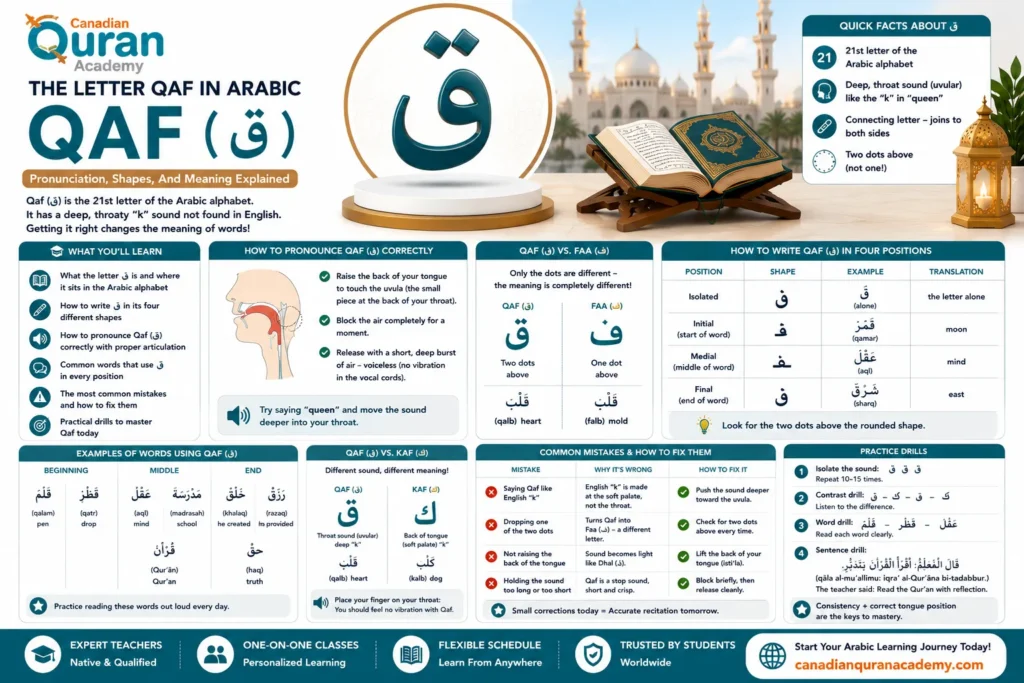
Say the English word “queen” out loud, then try to make that same “k” sound from deep in your throat instead of the roof of your mouth. That rough, throaty click is close to the letter Qaf in Arabic ق — one of the most distinctive sounds in the language, and one that trips up almost every new learner.
At Canadian Quran Academy, this is one of the first letters students ask about, because it appears in words they hear every day: قلب (heart), قلم (pen), and قرآن (Qur’an) itself. Getting it right isn’t a small detail — mispronouncing Qaf can change a word’s entire meaning.
This guide walks through what the letter Qaf in Arabic ق sounds like, how to write it in all four of its shapes, where it shows up in real vocabulary, and why Canadian Quran Academy teaches it the way we do for students learning to recite the Qur’an correctly.
What Is The Letter Qaf ق In The Arabic Alphabet?
Qaf (ق) is the twenty-first letter of the Arabic alphabet. It is a connecting letter, meaning it joins to the letters before and after it inside a word, and it belongs to a small group of Arabic sounds that don’t exist in English at all.
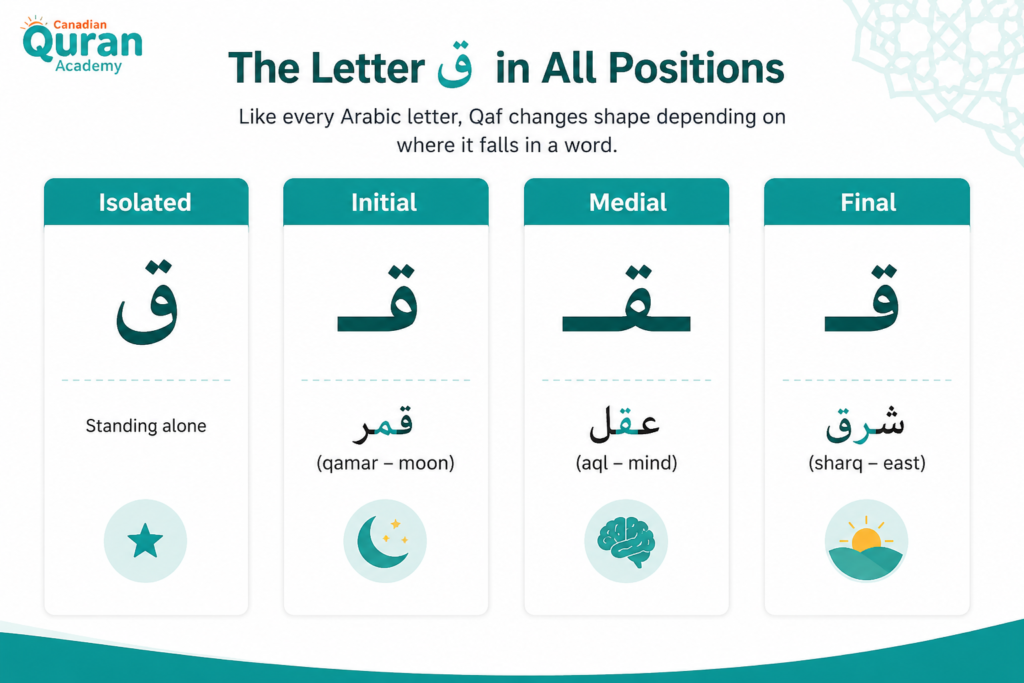
Visually, Qaf is easy to confuse with the letter Faa (ف) at first glance — both have a similar rounded body. The difference is the dots: Qaf carries two dots above it, while Faa has only one.
The Four Shapes Of Qaf ق
Like every Arabic letter, Qaf changes shape depending on where it falls in a word. Recognizing all four forms is essential for reading, not just an exercise in memorization.
| Position | Shape | Example |
| Isolated | ق | Standing alone |
| Initial | قـ | قمر (qamar – moon) |
| Medial | ـقـ | عقل (aql – mind) |
| Final | ـق | شرق (sharq – east) |
Qaf Vs. Faa ف: Spotting The Difference
Confusing Qaf ق with Faa ف is one of the most common beginner mistakes, since both letters share the same rounded base shape. The two dots above Qaf, compared to the single dot above Faa, are the only visual signal separating a word like قلب (heart) from a completely different one built on ف.
A quick habit that helps: whenever you write or read a word with this rounded shape, pause and count the dots before moving on. This single-second check prevents a mistake that’s easy to make and hard to catch later in a sentence.
Students working through the Madinah Arabic Course at Canadian Quran Academy drill this distinction early, because it resurfaces constantly once vocabulary expands.
Read Also: Letter Dha In Arabic ظ
Read Also: The Arabic Letter K (ك)
How To Pronounce The Letter Qaf ق Correctly?
The letter Qaf in Arabic ق is classified as a voiceless uvular stop. That means the sound is produced at the uvula — the small piece of soft tissue that hangs at the very back of your throat, well behind where English “k” is formed.
To find the right position, place your finger just behind your chin and swallow — the movement you feel is roughly where the back of your tongue needs to reach.
Raise the back of your tongue to meet the uvula, block the airflow completely for a fraction of a second, then release it with a short, deep burst of air.
A common practitioner trick: say the English “k” sound repeatedly, and with each repetition, deliberately push the point of contact further back in your throat.
Most learners reach an authentic Qaf within ten to fifteen repetitions of this drift-back method, though the exact number varies by learner.
Qaf ق Vs. Kaf ك: The Key Difference
Qaf ق and Kaf ك are two separate letters representing two separate sounds, and confusing them changes meaning entirely.
قلب (qalb) means “heart,” while كلب (kalb) means “dog” — not a small mix-up to make in conversation.
The mechanical difference is the point of articulation: Kaf is produced at the soft palate, in the middle of the mouth, while Qaf is produced at the uvula, further back and deeper in the throat.
Placing a hand lightly on the throat while practicing both sounds helps most students feel the difference before they can consistently hear it.
Live Class in Action
Watch how our instructors interact with students in real-time, focusing on interactive methods.
Start Your Quranic Journey in Canada
Join our vibrant community and learn with expert tutors through our flexible online platform.
Claim Your Free TrialHow To Write The Letter Qaf ق In Each Position?
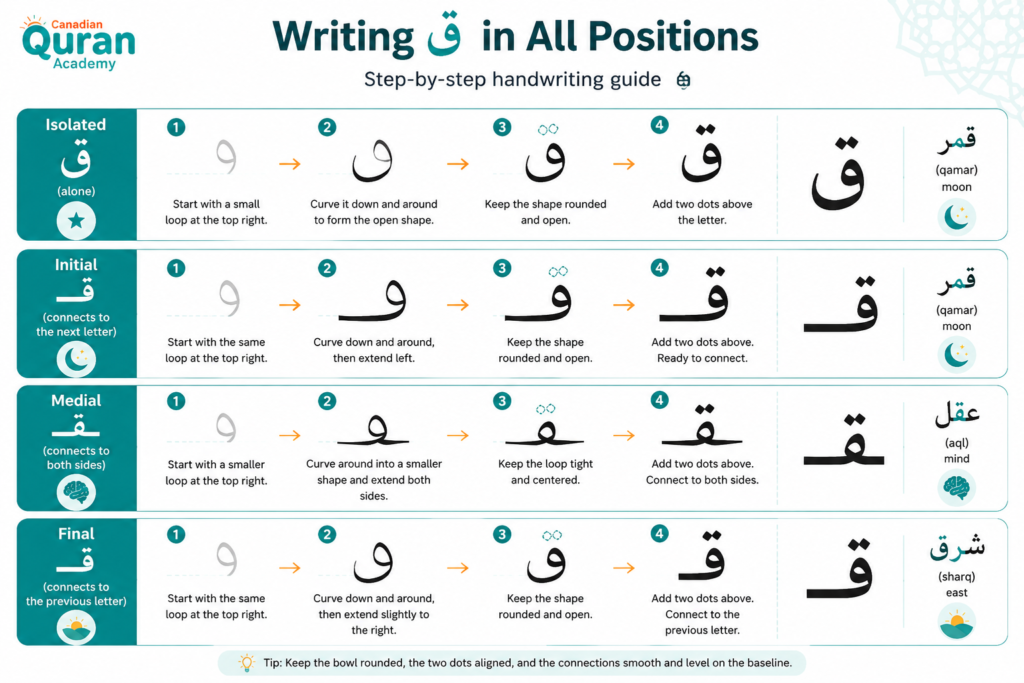
Writing Qaf accurately depends on getting its rounded bowl and two dots consistent across all four positions, since the shape shifts more than many other Arabic letters.
In its isolated form (ق), start with a small loop at the top right, curve it into a round open shape, then place two dots above it. The initial form (قـ) begins the same way but extends left to connect with the next letter.
The medial form (ـقـ) compresses into a smaller loop with connecting strokes on both sides, since it links to letters on the right and left. The final form (ـق) resembles the isolated shape, with one connecting line extending from the right side where it joins the previous letter.
Common Mistakes When Writing Qaf
The two most frequent writing errors are dropping one of the two dots — which turns the letter into Faa — and drawing the bowl too shallow, which makes it hard to distinguish from other rounded letters in handwritten or stylized text. Slowing down on the dots, even after the shape feels automatic, prevents both.
Instructors at Canadian Quran Academy see this mistake most often in students who learned to type Arabic before they learned to handwrite it, since keyboard fonts render the dots more clearly than rushed handwriting does.
Arabic Words With The Letter Qaf ق
Seeing Qaf inside real words, across all three positions it can occupy, builds recognition faster than studying the letter in isolation.
1. Qaf in Initial Position
قَلْب (qalb) means “heart,” and قَمَر (qamar) means “moon” — two of the most common words a beginner encounters.
قَهْوَة (qahwa), meaning “coffee,” is also the historical root of the English word “coffee” itself, borrowed through Turkish and European trade routes.
2. Qaf in Medial Position
وَقْت (waqt), meaning “time,” places Qaf in the middle of the word, between waw and taa.
عَقْل (aql), meaning “mind” or “intellect,” follows the same medial pattern and appears frequently in classical and modern texts alike.
3. Qaf in Final Position
شَرْق (sharq), meaning “east,” and صَدِيق (sadeeq), meaning “friend,” both end in Qaf.
طَرِيق (tareeq), meaning “road” or “path,” is worth learning early since it appears constantly in both literal directions and figurative expressions.
Students enrolled in Learning Arabic for Non-Arabic Speakers at Canadian Quran Academy typically encounter this exact word set within their first few lessons, since these terms recur across nearly every beginner text.
Read Also: The Letter Ta In Arabic (ط)
Qaf ق With The Harakat (Short Vowels)
The short vowel marks, or harakat, change how Qaf sounds without changing the letter’s core point of articulation.
With a fatha (َ), Qaf produces a deep “qa” sound, as in قَال (qaal, “he said”). With a damma (ُ), it becomes “qu,” as in قُطن (qutn, “cotton”). A kasra (ِ) produces “qi,” as in قِطار (qitar, “train”), and a sukoon (ْ) leaves the letter unvoweled and joined tightly to the sound before it, as in بَرْق (barq, “lightning”).
Because Qaf is an emphatic letter, the vowel following it tends to sound slightly deeper and rounder than the same vowel would after a lighter letter — a subtlety that becomes noticeable only after repeated listening practice.
Why Mastering Qaf ق Matters for Quran Recitation?
Correct pronunciation of the letter Qaf in Arabic ق isn’t only an academic exercise — in Tajweed, it directly affects how accurately the Qur’an is recited.
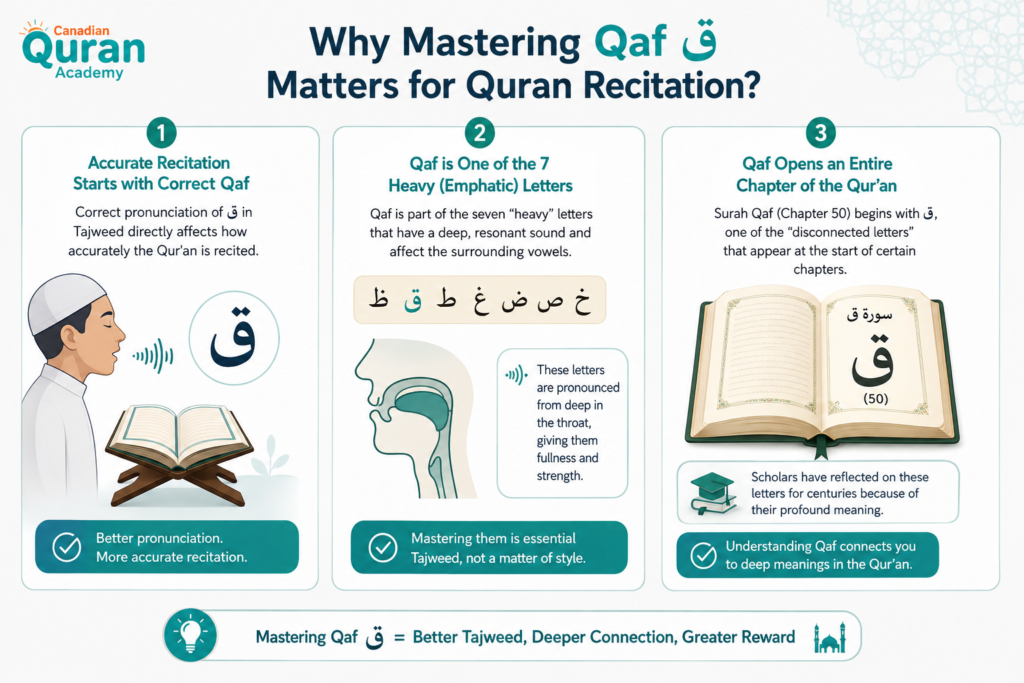
Qaf belongs to the seven “heavy” or emphatic letters in Arabic, grouped in the mnemonic خص ضغط قظ. These letters carry a fuller, more resonant quality that shapes the surrounding vowel sounds, and reciting them correctly is part of proper Tajweed technique rather than a stylistic choice.
An entire chapter of the Qur’an, Surah Qaf (Chapter 50), opens with this letter standing alone as one of the “disconnected letters,” a feature that has drawn centuries of scholarly commentary on its significance.
Practical Tips To Master The Qaf Sound
A practice sequence that works well for most learners: isolate the sound on its own first, then attach it to each short vowel (qa, qi, qu), then move into short high-frequency words like قلب and قمر before attempting full sentences.
Skipping straight to full words before the isolated sound is reliable is the most common reason progress stalls.
Recording your own voice and comparing it against a qualified reciter is one of the fastest ways to catch a Qaf that’s drifting too far forward toward a Kaf sound — a mistake that’s very hard to hear in your own head but obvious on playback.
Read Also: Arabic Letter Ra (ر)
Experience Our Classrooms
Don’t just take our word for it—take a look inside! Watch the videos below to experience our engaging teaching methods and vibrant online classrooms firsthand.
Start Your Quranic Journey in Canada
Join our vibrant community and learn with expert tutors through our flexible online platform.
Claim Your Free TrialStart Reciting The Letter Qaf ق Correctly Today
Reading about the letter Qaf in Arabic ق is a start, but this sound is learned by ear and corrected in real time — not from a page. A qualified teacher who can hear the difference between your Qaf and your Kaf, in the moment, is what turns understanding into accurate recitation.
Canadian Quran Academy pairs students with certified instructors who guide correct pronunciation from the first lesson, whether you’re a complete beginner or refining Tajweed rules you’ve already learned elsewhere.

Book a free trial class and get personalized feedback on your Qaf pronunciation within your first session.
Our Arabic Courses:
- Online Arabic Academy
- Online Arabic Course
- Classical Arabic Course
- Arabic Course for Beginners
- Advanced Arabic Course
- Quranic Arabic Course
- Arabic Grammar Course
- Modern Standard Arabic Course
- Arabic Conversation / Speaking Course
- Intensive Arabic Course
- Online Arabic Classes for Kids
- Arabic Classes for Adults
- Arabic Classes for Ladies
- Fusha Arabic Course
- Business Arabic Course
- Al-Azhar Arabic Course

Start Your Quranic Journey in Canada
Join our vibrant community and learn with expert tutors through our flexible online platform.
Claim Your Free TrialConclusion
The letter Qaf in Arabic ق is a uvular stop produced deep in the throat, written in four distinct shapes, and classified among Arabic’s seven emphatic letters — details that matter well beyond memorizing an alphabet chart.
Getting this letter right changes how clearly you’re understood, from everyday words like قلب and قمر to accurate Quran recitation.
The most reliable path is the one outlined here: isolate the sound, attach it to short vowels, then build up to full words while checking your pronunciation against a trained ear.
Canadian Quran Academy structures its Arabic and Tajweed programs around exactly this progression, so students build correct habits with the letter Qaf from day one rather than correcting mistakes later.

Frequently Asked Questions About The Letter Qaf ق
Here are direct answers to the questions students ask most often about the letter Qaf in Arabic ق, drawn from common searches and lessons taught at Canadian Quran Academy.
1. What is the difference between Qaf ق and Kaf ك?
Qaf is produced at the uvula, deep at the back of the throat, while Kaf is produced at the soft palate, further forward in the mouth. The two represent entirely different letters in Arabic, so swapping them changes a word’s meaning, as in قلب (heart) versus كلب (dog).
2. Is Qaf a sun letter or a moon letter?
Qaf is a moon letter. When the definite article “الـ” (al-) precedes a word starting with Qaf, the lam is pronounced clearly rather than assimilating into the following letter, so القمر (al-qamar) keeps its “l” sound.
3. How is the letter Qaf written in Arabizi (chat Arabic)?
In informal online typing, Qaf is most often represented by the numeral 9, since its shape loosely resembles the number, or by the Latin letter “q.” The word قلب (heart), for example, is commonly typed as “9alb” or “qalb.”
4. What are some common Arabic words that use the letter Qaf?
Frequent examples include قلب (qalb, heart), قمر (qamar, moon), قلم (qalam, pen), وقت (waqt, time), and طريق (tareeq, road). These words appear across beginner vocabulary lists precisely because Qaf is such a high-frequency letter.
5. Is Qaf one of the heavy letters in Arabic Tajweed?
Yes. Qaf is one of the seven emphatic letters in Arabic, grouped together in the mnemonic خص ضغط قظ, and its heavier articulation affects the surrounding vowel sounds during recitation.
6. Why is Qaf pronounced differently in Egyptian Arabic?
Spoken dialects evolved independently from formal written Arabic, and Egyptian Arabic developed a glottal stop in place of the classical uvular Qaf over generations of everyday use. The formal pronunciation remains standard for Modern Standard Arabic, media, and Quran recitation.






Leave a Reply