 Arabic

Have you ever read an Arabic storybook to your child and watched them lose interest by the second page? You’re not alone. Many Arab and Muslim parents in Canada see this, and the reason is usually the words, not the story.
If you want your child to learn Egyptian Arabic in kid-friendly ways, start with the language they hear at home. Egyptian Arabic is warm and widely understood across the Arab world, and it’s an easy way in for young learners.
This guide explains why the spoken dialect matters. It lists trusted Egyptian Arabic songs, books, shows, and podcasts, and it shows how to move your child from everyday speech toward Fusha, the Arabic of the Quran.
1. Create Arabic Moments in Your Daily Routine
Pick one routine, like breakfast or bedtime, as an “Arabic-only” time. Use simple phrases such as sabah el-kheir (good morning) and tesbah ala kheir (good night) until they become automatic.
Routines work because children link words to actions they repeat every day. Start with five to ten phrases, such as yalla nakol (let’s eat), ghassel senanak (brush your teeth), and fein el-gazma? (Where’s the shoe?). Add new ones only when the old ones feel natural.
This method suits children aged 3 to 8 best, since they pick up phrases just by hearing them over and over. Older kids aged 9 to 12 can become the family’s “Arabic helper” and lead the routine, which builds both responsibility and confidence.
For resources, put Arabic labels on everyday items like the fridge, door, and table. The book 20 Egyptian Songs to Learn and Sing adds simple songs to daily moments. The Tuta Tuta website offers Egyptian Aamiya translations of popular children’s books for bedtime reading.
2. Use Cartoons, Songs and Stories
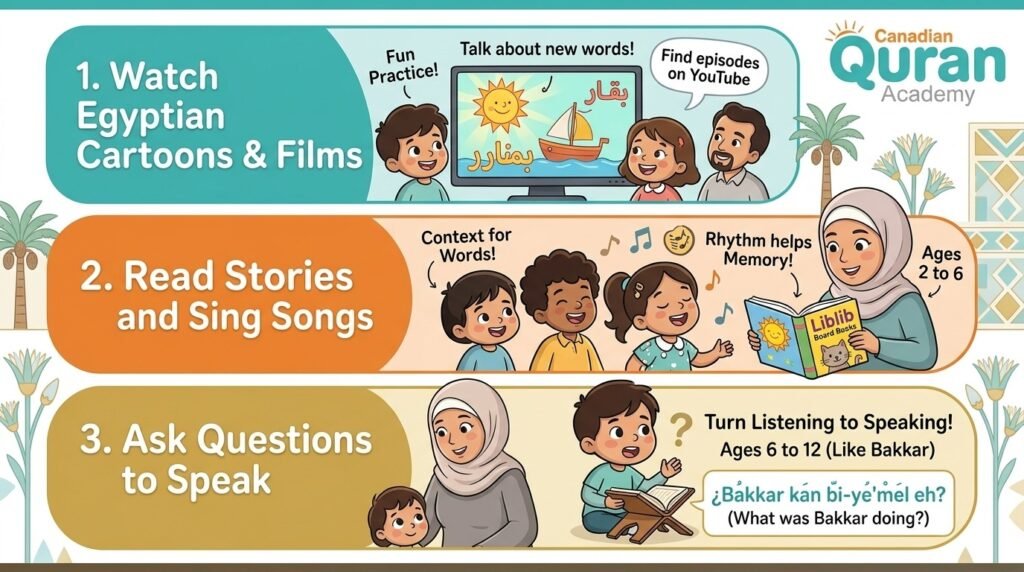
Egyptian children’s shows, such as the classic cartoon Bakkar, and dubbed animated films make practice feel like fun. Watch with your child and talk about new words afterwards.
Stories give words context, and songs give them rhythm, so both help children remember new vocabulary. After an episode or a story, ask simple questions in Egyptian Arabic, like Bakkar kan bi-ye’mel eh? (What was Bakkar doing?) to turn listening into speaking.
Songs and picture books work best for ages 2 to 6, when short, repeated language holds attention. Bakkar, which follows a young Nubian boy from southern Egypt, suits ages 6 to 12 because its storylines and values give older kids more to talk about.
For books, Liblib publishes board books in Egyptian Arabic for the youngest readers. Kan Yama Kan by Riham Shendy retells well-known folktales in Egyptian colloquial Arabic. Bakkar episodes are also easy to find on YouTube for home viewing.
3. Watch Videos and TV Shows in Egyptian Arabic
Alam Simsim, the Egyptian version of Sesame Street, is a strong choice for preschoolers. When producers switched to Modern Standard Arabic only, viewership dropped sharply, so they brought back Egyptian Arabic episodes.
Disney went through something similar. After large social media campaigns, it returned to Egyptian Arabic dubbing for its films. For stop-motion fans, Omar’s Family (made with Playmobil figures) and the clay-animated Farah series are well made.
Screen time works best when you watch together. Pause every few minutes, repeat a fun phrase, and ask your child to copy it. Keep sessions to 20–30 minutes so viewing stays an active learning moment instead of background noise.
Alam Simsim fits ages 3 to 6, with its puppets, songs, and simple dialogue. Dubbed Disney films suit ages 5 and up, and stop-motion series like Farah work well for early elementary kids who enjoy gentle, story-driven episodes.
Many Alam Simsim clips are available on YouTube and Vimeo. Classic Disney films with older Egyptian Arabic dubs are loved across the Arab world. On streaming services in Canada, check the audio settings for an Arabic track, since availability varies by title.
4. Connect Arabic With Family and Faith
Video calls with relatives in Egypt or elsewhere give kids a real reason to speak. Pairing everyday Arabic with short Quran recitation classes also helps children see Arabic as part of who they are.
Children learn a language faster when they need it to connect with people they love. Give each weekly call a small “mission,” like telling teta (grandma) or geddo (grandpa) about school, so your child prepares a few sentences before the call.
This approach works for every age. Children aged 3 to 6 can start with greetings and short duas like bismillah and alhamdulillah. Kids aged 7 to 12 can retell their week and learn the meanings of the short surahs they memorise.
Good starting points include the short surahs of Juz Amma and the Noorani Qaida for learning letter sounds correctly. Everyday Islamic phrases used in Egyptian speech, such as inshallah and mashallah, also link home Arabic with the language of worship.
5. Praise Effort, Not Perfection
Kids stop speaking when every mistake gets corrected. Celebrate their attempts, repeat the correct form gently, and keep the mood positive. Confidence comes first, and accuracy follows.
Carol Dweck’s research at Stanford found that praising effort, not ability, helps children keep going when things get hard. In practice, if your son says ana ayza mayya (the feminine form), just answer, Ah, enta ayez mayya? Etfaddal (“Oh, you want water? Here you go”).
This matters at every age, but especially for children aged 8 to 12. Preteens often feel shy about their accent next to fluent cousins, so a relaxed, encouraging tone at home keeps them speaking instead of going quiet.
Try a simple sticker chart or a weekly “Arabic Star” award for effort, such as using a new word or finishing a whole call in Arabic. Dweck’s book Mindset is a helpful read for parents, and regular progress notes from your child’s teacher help you celebrate real milestones.
Live Class in Action
Watch how our instructors interact with students in real time, focusing on interactive methods.
Start Your Quranic Journey in Canada
Join our vibrant community and learn with expert tutors through our flexible online platform.
Claim Your Free TrialLearn Egyptian Arabic for Kids: Why It’s a Smart Choice
Egyptian Arabic (called Masri) is the spoken dialect of Egypt. It’s also the dialect people across the Arab world understand best. That makes it a very practical choice for a child’s first spoken Arabic.
About 84 million people speak it as a native language, and around 35 million more speak it as a second language. For your child, that means real conversations with a very large community.
Why Arabs Everywhere Understand Egyptian Arabic
Egyptian films, TV series, and songs have been popular across the region since the early 20th century. Because of this, people from Morocco to the Gulf usually understand Egyptian Arabic even if they don’t speak it.
Egyptian teachers also helped build school systems in several Arab countries, which spread the dialect even further. A child who learns Masri can usually be understood by relatives from many different countries.
Why It’s Easier for Children to Pick Up
Egyptian Arabic has simpler sentence structures than formal Arabic, and it’s full of short, playful expressions. Words like yalla (let’s go), mashi (okay), and ezzayak? (how are you?) are easy for kids to remember and use.
It also has lots of children’s content, including cartoons, songs, and dubbed animated films. Kids can hear the dialect outside lessons, which helps new words stick.
Egyptian Arabic vs. Modern Standard Arabic vs. Quranic Arabic
Many parents worry that a dialect will confuse their child’s Quran learning. It won’t, as long as each form of Arabic is taught with a clear purpose. Here’s how the three fit together.
Egyptian Arabic: The Language of Conversation
This is what your child will use to talk with grandparents, cousins, and friends. It builds everyday speaking and listening skills, plus the confidence that comes from being understood.
In lessons, teachers use role-play, games, and real-life situations like ordering food or greeting guests. Because the dialect sounds like the Arabic spoken at home, children see progress quickly, and that keeps them motivated to learn more.
Modern Standard Arabic: The Language of Reading and Writing
Modern Standard Arabic (MSA, or Fusha) is used in books, news, and formal writing. Children usually learn it along with the Arabic alphabet so they can read and write properly.
MSA is also the bridge to Quran reading. It uses the same script and the same short vowel marks (harakat), so once children read Fusha fluently, reading the Mushaf feels much easier. Many kids begin reading and writing around ages 5 to 6.
Quranic Arabic: The Language of Worship
Classical Quranic Arabic has exact pronunciation rules. For example, Cairene Egyptian often turns the letter qaf (ق) into a glottal stop, but in Quran recitation it must be pronounced fully. A good tutor points out these differences early.
In practice, the dialect gives children a much bigger Arabic vocabulary, and many words share roots with the Quran. Combined with structured Tajweed lessons for kids, it strengthens both speaking and recitation.
What Is the Best Age for Kids to Learn Egyptian Arabic?
The best time to start is between ages 4 and 10. Children this age copy sounds naturally, including Arabic letters like ع (ain) and ح (haa) that adults often struggle with.
Still, it’s never too late. Teens and adults can learn the dialect quickly too, often with better structure and focus. Lessons just need to match the learner’s age, attention span, and goals.
Ages 4–6: Learning Through Play
Young children do best with songs, flashcards, puppets, and short sessions of 20–30 minutes. At this stage, the goal is to recognise words and feel comfortable with Arabic sounds, not to learn grammar.
Simple games work well here. Count toys with wahed, etnein, talata (one, two, three), name colours while drawing, or play an Arabic version of “Simon Says.” Movement and play help young children link each new word to something they can see and touch.
Parents play a big role at this age. Ten minutes of daily repetition at home counts for more than one long weekly session. Live one-on-one lessons with a patient teacher can also introduce letter sounds gently while keeping everything playful.
Ages 7–12: Building Real Conversations
Older children can handle short dialogues, role-play, and simple storytelling. They start forming their own sentences, asking questions, and describing their day in Arabic.
Try tasks with a real purpose. Your child can interview a relative, describe a family photo, retell a Bakkar episode, or role-play shopping with phrases like bikam da? (How much is this?) Tasks like these turn vocabulary into real communication.
This is also a good age to build Fusha reading and writing alongside the dialect, plus Quran recitation with Tajweed. Children learn to use Egyptian Arabic for conversation and Classical Arabic for reading and worship, keeping each in its place.
Experience Our Classrooms
Don’t just take our word for it—take a look inside! Watch the videos below to experience our engaging teaching methods and vibrant online classrooms firsthand.
Start Your Quranic Journey in Canada
Join our vibrant community and learn with expert tutors through our flexible online platform.
Claim Your Free TrialA Simple Weekly Routine for Canadian Families
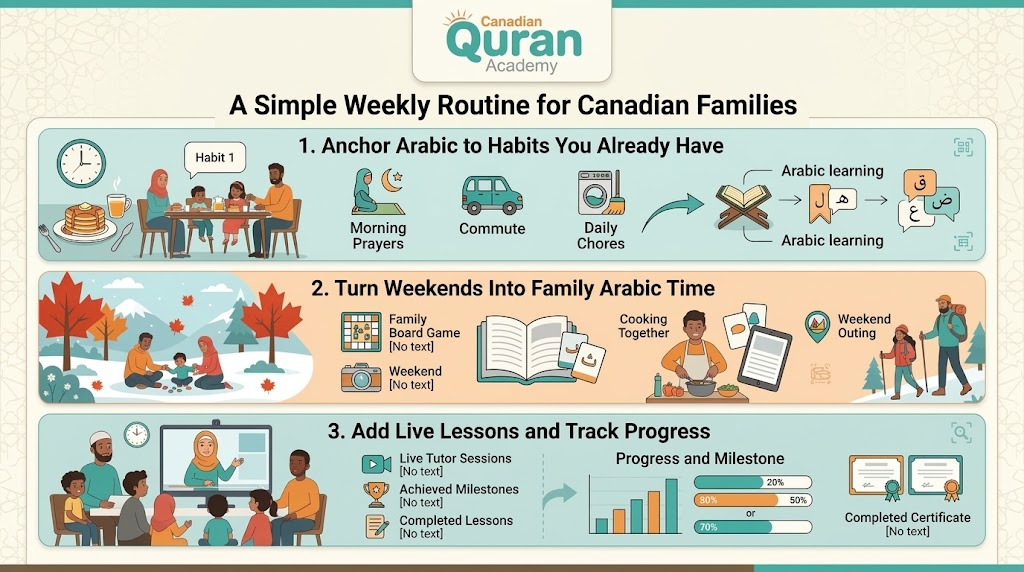
You don’t need hours every day. Consistency matters more than time spent. Here are three simple ways to build a weekly Arabic routine that fits busy family life in Canada.
1. Anchor Arabic to Habits You Already Have
Link Arabic to moments that already happen every day, so it never feels like an extra chore. Play one Egyptian Arabic song at breakfast, and swap the car radio for an audio story, such as the Egyptian podcast Kesas Le Atfal Elnaharda.
At bedtime, read one short book in dialect, then say a short surah together. These small moments add up to hours of listening every week, and they tie Arabic to warm, familiar parts of your child’s day.
2. Turn Weekends Into Family Arabic Time
Weekends give you more time to make Arabic fun and social. Watch one episode of Alam Simsim as a family and talk about it in Arabic afterwards, or cook an Egyptian dish together while naming each ingredient.
Plan a longer video call with relatives, or visit Arabic-speaking friends so your child hears the language outside the house. When the whole family takes part, children see Arabic as a shared family activity, not homework.
3. Add Live Lessons and Track Progress
Home habits build exposure, but a qualified teacher adds structure, correction, and steady progress. One or two live lessons a week are enough to move your child from single words to full sentences, and later to reading and recitation.
Keep a simple notebook of new words, surahs memorised, and small wins each week. Reviewing it together once a month shows your child how far they’ve come, and you’ll see steady progress within months.
Give Your Child a Confident Start in Arabic and Quran Today
At Canadian Quran Academy, children learn Arabic and the Quran in live, one-on-one online classes. They’re taught by qualified teachers who understand heritage learners growing up in Canada.
Our programs include Arabic language lessons, Quran recitation (Tilawah), and Tajweed circles for kids and adults. Class times fit Canadian time zones, from Toronto to Vancouver.
Our Arabic Courses
- Online Arabic Academy
- Online Arabic Course
- Classical Arabic Course
- Arabic Course for Beginners
- Advanced Arabic Course
- Quranic Arabic Course
- Arabic Grammar Course
- Online Arabic Classes for Kids
- Arabic Classes for Adults
- Arabic Classes for Ladies
Book a free trial class today and see how quickly your child’s confidence grows. The right teacher can turn Arabic from a struggle into something they love.
Start Your Quranic Journey in Canada
Join our vibrant community and learn with expert tutors through our flexible online platform.
Claim Your Free TrialConclusion
Helping your child learn Egyptian Arabic isn’t a detour from Fusha or the Quran. It meets children where they already are. Research shows they understand more and remember longer when learning starts in their mother tongue.
From Shamsena’s songs and Tuta-Tuta’s books to Alam Simsim and Egyptian Arabic podcasts, families have a lot of good material to choose from. Mix formats, match content to your child’s age, and keep sessions short and regular.
You don’t have to do everything at once. Choose one daily routine, one favourite resource, and one weekly live lesson, and start this week. Small, steady steps build lasting skills, and your child’s excitement about Arabic will grow with every conversation.
The key takeaway: start with the language your child hears at home, bridge it with shared vocabulary and phonics, then build toward Fusha and Quran recitation with a qualified teacher. With that plan, anyone who wants to learn Egyptian Arabic for kids-level fluency and Quran reading can get there.
FAQs
Is Egyptian Arabic good for kids to learn first?
Yes. Egyptian Arabic is one of the most widely understood dialects thanks to Egyptian film, music, and TV. Its everyday vocabulary gives children a friendly starting point before formal Arabic.
What age should kids start learning Arabic?
Children can start listening to Arabic songs and stories from infancy. Structured reading lessons usually work best from ages 4 to 6, once children can focus for short sessions.
Will learning a dialect confuse my child when reading the Quran?
No. Most children learn to switch between spoken and formal Arabic naturally, just as many kids switch between English and French in Canada. Shared words between the two actually help.
How can I teach my child Arabic if I don’t speak it well?
Use audio stories, songs, and shows so your child hears native speakers. Then add live lessons with a qualified teacher who can guide pronunciation and reading.
What’s the difference between Egyptian Arabic and Modern Standard Arabic?
Egyptian Arabic is the everyday spoken language of Egypt. Modern Standard Arabic (Fusha) is the formal written form used in books, news, and education, and it’s close to the classical Arabic of the Quran.
Can kids learn Arabic and Quran online in Canada?
Yes. Live online classes let children across Canada study Arabic, Quran recitation, and Tajweed with qualified teachers at times that fit school and family schedules.





Leave a Reply