 Arabic
Have you ever opened the Mushaf, looked at the beautiful Arabic script, and wished you could read even one line on your own? You’re not alone. Many Muslim families across Canada share that feeling, whether they’re a parent in Toronto or a new revert in Calgary.
The good news is that when you learn the Quran alphabet in Canada today, you don’t need a local Arabic school next door. With the right method and a patient teacher, children and adults can move from knowing no letters to reading real Quranic words within a few months.
Every rule of Tajweed depends on pronouncing each letter correctly. If a learner confuses ح (Haa) with ه (Ha), the meaning of a word can change completely.
A strong alphabet foundation prevents bad habits that are hard to undo later. It also builds confidence, because the learner reads the actual text of the Quran instead of relying on transliteration.
Effective Quran alphabet learning follows a fixed order. Each skill builds on the one before it, which is why traditional primers like the Noorani Qaida are organized in stages. Here is the six-step path most qualified teachers use with beginners.
1. Recognize the 28 Letters and Their Shapes
Arabic is written and read from right to left, which is often the first surprise for Canadian learners. Tracing each letter with a finger or pencil in the correct stroke direction helps the hand and eye remember shapes faster than looking alone.
The learner first memorizes the names and isolated shapes of all 28 letters, from Alif (ا) to Yaa (ي). Grouping similar letters speeds this up, such as ب ت ث, which share one body and differ only in the number and position of their dots.
Most letters change shape depending on whether they come at the start, middle, or end of a word. Six letters, ا د ذ ر ز و, never connect to the letter after them, so spotting them early helps learners read joined words without confusion later.
For kids, colourful letter charts, simple songs, and matching games make this stage fun and memorable. Adults usually prefer learning by shape families with short daily self-quizzes, and many can recognize all 28 letters within the first few weeks.
2. Master Correct Pronunciation (Makharij)
Makharij are the points of articulation where each sound is produced. Scholars of Tajweed describe 17 points within five main areas: the mouth cavity, throat, tongue, lips, and nasal passage. Canadian English and French speakers often find throat letters like ع, ح, خ, غ the hardest.
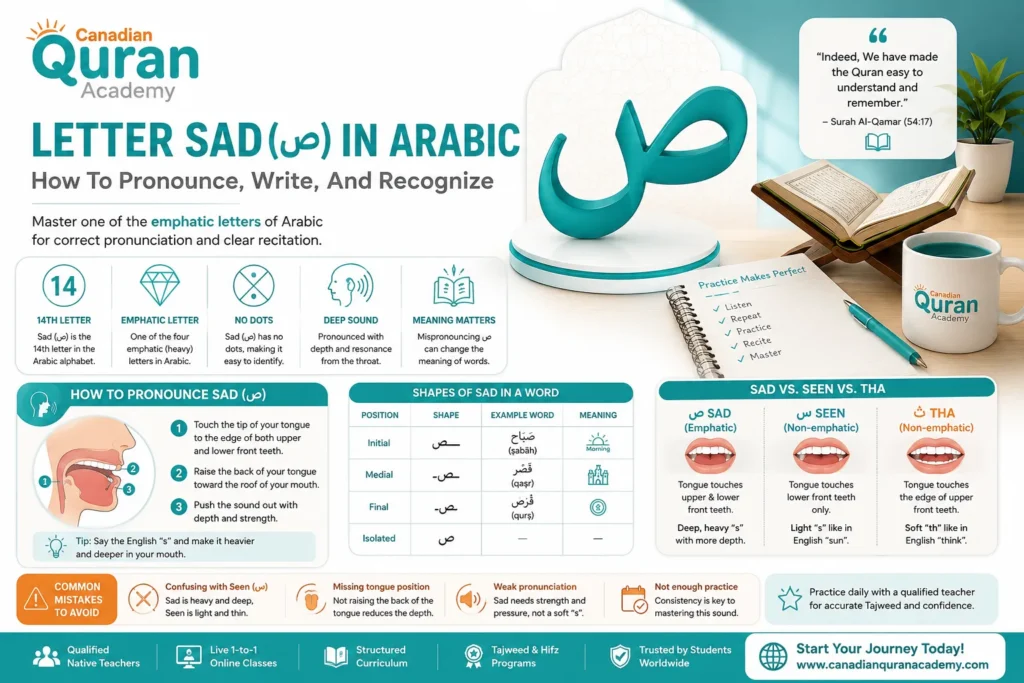
Heavy letters such as ص, ض, ط, ظ, ق also need extra practice, because English has no direct equivalent. This is where a live teacher makes the biggest difference: a recording can’t hear your mistakes, but an instructor can correct your tongue position in seconds.
Beyond where a sound comes from, each letter also has its own characteristics, called Sifat, such as heaviness, lightness, or a slight echo. The five Qalqalah letters, ق ط ب ج د, for example, bounce slightly when they carry a Sukoon or when you stop on them, as in أَحَدْ.
A simple mirror at home helps learners check their lip and tongue position while they practise. In live online classes, teachers can bring the camera closer to their mouth, so students see exactly how each letter is formed before they try it themselves.

3. Add Short Vowels (Harakat)
Next come the three short vowels: Fatha (a), written above the letter; Kasra (i), written below it; and Damma (u), a small waw-shaped sign above it. The learner reads each letter with every vowel, for example بَ بِ بُ (ba, bi, bu), until the sounds become automatic.
This stage turns silent shapes into real sounds, and it’s often when kids start to feel excited about reading. Teachers keep each vowel short and crisp, because stretching a Fatha into a long “aa” is a common error that can change a word’s meaning.
Teachers often use drills that mix vowels across different letters, such as دَ رِ سُ, so learners read each sign instead of guessing from memory. This builds real decoding skill, the same ability students will need later to read unfamiliar words in the Mushaf.
Short vowels are also where the Quran differs from most modern Arabic writing, which usually leaves them out. Because the Mushaf is fully vowelized, mastering Harakat lets beginners read every word correctly, even before they understand its meaning.
4. Learn Sukoon, Shaddah and Tanween
Sukoon marks a letter with no vowel, like the ل and م in الْحَمْدُ. Shaddah doubles a letter’s sound, so رَبِّ is read “rab-bi.” Tanween adds an “n” sound at the end of a word, as in كِتَابٌ (kitaabun), and it comes in three forms that match the three vowels.
The learner also practises the long-vowel letters of Madd, ا و ي, which hold a sound for two counts, as in قَالَ, يَقُولُ and قِيلَ. Getting these signs right is the first real step into Tajweed, because they control the rhythm and length of recitation across the Quran.
A Shaddah always comes with a short vowel or Tanween, so learners get used to reading two signs on a single letter at once. Practising common Quranic words like إِنَّ, ثُمَّ and رَبُّكَ trains the eye to notice these combined marks quickly and read them without hesitation.
This stage also introduces Hamza (ء) and letters that are written but not pronounced, such as the Alif at the end of قَالُوا. Knowing which letters are read and which are silent prevents many errors once students move on to longer Quranic verses.
5. Join Letters and Read Words
Now the learner combines letters, vowels, and signs to read connected words and short phrases. Teachers usually choose words straight from the Quran, such as رَبِّ, الْحَمْدُ and الرَّحِيمِ, so every practice session feels meaningful and familiar to the student.
Reading may be slow at first, and that’s completely normal. Reading slowly and accurately always beats reading fast with mistakes, and fluency builds naturally once the eye learns to recognize common letter combinations at a glance.
Learners also meet the definite article ال and learn the difference between Sun letters and Moon letters. In الْقَمَرِ the Laam is pronounced, while in الشَّمْسِ it merges into the next letter, a pattern that appears on almost every page of the Quran.
Breaking long words into small syllables makes this step much easier. A word like الْمُسْتَقِيمَ becomes manageable when read piece by piece, الْ / مُسْ / تَ / قِيمَ, and teachers use this method to help students tackle longer words with confidence.
6. Move from the Qaida to the Mushaf
Once the Qaida is complete, the learner begins reading Surah Al-Fatiha and short surahs from Juz’ Amma, such as Al-Ikhlas and An-Nas, with a teacher listening closely. The teacher corrects small slips in real time, before they turn into lasting habits.
Many learners notice that the Mushaf looks slightly different from the Qaida, especially because of the small stopping signs (Waqf marks) and extra symbols. A teacher explains these marks gradually, so students know where to pause and how to continue without breaking the meaning.
This is also a great moment to set a small, motivating goal, such as reciting Al-Fatiha correctly in Salah or memorizing the last three surahs. Reaching these milestones gives kids and adults a real sense of achievement and keeps them committed to learning.
From there, it’s a natural step into full Tajweed and regular recitation classes. If you or your child is ready for this stage, our Tajweed circles pick up exactly where alphabet lessons end, so progress continues without a gap.
Experience Our Classrooms
Don’t just take our word for it—take a look inside! Watch the videos below to experience our engaging teaching methods and vibrant online classrooms firsthand.
Start Your Quranic Journey in Canada
Join our vibrant community and learn with expert tutors through our flexible online platform.
Claim Your Free TrialIs It Better to Learn Quran Alphabet Online or at a Local Masjid?
Both work, but online classes usually offer more flexibility for Canadian families. Masjid weekend programs are valuable for community, yet they often have large groups and fixed schedules.
Canada spans six time zones, and winter commutes can be difficult. Live online lessons let a child in Vancouver or a working parent in Halifax learn from home at a time that fits.
For many families, a mix works best: online lessons for focused, personal correction, and the masjid for community and practice.
What Do Kids and Adults Need Differently?
Kids need short, playful lessons with repetition, visuals, and lots of encouragement. Sessions of 30 minutes usually hold a young learner’s attention best.
Adults need clear explanations of the rules and a judgment-free space to make mistakes. Many adults also appreciate knowing the reward for effort. The Prophet ﷺ said that :
وَالَّذِي يَقْرَأُ الْقُرْآنَ وَيَتَتَعْتَعُ فِيهِ وَهُوَ عَلَيْهِ شَاقٌّ لَهُ أَجْرَانِ ”
“ and he who falters in it, and finds it difficult for him, will have two rewards. “ (Sahih Muslim 798).
At Canadian Quran Academy, Arabic beginner lessons are matched to the learner’s age and pace, so a six-year-old and a forty-year-old each get the approach that fits them.
Live Class in Action
Watch how our instructors interact with students in real time, focusing on interactive methods.
Start Your Quranic Journey in Canada
Join our vibrant community and learn with expert tutors through our flexible online platform.
Claim Your Free TrialWhat Are the Most Common Beginner Mistakes?
The three most common mistakes are relying on transliteration, mixing up similar letters, and rushing through the Qaida. Here’s why each one matters and how to avoid it.
1. Relying on Transliteration
Transliteration spells Arabic sounds with English letters, like “Bismillah” or “Alhamdulillah.” It feels helpful at first, but it hides the real sounds, since English has no letters for ع, ح, or ق.
Learners who depend on it often hit a plateau and struggle to read the Mushaf on their own. It’s better to read directly from Arabic script from the very first lesson, even if progress feels slower at the beginning.
2. Mixing Up Similar Letters
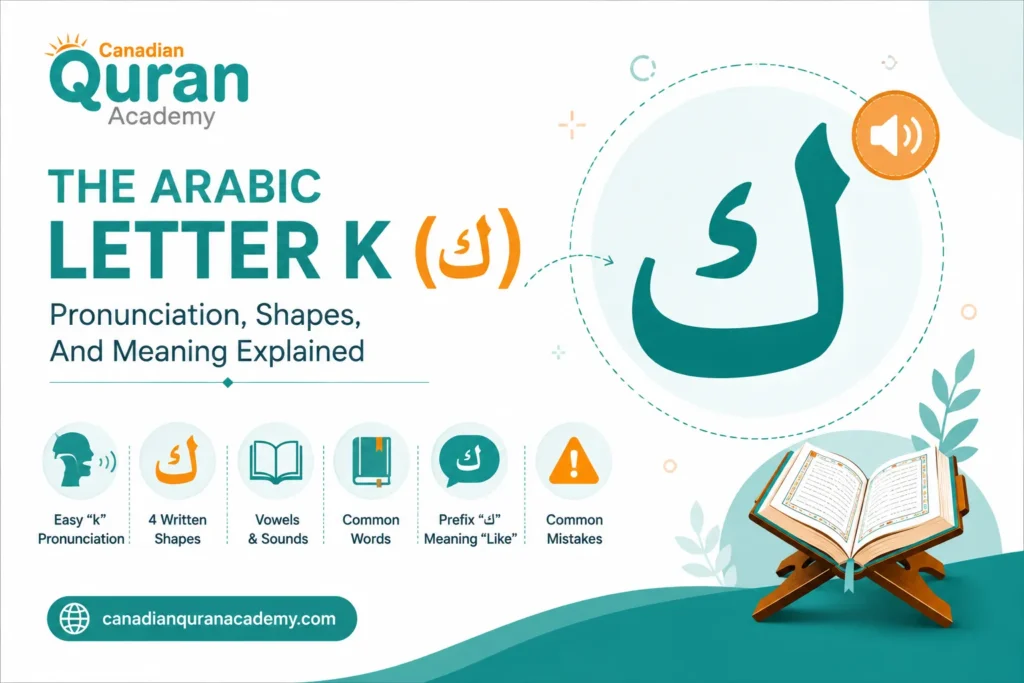
Letters such as س / ص, ت / ط, ك / ق, and ذ / ز / ظ sound close to English ears but are completely different in Arabic. Confusing ق with ك, for example, turns قَلْب (heart) into كَلْب (dog).
The fix is focused pair practice: the teacher reads two similar letters side by side, and the learner repeats them. Recording yourself and comparing it with your teacher’s pronunciation also helps you hear the difference clearly.
3. Rushing Through the Qaida
Many families are eager to reach the Mushaf quickly, so they skip lessons or ignore vowel marks and signs. This leaves gaps that show up later as unclear, broken recitation that takes months to correct.
Every page of the Qaida builds a skill needed for the next one. Moving on only after each lesson reads smoothly saves time in the long run and makes learning Tajweed much easier.

Book Your Child’s First Free Quran Alphabet Class Today
Your family’s journey with the Quran can start this week. At Canadian Quran Academy, qualified teachers guide kids and adults across Canada from their first letter to confident, correct recitation.
Classes are live and interactive, and they’re scheduled around Canadian school, work, and time zones. Every learner gets patient correction of their pronunciation, so good habits form from the very first lesson.
Our Arabic Courses
- Online Arabic Academy
- Online Arabic Course
- Classical Arabic Course
- Arabic Course for Beginners
- Advanced Arabic Course
- Quranic Arabic Course
- Arabic Grammar Course
- Modern Standard Arabic Course
- Arabic Conversation / Speaking Course
- Online Arabic Classes for Kids
- Arabic Classes for Adults
- Arabic Classes for Ladies
After the alphabet, students can continue into our Tajweed circles, Quran recitation classes, and Arabic language courses, all at the same academy. Reserve your seat now and hear your child read their first Quranic word.
Start Your Quranic Journey in Canada
Join our vibrant community and learn with expert tutors through our flexible online platform.
Claim Your Free TrialConclusion
Learning the Quran alphabet in Canada is easier and more flexible than ever. Children and adults alike can move from recognizing 28 letters to reading real Quranic words, as long as they follow a clear, step-by-step method.
The path is always the same. Learn the letter shapes, master correct pronunciation, add vowels and signs, join letters into words, and then move to the Mushaf. Qualified, live correction at every stage is what keeps mistakes from becoming habits.
Avoiding the three classic beginner mistakes (relying on transliteration, mixing up similar letters, and rushing through the Qaida) protects your recitation from errors that are hard to fix later.
At home, short daily practice turns every live class into steady progress. That can mean a fixed review time, listening to a trusted reciter, or using flashcards and teach-back games.
The takeaway: consistency and correct pronunciation matter more than speed. Start with the alphabet, practise a little every day, and learn with a teacher who can hear you, because that foundation shapes every recitation that follows.
FAQs
What is the best age to start learning the Quran alphabet?
Most children can start between ages 4 and 6, once they can focus for 20 to 30 minutes. There’s no upper age limit. Many adults and reverts in Canada begin in their 30s, 50s, or later and succeed with the right support.
Can adults learn the Quran alphabet quickly?
Yes. Adults often finish the basics in 1 to 3 months with regular classes, because they understand rules and patterns faster. The key is steady weekly lessons and short daily review.
Is Noorani Qaida necessary before reading the Quran?
No. It isn’t mandatory, but a structured primer like the Noorani Qaida is highly recommended. It teaches letters, vowels, and joining in a logical order, which prevents gaps and pronunciation errors later.
Do I need to know Arabic to learn the Quran alphabet?
No. Quran alphabet learning starts from zero and is taught in English, so no prior Arabic knowledge is needed. Many students later add Arabic language classes to understand what they recite.
How many classes per week are ideal for beginners?
Two to three classes per week of 30 to 45 minutes each works well for most learners. Kids benefit from shorter, more frequent sessions, while adults can manage slightly longer ones.
Can I learn the Quran alphabet online in Canada?
Yes. Live online classes let students anywhere in Canada learn with qualified teachers, get real-time pronunciation correction, and choose times that fit their province’s time zone.





Leave a Reply