 Quran
Quran
Marriage in the Quran is described as a mithaqan ghalizan — a solemn, weighty covenant — not a casual arrangement between two people. If you are searching for Quran verses about marriage in Arabic, you are likely looking for the exact wording to recite at a nikah, write on an invitation, or simply understand what the Quran actually says about this bond.
This guide brings together the most cited ayahs on marriage in their original Arabic, with full tashkeel, alongside their English translation, surah name, and ayah number for accurate citation. Each verse links directly to its page on Quran.com so you can read it in full context.
We are covering Quran verses only in this guide — no hadith — so every reference below comes straight from the Quran itself.
What You’ll Learn in This Article
- The single most-quoted Quran verse about marriage, in Arabic with full context
- Short verses suitable for wedding invitations or quick recitation
- How the Quran describes marriage as protection, provision, and partnership
- The exact surah and ayah number for every verse, formatted for citation
- Where to go next if you want to understand these verses in their original Arabic rather than through translation alone
The Foundational Verse: Tranquility, Affection, and Mercy
Among every ayah on this topic, one is quoted more than all the others combined. It sets the emotional tone for nearly everything else the Quran says about marriage.
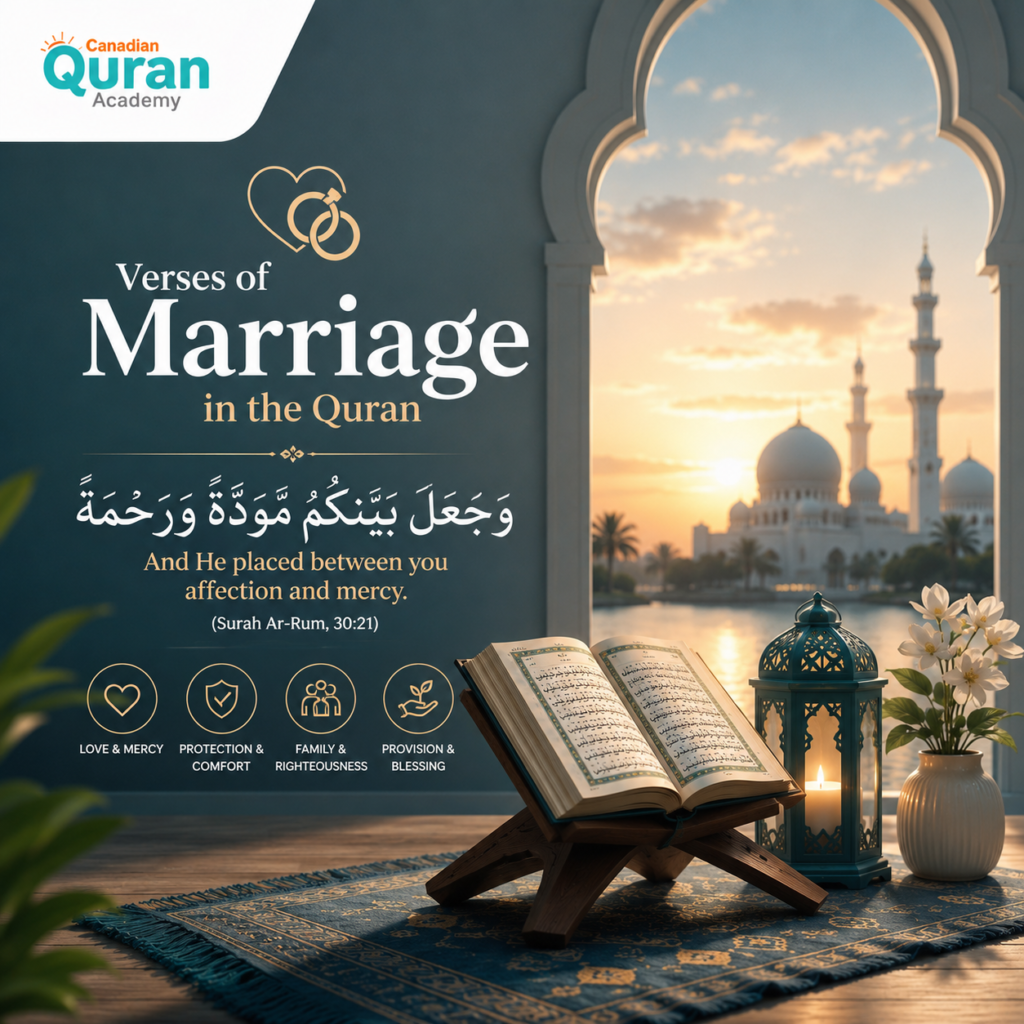
وَمِنْ آيَاتِهِ أَنْ خَلَقَ لَكُم مِّنْ أَنفُسِكُمْ أَزْوَاجًا لِّتَسْكُنُوا إِلَيْهَا وَجَعَلَ بَيْنَكُم مَّوَدَّةً وَرَحْمَةً ۚ إِنَّ فِي ذَٰلِكَ لَآيَاتٍ لِّقَوْمٍ يَتَفَكَّرُونَ
“And of His signs is that He created for you from yourselves mates that you may find tranquility in them, and He placed between you affection and mercy. Indeed in that are signs for a people who give thought.” (Surah Ar-Rum, 30:21)
Three Arabic words carry the weight of this verse, and they are not synonyms for one another. Sakan is the calm a person feels simply being near their spouse. Mawaddah is the active, expressed love that grows through shared life. Rahmah is the mercy and patience that sustains a marriage once the intensity of early years settles into something steadier. Classical commentary treats these as three separate stages of the same relationship, which is one reason this ayah is recited at Muslim weddings around the world — it names the emotional target of the marriage, not just its starting point.
Reading a verse like this in translation tells you what it says. Reading it in Arabic — and knowing why sakan was chosen instead of a more general word for peace — tells you why it was chosen. This is exactly the gap that structured Islamic studies courses are built to close, by walking through the vocabulary and context behind verses like this one rather than leaving you with a single translated line.

Short Quran Verses About Marriage in Arabic
Not every verse on this topic is long. Several run a single line, which makes them practical for nikah ceremonies, wedding cards, or a short recitation without needing to memorize a full passage.
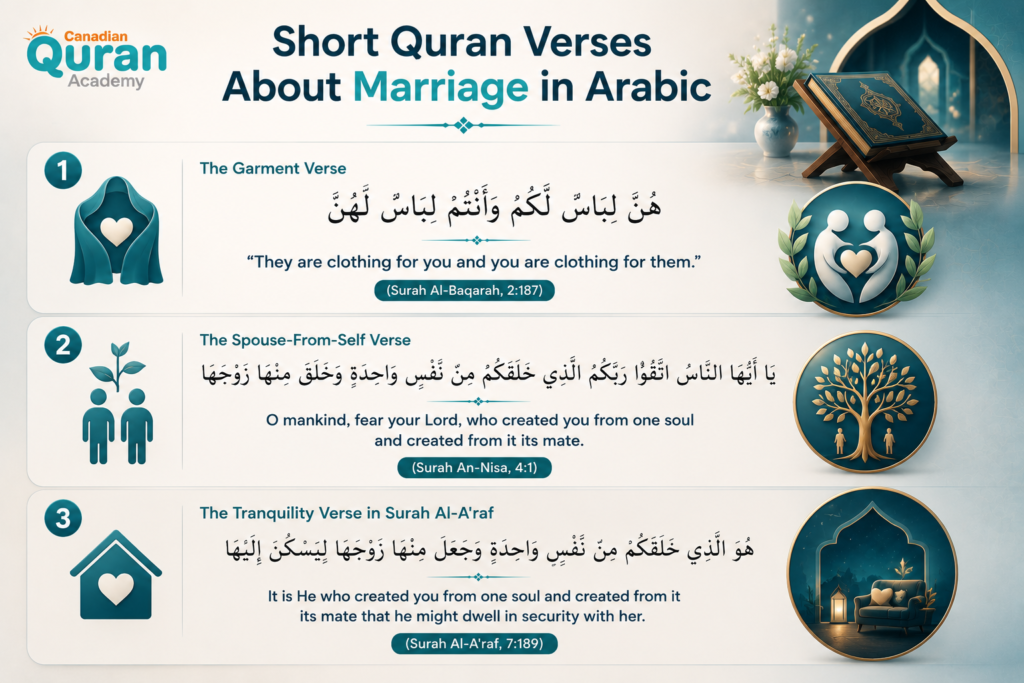
1. The Garment Verse
This is the shortest widely-cited marriage verse in the Quran.
هُنَّ لِبَاسٌ لَّكُمْ وَأَنتُمْ لِبَاسٌ لَّهُنَّ
“They are clothing for you and you are clothing for them.” (Surah Al-Baqarah, 2:187)
A garment covers, protects, and stays close to the body. The metaphor places both spouses in an equal role of protection and closeness — neither one is described as the covering and the other as the covered. It is short enough to memorize in one sitting, which is why it appears so often on invitations and in wedding speeches.
2. The Spouse-From-Self Verse
This verse opens Surah An-Nisa, the chapter the Quran uses to introduce family law.
يَا أَيُّهَا النَّاسُ اتَّقُوا رَبَّكُمُ الَّذِي خَلَقَكُم مِّن نَّفْسٍ وَاحِدَةٍ وَخَلَقَ مِنْهَا زَوْجَهَا
“O mankind, fear your Lord, who created you from one soul and created from it its mate.” (Surah An-Nisa, 4:1)
This verse establishes a shared human origin before any legal distinction between spouses appears later in the same surah. It is one reason scholars often introduce this ayah before moving into the more detailed rulings on marriage that follow it.
3. The Tranquility Verse in Surah Al-A’raf
This verse uses the same root word as sakan from Ar-Rum 21, in a different surah.
هُوَ الَّذِي خَلَقَكُم مِّن نَّفْسٍ وَاحِدَةٍ وَجَعَلَ مِنْهَا زَوْجَهَا لِيَسْكُنَ إِلَيْهَا
“It is He who created you from one soul and created from it its mate that he might dwell in security with her.” (Surah Al-A’raf, 7:189)
Seeing the same root repeated in a second surah reinforces that rest and security, not just companionship, are built into how the Quran describes the purpose of marriage.
Verses on Love, Provision, and Family
A bridge worth making here: the verses above describe marriage as it exists between two people. The verses below extend that picture outward — to what a person should ask for in a spouse, to the financial worry that often delays marriage, and to the children who follow it.
1. The Prayer for a Righteous Spouse
This verse is framed as a prayer, teaching believers what to actively ask for.
وَالَّذِينَ يَقُولُونَ رَبَّنَا هَبْ لَنَا مِنْ أَزْوَاجِنَا وَذُرِّيَّاتِنَا قُرَّةَ أَعْيُنٍ وَاجْعَلْنَا لِلْمُتَّقِينَ إِمَامًا
“And those who say: ‘Our Lord, grant us from among our spouses and offspring comfort to our eyes, and make us an example for the righteous.'” (Surah Al-Furqan, 25:74)
This is a dua, not a description. It teaches the believer to actively ask God for a spouse and children who bring genuine comfort — the Arabic phrase qurrat a’yun (comfort of the eyes) describes the deepest kind of contentment, not a relationship that is merely tolerated.
2. The Divine Promise of Provision
This verse addresses one of the most common hesitations people have before marrying: money.
وَأَنكِحُوا الْأَيَامَىٰ مِنكُمْ وَالصَّالِحِينَ مِنْ عِبَادِكُمْ وَإِمَائِكُمْ ۚ إِن يَكُونُوا فُقَرَاءَ يُغْنِهِمُ اللَّهُ مِن فَضْلِهِ ۗ وَاللَّهُ وَاسِعٌ عَلِيمٌ
“And marry the unmarried among you… If they are poor, Allah will enrich them from His bounty. And Allah is all-Encompassing, all-Knowing.” (Surah An-Nur, 24:32)
The command here is not to wait for financial security before marrying. It reframes provision as something God facilitates through the marriage, not a precondition the person must fully secure alone first.
3. The Blessing of Spouses and Children
This verse extends the conversation from the couple to the family that grows from it.
وَاللَّهُ جَعَلَ لَكُم مِّنْ أَنْفُسِكُمْ أَزْوَاجًا وَجَعَلَ لَكُمْ مِنْ أَزْوَاجِكُمْ بَنِينَ وَحَفَدَةً وَرَزَقَكُمْ مِنَ الطَّيِّبَاتِ
“And Allah has made for you spouses of your own kind, and has made for you, from your spouses, sons and grandsons, and has provided for you good things.” (Surah An-Nahl, 16:72)
This verse frames children and family growth as a ni’mah — a divine favor — rather than simply a biological outcome of marriage.
If you want to work through verses like these for memorization or recitation rather than just reading them, getting the pronunciation exactly right matters, since a single shifted vowel can change a word’s meaning. This is the kind of detail covered directly in Quran courses for adults, where recitation is corrected letter by letter rather than left to guesswork.

Experience Our Classrooms
Don’t just take our word for it—take a look inside! Watch the videos below to experience our engaging teaching methods and vibrant online classrooms firsthand.
Start Your Quranic Journey in Canada
Join our vibrant community and learn with expert tutors through our flexible online platform.
Claim Your Free TrialRead also: Quran Verses About Lying in Arabic
Verses on the Purpose and Protection of Marriage
These verses shift focus from comfort and mercy to marriage as a safeguard — for chastity, and as part of a wider pattern the Quran describes across all of creation.
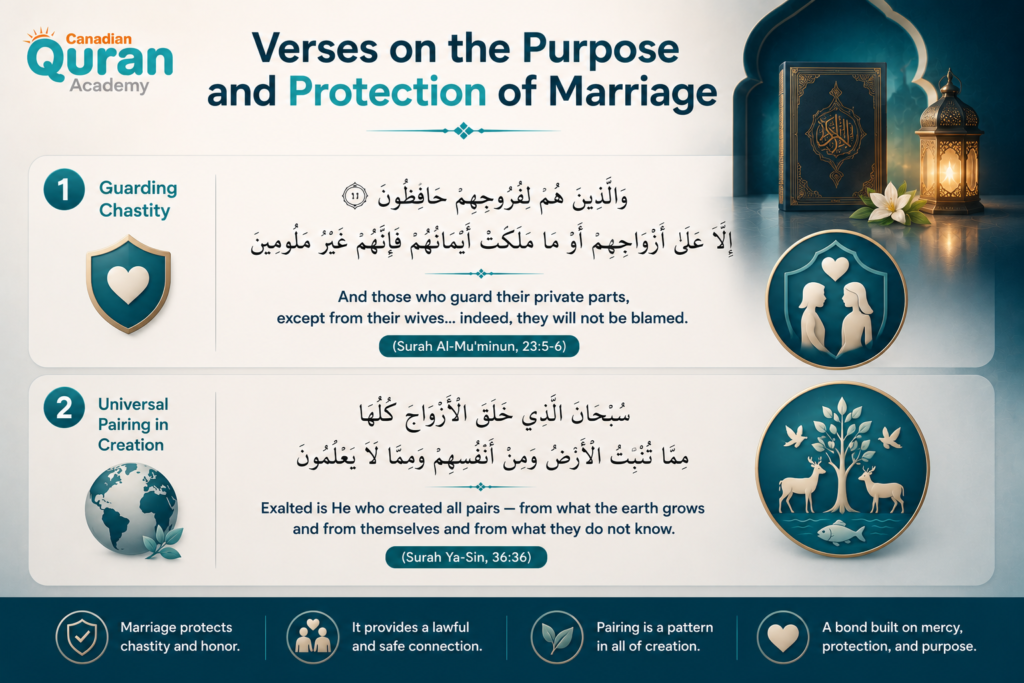
1. Guarding Chastity
This verse identifies marriage as the sanctioned framework for intimacy.
وَالَّذِينَ هُمْ لِفُرُوجِهِمْ حَافِظُونَ إِلَّا عَلَىٰ أَزْوَاجِهِمْ أَوْ مَا مَلَكَتْ أَيْمَانُهُمْ فَإِنَّهُمْ غَيْرُ مَلُومِينَ
“And those who guard their private parts, except from their wives… indeed, they will not be blamed.” (Surah Al-Mu’minun, 23:5-6)
This is one of several legal verses on marriage, distinct from the emotional register of Ar-Rum 21 or the garment verse. It marks marriage as the boundary within which intimacy is permitted.
2. Universal Pairing in Creation
This verse widens the discussion beyond human marriage entirely.
سُبْحَانَ الَّذِي خَلَقَ الْأَزْوَاجَ كُلَّهَا مِمَّا تُنبِتُ الْأَرْضُ وَمِنْ أَنفُسِهِمْ وَمِمَّا لَا يَعْلَمُونَ
“Exalted is He who created all pairs — from what the earth grows and from themselves and from what they do not know.” (Surah Ya-Sin, 36:36)
The Arabic word zawj (pair, mate) is used across the Quran for plants, animals, and humans alike. This verse is often cited as evidence that pairing is a structural principle running through creation, not an isolated human custom.
Read also: Quran Verses About Love in Arabic: 7 Beautiful Verses
The Marriage Covenant and Mutual Rights
The verses above describe why marriage exists. These three describe how it is meant to be conducted once it begins — as a binding pledge, a relationship of kindness, and a set of reciprocal rights.
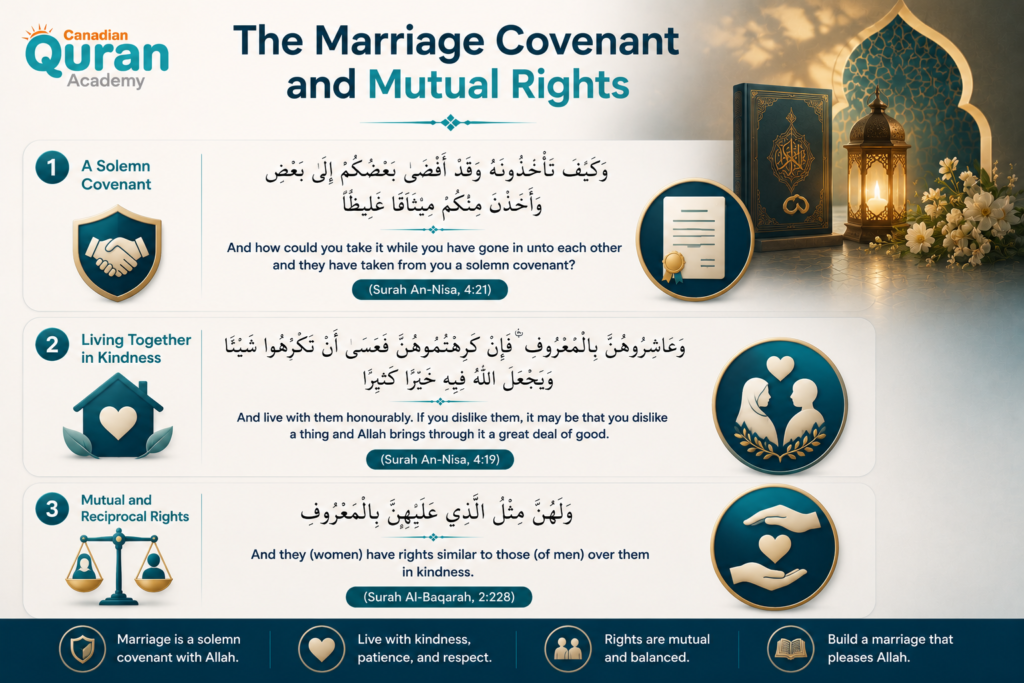
1. A Solemn Covenant
This verse describes the marriage contract with unusually forceful language.
وَكَيْفَ تَأْخُذُونَهُ وَقَدْ أَفْضَىٰ بَعْضُكُمْ إِلَىٰ بَعْضٍ وَأَخَذْنَ مِنكُم مِّيثَاقًا غَلِيظًا
“And how could you take it while you have gone in unto each other and they have taken from you a solemn covenant?” (Surah An-Nisa, 4:21)
The phrase mithaqan ghalizan — a solemn, weighty covenant — is used in the Quran for very few agreements. Applying it to marriage marks the contract as far more serious than an ordinary social arrangement.
2. Living Together in Kindness
This verse instructs spouses, particularly husbands, on the standard of conduct expected within the marriage.
وَعَاشِرُوهُنَّ بِالْمَعْرُوفِ ۚ فَإِن كَرِهْتُمُوهُنَّ فَعَسَىٰ أَن تَكْرَهُوا شَيْئًا وَيَجْعَلَ اللَّهُ فِيهِ خَيْرًا كَثِيرًا
“And live with them honourably. If you dislike them, it may be that you dislike a thing and Allah brings through it a great deal of good.” (Surah An-Nisa, 4:19)
The word al-ma’ruf here covers far more than politeness. It includes fairness, patience, and overlooking minor faults — and the second half of the verse asks spouses to be patient with what they dislike, since good may be hidden inside it.
3. Mutual and Reciprocal Rights
This verse states the principle that rights in marriage run in both directions.
وَلَهُنَّ مِثْلُ الَّذِي عَلَيْهِنَّ بِالْمَعْرُوفِ
“And they (women) have rights similar to those (of men) over them in kindness.” (Surah Al-Baqarah, 2:228)
This establishes that responsibilities in marriage are matched by corresponding rights, all measured against the same standard of al-ma’ruf used in the previous verse.
Understanding how these three legal verses relate to one another — covenant, conduct, and reciprocity — is exactly the kind of connected reading that a structured Islamic studies course for adults is designed to walk you through, rather than encountering each verse in isolation.
Live Class in Action
Watch how our instructors interact with students in real-time, focusing on interactive methods.
Start Your Quranic Journey in Canada
Join our vibrant community and learn with expert tutors through our flexible online platform.
Claim Your Free TrialStart Reading These Verses in Their Original Arabic
Translation gives you the meaning of a verse. It does not tell you why sakan was chosen over a more general word for peace, or why mithaqan ghalizan is used for marriage and almost nothing else in the Quran. That distinction only becomes clear when you read the Arabic directly, with someone who can walk you through the grammar and the word choice alongside you.
Canadian Quran Academy’s courses are built for exactly this — one-on-one sessions where you go through the vocabulary, grammar, and meaning of verses like these together with a qualified teacher, until Ar-Rum 21 stops being something you read in translation and becomes something you understand in its own language.

Our Quran Courses
- Quran Online Academy
- Quran Recitation Classes
- Quran Reading Classes
- Online Quran Classes for Kids
- Quran Classes for Adults
- Quran Classes for Female/Sisters
- Learn Quran for Beginners
- Quran Memorization (Hifz) Course
- Hifz Classes for Adults
- Quran Memorization and Hifz for Kids
- Quran Hifz for Ladies
- Quran Ijazah Program
- Quran Qirat Learning Course
- Quran Tafsir Course
- Noorani Qaida Course
- Noorani Qaida Course for Kids
- Weekend Quran Classes
- Intensive Quran Course
- Al-Azhar Quran Course
- Online Tajweed Classes
- Tajweed Course for Kids
- Tajweed Course for Adults
- Tajweed Course for Ladies/Sisters
Start Your Quranic Journey in Canada
Join our vibrant community and learn with expert tutors through our flexible online platform.
Claim Your Free TrialConclusion
The Quran’s treatment of marriage runs across Surah Ar-Rum’s tranquility and mercy, Al-Baqarah’s mutual protection and reciprocal rights, An-Nisa’s solemn covenant and standard of kindness, An-Nur’s promise of provision, and the structural pairing described in Ya-Sin. Read together, these Quran verses about marriage in Arabic describe a bond built on shared origin, active compassion, and lasting protection — a theme the Quran returns to across nearly every surah that addresses family life, not a single verse mentioned once and left behind.
Whether you are memorizing these ayahs for a wedding, citing them for study, or trying to understand the Quran’s view of marriage in full, reading them in the original Arabic is where the fuller meaning sits.
Frequently Asked Questions
What is the most famous Quran verse about marriage?
Surah Ar-Rum, verse 21, is the most cited Quran verse about marriage. It describes marriage as built on tranquility (sakan), affection (mawaddah), and mercy (rahmah), and is the verse most commonly recited at Muslim weddings.
What is the shortest Quran verse about marriage?
The shortest widely-cited verse is from Surah Al-Baqarah, 2:187: “They are clothing for you and you are clothing for them.” Its brevity and imagery make it a common choice for wedding invitations.
Does the Quran say marriage requires financial security first?
No. Surah An-Nur, 24:32 directly addresses this concern, promising that Allah will provide for those who marry while poor rather than requiring wealth as a precondition.
Why does the Quran use the word “zawj” for things other than spouses?
The Arabic word zawj means “pair” or “mate,” and the Quran uses it for plants, animals, and natural phenomena as well as human spouses. Surah Ya-Sin, 36:36 uses this wider sense to describe pairing as a principle across creation.
How many Quran verses mention marriage or spouses?
Dozens of verses across the Quran use the words zawj (spouse/pair) or forms of nikah (marriage), spanning Al-Baqarah, An-Nisa, An-Nur, Ar-Rum, Ya-Sin, and other surahs. They cover the emotional purpose of marriage, its legal conditions, and its place within the wider pattern of creation.
Can these verses be recited at a wedding?
Yes. Surah Ar-Rum, 30:21 and the garment verse from Surah Al-Baqarah, 2:187 are commonly recited at nikah ceremonies because of their direct relevance to the purpose and tone of the marital relationship.





Leave a Reply