 Arabic
| Key Takeaways |
| You cannot become fluent in Arabic in 5 minutes, but you can learn your first functional Arabic words and sounds in that time. |
| The Arabic alphabet has 28 letters, many with sounds absent in English, making structured pronunciation practice essential from day one. |
| Canadian learners can access free beginner Arabic resources online, including apps and YouTube channels, for short daily practice sessions. |
| Five-minute micro-sessions work best as supplements to structured instruction, not replacements for a proper Arabic course. |
You can learn your first Arabic words and sounds in 5 minutes in Canada — right now, on your phone or laptop, for free. That is the honest answer. What you cannot do in 5 minutes is learn Arabic. But you can make real, measurable progress in a single focused session if you know exactly what to practice.
The approach that actually works for Canadian beginners combines short, targeted micro-sessions with a clear learning sequence: sounds before letters, letters before words, words before sentences.
This guide walks through each step, tells you what free tools to use, and shows you precisely what to do in your first 5 minutes.
1. Start With Three Arabic Sounds English Does Not Have
To learn Arabic in 5 minutes for beginners, start with sounds — not the alphabet, not vocabulary.
Arabic has several phonemes that do not exist in English, and training your ear and mouth on these first prevents the mispronunciation habits that take months to undo later.
The three sounds every beginner must meet in the first session are:
- ع (ʿAyn): A deep, voiced constriction at the back of the throat — not a vowel, not a consonant by English standards. Listen to it pronounced on Forvo’s Arabic pronunciation database before attempting it yourself.
- خ (Kha): Similar to the “ch” in the Scottish “loch” — a rasping sound produced at the soft palate. Most English speakers find this accessible within minutes.
- ح (Ha): A breathy, forceful H produced deep in the throat. Distinct from the regular ه (Ha), which is softer and closer to the English H.
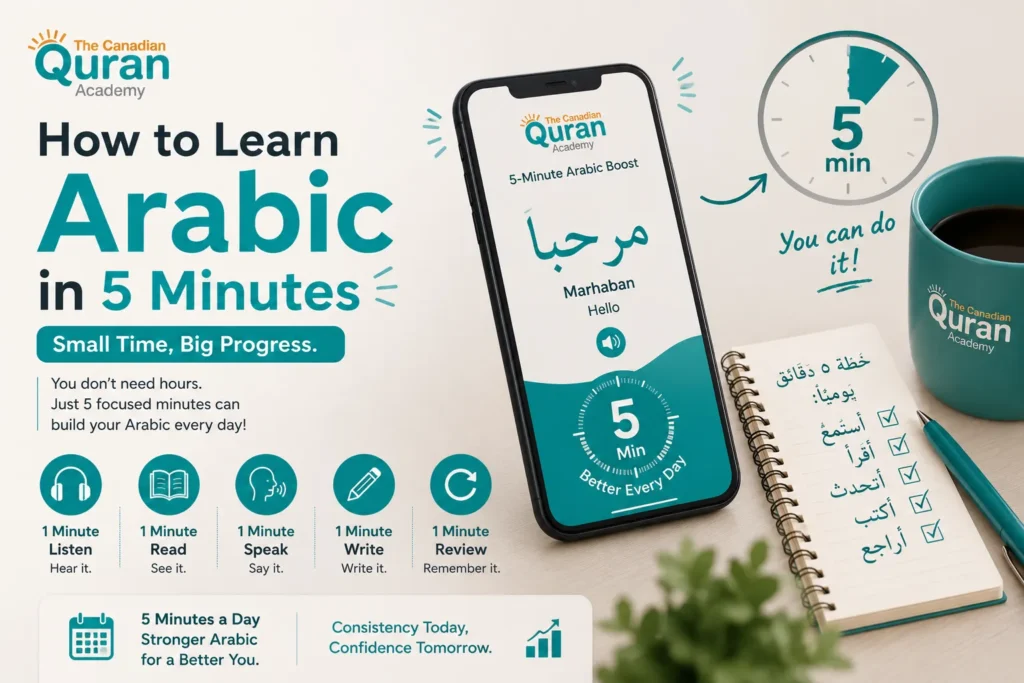
Spend 60–90 seconds on each sound: listen, repeat five times, record yourself, compare. That is your first 5 minutes done — and done correctly.
At The Canadian Quran Academy, our instructors observe that students who skip this phonetic foundation in the first week consistently mispronounce ع and ح throughout their first months of study.
Correcting ingrained errors later costs far more time than building correct habits now.
2. Learn Five High-Frequency Arabic Words You Will Use Immediately
How to learn Arabic in 5 minutes online effectively means choosing vocabulary that appears constantly — in the Quran, in conversation, and in Islamic life. These words give you immediate returns.
| Arabic | Transliteration | Meaning | Where You Will Hear It |
| الله | Allāh | God | Everywhere in Islamic speech |
| نعم | Naʿam | Yes | Daily conversation |
| لا | Lā | No | Daily conversation |
| شكراً | Shukran | Thank you | Social interaction |
| السلام عليكم | As-salāmu ʿalaykum | Peace be upon you | Islamic greeting |
Practice these five in one pass: read the transliteration aloud, then cover it and read the Arabic. Five minutes of this builds both recognition and pronunciation simultaneously.
Read also: HOW TO LEARN ARABIC IN ONE MONTH IN CANADA?
Shots Videos from Our Courses
Start Your Quranic Journey in Canada
Join our vibrant community and learn with expert tutors through our flexible online platform.
Claim Your Free Trial3. Use One Free App for Your First Arabic Letters in Under Five Minutes
How to learn Arabic in 5 minutes free is entirely possible using the right app. Two tools stand out for genuine Arabic beginners in Canada:
Duolingo Arabic (free tier): Teaches the letters through gamified writing and listening exercises. The first lesson introduces ب، ت، ث in under 5 minutes and reinforces them with immediate practice.
The key insight our instructors share with new students: Arabic letters change shape depending on their position in a word — initial, medial, final, and isolated forms. You do not need to learn all four forms in one sitting.
Learn the isolated form of three letters per session, then encounter their connected forms naturally through reading practice.
For Canadian learners with tight schedules — professionals in Toronto or Calgary fitting in a session during a lunch break — this is a sustainable and realistic entry point.
4. Understand the Difference Between Quranic Arabic and Conversational Arabic Before Choosing Your Path
Quranic Arabic is the classical Arabic of the Quran — grammatically precise, using a standardized dialect preserved through centuries of Islamic scholarship. Modern Standard Arabic (MSA) is the formal written and broadcast Arabic used across the Arab world today. Colloquial Arabic refers to regional spoken dialects — Egyptian, Levantine, Gulf — which differ significantly from both.
For Canadian Muslims whose primary goal is understanding the Quran and prayers, Quranic Arabic is the correct starting path. For those seeking conversational ability with Arab communities or travel, MSA provides the most transferable foundation.
The good news: the script, the core vocabulary, and the grammatical framework of Quranic Arabic and MSA overlap heavily. Starting with either does not mean starting over if you later pursue the other.
The Canadian Quran Academy offers a dedicated Arabic for Beginners course that covers both Quranic vocabulary and foundational MSA grammar — taught by native Arabic-speaking instructors who understand exactly where English speakers struggle.
Begin learning Arabic with a FREE trial class

5. Build a 5-Minute Daily Practice Habit Using a Specific Weekly Schedule
Arabic is a language of accumulation. Five minutes of daily, structured practice consistently outperforms two hours of occasional, unfocused study.
The mechanism is straightforward: short daily exposure keeps new vocabulary and sounds in active memory rather than allowing them to decay between sessions.
A practical weekly schedule for Canadian beginners:
| Day | 5-Minute Focus |
| Saturday | 3 new letters — isolated forms only |
| Sunday | Review Saturday’s letters + 3 new vocabulary words |
| Monday | Phonetics — practice ع ح خ with audio comparison |
| Tuesday | Read 5 words from the previous week aloud |
| Wednesday | New letters — connected forms of Saturday’s letters |
| Thursday | Quran listening — find your 5 vocabulary words in Surah Al-Fatiha |
| Friday | Full review — letters, sounds, and vocabulary from the week |
Students working through The Canadian Quran Academy’s Intensive Arabic course often tell us that this daily micro-session model — 5 focused minutes before Fajr or after Isha — produces visible progress within two weeks. The consistency matters far more than the duration.
Book a FREE trial class in the intensive Arabic course
Read also: HOW LONG DOES IT TAKE TO LEARN ARABIC IN CANADA?
6. Know What You Can Realistically Achieve in 5 Minutes and What Requires More
How to learn Arabic in 5 minutes in Canada honestly means understanding the scope of what is achievable. Five minutes is enough time to:
- Learn the pronunciation and shape of 2–3 Arabic letters
- Memorize 5 new vocabulary words with their meanings
- Train one difficult phoneme through focused repetition
- Read a short Quranic sentence with the help of transliteration
- Complete one introductory app lesson
Five minutes is not enough time to:
- Understand Arabic grammar rules and their application
- Build the ability to read Arabic text without transliteration
- Develop listening comprehension for natural Arabic speech
- Progress through Tajweed rules for Quranic recitation
For learners whose goal extends beyond the absolute basics — whether that is reading the Quran fluently, conversing with Arab communities, or understanding Islamic texts — structured instruction is not optional.
The Canadian Quran Academy’s Conversational Arabic course provide the systematic framework that 5-minute sessions alone cannot.
Begin speaking Arabic with a FREE trial class
Our Students Reviews
Start Your Quranic Journey in Canada
Join our vibrant community and learn with expert tutors through our flexible online platform.
Claim Your Free TrialStart Your Arabic Learning with Qualified Guidance at The Canadian Quran Academy
Five minutes gets you started. Qualified instruction takes you forward. The Canadian Quran Academy connects Canadian Muslims with experienced, native Arabic-speaking instructors for personalized 1-on-1 sessions.
Why learners across Canada choose The Canadian Quran Academy:
- Native Arabic instructors who understand English-speaker challenges
- Personalized sessions tailored to your pace and goal — Quranic, conversational, or both
- Flexible scheduling across Canadian time zones — mornings, evenings, weekends
- Programs for all ages: adults, children, women, and new Muslims
- Accessible from anywhere in Canada or internationally
Book your free trial lesson — no commitment, no prior Arabic required.
Check out our top Arabic courses
Book your FREE trial session today
Conclusion
Arabic does not require years of groundwork before it becomes useful. The letters you learn in your first 5-minute session are the same letters you will read in the Quran. The sounds you train this week are the sounds of every du’a you will make for the rest of your life.
The gap between knowing nothing and knowing something in Arabic is smaller than most Canadian beginners expect — and it closes faster with a clear starting point than with endless preparation.
Five minutes today. A qualified instructor when you are ready to go further. That is the honest, practical path — and The Canadian Quran Academy is here for both.
Frequently Asked Questions About Learning Arabic in 5 Minutes
Can I actually learn Arabic in 5 minutes as a complete beginner?
You can learn specific, measurable Arabic skills in 5 minutes — including the pronunciation of 2–3 letters, 5 vocabulary words, or one phoneme. Full Arabic proficiency takes sustained study over months. Five-minute sessions are a valid and effective entry point for building daily habits that compound into real progress over time.
How long does it realistically take to read Arabic fluently?
The Foreign Service Institute classifies Arabic as a Category IV language — meaning it requires approximately 2,200 hours of study for English speakers to reach professional working proficiency. Reading the Quran with proper Tajweed is a more focused goal that many dedicated learners reach within one to two years of consistent study.
Can children learn Arabic in short daily sessions in Canada?
Yes — and children typically acquire Arabic phonetics faster than adults due to greater neuroplasticity in language learning. Five-minute daily sessions are age-appropriate for children aged 5–8. The Canadian Quran Academy offers a specialized Arabic course for kids built around short, engaging sessions structured for Canadian school-age children.





Leave a Reply