 Arabic
| Key Takeaways |
| Most adult learners in Canada reach conversational Arabic proficiency within 1–3 years of consistent, structured study. |
| The U.S. Foreign Service Institute classifies Arabic as a Category IV language, estimating 2,200 classroom hours for professional proficiency. |
| Quranic Arabic is a distinct and faster goal — many beginners read Quran with basic comprehension within 6–12 months. |
| Study frequency matters more than total time: 5 hours per week produces results dramatically faster than 1 hour per week. |
| Structured 1-on-1 instruction with a qualified teacher consistently outperforms self-study apps for lasting Arabic acquisition. |
The honest answer for how long it takes to learn Arabic in Canada depends on three variables: your goal (Quranic Arabic, Modern Standard Arabic, or spoken dialect), your weekly study hours, and the quality of your instruction.
A learner in Toronto doing two structured sessions per week with a native Arabic instructor will outpace someone spending the same hours on a self-study app — every time. The method and the teacher matter as much as the hours logged.
How Long Does It Take to Learn Arabic in Canada?
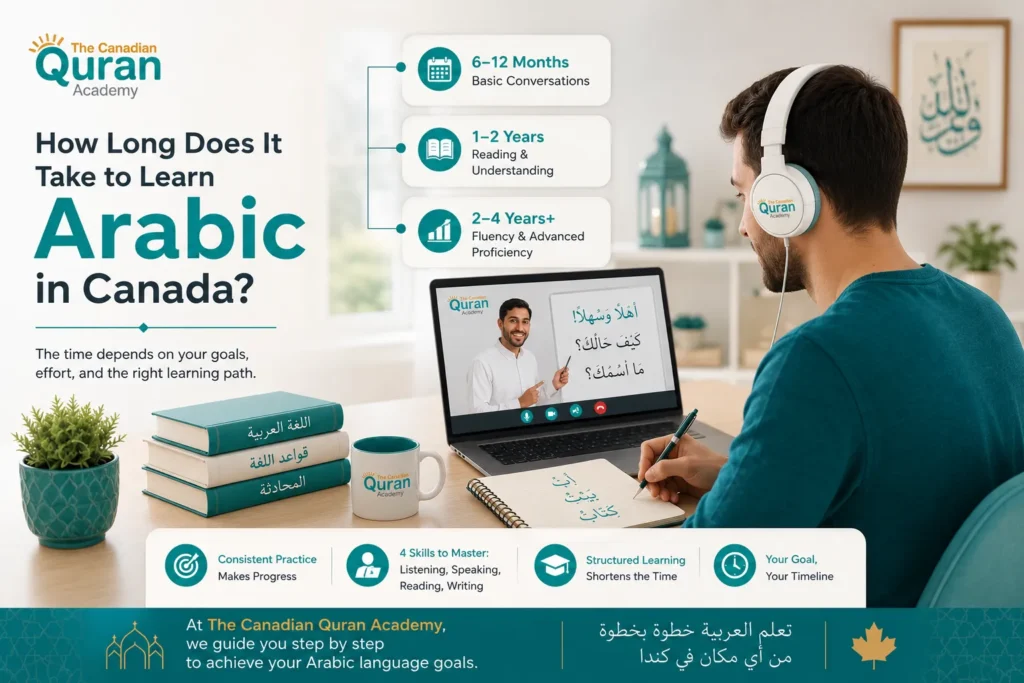
Learning Arabic in Canada takes most adult beginners between 1 and 3 years to reach solid conversational ability, provided they study consistently with qualified instruction. That range compresses dramatically for learners focused specifically on Quranic Arabic. With focused effort and the right method, reading the Quran with foundational comprehension is achievable within six to twelve months.
The U.S. Foreign Service Institute classifies Arabic among its most demanding languages for English speakers, placing it in Category IV alongside Chinese, Japanese, and Korean. That classification reflects full professional fluency — a goal most Canadian Muslims learning for Quranic connection do not need to chase.
What “Learning Arabic” Actually Means Changes the Timeline
The phrase “learning Arabic” covers very different goals, each with its own realistic timeframe:
- Quranic Arabic — Reading and understanding the Quran: 6 months to 2 years
- Modern Standard Arabic (MSA) — Formal written and spoken Arabic: 2–4 years
- Spoken dialect (Egyptian, Levantine, Gulf): 1–3 years alongside MSA
- Professional Arabic fluency: 4–6+ years for most English speakers
At The Canadian Quran Academy, the majority of students come with one primary goal: connecting with the Quran in its original language.
Our Arabic for Beginners course is designed around that exact objective — building Arabic letter recognition, basic grammar, and Quranic vocabulary without the detour into dialect or political news vocabulary.
Begin learning Arabic with a FREE trial class

How Many Hours Does It Take to Learn Arabic?
The total hours required to learn Arabic depends on your target level: approximately 150–250 hours for basic Quranic reading, 600–900 hours for intermediate comprehension, and 2,200+ hours for advanced professional proficiency.
Most Canadian adults realistically reach solid intermediate Arabic within 2–3 years studying five hours per week.
Here is a practical breakdown of hours-to-outcome for Arabic learners:
| Goal | Estimated Hours | Weekly Study (5 hrs/wk) |
| Read Arabic script fluently | 40–80 hours | 2–4 months |
| Basic Quranic reading | 150–250 hours | 7–12 months |
| Quranic comprehension (intermediate) | 400–600 hours | 1.5–2.5 years |
| Modern Standard Arabic (intermediate) | 600–900 hours | 2–3.5 years |
| Professional Arabic proficiency | 2,200+ hours | 8+ years |
These figures assume structured, quality instruction — not passive exposure or app-only learning.
Shots Videos from Our Courses
Start Your Quranic Journey in Canada
Join our vibrant community and learn with expert tutors through our flexible online platform.
Claim Your Free TrialWhy Weekly Consistency Matters More Than Total Hours
Five hours per week studied consistently beats fifteen hours crammed into a single weekend session. Arabic grammar, vocabulary retention, and script fluency all depend on spaced repetition — returning to material before it fades.
In our experience at The Canadian Quran Academy, students who maintain two to three sessions weekly make measurably faster progress than those with irregular intensive bursts.
This is particularly relevant for Canadian learners balancing full-time work, family schedules, and community commitments. Short, consistent sessions are not a compromise — they are often the most effective format available.
Read also: BEST UNIVERSITIES TO LEARN ARABIC IN CANADA
What Factors Affect How Fast You Learn Arabic in Canada?
Your Arabic learning speed is shaped primarily by instruction quality, study frequency, prior language background, and goal clarity. Native speakers of other Semitic languages (Hebrew, Amharic, Tigrinya) typically progress faster due to shared root-word structures.
Learners without prior non-Latin script experience need additional time building Arabic script fluency before vocabulary acquisition accelerates.
The key factors, in order of impact:
- Instruction quality — 1-on-1 sessions with a qualified teacher produce faster, more accurate results than group classes or self-study
- Study frequency — consistent weekly sessions outperform irregular intensive periods
- Goal clarity — learners who know whether they want Quranic Arabic, MSA, or conversational practice progress faster
- Linguistic background — prior knowledge of any Semitic language reduces the learning curve significantly
- Immersion opportunities — Arabic media, conversation partners, and Quranic listening add real hours outside formal sessions
Does Your Arabic Dialect Goal Add Time?
Modern Standard Arabic (MSA) and spoken dialects are related but distinct. MSA is the formal written and broadcast Arabic of Al-Jazeera, literature, and the Quran’s prose structure.
Dialects (Egyptian, Levantine, Gulf) differ in vocabulary, pronunciation, and grammar in ways that can genuinely confuse a learner studying one while hearing the other.
For most Canadian Muslims whose primary goal is Quranic connection, focusing on Quranic Arabic and MSA first is the most efficient path. Adding a spoken dialect later is far easier once the grammar foundation is solid.
Our Quranic Arabic course in Canada at The Canadian Quran Academy is specifically designed to build this foundation — starting with Quranic vocabulary and root-word patterns so learners access meaning quickly, not after years of abstract grammar study.
Book a FREE trial class in the Quranic Arabic course in Canada

Is It Harder to Learn Arabic in Canada Than in an Arabic Country?
Learning Arabic in Canada without daily immersion does extend the learning timeline, but structured online instruction with native Arabic speakers closes most of that gap. Canadian learners lack ambient language exposure — no Arabic street signs, no overheard conversations — but they gain scheduling flexibility and access to qualified online instructors from across the Arab world.
The immersion advantage in Arabic-speaking countries is real but often overstated for Quranic learners. Classical Quranic Arabic is nobody’s first language — even native Arabic speakers study it formally.
A student in Calgary working through Arabic grammar course materials with a qualified instructor has access to the same scholarly tradition as a student sitting in Cairo.
Begin learning Arabic grammar with a FREE trial class
How Online Arabic Instruction Works for Canadian Learners
The Canadian Quran Academy’s approach to Arabic instruction is built for exactly this context: English-speaking learners in Canadian cities, working around professional and family schedules, seeking authentic instruction that reaches beyond an app.
Our Conversational Arabic course pair students 1-on-1 with qualified native Arabic instructors — covering conversational practice depending on stated goals, with flexible morning, evening, and weekend sessions across Canadian time zones.
Begin speaking Arabic with a FREE trial class
What Is the Fastest Way to Learn Arabic as a Canadian Muslim?
The fastest path to functional Arabic for most Canadian Muslims combines three elements: structured 1-on-1 instruction with a qualified teacher, daily 15–30 minute personal practice between sessions, and deliberate Quranic listening exposure. Learners who add Quranic audio listening to their study routine internalize Arabic phonology faster than those studying in silence.
Practically, this means:
- Two structured sessions per week with a qualified Arabic instructor
- Daily personal review: 15–30 minutes revising vocabulary and grammar points from sessions
- Quranic listening: following along in a mushaf while listening to a clear reciter like Sheikh Mishary Al-Afasy or Sheikh Abdul Basit
- Active engagement: writing out Arabic roots by hand, not just reading — motor memory reinforces retention
At The Canadian Quran Academy, we also offer an Intensive Arabic Course for learners who want to accelerate their progress with increased session frequency and a structured curriculum. This format is particularly effective for adults who have a specific Arabic fluency goal and a defined timeline.
Book a FREE trial class in the intensive Arabic course
Read also: HOW TO LEARN ARABIC FOR QURAN IN CANADA?
Can Children Learn Arabic Faster Than Adults?
Children generally acquire pronunciation and natural fluency more easily than adults due to neuroplasticity, but adults typically master Arabic grammar structure faster because they can engage with explicit rules analytically. For Canadian Muslim families, starting children early in Arabic delivers a meaningful head start — but adults who begin later should not expect dramatically slower progress on grammar and vocabulary.
In our experience at The Canadian Quran Academy, children who begin Arabic instruction between ages six and nine often develop near-native pronunciation within two to three years of consistent study.
Adult learners typically reach comfortable reading comprehension faster, but carry more self-consciousness about pronunciation errors — which is the primary internal obstacle, not cognitive capacity.
Our Arabic Classes for Kids use age-appropriate methods to build Arabic letter recognition, basic vocabulary, and Quranic reading in a format designed for short attention spans and active engagement.
Get your child a FREE trial class in our Arabic course for kids
Our Students Reviews
Start Your Quranic Journey in Canada
Join our vibrant community and learn with expert tutors through our flexible online platform.
Claim Your Free TrialStarting Your Arabic Learning with Qualified Instruction at The Canadian Quran Academy
Arabic is learnable for Canadian Muslims at any age — with the right structure, realistic expectations, and qualified guidance.
The Canadian Quran Academy offers:
- Qualified, experienced Arabic instructors with native-level fluency
- Personalized 1-on-1 sessions tailored to your specific goal (Quranic, MSA, or conversational Arabic)
- Flexible scheduling across Canadian time zones — morning, evening, and weekends
- Courses for beginners through advanced learners, and dedicated programs for kids
- A free trial lesson — no commitment required
Book your free trial lesson and start with a session designed around your actual goal and schedule.
Check out our top Arabic courses
Book your FREE trial session today
Conclusion
Reaching genuine Arabic fluency is a multi-year commitment — but for most Canadian Muslims, the most meaningful milestone is far closer: reading the Quran in Arabic with comprehension. That goal is realistic within one to two years of structured, consistent instruction.
The learners at The Canadian Quran Academy who make the fastest progress share one pattern: they start with a clear goal, study consistently, and work with a qualified instructor who corrects errors before they become habits.
The hours add up faster than most beginners expect — and the connection to the Quran that opens on the other side of that effort is worth every one of them. Insha’Allah.
Frequently Asked Questions About Learning Arabic in Canada
How long does it take to learn Arabic for the Quran specifically?
Most adult beginners can read Quranic Arabic with basic comprehension within 6–18 months of structured study, provided they study at least 3–5 hours per week with qualified instruction. Reading the Arabic script fluently typically takes 2–4 months. Adding foundational grammar and 500–800 core Quranic vocabulary words brings functional Quranic reading within reach for most learners within a year.
Can I learn Arabic online in Canada as effectively as in a classroom?
Yes — for structured language instruction, 1-on-1 online sessions with a qualified native Arabic instructor are comparably effective to in-person classes and often more so for adult learners. The key variable is instruction quality and session consistency, not the medium. Scheduling flexibility also means online learners in Canada maintain more consistent attendance, which directly improves outcomes.
What level of Arabic can I realistically reach in one year?
In one year of consistent study at five hours per week with qualified instruction, most adult Canadian learners reach solid foundational Arabic: confident Arabic script reading, basic grammar comprehension, and functional Quranic reading with some vocabulary understanding. Conversational fluency in MSA typically requires 2–3 years minimum. Setting a focused goal — Quranic reading vs. spoken fluency — dramatically affects what one year realistically achieves.
Does speaking French as a Canadian help with learning Arabic?
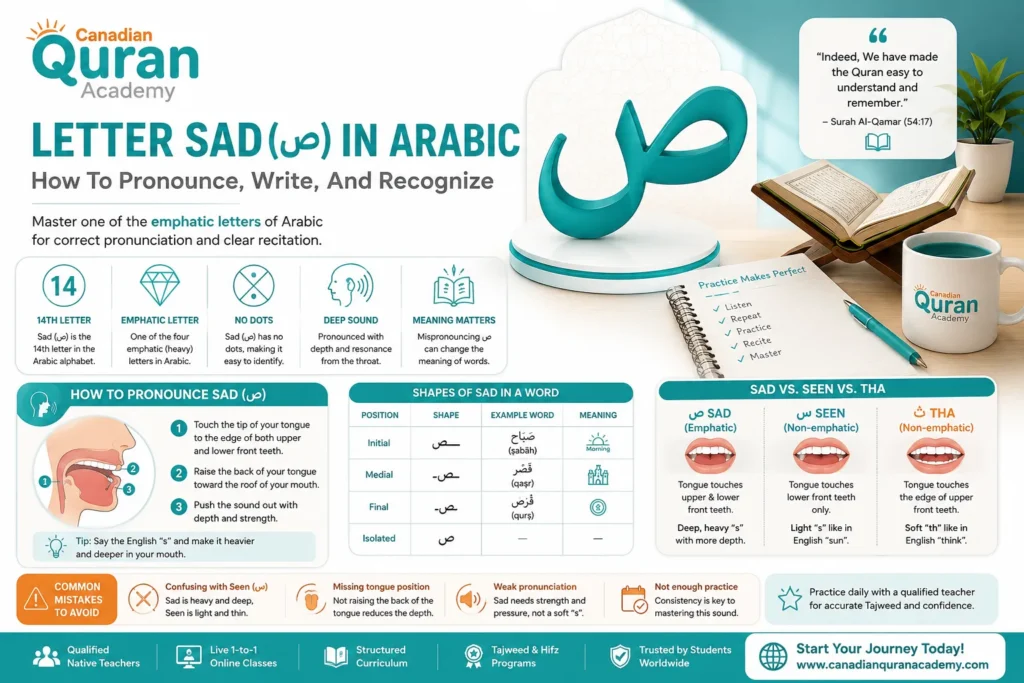
French provides minimal direct structural advantage for Arabic learning, unlike Semitic languages. However, French-speaking Canadians often have stronger phonological flexibility than monolingual English speakers, which can help with Arabic sounds like ع (ayn), غ (ghayn), and the uvular ر (ra’) in some dialects. The shared Arabic-origin vocabulary in French (admiral, algebra, algorithm, cotton) also provides scattered familiar reference points.





Leave a Reply