 Arabic
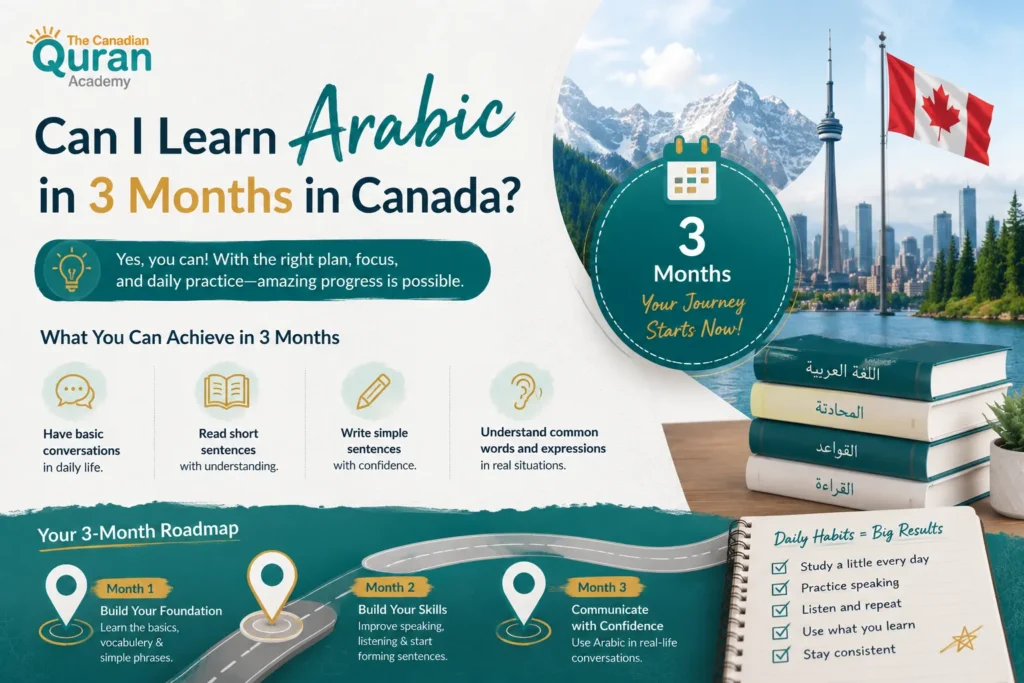
Yes, you can reach meaningful Arabic proficiency in 3 months in Canada — if you define your goal precisely and commit to structured daily practice. Three months is not enough to master Arabic. It can be enough to read Quranic Arabic with basic understanding, hold foundational conversations, or build the grammatical framework for deeper study.
Arabic learners who succeed in 90-day timelines share one thing: they stop trying to learn “Arabic” and start learning a specific layer of it.
Can I Learn Arabic in 3 Months in Canada?
You can learn Arabic in 3 months in Canada at a functional level — specifically, basic Quranic reading comprehension, foundational spoken Arabic, or core grammatical structures — provided you study 45–60 minutes daily with a qualified instructor and follow a curriculum designed for English-speaking learners.
Full fluency takes years; purposeful beginner-to-intermediate progress takes 90 days.
The Canadian context matters here. Most Arabic learners in Toronto, Calgary, or Vancouver are balancing full-time work, family schedules, and commute times.
That means 45 minutes of focused, structured study daily is often more realistic — and more effective — than weekend-only marathon sessions.
Consistency in shorter increments consistently outperforms irregular long sessions when learning a language as structured as Arabic.
The honest answer is this: three months gets you through the door. What you do inside that door depends on which door you choose to enter.
What Is a Realistic Arabic Learning Goal for 3 Months?
A realistic Arabic learning goal for 3 months is one specific, measurable skill layer — not the entire language. English-speaking learners typically choose between Quranic Arabic reading, Modern Standard Arabic fundamentals, or conversational Arabic basics. Attempting all three simultaneously within 90 days produces shallow results across all three.
Here is a practical breakdown of what each track can deliver in 3 months:
| Goal Track | What’s Achievable in 90 Days | Daily Time Required |
| Quranic Arabic Reading | Read and understand basic Quranic sentences; recognize 300+ root words | 45–60 min |
| Modern Standard Arabic (MSA) | Foundational grammar, 500–700 vocabulary words, simple reading | 60 min |
| Conversational Arabic | Greetings, introductions, basic daily phrases, simple Q&A | 45 min |
| Arabic Grammar Foundation | Noun-verb-adjective agreement, basic sentence structure, root system | 45–60 min |
At The Canadian Quran Academy, the most common 3-month goal among Canadian adult learners is Quranic Arabic — specifically reaching the point where they can recite and understand the short surahs they pray daily.
This is achievable with consistent effort. Our Arabic for Beginners course is specifically designed to build exactly this foundation.
Begin learning Arabic with a FREE trial class

How to Learn Arabic in 3 Months in Canada?
Achieving meaningful Arabic proficiency in just three months requires more than just enthusiasm; it demands a systematic, step-by-step roadmap.
Let’s outline the essential process—from defining your singular goal to scheduling daily practice—proven to yield the best results for adult Canadian learners.
1. Define Your Arabic Goal Before You Begin a Single Lesson
The first step to learning Arabic in 3 months is choosing one goal and committing to it exclusively. Ambiguity at the start is the most consistent reason Canadian adult learners stall within the first few weeks. Ask yourself one question: Why do I want Arabic?
- To understand the Quran I recite in salah → Quranic Arabic track
- To speak with Arabic-speaking family or colleagues → Conversational track
- To study Islamic texts and classical scholarship → Grammar-first track
- To read Arabic script fluently for any purpose → Script and reading fluency track
Your answer determines your curriculum, your vocabulary sets, and your instructor requirements. Do not skip this step.
2. Learn the Arabic Alphabet and Script in the First Two Weeks
Before any vocabulary or grammar can stick, you need confident Arabic script recognition. Most motivated adult learners can achieve comfortable letter recognition — including connected forms — within 10–14 days of daily practice.
Arabic has 28 letters, each with up to four positional forms (initial, medial, final, isolated). The good news: Arabic is phonetically consistent. Once you know a letter, it sounds the same almost every time — unlike English spelling irregularities.
The critical milestone: By the end of week two, you should read any combination of letters aloud, even without understanding the meaning. This unlocks every subsequent step.
Shots Videos from Our Courses
Start Your Quranic Journey in Canada
Join our vibrant community and learn with expert tutors through our flexible online platform.
Claim Your Free Trial3. Build Vocabulary Around Your Chosen Track
Vocabulary acquisition should be track-specific from week one. Quranic Arabic learners need a different vocabulary set than conversational learners, and mixing them dilutes both.
- Quranic track: Focus on the 300 most-frequent Quranic roots. These cover approximately 70% of Quranic text by frequency.
- Conversational track: Focus on the 500 most-common Modern Standard Arabic words used in daily interaction.
- Grammar track: Vocabulary is secondary — focus on pattern recognition within a core 200-word working set.
Flashcard systems with audio reinforcement work well for vocabulary retention. Our instructors at The Canadian Quran Academy typically pair vocabulary work with reading practice so new words are encountered in context immediately.
Read also: HOW TO LEARN ARABIC IN 5 MINUTES IN CANADA?
4. Study Grammar as a System, Not a List of Rules
Arabic grammar is not a collection of disconnected rules — it is a root-based system. Every Arabic word derives from a three-letter root that carries a core meaning. Once you understand this system, vocabulary acquisition accelerates dramatically.
The three grammar foundations every 3-month learner must prioritize:
- The root system (الجذر): Learn to identify three-letter roots and predict word meanings
- Noun-adjective agreement: Gender and number agreement between nouns and their modifiers
- Basic verb conjugation: Past and present tense of Form I (فَعَلَ pattern) verbs
Our Arabic Grammar course at The Canadian Quran Academy is structured around exactly this foundation — building the grammatical framework systematically before expanding into advanced forms.
Begin learning Arabic grammar with a FREE trial class
5. Work with a Qualified Arabic Instructor at Least Three Times Per Week
Self-study tools — apps, YouTube videos, workbooks — are useful supplements. They cannot replace real-time error correction from a qualified instructor. Arabic pronunciation errors left uncorrected become habits within weeks, and habits require significant effort to undo.
At The Canadian Quran Academy, our Online Arabic Classes pair each student with a native Arabic instructor for live 1-on-1 sessions.
In our experience, students who attend three sessions per week consistently progress faster than those attending once weekly regardless of total study hours — because errors are caught and corrected before they solidify.
The Canadian Quran Academy offers flexible session scheduling across Canadian time zones — morning, evening, and weekend slots that work around Toronto rush hours, Calgary work schedules, and Montreal school pick-up times. You can start with a free trial lesson before committing.
6. Schedule Daily Practice That Fits the Canadian Lifestyle
Forty-five minutes per day, six days a week, beats three-hour weekend sessions. The research on language acquisition consistently supports distributed practice — shorter, more frequent study intervals produce better retention than massed practice.
A practical daily structure for a 45-minute session:
- 10 minutes: Vocabulary review (previous day’s words + 5 new words)
- 15 minutes: Reading practice (connected text, not isolated words)
- 15 minutes: Grammar or pattern drilling
- 5 minutes: Listening to native Arabic audio at natural speed
Adult learners managing full-time work in Ontario and Alberta consistently find that a fixed early-morning or post-Isha session produces better adherence than flexible scheduling. Pick a time and protect it.
7. Immerse Within the Arabic You Already Have Access To
Canadian Muslims have a significant advantage that many learners overlook: daily Arabic exposure through salah, Quran recitation, and Islamic content. This is free, consistent immersion.
Practical immersion strategies for Canadian learners:
- Recite Surah Al-Fatiha slowly and deliberately, focusing on word meanings, not just sound
- Listen to Quran recitation with a word-by-word translation open alongside
- Watch Arabic-language lectures by scholars you already follow — with Arabic subtitles where possible
- Read short Quranic passages and parse individual words using a root dictionary
This kind of embedded immersion keeps the language active between formal study sessions without requiring additional time blocks.
Read also: HOW TO LEARN ARABIC IN 6 MONTHS IN CANADA?
8. Assess Progress at the 30-Day and 60-Day Marks
Three months without checkpoints is a 90-day drift. Set measurable milestones at weeks four and eight.
30-day checkpoint — ask yourself:
- Can I read Arabic text aloud without stopping to recall letters?
- Do I recognize 100+ vocabulary items on sight?
- Can I produce a basic Arabic sentence using correct gender agreement?
60-day checkpoint — ask yourself:
- Can I read a short Quranic verse and explain the meaning of each word?
- Can I conjugate 10 common verbs in past and present tense?
- Is my instructor identifying fewer pronunciation errors per session than at week one?
If you are behind on these markers at day 30, the issue is almost always one of three things: inconsistent daily practice, insufficient vocabulary focus, or limited instructor contact. All three are correctable.
Can I learn Arabic online from Canada effectively?
Online Arabic instruction is fully effective for Canadian learners when it includes live 1-on-1 sessions with a qualified native instructor. Pre-recorded courses and apps cannot replace real-time pronunciation correction, which is essential in Arabic.
At The Canadian Quran Academy, all Arabic instruction is delivered through live sessions with native instructors, scheduled flexibly across Canadian time zones.
The Conversational Arabic course and Intensive Arabic course both run online with this structure.
Book a FREE trial class in the intensive Arabic course
Our Students Reviews
Start Your Quranic Journey in Canada
Join our vibrant community and learn with expert tutors through our flexible online platform.
Claim Your Free TrialStart Your Arabic Learning with Qualified Instruction at The Canadian Quran Academy
Structured guidance from a qualified instructor is the highest-impact variable in a 3-month Arabic goal. The Canadian Quran Academy connects Canadian and global learners with experienced native Arabic instructors for personalized 1-on-1 online sessions.
Why learners choose The Canadian Quran Academy:
- Native Arabic instructors with formal teaching credentials
- 1-on-1 sessions tailored to your specific goal track
- Flexible scheduling across all Canadian time zones
- Programs for adults, children, women, and complete beginners
- Free trial lesson — no commitment required
Book your free trial lesson today and start with a session designed around your specific 3-month goal.
Check out our top Arabic courses
Book your FREE trial session today

Conclusion
Three months is a serious commitment — and a genuinely achievable one. The learners who reach meaningful Arabic proficiency in 90 days are not exceptional; they are consistent. They define a clear goal, work with a qualified instructor, and protect their daily practice time.
Quranic Arabic, foundational grammar, or basic conversational fluency — whichever track fits your life right now — is within reach before those 90 days are finished. Alhamdulillah, the tools, the instruction, and the structure are all available. The remaining variable is the decision to begin.
Frequently Asked Questions About Learning Arabic in 3 Months in Canada
How many Arabic words do I need to know after 3 months?
A functional 3-month Arabic vocabulary depends on your goal track. Quranic Arabic learners need approximately 300 high-frequency root-based words to access roughly 70% of Quranic text. Conversational Modern Standard Arabic learners should target 500–700 words for basic interactive fluency. Grammar-track learners can function with a core 200-word working set while focusing on structural patterns.
Is Quranic Arabic easier to learn than Modern Standard Arabic?
Quranic Arabic is more achievable in 3 months for most Canadian Muslim learners because it has a fixed, finite vocabulary drawn from one text. Modern Standard Arabic encompasses a living language used across 22 countries with a far larger active vocabulary. Quranic Arabic also does not require conversational production — reading and comprehension are the primary skills — which reduces the skill set required for functional literacy.
Should children learn Arabic differently than adults in a 3-month timeframe?
Children acquire Arabic differently than adults and can reach reading and speaking milestones faster due to neuroplasticity and lower self-consciousness about error-making. Adult learners bring stronger analytical skills and can process grammatical rules explicitly — which accelerates grammar comprehension. The Canadian Quran Academy offers a dedicated Arabic course for kids with age-appropriate methods separate from adult tracks.
What happens if I miss days during my 3-month Arabic study plan?
Missing one to two days occasionally does not derail a 3-month plan. Missing multiple consecutive days — especially in the first four weeks when letter recognition and basic vocabulary are forming — creates gaps that require backtracking. If you fall behind, the most effective response is to return immediately at your last solid checkpoint rather than trying to cover missed material all at once. Your instructor should adjust the session plan accordingly.






Leave a Reply