 Arabic
Improving your Arabic language skills in Canada is absolutely achievable — and the path is more structured than most learners realize. Whether your goal is reading the Quran fluently, conversing with Arabic-speaking family, or studying Islamic texts in their original language, a clear method exists.
The learners who struggle are usually those attempting to improve without understanding which type of Arabic they actually need.
The practical steps that work consistently for Canadian learners involve identifying your Arabic goal, building daily habits around immersion, securing qualified instructor feedback, and using Canada’s multicultural environment as a resource rather than an obstacle. Each of those steps has a specific approach, and each one builds on the one before it.
1. Identify Whether You Need Quranic Arabic, Modern Standard Arabic, or Conversational Arabic
The single most important decision before doing anything else is determining which Arabic you need to learn. Quranic Arabic (Classical Arabic) is the language of the Quran and classical Islamic texts — formal, precise, and distinct from daily speech. Modern Standard Arabic (MSA) is the written and broadcast standard across the Arab world. Colloquial Arabic varies by country — Egyptian, Levantine, Gulf — and is what native speakers use in conversation. Trying to learn all three simultaneously produces confusion, not fluency.
How to Choose the Right Arabic Path?
If your primary motivation is Quran recitation, understanding prayer, or reading tafsir — Quranic Arabic is the right starting point.
If you want to communicate with Arabic-speaking colleagues, family members, or travel in Arab countries — pair MSA with a relevant dialect.
Many Canadian Muslims actually need Quranic Arabic first and discover their other goals fall into place afterward.
Our Quranic Arabic course in Canada at The Canadian Quran Academy is specifically designed to build this foundation — starting with Quranic vocabulary and root-word patterns so learners access meaning quickly, not after years of abstract grammar study.
Book a FREE trial class in the Quranic Arabic course in Canada

2. Build a Daily Arabic Habit Around Short, Consistent Sessions
Improving Arabic language skills in Canada depends more on daily consistency than on total hours studied. A 20–30 minute daily session produces stronger retention than a single two-hour block on weekends. This is not motivation — it is how memory consolidation works. Short sessions repeated across days form durable neural pathways; cramming does not.
What a Productive Daily Arabic Session Looks Like
A structured 25-minute daily session might include:
- 5 minutes reviewing vocabulary from the previous session using spaced repetition
- 10 minutes working through new grammar or Quranic vocabulary in context
- 10 minutes reading or listening — either Quranic recitation or MSA audio
In our experience at The Canadian Quran Academy, adult learners in Toronto and Calgary who commit to 25 daily minutes consistently outperform students studying 90 minutes twice a week. The key is regularity, not volume — especially when managing full-time work and family responsibilities.
This is achievable with consistent effort. Our Arabic for Beginners course is specifically designed to build exactly this foundation.
Begin learning Arabic with a FREE trial class

3. Focus on Arabic Grammar Systematically, Starting with the Essentials
Arabic grammar is not optional background knowledge — it is the architecture of the entire language. Without it, vocabulary acquisition stalls because learners cannot parse new sentences independently.
The good news: you do not need to master all of Arabic grammar before becoming functional. A focused sequence of core grammatical concepts builds reading competence relatively quickly.
The Core Grammar Sequence That Actually Works
The foundational sequence for Quranic Arabic learners follows this progression:
| Stage | Focus Area | Typical Duration |
| Stage 1 | Arabic alphabet, vowel system (Harakaat), basic word structure | 4–8 weeks |
| Stage 2 | Nominal sentences (Jumlah Ismiyyah), definiteness, gender | 6–10 weeks |
| Stage 3 | Verbal sentences (Jumlah Fi’liyyah), verb conjugation patterns | 8–12 weeks |
| Stage 4 | Particles, prepositions, and Quranic sentence analysis | Ongoing |
The Canadian Quran Academy’s Arabic Grammar course follows a structured progression designed specifically for English-speaking learners, addressing the exact points where native English speakers consistently misread Arabic grammatical logic.
Broken plurals and verb root systems are the two most reliably difficult areas — and both require systematic instruction, not guesswork.
Begin learning Arabic grammar with a FREE trial class
4. Secure Regular Feedback from a Qualified Arabic Instructor
Self-study apps and textbooks can introduce Arabic — they cannot correct it. Errors in pronunciation, grammatical case endings, and sentence structure accumulate silently in self-study and calcify into habits that become progressively harder to fix.
Qualified instructor feedback is the mechanism that separates learners who plateau from learners who advance.
Why Instructor Feedback Accelerates Arabic Progress
A qualified instructor identifies the specific pattern behind an error, not just the error itself. When a student consistently drops case vowels at the end of nouns, the solution is not simply “practice more” — it is addressing whether the student has internalized the grammatical function those vowels serve.
The Canadian Quran Academy connects Canadian learners with native Arabic instructors for 1-on-1 online sessions — flexible enough to fit around professional schedules in any Canadian time zone.
You can explore options through our qualified teacher profiles to find the right instructional match for your level and goals.
Read also: WHICH ARABIC SHOULD I LEARN IN CANADA?
Shots Videos from Our Courses
Start Your Quranic Journey in Canada
Join our vibrant community and learn with expert tutors through our flexible online platform.
Claim Your Free Trial5. Use Arabic Immersion Resources Available in Canada
Canada’s multicultural landscape provides meaningful Arabic immersion opportunities that learners in other contexts simply do not have. Arabic-speaking communities are present in significant concentrations across the Greater Toronto Area, Ottawa, Montreal, Edmonton, and Calgary.
These communities are a live immersion resource that too many learners ignore completely.
Immersion Options Available to Canadian Arabic Learners
- Arabic media: Al Jazeera Arabic, BBC Arabic, and Arabic-language YouTube channels provide high-quality MSA listening practice freely accessible across Canada
- Masjid Arabic circles: Many masajid across Ontario and Alberta run Arabic conversation circles — free and community-based
- Arabic community events: Cultural festivals, Arabic-language film screenings, and Islamic conference lectures in Arabic
- Online Arabic tutoring: Supplements formal classes with additional conversation practice
The learners who progress fastest are those who treat their Arabic study as a living practice, not just a class they attend. Every Friday khutbah in Arabic, every du’a made slowly and consciously, every Arabic podcast on a commute — these accumulate.
6. Leverage Conversational Arabic Practice to Accelerate Spoken Fluency
Conversational fluency requires speaking — and most Canadian Arabic learners spend too much time reading and listening without producing language themselves.
Speaking activates different memory retrieval pathways than passive reception. Even imperfect speaking practice accelerates acquisition significantly faster than passive study alone.
The Canadian Quran Academy’s Conversational Arabic course pairs learners directly with instructors for structured speaking sessions — not scripted role-play, but real conversation with real-time correction.
For Canadian Muslims who want to communicate with Arab family members or participate in Arabic-language Islamic settings, this is the fastest practical path.
Begin speaking Arabic with a FREE trial class
Tips for Building Speaking Confidence in Arabic
Begin with short, high-frequency phrases used in Islamic contexts — Salam, Jazakallahu Khayran, Insha’Allah — and expand from there
Practice reading Quranic verses aloud, then gradually extend to Tafsir excerpts read aloud
Join an Arabic language exchange if available in your city — many Canadian universities facilitate these through Arabic language departments
7. Children Learning Arabic in Canada Need Age-Appropriate Methods, Not Adult Curricula
If you are a parent supporting a child’s Arabic learning, the instructional approach must differ substantially from adult methods. Children aged 5–12 acquire language through pattern exposure, repetition, games, and story-based immersion — not explicit grammar explanation.
Applying adult grammar-first curricula to young learners stifles acquisition and creates aversion.
The Canadian Quran Academy’s Arabic course for kids uses age-appropriate methods designed for the Canadian school-age learner: shorter sessions, visually engaging materials, and patient instructors trained specifically in children’s Arabic acquisition. Sessions are scheduled around Canadian school hours.
Get your child a FREE trial class in our Arabic course for kids
When to Start Arabic Instruction for Children?
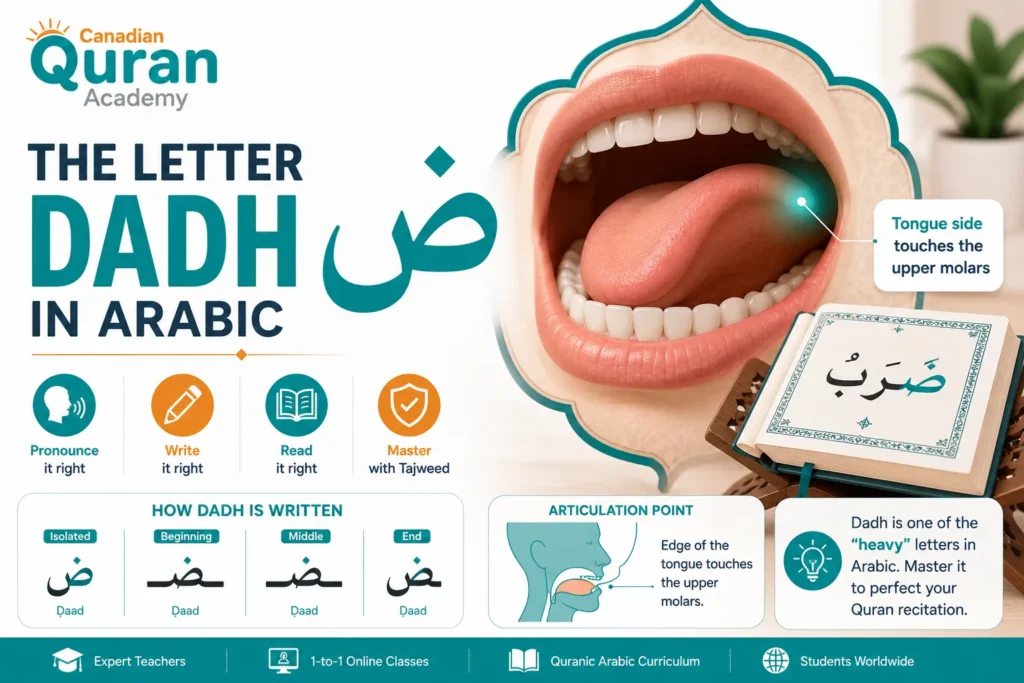
Children who begin structured Arabic exposure between ages 5 and 8 demonstrate measurably easier acquisition of the Arabic sound system — including sounds like ع (Ayn), غ (Ghayn), and خ (Kha) that adult English speakers typically struggle with for months.
Starting early does not mean starting formally — beginning with the Arabic alphabet and short Quranic phrases is sufficient.
Read also: HOW TO LEARN ARABIC ON YOUR OWN IN CANADA?
8. Use Intensive Arabic Study Periods to Break Through Plateaus
Every Arabic learner reaches a plateau — a stage where regular study no longer produces visible progress.
The cause is usually insufficient input volume or insufficient output challenge. An intensive Arabic study period — structured to significantly increase both — reliably breaks these plateaus.
The Canadian Quran Academy offers an Intensive Arabic course designed for learners who need to accelerate progress, prepare for Islamic studies, or recover from a long gap in their learning.
The intensive format compresses progression that would otherwise take a year into a significantly shorter period through increased session frequency and structured immersion tasks.
Book a FREE trial class in the intensive Arabic course
Signs You Have Hit an Arabic Plateau
- You can read Arabic slowly but comprehension has not improved in months
- New vocabulary is not sticking despite regular review
- Listening comprehension feels no better than six months ago
A plateau is not a ceiling — it is a signal to change the study method, not the commitment to learning.
Our Students Reviews
Start Your Quranic Journey in Canada
Join our vibrant community and learn with expert tutors through our flexible online platform.
Claim Your Free TrialStart Your Arabic Language Progress with Qualified Instruction at The Canadian Quran Academy
The steps above work — but they work fastest with structured guidance, not trial and error.
The Canadian Quran Academy offers:
- Qualified native Arabic instructors with experience teaching English-speaking Canadian learners
- 1-on-1 personalized sessions — tailored to your specific goal and current level
- Flexible scheduling across all Canadian time zones — mornings, evenings, and weekends
- Programs for adults, children, women, and new Muslims at every starting level
- Accessible from anywhere in Canada and internationally
Book your free trial lesson — no commitment required, just a conversation with a qualified instructor about where you are and where you want to be.
Check out our top Arabic courses
Book your FREE trial session today
Conclusion
Arabic is not a language you either speak or do not speak — it is a skill built incrementally, habit by habit, session by session. Canadian Muslims are learning it successfully every week, balancing full-time careers and family life with a genuine drive to connect more deeply with the Quran and their faith. The method matters. The consistency matters. And the right instructor changes the timeline entirely.
The path forward is clear: identify your Arabic goal, build daily habits, secure instructor feedback, and use every resource Canada’s multicultural environment makes available. Alhamdulillah, the tools are there — and qualified guidance is one free trial lesson away.
Frequently Asked Questions About Improving Arabic in Canada
How long does it take to learn Arabic in Canada as a beginner?
Adult beginners who study Arabic consistently — 20–30 minutes daily with qualified instructor feedback — typically reach functional Quranic reading ability within 6–12 months. Conversational fluency takes longer: 12–36 months of sustained effort for most English-speaking Canadian learners, depending on exposure volume and the dialect targeted.
Can I learn Arabic online in Canada as effectively as in person?
Yes — for most learners, online Arabic instruction is equally effective as in-person, provided sessions involve live instructor interaction rather than pre-recorded video only. The flexibility of online learning is particularly valuable for Canadian learners managing work, family, and time zone realities across provinces.
What is the difference between Quranic Arabic and Modern Standard Arabic?
Quranic Arabic is the classical Arabic of the Quran, characterized by specific grammatical structures, vocabulary, and rhetorical patterns. Modern Standard Arabic (MSA) is the contemporary formal standard used in media, literature, and cross-regional communication. They share the same foundational grammar but differ meaningfully in vocabulary, idiom, and stylistic convention.
Is it too late to learn Arabic as an adult in Canada?
Adults learn Arabic successfully at every age. The learning process differs from childhood acquisition — adults rely more on explicit grammar understanding and consistent review systems rather than immersive pattern exposure — but adult learners often progress faster in the early grammar stages due to stronger analytical capacity. Starting at 30, 40, or 50 is not a disadvantage when the right method is applied.





Leave a Reply