 Arabic

| Key Takeaways |
| Arabic is the fifth most spoken language globally, with over 400 million speakers across 22 countries. |
| Learning Arabic in Canada opens bilingual career paths in federal government, diplomacy, and international trade roles. |
| Quranic Arabic connects Muslim learners directly to their faith without relying on translations or interpretations. |
| Canadian universities increasingly offer Arabic programs, and demand for Arabic-speaking professionals is rising nationally. |
| Online Arabic instruction lets Canadian learners study with qualified native instructors from any province, at any schedule. |
Learning Arabic in Canada gives Muslim and non-Muslim learners alike a significant cognitive, professional, and spiritual advantage — one that English or French alone simply cannot provide.
For Canadian Muslims specifically, Arabic is not an optional skill. It is the language of Salah, the Quran, and 14 centuries of Islamic scholarship.
Canada’s multicultural landscape makes Arabic uniquely valuable. From federal bilingualism initiatives to rising demand in international relations, healthcare, and academia, Canadian Arabic learners are entering a market where this skill is rare, sought-after, and deeply meaningful — both professionally and in their daily worship.
1. Arabic Fluency Strengthens Your Connection to the Quran at Its Source
Understanding Arabic transforms your relationship with the Quran from passive listening to active comprehension. When you understand what Allah says in His own words — not through a translation — the meaning lands differently. It is not an intellectual shift. It is a felt one, in Salah, in recitation, in reflection.
This is the core reason most Canadian Muslims at The Canadian Quran Academy begin their Arabic study. The goal is not to become a linguist.
The goal is to hear “Alhamdulillahi Rabbil ‘Alameen” in Surah Al-Fatihah and understand, in real time, that they are saying “All praise belongs to Allah, the Lord of all worlds.”
Consider this ayah, which every Muslim recites in every rak’ah:
ٱلْحَمْدُ لِلَّهِ رَبِّ ٱلْعَٰلَمِينَ
Al-ḥamdu lillāhi rabbi l-ʿālamīn
“Praise be to Allah, Lord of the Worlds.” (Surah Al-Fatihah 1:2)
When you understand this phrase grammatically — that “rabb” means Lord and Master, that “al-ʿālamīn” means all of creation — the recitation becomes contemplation. That shift is irreversible.
Our Quranic Arabic course in Canada at The Canadian Quran Academy is specifically designed to build this foundation — starting with Quranic vocabulary and root-word patterns so learners access meaning quickly, not after years of abstract grammar study.
Book a FREE trial class in the Quranic Arabic course in Canada

2. Arabic Is One of the Most Strategically Valuable Languages in the Canadian Job Market
Arabic is the fifth most widely spoken language in the world, and in Canada, Arabic-speaking professionals are in short supply relative to demand.
Federal government roles in foreign affairs, immigration, intelligence, and translation actively recruit bilingual candidates with Arabic fluency.
The same applies to international NGOs, academic research positions, and Arabic-language community services across Ontario, Quebec, and Alberta.
The government of Canada officially recognizes Arabic as a key language for international engagement. Candidates with professional Arabic proficiency hold a distinct advantage in competitive federal hiring processes.
For Muslim Canadians already embedded in Arabic-speaking communities, formalizing that skill through structured instruction is one of the highest-return educational investments available.
The Canadian Quran Academy’s Conversational Arabic Course develops the spoken fluency that professional contexts demand — not just reading comprehension, but the ability to communicate confidently in Modern Standard Arabic and navigate real-world dialogue.
Begin speaking Arabic with a FREE trial class
3. Learning Arabic in Canada Builds Cognitive Abilities That Improve Overall Academic Performance
Arabic is one of the most cognitively demanding languages an English speaker can study — and that difficulty is precisely what makes it beneficial. Arabic uses a completely different script, a root-based morphological system, and a grammatical structure unlike any European language.
Engaging with this complexity measurably strengthens working memory, pattern recognition, and analytical reasoning.
Research in multilingual cognitive development consistently finds that learners of morphologically rich languages — Arabic being among the most complex — develop stronger metalinguistic awareness.
For Canadian children, this benefit is compounded. Heritage-language learners who maintain Arabic alongside English and French develop stronger executive function and show advantages in reading comprehension.
Enrolling children early in structured Arabic instruction is one of the highest-leverage educational decisions a Canadian Muslim family can make.
The Canadian Quran Academy’s Arabic Classes for Kids uses age-appropriate methods and qualified instructors to introduce Arabic script, vocabulary, and Quranic phrases in a structured, engaging format that works around Canadian school schedules.
Get your child a FREE trial class in our Arabic course for kids
4. Arabic Opens Direct Access to 14 Centuries of Islamic Scholarship
The overwhelming majority of Islamic scholarship — Tafsir, Fiqh, Hadith sciences, Aqeedah, and classical jurisprudence — was written in Arabic and has never been translated into English. Even translated texts lose significant nuance.
A scholar reading Ibn Kathir’s Tafsir in Arabic encounters layers of linguistic precision that a translation simply cannot carry.
For Canadian Muslims pursuing Islamic studies at any level, Arabic literacy is not supplementary. It is foundational.
Read also: HOW TO IMPROVE YOUR ARABIC LANGUAGE SKILLS IN CANADA?
Shots Videos from Our Courses
Start Your Quranic Journey in Canada
Join our vibrant community and learn with expert tutors through our flexible online platform.
Claim Your Free Trial5. Arabic Proficiency Strengthens Your Salah
Most Canadian Muslims recite their prayers in Arabic phonetically — correctly pronounced, but without comprehension. This is valid. But it is a fundamentally different experience from praying while understanding every phrase. The difference between the two is not minor. It is the difference between reciting and conversing.
When you understand “Subhaana Rabbiy al-Adheem” in Ruku — “Glory be to my Lord, the Magnificent” — the posture carries weight it did not carry before. When you hear the Imam recite “Iyyaka na’budu wa iyyaka nasta’een” — “You alone we worship, and You alone we ask for help” — and you understand it in real time, the prayer becomes a direct address, not a recitation.
At The Canadian Quran Academy, we consistently see adult learners describe this as the most unexpected and most meaningful change they experience. In our experience, it typically begins after just a few months of structured Quranic Arabic study — once the student can parse Surah Al-Fatihah completely, the Salah changes permanently.
6. Arabic Is the Language of Canada’s Fastest-Growing Muslim Communities
Canada’s Muslim population has grown substantially over the past two decades, with significant Arabic-speaking communities in Toronto, Montreal, Ottawa, Calgary, and Edmonton. Across Ontario and Quebec especially, Arabic is a living community language — not an academic subject.
Learning Arabic in Canada means gaining communicative access to millions of people and an entire cultural ecosystem within your own country.
For non-Arabic-heritage Canadian Muslims, Arabic fluency opens doors inside their own communities — to imams, scholars, community leaders, and the full meaning of Friday khutbahs delivered in Arabic.
For heritage speakers who grew up speaking a regional Arabic dialect but never studied Modern Standard or Quranic Arabic formally, structured instruction closes that gap with precision.
7. Arabic Instruction in Canada Is Now More Accessible Than at Any Previous Point
Online learning has fundamentally changed what is possible for Canadian Arabic students. A Muslim in Kelowna, BC, or Moncton, NB, no longer needs to be in a major urban centre to access qualified Arabic instruction.
Native Arabic-speaking instructors with formal qualifications in Quranic Arabic and Modern Standard Arabic are now one scheduled session away — regardless of postal code.
The Canadian Quran Academy connects Canadian learners with experienced Arabic instructors for personalized 1-on-1 sessions, available morning, evening, and weekend slots across all Canadian time zones. Whether you are in Vancouver navigating Pacific Time or in Halifax on Atlantic, the schedule adapts to you — not the other way around.
Our Arabic Grammar Course and Intensive Arabic Course give learners who want to move quickly a structured, efficient path to real proficiency — without commuting to a language centre or compromising family and work commitments.
Book a FREE trial class in the intensive Arabic course
8. Benefits of Learning the Arabic Language Extend to Mental Wellness and Spiritual Grounding
For Muslim learners — particularly adults managing high-pressure professional lives in cities like Toronto or Calgary — the structured, focused nature of Arabic study becomes a form of intentional spiritual practice.
The act of sitting down, even for 30 minutes, to understand a new ayah or master a new grammatical pattern is an act of presence. It pulls attention away from the noise of a demanding week and directs it toward something permanent and meaningful.
Many adult learners at The Canadian Quran Academy describe their Arabic sessions as the most focused, calm part of their week.
This is not incidental. Arabic has been the language of du’a, dhikr, and worship for over 1,400 years. Engaging with it seriously — learning its rules, its beauty, its precision — produces a sense of rootedness that is difficult to find elsewhere.
Read also: WHICH ARABIC SHOULD I LEARN IN CANADA?
9. Benefits of Learning Arabic for Islam Include Understanding Hadith in Their Original Form
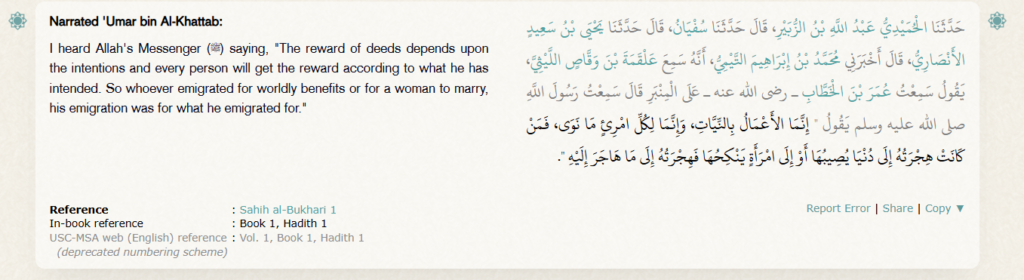
Hadith literature — the recorded sayings and actions of the Prophet ﷺ — forms the second primary source of Islamic guidance after the Quran. The most reliable collections, including Sahih Al-Bukhari and Sahih Muslim, were recorded in Arabic. Translation captures meaning, but Arabic captures intent, tone, and the precise weight of each word the Prophet ﷺ chose.
When a student of Arabic reads “إِنَّمَا الْأَعْمَالُ بِالنِّيَّاتِ” — “Actions are judged by intentions” — and understands that “innamaa” is a particle of exclusivity, meaning “only” and “nothing but”, the hadith carries its full weight. That precision is only available in the original Arabic.
As confirmed in Sahih Bukhari 1, this hadith stands as one of the foundational principles of Islamic jurisprudence. Understanding it in Arabic is understanding it as the scholars of Islam have understood it across fourteen centuries.
Our Students Reviews
Start Your Quranic Journey in Canada
Join our vibrant community and learn with expert tutors through our flexible online platform.
Claim Your Free TrialStart Learning Arabic at The Canadian Quran Academy with a Free Trial Lesson
Arabic fluency is one of the most transformative investments a Canadian Muslim can make — for their faith, their career, and their family’s future. The Canadian Quran Academy offers personalized 1-on-1 Arabic instruction with qualified native instructors, built around your schedule and goals.
- Qualified, experienced Arabic instructors — Quranic, MSA, and conversational tracks
- Personalized 1-on-1 sessions — adapted to your pace and starting level
- Flexible scheduling across all Canadian time zones — morning, evening, and weekend slots
- Programs for adults, children, women, and complete beginners
- Online classes accessible from anywhere in Canada and internationally
Book your free trial lesson today — no commitment required. Explore all Arabic programs at The Canadian Quran Academy.
Check out our top Arabic courses
Book your FREE trial session today
Conclusion
The benefits of learning Arabic in Canada extend into every dimension of a Muslim’s life — from the clarity of Salah to the depth of Islamic scholarship to the professional opportunities available in one of the world’s most multicultural countries. Arabic is not a supplementary skill. For Canadian Muslims, it is a foundational one.
Learners who commit to Arabic study — at any age, from any starting point — consistently report that the language changes how they experience their faith, not incrementally, but fundamentally. The Quran reads differently. The prayer feels different. The scholars of the past become accessible.
Alhamdulillah, the barriers to quality Arabic instruction in Canada have never been lower. Wherever you are — Toronto, Calgary, Vancouver, or a smaller community across any province — qualified instruction is available, structured around your life, and ready to begin. The only prerequisite is the decision to start.
Frequently Asked Questions About Learning Arabic in Canada
How long does it take to learn Arabic as a Canadian adult with no prior experience?
Most adult beginners with consistent structured practice — two to three sessions per week — develop functional Quranic Arabic reading ability within six to twelve months. Conversational Modern Standard Arabic fluency typically requires eighteen to thirty-six months of sustained study. Starting with Quranic Arabic vocabulary accelerates both tracks simultaneously.
Is Quranic Arabic different from the Arabic spoken in Arab countries?
Quranic Arabic is Classical Arabic — the most formal and precise register of the language. Modern Standard Arabic (MSA), used in media and formal communication, is derived from it. Spoken dialects — Egyptian, Levantine, Gulf — differ significantly from both. For Muslim learners, starting with Quranic Arabic builds the strongest foundation and delivers immediate spiritual benefit.
Can children learn Arabic online effectively, or do they need in-person classes?
Children learn Arabic effectively online when instruction is structured, age-appropriate, and delivered by a qualified instructor in live 1-on-1 or small-group sessions. Passive video content does not produce real acquisition. Interactive sessions with a qualified teacher — where the child speaks, responds, and receives correction in real time — produce the same outcomes as in-person instruction for most learners under age twelve.
What is the best age to start learning Arabic?
There is no wrong age to begin learning Arabic. Children aged five to ten acquire Arabic script and phonetics most naturally. Teenagers benefit from their stronger analytical capacity for grammar. Adults bring motivation and self-discipline that accelerate progress significantly. The consistent finding at The Canadian Quran Academy is that committed adult beginners often outpace unmotivated younger learners within six months.





Leave a Reply