 Quran
Quran
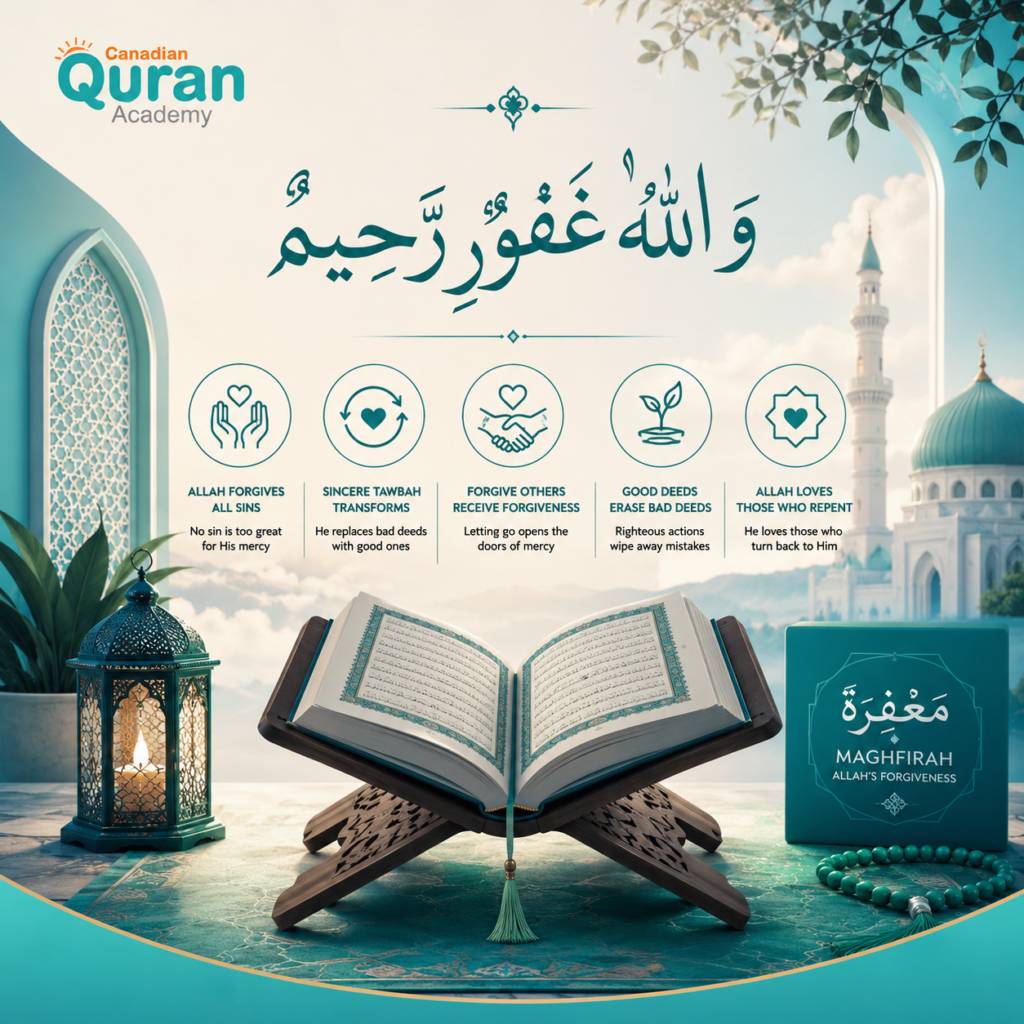
Forgiveness — maghfirah — runs through the Quran by way of the root ghafara and its many derivatives, appearing across dozens of surahs in different forms: as a promise, as a name of Allah, as a description of Paradise, and as a direct instruction on what to say. Quran verses about forgiveness in Arabic are not confined to one warning passage — they build a single argument across separate surahs: no sin disqualifies a sincere servant from Allah’s mercy.
This guide brings together the verses most often searched for on this topic. Each one is given in Arabic with tashkeel, transliteration, English translation, the exact surah and ayah number, and a link to read it in full context on Quran.com. Where a hadith is relevant to the same theme, it’s included with its Arabic wording, its narrator, and a link to Sunnah.com.
What the Quran Says About Forgiveness?
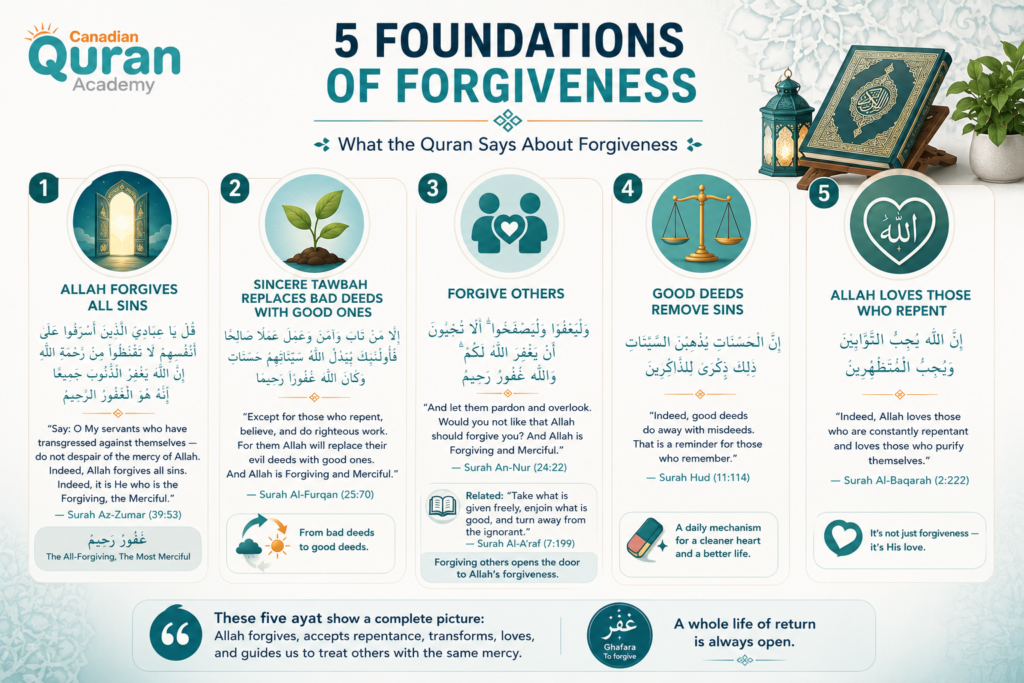
Three verses form the foundation of how the Quran presents forgiveness — as unlimited in scope, conditional on sincerity, and transformative rather than a simple erasure.
1. Forgiveness Without Exception
This is one of the most direct promises in the Quran, addressed specifically to people who fear their sins have grown too large to forgive.
قُلْ يَا عِبَادِيَ الَّذِينَ أَسْرَفُوا عَلَىٰ أَنْفُسِهِمْ لَا تَقْنَطُوا مِنْ رَحْمَةِ اللَّهِ ۚ إِنَّ اللَّهَ يَغْفِرُ الذُّنُوبَ جَمِيعًا ۚ إِنَّهُ هُوَ الْغَفُورُ الرَّحِيمُ
Qul ya ‘ibadiyal ladheena asrafoo ‘ala anfusihim la taqnatoo mir rahmatillah, innallaha yaghfiru dhunooba jamee’a, innahoo huwal Ghafoorur Raheem.” (Surah Az-Zumar 39:53)
“Say: O My servants who have transgressed against themselves — do not despair of the mercy of Allah. Indeed, Allah forgives all sins. Indeed, it is He who is the Forgiving, the Merciful.
The phrase “forgives all sins” is stated without a listed exception in this ayah — a point classical commentators single out precisely because the audience being addressed has already “transgressed against themselves.”
2. Sincere Tawbah Replaces Bad Deeds With Good Ones
Repentance in the Quran is not described as neutral erasure. This verse goes a step further and describes an exchange.
إِلَّا مَنْ تَابَ وَآمَنَ وَعَمِلَ عَمَلًا صَالِحًا فَأُولَـٰئِكَ يُبَدِّلُ اللَّهُ سَيِّئَاتِهِمْ حَسَنَاتٍ ۗ وَكَانَ اللَّهُ غَفُورًا رَحِيمًا
Illa man taba wa amana wa ‘amila ‘amalan salihan fa-ula’ika yubaddilullahu sayyi’atihim hasanat, wa kanallahu Ghafooran Raheema.” — Surah Al-Furqan, 25:70
“Except for those who repent, believe, and do righteous work. For them Allah will replace their evil deeds with good ones. And Allah is Forgiving and Merciful.
3. Forgiving Others Is Linked to Receiving Forgiveness
The Quran ties interpersonal forgiveness directly to divine forgiveness, treating the two as one connected instruction rather than two separate ideas.
وَلْيَعْفُوا وَلْيَصْفَحُوا ۗ أَلَا تُحِبُّونَ أَنْ يَغْفِرَ اللَّهُ لَكُمْ ۗ وَاللَّهُ غَفُورٌ رَحِيمٌ
Walya’foo walyasfahoo, ala tuhibboona ay yaghfirallahu lakum, wallahu Ghafoorur Raheem.” — Surah An-Nur, 24:22
“And let them pardon and overlook. Would you not like that Allah should forgive you? And Allah is Forgiving and Merciful.
A related instruction appears in Surah Al-A’raf, 7:199 — “Take what is given freely, enjoin what is good, and turn away from the ignorant” — which scholars read as the practical behavior that the promise in 24:22 is built on.
4. Good Deeds Erase Bad Ones
A companion verse to 25:70, this ayah gives the mechanism rather than the promise — it explains how the exchange happens in daily practice, not just that it happens.
إِنَّ الْحَسَنَاتِ يُذْهِبْنَ السَّيِّئَاتِ ۚ ذَٰلِكَ ذِكْرَىٰ لِلذَّاكِرِينَ
Innal hasanati yudh-hibnas sayyi’at, dhalika dhikra lidh-dhakireen. (Surah Hud 11:114)
“Indeed, good deeds do away with misdeeds. That is a reminder for those who remember.”
Where 25:70 describes what Allah does with sincere repentance, 11:114 describes an ongoing mechanism available every day — this is the verse most often cited alongside the hadith on Subhan-Allahi wa bihamdihi below.
5. Allah Loves Those Who Turn Back
This shorter verse is often overlooked because it lacks the length of 39:53 or 25:70, but it makes a distinct point: Allah’s love, not just His forgiveness, is attached to repentance.
إِنَّ اللَّهَ يُحِبُّ التَّوَّابِينَ وَيُحِبُّ الْمُتَطَهِّرِينَ
Innallaha yuhibbut tawwabeena wa yuhibbul mutatahhireen. (Surah Al-Baqarah 2:222)
“Indeed, Allah loves those who are constantly repentant and loves those who purify themselves.”
Reading these five ayat side by side in Arabic shows a relationship the English translation alone doesn’t fully carry — the same root, ghafara, describes Allah’s action and the action asked of the reader. That kind of pattern only becomes visible once you can follow the Arabic directly, which is the specific gap our Quranic Arabic course is built to close.
Book a FREE trial class in our Quranic Arabic Course in Canada

Read also: Quran Verses About Not Giving Up In Arabic and English
The Names of Allah Connected to Forgiveness
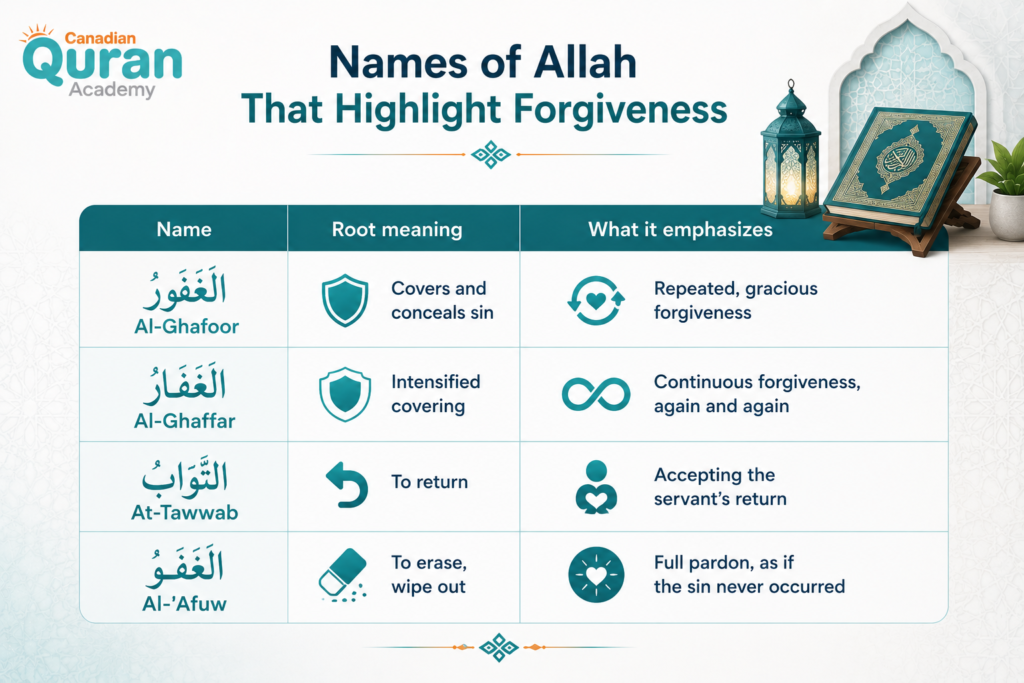
Four names of Allah relate directly to forgiveness, and each describes a distinct angle on the same mercy — treating them as interchangeable synonyms loses the specific meaning each one is carrying.
1. Al-Ghafoor
Al-Ghafoor is the One who forgives repeatedly and covers sin from view, drawn from the same root as maghfirah. It appears at the end of 39:53 and 25:70 above, closing each promise with the quality that makes it possible.
2. Al-Ghaffar
Al-Ghaffar intensifies Al-Ghafoor — it describes forgiveness as a continuous, repeated action rather than a single event.
اسْتَغْفِرُوا رَبَّكُمْ إِنَّهُ كَانَ غَفَّارًا
Istaghfiroo rabbakum innahoo kana Ghaffara. (Surah Nuh 71:10)
“Seek forgiveness from your Lord; indeed, He is ever a Perpetual Forgiver.”
3. At-Tawwab
At-Tawwab describes Allah as the One who repeatedly accepts repentance and turns back toward the servant who returns to Him — the same root as tawbah itself, which literally means “to return.” This is the name used in Surah Al-Baqarah 2:222 above.
4. Al-‘Afuw
Al-‘Afuw goes a step further than ghafara. Where forgiveness (ghafr) covers the sin, pardon (‘afw) erases it entirely, as though it never happened.
اللَّهُمَّ إِنَّكَ عَفُوٌّ تُحِبُّ الْعَفْوَ فَاعْفُ عَنِّي
Allahumma innaka ‘Afuwwun tuhibbul ‘afwa fa’fu ‘annee. (Jami’ at-Tirmidhi 3513)
“O Allah, You are Pardoning and You love pardon, so pardon me.”
This is the name the Prophet ﷺ taught A’ishah (RA) to recite specifically on Laylatul Qadr.
Experience Our Classrooms
Don’t just take our word for it—take a look inside! Watch the videos below to experience our engaging teaching methods and vibrant online classrooms firsthand.
Start Your Quranic Journey in Canada
Join our vibrant community and learn with expert tutors through our flexible online platform.
Claim Your Free TrialTwo Verses Every Repentant Believer Recites Directly From the Quran
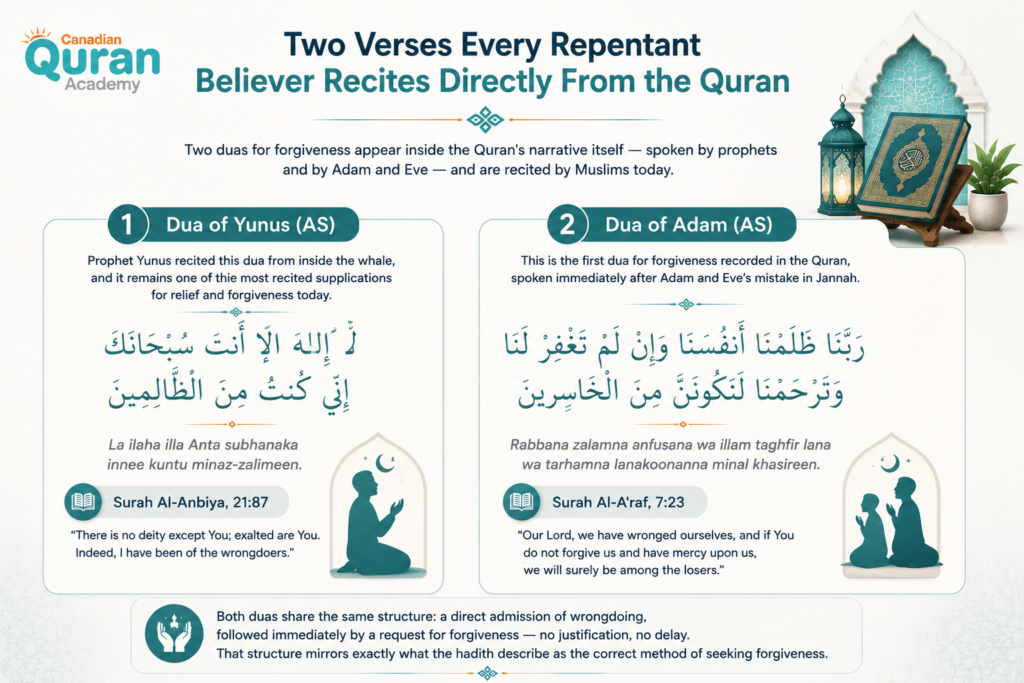
Two duas for forgiveness appear inside the Quran’s narrative itself — spoken by prophets and by Adam and Eve — and are recited by Muslims today for the same reason they were first spoken.
1. The Dua of Prophet Yunus (AS) — Ayat e-Kareema
Prophet Yunus recited this dua from inside the whale, and it remains one of the most recited supplications for relief and forgiveness today.
لَّا إِلَـٰهَ إِلَّا أَنتَ سُبْحَانَكَ إِنِّي كُنتُ مِنَ الظَّالِمِينَ
La ilaha illa Anta subhanaka innee kuntu minaz-zalimeen.” — Surah Al-Anbiya, 21:87
“There is no deity except You; exalted are You. Indeed, I have been of the wrongdoers.
2. The Dua of Adam and Eve
This is the first dua for forgiveness recorded in the Quran, spoken immediately after Adam and Eve’s mistake in Jannah.
رَبَّنَا ظَلَمْنَا أَنفُسَنَا وَإِن لَّمْ تَغْفِرْ لَنَا وَتَرْحَمْنَا لَنَكُونَنَّ مِنَ الْخَاسِرِينَ
Rabbana zalamna anfusana wa illam taghfir lana wa tarhamna lanakoonanna minal khasireen.” — Surah Al-A’raf, 7:23
“Our Lord, we have wronged ourselves, and if You do not forgive us and have mercy upon us, we will surely be among the losers.
Both duas share the same structure: a direct admission of wrongdoing, followed immediately by a request for forgiveness — no justification, no delay. That structure is worth noticing on its own, since it mirrors exactly what the hadith below describe as the correct method of seeking forgiveness.
Read also: Quran Verses About Marriage in Arabic
How These Verses Apply to Specific Sins?
Not every sin is treated the same way in the texts above, and the Quran and Sunnah give different instructions depending on what’s being forgiven.
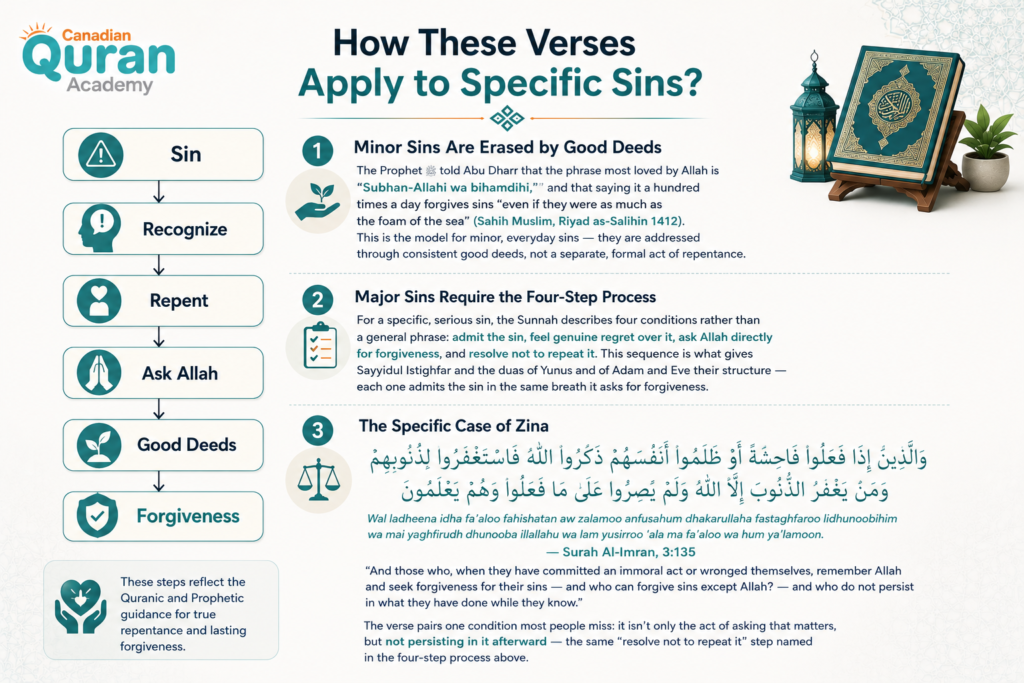
1. Minor Sins Are Erased by Good Deeds
The Prophet ﷺ told Abu Dharr that the phrase most loved by Allah is “Subhan-Allahi wa bihamdihi,” and that saying it a hundred times a day forgives sins “even if they were as much as the foam of the sea” (Sahih Muslim, Riyad as-Salihin 1412). This is the model for minor, everyday sins — they are addressed through consistent good deeds, not a separate, formal act of repentance.
2. Major Sins Require the Four-Step Process
For a specific, serious sin, the Sunnah describes four conditions rather than a general phrase: admit the sin, feel genuine regret over it, ask Allah directly for forgiveness, and resolve not to repeat it. This sequence is what gives Sayyidul Istighfar and the duas of Yunus and of Adam and Eve their structure — each one admits the sin in the same breath it asks for forgiveness.
3. The Specific Case of Zina
Surah Al-Imran addresses this sin by name rather than leaving it under a general instruction.
وَالَّذِينَ إِذَا فَعَلُوا فَاحِشَةً أَوْ ظَلَمُوا أَنفُسَهُمْ ذَكَرُوا اللَّهَ فَاسْتَغْفَرُوا لِذُنُوبِهِمْ وَمَن يَغْفِرُ الذُّنُوبَ إِلَّا اللَّهُ وَلَمْ يُصِرُّوا عَلَىٰ مَا فَعَلُوا وَهُمْ يَعْلَمُونَ
Wal ladheena idha fa’aloo fahishatan aw zalamoo anfusahum dhakarullaha fastaghfaroo lidhunoobihim wa mai yaghfirudh dhunooba illallahu wa lam yusirroo ‘ala ma fa’aloo wa hum ya’lamoon.” — Surah Al-Imran, 3:135
“And those who, when they have committed an immoral act or wronged themselves, remember Allah and seek forgiveness for their sins — and who can forgive sins except Allah? — and who do not persist in what they have done while they know.
The verse pairs one condition most people miss: it isn’t only the act of asking that matters, but not persisting in it afterward — the same “resolve not to repeat it” step named in the four-step process above.
How to Recite These Verses With the Meaning Intact?
Reading a transliteration is enough to get through the words of a dua. It is not enough to understand what is actually being asked of Allah.
The Quran verses about forgiveness in Arabic use specific, deliberate vocabulary — ghafara (to forgive and cover a sin), tawbah (repentance, literally “to return”), and rahma (mercy) are not interchangeable, and each carries a different shade of meaning across the ayat above. A translation flattens these distinctions into one English word, which is why many reciters can say Sayyidul Istighfar from memory without registering that they are naming a specific favor of Allah and a specific sin in the same sentence.
Building that kind of verse-by-verse familiarity, rather than surface-level memorization, is what a structured reading plan is designed for. Our beginner Quran courses start from correct pronunciation of exactly these kinds of verses, so the meaning isn’t lost underneath the sound.
Verses that repeat across surahs — like the forgiving-others instruction in both 24:22 and 7:199 — are also easier to retain when studied for memorization rather than read once.

Live Class in Action
Watch how our instructors interact with students in real-time, focusing on interactive methods.
Start Your Quranic Journey in Canada
Join our vibrant community and learn with expert tutors through our flexible online platform.
Claim Your Free TrialStudy These Verses in Depth With The Canadian Quran Academy
Reciting these verses is worth doing well — for your Deen, your understanding, and your connection to the Quran. The only question is whether you learn them with the right support.
The Canadian Quran Academy offers:
- Qualified, experienced instructors — Al-Azhar-trained in Tajweed and tafsir, not just recitation
- Personalized 1-on-1 sessions matched to your specific goal — Quranic Arabic, Tajweed correction, or full tafsir study
- Flexible scheduling across Canadian time zones — morning, evening, and weekend sessions
- Programs for adults, children, and complete beginners
- Free trial lesson — no commitment required
Book your free trial at The Canadian Quran Academy and start reciting these verses with a teacher who can walk you through the meaning as well as the pronunciation.

Our Quran Courses
- Quran Online Academy
- Quran Recitation Classes
- Quran Reading Classes
- Online Quran Classes for Kids
- Quran Classes for Adults
- Quran Classes for Female/Sisters
- Learn Quran for Beginners
- Quran Memorization (Hifz) Course
- Hifz Classes for Adults
- Quran Memorization and Hifz for Kids
- Quran Hifz for Ladies
- Quran Ijazah Program
- Quran Qirat Learning Course
- Quran Tafsir Course
- Noorani Qaida Course
- Noorani Qaida Course for Kids
- Weekend Quran Classes
- Intensive Quran Course
- Al-Azhar Quran Course
- Online Tajweed Classes
- Tajweed Course for Kids
- Tajweed Course for Adults
- Tajweed Course for Ladies/Sisters
Start Your Quranic Journey in Canada
Join our vibrant community and learn with expert tutors through our flexible online platform.
Claim Your Free TrialConclusion
Quran verses about forgiveness in Arabic return to the same argument from different directions: Surah Az-Zumar’s promise that Allah “forgives all sins,” the transformation described in Surah Al-Furqan, and the duas of Yunus and of Adam and Eve, all point to one conclusion — Allah’s mercy is not conditional on the size of the sin, only on the sincerity of the return.
The hadith add the practical side — specific wording, like Sayyidul Istighfar, and specific habits, like repeating istighfar dozens of times a day, that turn belief in forgiveness into daily practice rather than an idea held only in theory. Read alongside their Arabic text and correct reference, these verses and hadith are not just comforting to hear — they are meant to be understood, recited, and returned to.
Frequently Asked Questions
How do I know if Allah has forgiven me?
The Quran does not ask for certainty about forgiveness — it asks for sincerity of repentance. If you have genuinely returned to Allah with remorse, resolved not to repeat the sin, and made amends where needed, the promise in Surah Az-Zumar, 39:53 applies to you. Feeling concerned about a sin is itself a sign of a conscience that is still responsive.
Is there any sin that cannot be forgiven in Islam?
Every sin is forgivable through sincere tawbah, with one exception: dying in a state of shirk without repenting from it (Surah An-Nisa, 4:48). Short of that, the hadith in Jami’ at-Tirmidhi 3540 states plainly that sins “reaching the clouds of the sky” are still forgiven upon sincere istighfar.
How do I seek forgiveness from Allah in Islam?
Seeking forgiveness follows four steps drawn directly from the Sunnah: admit the specific sin, feel genuine regret over it, ask Allah for forgiveness through istighfar, and resolve not to repeat it. Reciting Sayyidul Istighfar (Sahih al-Bukhari 6306) while consciously holding these four steps in mind is the method taught by the Prophet ﷺ.
What is the most powerful dua for forgiveness in the Quran?
Scholars often point to the dua of Prophet Yunus (AS) in Surah Al-Anbiya, 21:87, because it was answered with immediate relief from total helplessness. Sayyidul Istighfar from Sahih al-Bukhari 6306 is described by the Prophet ﷺ himself as the most superior wording for asking forgiveness.
How many times should I say Astaghfirullah?
There is no fixed minimum. The Prophet ﷺ reported saying it more than seventy times a day in Sahih al-Bukhari 6307, and a related narration in Sunan Ibn Majah 3815 records a hundred times a day. The number matters less than saying it with attention to its meaning rather than as a quick, repeated phrase.






Leave a Reply