 Quran
Quran
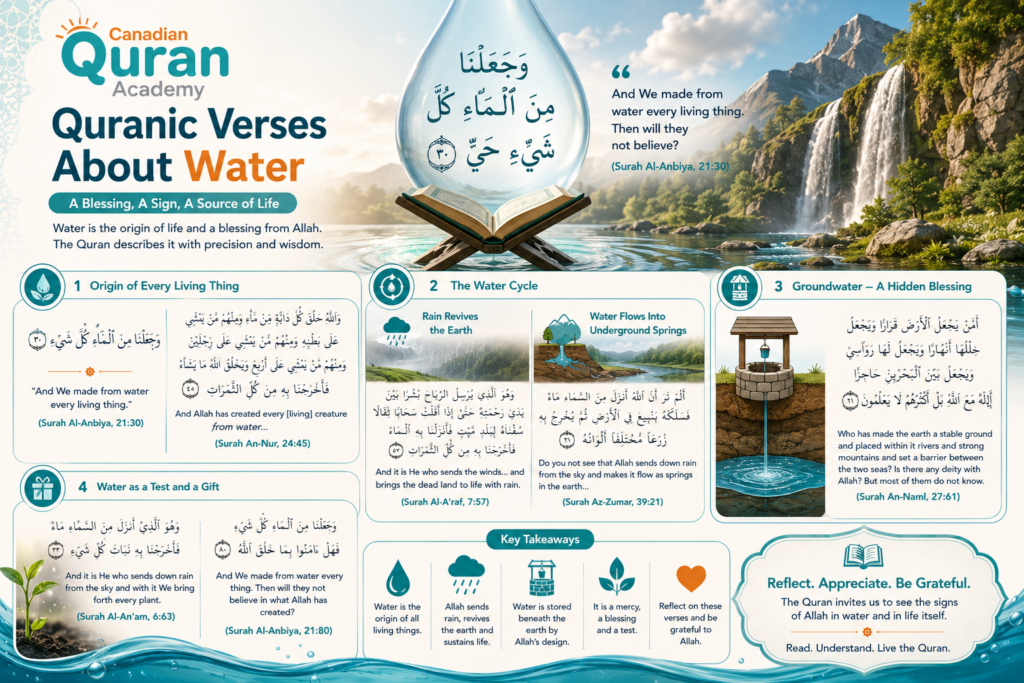
Water appears in the Quran more than 60 times. It is the origin of life, the foundation of creation, and — in the Quran’s own words — a blessing that Allah alone controls, sends, stores, and could just as easily take away. If you are searching for Quranic verses about water in Arabic, this guide brings the most direct ones together in one place: full Arabic text with tashkeel, English translation, surah name, ayah number, and a direct link to each verse on Quran.com.
Every reference in this article comes from the Quran only — no hadith. The verses are grouped by theme so you can find exactly what you are looking for, whether for study, reflection, citation, or understanding what the Quran actually says about water as its central subject.
What the Quran Says About Water and the Origin of Every Living Thing?
The Quran’s most foundational statement about water is not about rain or rivers — it is about life itself. Before any other theme, the Quran establishes water as the origin from which every living thing was made.
1. Water as the Source of All Living Things
This is the Quran’s broadest and most direct verse on water and creation. It appears in a verse that challenges those who refuse to reflect:
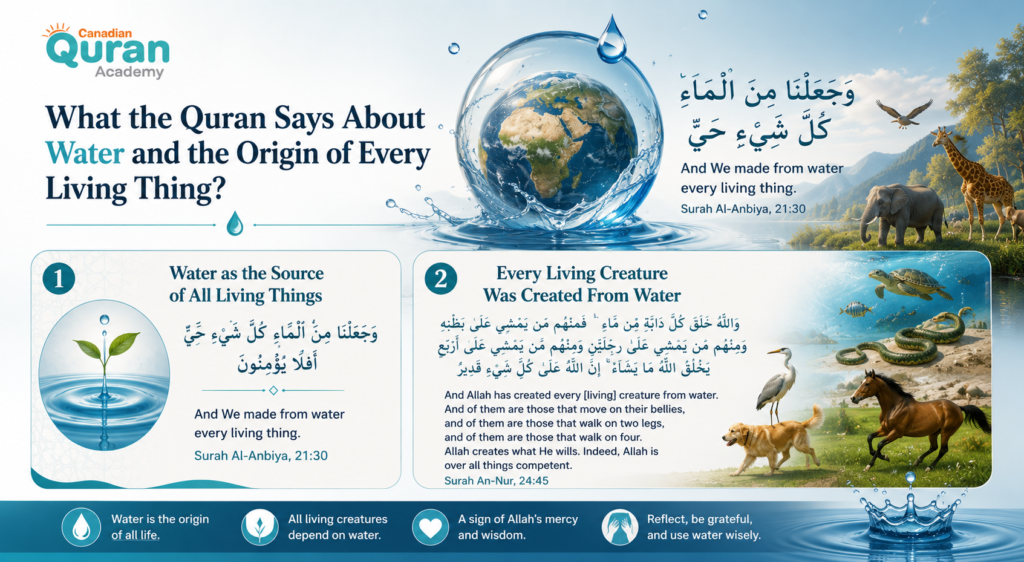
وَجَعَلْنَا مِنَ الْمَاءِ كُلَّ شَيْءٍ حَيٍّ ۖ أَفَلَا يُؤْمِنُونَ
“And We made from water every living thing. Then will they not believe?” (Surah Al-Anbiya, 21:30)
The phrase كُلَّ شَيْءٍ حَيٍّ — “every living thing” — carries no qualification or exception. Every organism, every creature, every form of life the Quran places under the same origin. Modern biology’s confirmation that all living cells depend on water for their most basic functions gives this verse a precision that continues to reward reflection.
2. Every Living Creature Was Created From Water
The Quran expands the concept of water beyond the origin of life by stating that every moving creature was created from it.
وَاللَّهُ خَلَقَ كُلَّ دَابَّةٍ مِّن مَّاءٍ ۖ فَمِنْهُم مَّن يَمْشِي عَلَىٰ بَطْنِهِ وَمِنْهُم مَّن يَمْشِي عَلَىٰ رِجْلَيْنِ وَمِنْهُم مَّن يَمْشِي عَلَىٰ أَرْبَعٍ ۚ يَخْلُقُ اللَّهُ مَا يَشَاءُ ۚ إِنَّ اللَّهَ عَلَىٰ كُلِّ شَيْءٍ قَدِيرٌ
“And Allah has created every [living] creature from water. And of them are those that move on their bellies, and of them are those that walk on two legs, and of them are those that walk on four. Allah creates what He wills. Indeed, Allah is over all things competent.” (Surah An-Nur, 24:45)
The classification — belly-crawlers, two-legged, four-legged — covers the major categories of animate life in a single ayah, all traced back to the same origin. The verse closes not with a description of water but with a statement about divine power: يَخْلُقُ اللَّهُ مَا يَشَاءُ. Water is the material; the will is entirely Allah’s.
Students memorizing these verses through a Hifz program will notice this parallel structure recurring as one of the Quran’s most consistent rhetorical patterns — the same divine act demonstrated in the visible world as evidence for what will happen in the unseen.

Read More: Quranic Verses About Tawheed in Arabic
Quran Verses About the Water Cycle
The Quran describes how water is sent down from the sky, stored beneath the earth, and used to bring life to plants and crops. These verses highlight water as a carefully measured blessing from Allah, sustaining life through every stage of its journey.
1. Rain Revives the Earth
Rain is one of the greatest signs of Allah’s mercy, bringing barren land back to life. The Quran repeatedly presents this transformation as evidence of His power and wisdom.
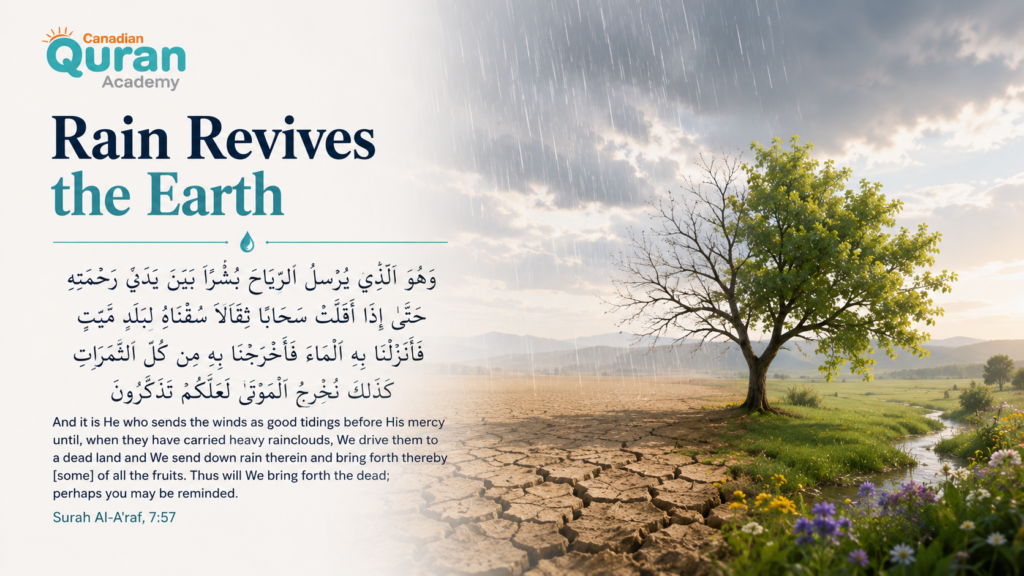
وَهُوَ الَّذِي يُرْسِلُ الرِّيَاحَ بُشْرًا بَيْنَ يَدَيْ رَحْمَتِهِ ۖ حَتَّىٰ إِذَا أَقَلَّتْ سَحَابًا ثِقَالًا سُقْنَاهُ لِبَلَدٍ مَّيِّتٍ فَأَنزَلْنَا بِهِ الْمَاءَ فَأَخْرَجْنَا بِهِ مِن كُلِّ الثَّمَرَاتِ ۚ كَذَٰلِكَ نُخْرِجُ الْمَوْتَىٰ لَعَلَّكُمْ تَذَكَّرُونَ
“And it is He who sends the winds as good tidings before His mercy until, when they have carried heavy rainclouds, We drive them to a dead land and We send down rain therein and bring forth thereby [some] of all the fruits. Thus will We bring forth the dead; perhaps you may be reminded.” (Surah Al-A’raf, 7:57)
The verse closes by drawing a direct comparison between rain reviving dead earth and the resurrection of the dead — not as a metaphor, but as a logical parallel. If water can bring life back to land that appeared permanently dead, the same divine power operates on a greater scale on the Day of Resurrection.
Read also: Quranic Verses on Cleanliness in Arabic
2. Water Flows Into Underground Springs
The Quran explains that rainwater is not lost after it falls but is guided into underground springs. This hidden storage reflects Allah’s perfect planning and provision for life.
أَلَمْ تَرَ أَنَّ اللَّهَ أَنزَلَ مِنَ السَّمَاءِ مَاءً فَسَلَكَهُ يَنَابِيعَ فِي الْأَرْضِ ثُمَّ يُخْرِجُ بِهِ زَرْعًا مُّخْتَلِفًا أَلْوَانُهُ ثُمَّ يَهِيجُ فَتَرَاهُ مُصْفَرًّا ثُمَّ يَجْعَلُهُ حُطَامًا ۚ إِنَّ فِي ذَٰلِكَ لَذِكْرَىٰ لِأُولِي الْأَلْبَابِ
“Do you not see that Allah sends down rain from the sky and makes it flow as springs [and rivers] in the earth; then He produces thereby crops of varying colors; then they dry and you see them turned yellow; then He makes them [scattered] debris. Indeed in that is a reminder for those of understanding.” (Surah Az-Zumar, 39:21)
This single verse traces the complete agricultural water cycle: rainfall → underground springs → crops → harvest → decay. The Arabic verb فَسَلَكَهُ (He channels it, makes it travel along a path) is a precise term for directional flow, not random seepage — the Quran describes groundwater movement as guided, not incidental.
Students working through Quran reading courses often find these verses among the most linguistically rewarding in the Quran, because the verb patterns chosen for each stage carry shades of meaning no single English word fully captures.

Live Class in Action
Watch how our instructors interact with students in real-time, focusing on interactive methods.
Start Your Quranic Journey in Canada
Join our vibrant community and learn with expert tutors through our flexible online platform.
Claim Your Free TrialQuranic Verses About Groundwater
The Quran describes water stored beneath the earth’s surface not as a geological accident but as a provision placed there by divine measure. Two verses address this directly.
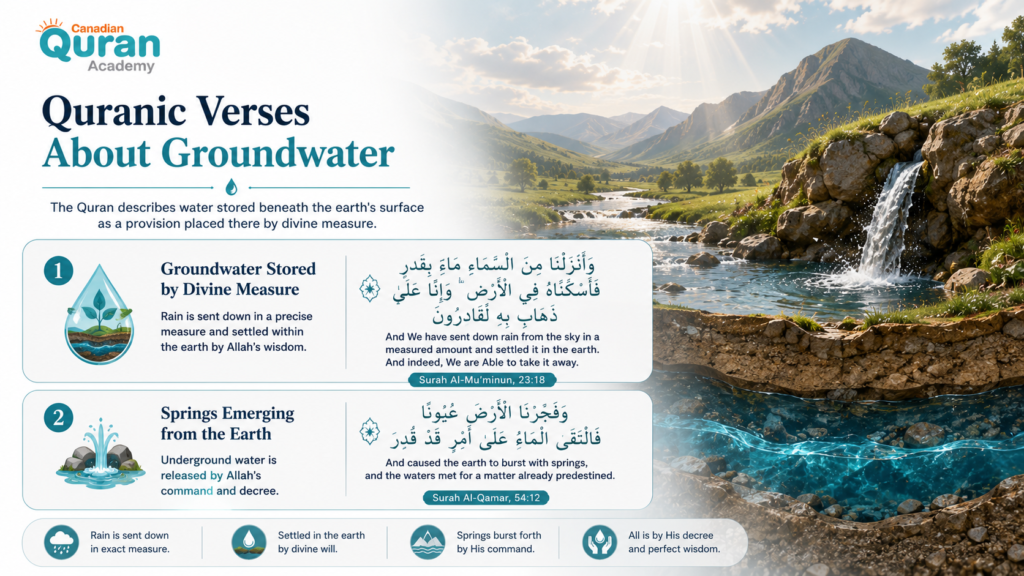
1. Groundwater Stored by Divine Measure
The Quran describes groundwater as a blessing deliberately placed beneath the earth by Allah. This verse explains that rain is sent down in precise measure and then settled within the earth according to His perfect wisdom.
وَأَنزَلْنَا مِنَ السَّمَاءِ مَاءً بِقَدَرٍ فَأَسْكَنَّاهُ فِي الْأَرْضِ ۖ وَإِنَّا عَلَىٰ ذَهَابٍ بِهِ لَقَادِرُونَ
“And We have sent down rain from the sky in a measured amount and settled it in the earth. And indeed, We are Able to take it away.” (Surah Al-Mu’minun, 23:18)
Two Arabic words carry the theological weight of this verse.
بِقَدَرٍ means in an exact, predetermined measure — not randomly, not in excess or deficit.
فَأَسْكَنَّاهُ means We caused it to dwell, to settle — the same verb root used elsewhere in the Quran for human habitation. The Quran describes groundwater as settled by deliberate divine decision, and closes with a direct statement of Allah’s ability to remove it entirely.
2. The Quran’s Description of Springs Emerging from the Earth
The Quran also portrays underground water as something released only by Allah’s command. This verse illustrates how springs emerge from the earth as part of His divine decree, demonstrating His complete control over the natural world.
وَفَجَّرْنَا الْأَرْضَ عُيُونًا فَالْتَقَى الْمَاءُ عَلَىٰ أَمْرٍ قَدْ قُدِرَ
“And caused the earth to burst with springs, and the waters met for a matter already predestined.” (Surah Al-Qamar, 54:12)
The phrase عَلَىٰ أَمْرٍ قَدْ قُدِرَ — “for a matter already predestined” — frames the meeting of underground waters as a planned event, not a natural coincidence. The verb فَجَّرْنَا (We caused to burst forth) describes an active, forceful release — springs as something opened, not something that simply leaked.
Read More: Quranic Verses About Arabic Language
Quranic Verses on Water as Physical and Spiritual Purification
The Quran treats water as a purifying agent that operates on two levels simultaneously — it cleanses the body and removes spiritual harm. This dual function appears explicitly in two verses and is one of the most theologically precise observations the Quran makes about water’s nature.
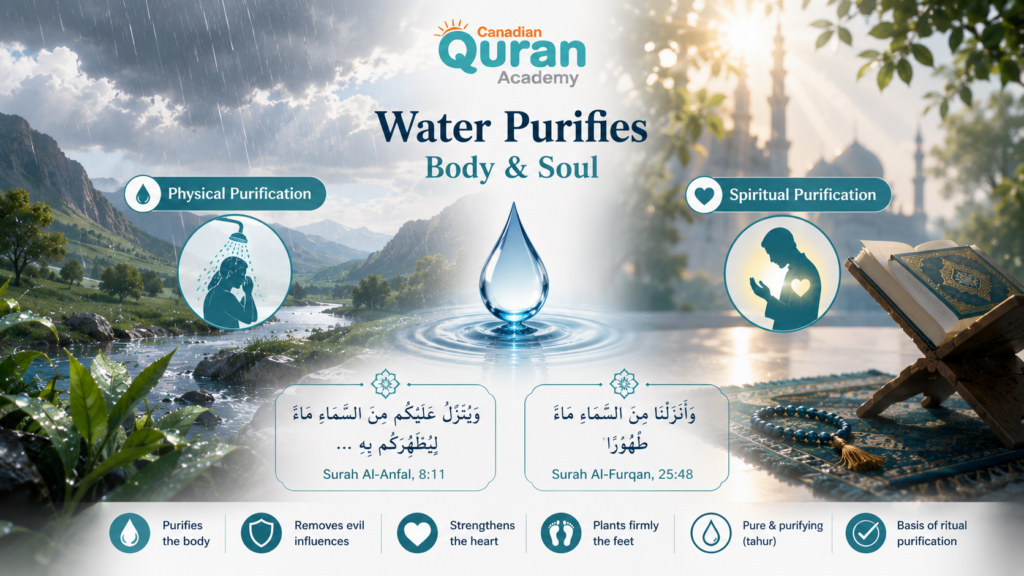
1. Rain as a Source of Physical and Spiritual Purification
The Quran presents rain as more than a source of physical life—it is also a means of spiritual purification. In this verse, Allah explains the multiple blessings of rain, showing how it cleanses the body while strengthening the heart and removing the whispers of Satan.
وَيُنَزِّلُ عَلَيْكُم مِّنَ السَّمَاءِ مَاءً لِّيُطَهِّرَكُم بِهِ وَيُذْهِبَ عَنكُمْ رِجْزَ الشَّيْطَانِ وَلِيَرْبِطَ عَلَىٰ قُلُوبِكُمْ وَيُثَبِّتَ بِهِ الْأَقْدَامَ
“And He sends down upon you rain from the sky to purify you thereby, to remove from you the evil [suggestions] of Satan, to make firm your hearts, and to plant firmly your feet.” (Surah Al-Anfal, 8:11)
This verse connects rain to four outcomes simultaneously: physical purification (لِّيُطَهِّرَكُم), removal of Satanic influence, firm hearts, and firm footing. The four outcomes are presented not as interpretations of the verse but as the stated divine purposes behind sending the rain — making water’s spiritual function as explicit as its physical one.
2. The Quran’s Description of Purifying Water
Not all descriptions of water in the Quran are the same. In Surah Al-Furqan, Allah describes rainwater as ṭahūr—a term that signifies water that is inherently pure and capable of purifying others, forming the basis for Islamic rulings on ritual purification.
وَهُوَ الَّذِي أَرْسَلَ الرِّيَاحَ بُشْرًا بَيْنَ يَدَيْ رَحْمَتِهِ ۚ وَأَنزَلْنَا مِنَ السَّمَاءِ مَاءً طَهُورًا
“And it is He who sends the winds as good tidings before His mercy, and We send down from the sky pure water.” (Surah Al-Furqan, 25:48)
The word طَهُورًا (tahur) is not simply “clean.” It describes something that is itself pure and that purifies whatever it contacts — an active purifying agent, not a passive clean substance. Islamic jurisprudence uses this specific Quranic term as the technical standard for which types of water are valid for ritual purification (wudu and ghusl), distinguishing tahur water from water that is merely clean but cannot purify others.
For students working through intensive Quran programs, these verses are particularly important because the Arabic root ط ه ر (purification) connects them directly to the jurisprudential concept of taharah — the foundation of Islamic ritual cleanliness.

Quranic Verses on Rain Reviving Dead Land — and What It Proves
The Quran draws a direct and repeated parallel between rain reviving barren land and Allah bringing the dead back to life on the Day of Resurrection. This parallel appears across multiple surahs — each time presenting water’s power over dead earth as a logical proof for resurrection, not merely a poetic comparison.
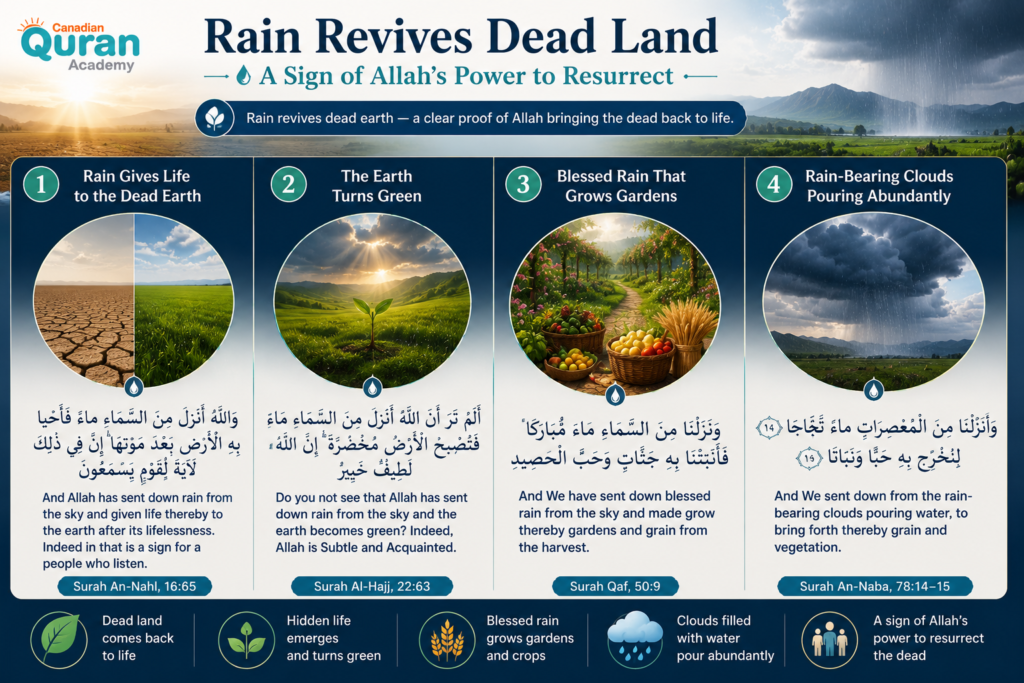
1. Rain Gives Life to the Dead Earth
The Quran repeatedly presents rainfall as a sign of Allah’s power to restore life. What appears to be lifeless land is transformed by rain into a living landscape, reminding people of His ability to create, sustain, and resurrect.
وَاللَّهُ أَنزَلَ مِنَ السَّمَاءِ مَاءً فَأَحْيَا بِهِ الْأَرْضَ بَعْدَ مَوْتِهَا ۚ إِنَّ فِي ذَٰلِكَ لَآيَةً لِّقَوْمٍ يَسْمَعُونَ
“And Allah has sent down rain from the sky and given life thereby to the earth after its lifelessness. Indeed in that is a sign for a people who listen.” (Surah An-Nahl, 16:65)
2. The Earth Turns Green
The transformation of dry land into vibrant greenery is one of the Quran’s most vivid images of divine mercy. This verse invites believers to observe how Allah brings hidden life from beneath the soil through rainfall.
أَلَمْ تَرَ أَنَّ اللَّهَ أَنزَلَ مِنَ السَّمَاءِ مَاءً فَتُصْبِحُ الْأَرْضُ مُخْضَرَّةً ۗ إِنَّ اللَّهَ لَطِيفٌ خَبِيرٌ
“Do you not see that Allah has sent down rain from the sky and the earth becomes green? Indeed, Allah is Subtle and Acquainted.” (Surah Al-Hajj, 22:63)
The pairing of لَطِيفٌ (the Subtle) with خَبِيرٌ (the All-Aware) at the end of a rain verse is precise: Allah’s knowledge of what lies hidden in the soil is what enables the subtle, exact delivery of what brings it to life. The two divine names are not decoration — they explain the mechanism.
3. Blessed Rain That Grows Gardens
The Quran describes rain as mubārak (blessed), emphasizing that its benefit extends beyond watering the land. By Allah’s permission, this blessed rain becomes the source of flourishing gardens, crops, and abundant provision.
وَنَزَّلْنَا مِنَ السَّمَاءِ مَاءً مُّبَارَكًا فَأَنبَتْنَا بِهِ جَنَّاتٍ وَحَبَّ الْحَصِيدِ
“And We have sent down blessed rain from the sky and made grow thereby gardens and grain from the harvest.” (Surah Qaf, 50:9)
The word مُّبَارَكًا (mubarakan — blessed) is applied directly to the rain itself, not only to its results. The Quran frames blessing as a property inherent in the water, not a side effect of what it grows.
4. The Quran’s Description of Rain-Bearing Clouds
The Quran uses vivid language to describe clouds filled with rain and the abundant water they release. These expressions highlight both the precision of Allah’s creation and the life-giving purpose behind every rainfall.
وَأَنزَلْنَا مِنَ الْمُعْصِرَاتِ مَاءً ثَجَّاجًا ﴿١٤﴾ لِّنُخْرِجَ بِهِ حَبًّا وَنَبَاتًا
“And We sent down from the rain-bearing clouds pouring water, to bring forth thereby grain and vegetation.” (Surah An-Naba, 78:14–15)
الْمُعْصِرَاتِ refers specifically to clouds so heavily laden with water they are on the point of releasing it — the image of a cloth being wrung out.
ثَجَّاجًا means cascading, pouring in abundance. These are not general words for rain; they are precise vocabulary for a specific intensity of rainfall.
The Barrier Between Freshwater and Saltwater in the Quran
The Quran describes two bodies of water meeting yet remaining distinct — held apart by an invisible boundary it calls a barzakh. This phenomenon appears in two separate surahs, each adding a different dimension to the same observation.
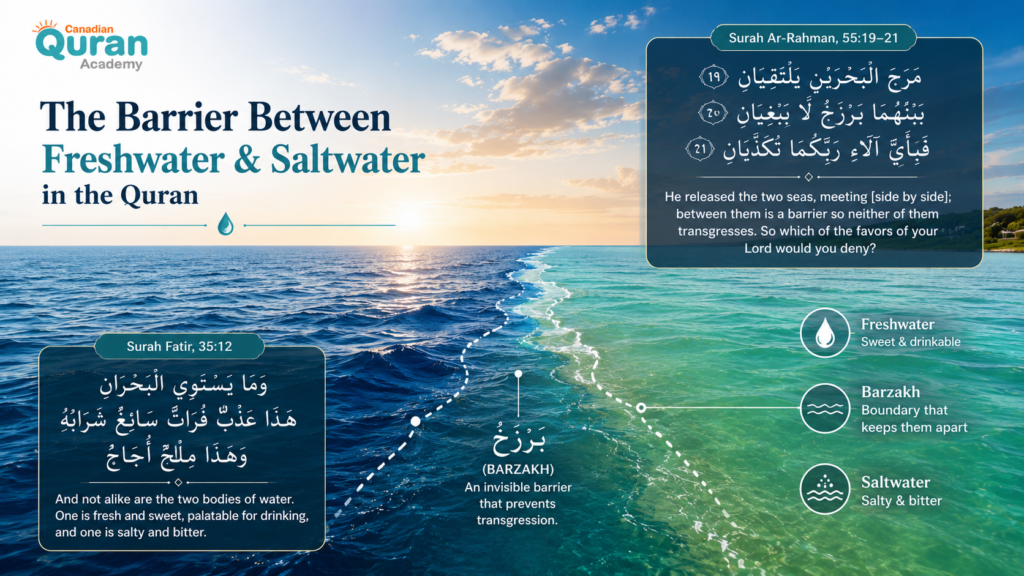
مَرَجَ الْبَحْرَيْنِ يَلْتَقِيَانِ ﴿١٩﴾ بَيْنَهُمَا بَرْزَخٌ لَّا يَبْغِيَانِ ﴿٢٠﴾ فَبِأَيِّ آلَاءِ رَبِّكُمَا تُكَذِّبَانِ
“He released the two seas, meeting [side by side]; between them is a barrier so neither of them transgresses. So which of the favors of your Lord would you deny?” (Surah Ar-Rahman, 55:19–21)
وَمَا يَسْتَوِي الْبَحْرَانِ هَٰذَا عَذْبٌ فُرَاتٌ سَائِغٌ شَرَابُهُ وَهَٰذَا مِلْحٌ أُجَاجٌ
“And not alike are the two bodies of water. One is fresh and sweet, palatable for drinking, and one is salty and bitter.” (Surah Fatir, 35:12)
The Arabic بَرْزَخٌ (barzakh) is a specific Quranic term for a boundary that is real but invisible — a barrier that prevents transgression without being a physical wall. Oceanographers have documented haloclines and density-based mixing barriers between saltwater and freshwater at river estuaries, where the two bodies meet but maintain distinct chemical identities. The Quran names this as a divine arrangement, not a natural accident.
Read More: Quran Verses for Broken Hearts in Arabic
What the Quran Says About the Loss of Water — and Why You Should Be Grateful?
The Quran does not only describe water as a gift. It describes its withdrawal as a real and possible outcome, and uses that possibility directly to ask: why are you not grateful?
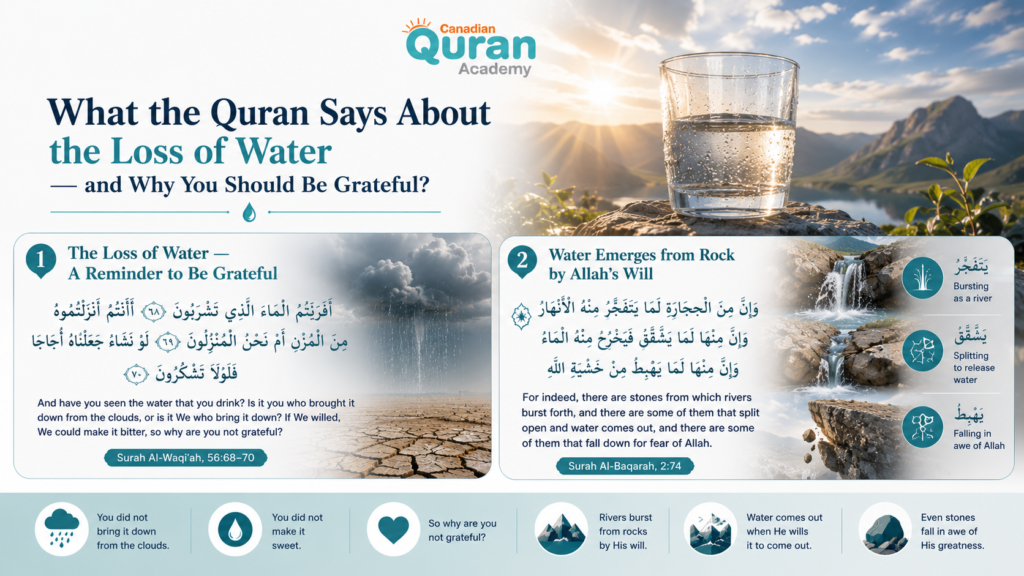
أَفَرَأَيْتُمُ الْمَاءَ الَّذِي تَشْرَبُونَ ﴿٦٨﴾ أَأَنتُمْ أَنزَلْتُمُوهُ مِنَ الْمُزْنِ أَمْ نَحْنُ الْمُنزِلُونَ ﴿٦٩﴾ لَوْ نَشَاءُ جَعَلْنَاهُ أُجَاجًا فَلَوْلَا تَشْكُرُونَ
“And have you seen the water that you drink? Is it you who brought it down from the clouds, or is it We who bring it down? If We willed, We could make it bitter, so why are you not grateful?” (Surah Al-Waqi’ah, 56:68–70)
Three questions move in sequence, each one stripping away a further human claim on drinking water: did you bring it from the clouds? did you ensure it stayed sweet? The answer to both is no — and the verse closes not with a command or a threat but with a question about gratitude, which is rhetorically more forceful than either.
وَإِنَّ مِنَ الْحِجَارَةِ لَمَا يَتَفَجَّرُ مِنْهُ الْأَنْهَارُ ۚ وَإِنَّ مِنْهَا لَمَا يَشَّقَّقُ فَيَخْرُجُ مِنْهُ الْمَاءُ ۚ وَإِنَّ مِنْهَا لَمَا يَهْبِطُ مِنْ خَشْيَةِ اللَّهِ
“For indeed, there are stones from which rivers burst forth, and there are some of them that split open and water comes out, and there are some of them that fall down for fear of Allah.” (Surah Al-Baqarah, 2:74)
The verse uses three distinct Arabic verbs for three different ways water emerges from rock: يَتَفَجَّرُ (bursting as a river), يَشَّقَّقُ (splitting to release water), and يَهْبِطُ (falling in awe of Allah). The specificity of the three verbs reflects close, precise observation of how water actually behaves in rocky terrain.
Experience Our Classrooms
Don’t just take our word for it—take a look inside! Watch the videos below to experience our engaging teaching methods and vibrant online classrooms firsthand.
Start Your Quranic Journey in Canada
Join our vibrant community and learn with expert tutors through our flexible online platform.
Claim Your Free TrialLearn Quranic Arabic with Canadian Quran Academy
Understanding the Quran goes beyond reading its translation. At Canadian Quran Academy, you’ll learn how to explore the Quran in its original Arabic with the guidance of experienced teachers.
- One-on-one live classes with qualified Quran instructors.
- Learn Quranic Arabic to understand the vocabulary, grammar, and rhetorical beauty behind every verse.
- Master accurate Quran reading with proper pronunciation and Tajweed.
- Programs for children and adults, from complete beginners to advanced learners.
- Structured Hifz and Quran reading courses tailored to your learning goals.
- Flexible class schedules designed for Canadian time zones.
- FREE trial class with no obligation to enroll.
Book your FREE trial class today and begin reading—and understanding—the Quran directly from its original Arabic.
Our Quran Courses
- Quran Online Academy
- Quran Recitation Classes
- Quran Reading Classes
- Online Quran Classes for Kids
- Quran Classes for Adults
- Quran Classes for Female
- Learn Quran Course for Beginners
- Quran Memorization (Hifz) Course
- Hifz Classes for Adults
- Quran Memorization and Hifz Course for Kids
- Quran Hifz Course for Ladies
Start Your Quranic Journey in Canada
Join our vibrant community and learn with expert tutors through our flexible online platform.
Claim Your Free TrialConclusion
The Quranic verses about water in Arabic cover a consistent and connected picture across more than a dozen surahs. Water is the origin of every living thing, the vehicle of purification for body and soul, a resource sent down in measured amounts and stored underground by divine arrangement, and a gift whose withdrawal remains entirely in Allah’s hands. The Quran describes the water cycle with precise Arabic vocabulary, names the invisible barrier between freshwater and saltwater, and presents the diversity of fruits produced by one water as a sign that demands rational reflection. Read together — from Surah Al-Anbiya’s statement on the origin of life, through Surah Az-Zumar’s description of underground springs, to Surah Al-Mulk’s warning about water sinking beyond reach — these verses treat water not as background scenery but as one of the Quran’s central signs of divine power, knowledge, and provision.
Frequently Asked Questions
The Quran discusses water from many perspectives, including creation, purification, sustenance, and the signs of Allah’s power in the natural world. The following frequently asked questions summarize the key verses and concepts explored throughout this guide.
How many times is water mentioned in the Quran?
The word مَاء (water) appears over 60 times in the Quran across more than 40 surahs, covering water’s role in creation, the water cycle, underground storage, purification, agricultural diversity, the barrier between seas, and warnings about its potential loss.
What is the most direct Quranic verse about water and the origin of life?
Surah Al-Anbiya, 21:30 states: “And We made from water every living thing.” It is the broadest and most direct Quranic statement on water and life, with no qualification or category excluded.
Which Quranic verse describes water as purifying?
Surah Al-Furqan, 25:48 describes rain sent from the sky as طَهُورًا (tahur) — a word meaning something that is itself pure and that actively purifies whatever it contacts. Islamic jurisprudence uses this specific Quranic term as the technical standard for water valid in ritual purification.
What does the Quran say about the barrier between freshwater and saltwater?
Surah Ar-Rahman, 55:19–21 describes two seas that meet but do not transgress against each other, held apart by a بَرْزَخٌ (barzakh) — an invisible boundary. Surah Fatir, 35:12 identifies the two bodies as one fresh and sweet, one salty and bitter.
Which verse warns about water becoming inaccessible?
Surah Al-Mulk, 67:30 asks: if your water sank so deep it could not be reached (غَوْرًا), who could bring you flowing water in its place? The verse frames accessible water as a provision entirely under divine control, not a permanent guarantee.
What Arabic word does the Quran use for the water cycle?
The Quran does not use a single term for the water cycle as a whole but uses precise individual verbs for each stage: يُرْسِلُ (sends) for winds, فَيَبْسُطُهُ (spreads) for cloud formation, أَنزَلْنَا (We sent down) for rainfall, and فَسَلَكَهُ (He channels it) for water moving into underground springs — each verb chosen for the specific action it describes.






Leave a Reply