 Quran
Quran
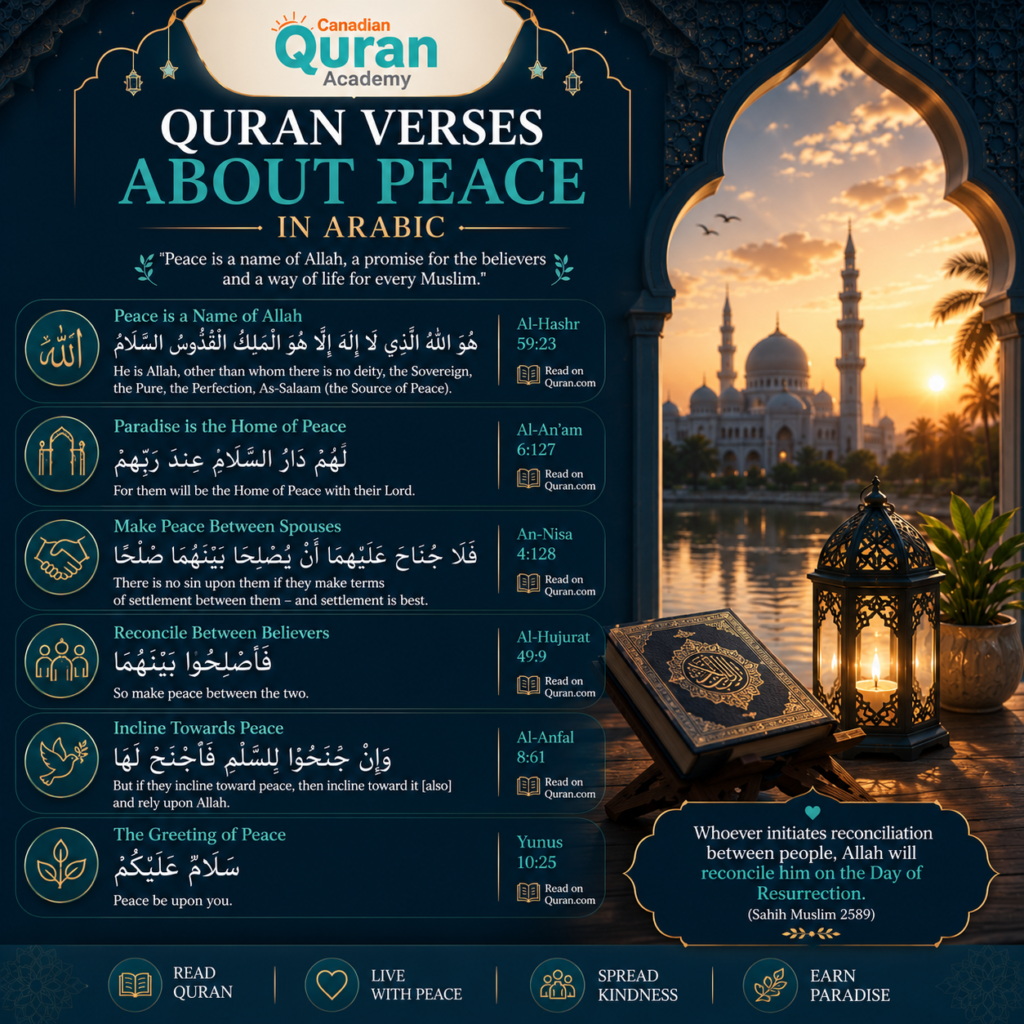
Peace in the Quran is not a single idea expressed once and left behind. It is a name of Allah, a description of Paradise, a greeting exchanged between prophets, and a standard of conduct required even from a Muslim toward someone who insults them. Quran verses about peace in Arabic return to this theme across more than a dozen surahs, and the Arabic wording — as-salaam (السَّلَام) — carries a precision that a single English word cannot fully hold.
Reading these verses in Arabic matters because the root س-ل-م (s-l-m) that gives us “salaam” is the same root behind “Islam” and “taslim” (submission). That connection is not a coincidence of language — it is the Quran’s own way of tying peace to surrender to Allah’s will. This article walks through the Quran’s core verses on peace, in Arabic with full diacritics, alongside their English meaning, exact surah and ayah reference, and the context that explains why each verse says what it says.
What Does the Quran Say About Peace as a Name of Allah?
Before peace is something a person practices, the Quran presents it as something Allah is.
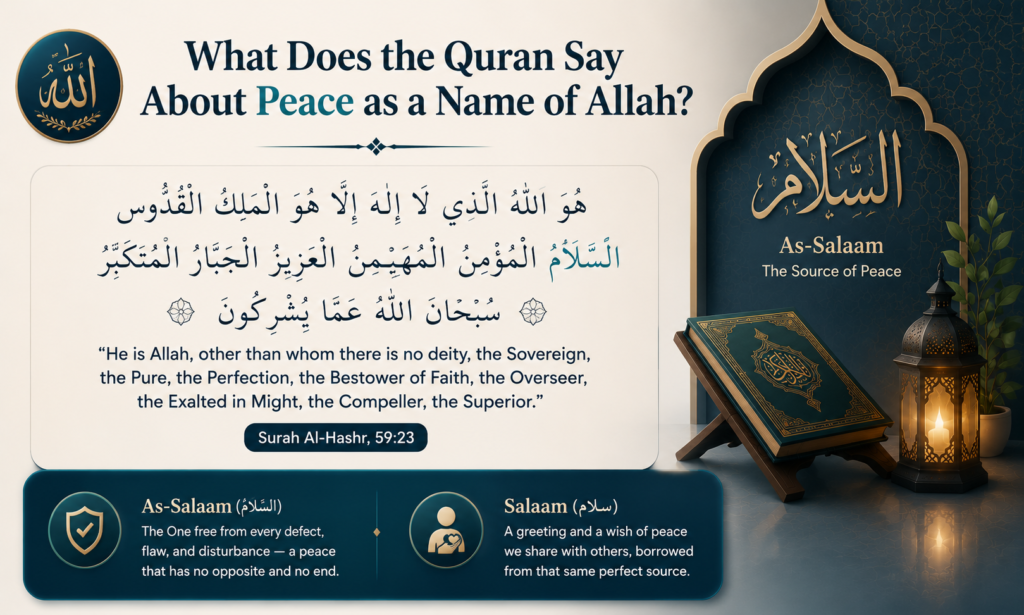
هُوَ اللَّهُ الَّذِي لَا إِلَٰهَ إِلَّا هُوَ الْمَلِكُ الْقُدُّوسُ السَّلَامُ الْمُؤْمِنُ الْمُهَيْمِنُ الْعَزِيزُ الْجَبَّارُ الْمُتَكَبِّرُ ۚ سُبْحَانَ اللَّهِ عَمَّا يُشْرِكُونَ
“He is Allah, other than whom there is no deity, the Sovereign, the Pure, the Perfection, the Bestower of Faith, the Overseer, the Exalted in Might, the Compeller, the Superior.” (Surah Al-Hashr, 59:23)
As-Salaam (السَّلَام) here means the One free of every defect, flaw, and disturbance — a peace that has no opposite and no end. This is why Muslim scholars distinguish As-Salaam as a divine name from salaam as a human greeting: the first describes Allah’s essence, the second is a wish extended from one person to another, borrowed from that same root.
What Does the Quran Say About Paradise as the Home of Peace?
If peace begins as a divine attribute, the next question is where a person experiences it in its complete form. The Quran’s answer is direct: Paradise itself is named after peace.
لَهُمْ دَارُ السَّلَامِ عِندَ رَبِّهِمْ ۖ وَهُوَ وَلِيُّهُم بِمَا كَانُوا يَعْمَلُونَ
“For them will be the Home of Peace with their Lord. And He will be their protecting friend because of what they used to do.” (Surah Al-An’am, 6:127)
The phrase دَارُ السَّلَامِ (Dar As-Salam) is one of the Quran’s names for Paradise, used again a few surahs later:
وَاللَّهُ يَدْعُو إِلَىٰ دَارِ السَّلَامِ وَيَهْدِي مَن يَشَاءُ إِلَىٰ صِرَاطٍ مُّسْتَقِيمٍ
“And Allah invites to the Home of Peace and guides whom He wills to a straight path.” (Surah Yunus, 10:25)
The verb يَدْعُو (yad’u — invites) is deliberate. Paradise is not framed as something earned through negotiation; it is something Allah actively calls people toward, and peace is the specific quality used to describe the destination rather than its comfort, wealth, or scenery.
Learning to read verses like these directly in Arabic — rather than through translation only — is where the precision of words like دَارُ السَّلَامِ becomes clear. This is the kind of detail the Quran reading course at Canadian Quran Academy is built around, teaching students to follow the Arabic text itself instead of relying on a single translated phrase.

Read More: Quranic Verses About Water in Arabic
What Does the Quran Say About Making Peace Between People?
Peace in the Quran is not only a spiritual state — it is also a practical obligation between people who disagree.
1. Reconciling Between a Husband and Wife
The Quran does not leave marital conflicts without guidance. It encourages reconciliation whenever possible and outlines practical steps to preserve the marriage through mutual agreement and fair mediation before separation becomes necessary.
وَإِنِ امْرَأَةٌ خَافَتْ مِن بَعْلِهَا نُشُوزًا أَوْ إِعْرَاضًا فَلَا جُنَاحَ عَلَيْهِمَا أَن يُصْلِحَا بَيْنَهُمَا صُلْحًا ۚ وَالصُّلْحُ خَيْرٌ
“And if a woman fears from her husband contempt or evasion, there is no sin upon them if they make terms of settlement between them — and settlement is best.” (Surah An-Nisa, 4:128)
The verse states صُلْحٌ خَيْرٌ — “settlement is best” — as a general principle, not a conditional one. A related verse instructs bringing in a neutral arbitrator from each side when a marriage is under strain:
وَإِنْ خِفْتُمْ شِقَاقَ بَيْنِهِمَا فَابْعَثُوا حَكَمًا مِّنْ أَهْلِهِ وَحَكَمًا مِّنْ أَهْلِهَا إِن يُرِيدَا إِصْلَاحًا يُوَفِّقِ اللَّهُ بَيْنَهُمَا
“And if you fear dissension between the two, send an arbitrator from his people and an arbitrator from her people. If they both desire reconciliation, Allah will cause it between them.” (Surah An-Nisa, 4:35)
2. Reconciling Between Two Groups of Believers
The Quran extends the principle of reconciliation beyond the family to the entire Muslim community. When conflict arises between believers, it provides a clear process for restoring justice, ending hostility, and preserving the bonds of brotherhood.
The same principle scales up from a household to a community. When two groups of believers are in conflict, the Quran gives a specific sequence rather than a vague call to “get along”:
وَإِن طَائِفَتَانِ مِنَ الْمُؤْمِنِينَ اقْتَتَلُوا فَأَصْلِحُوا بَيْنَهُمَا ۖ فَإِن بَغَتْ إِحْدَاهُمَا عَلَى الْأُخْرَىٰ فَقَاتِلُوا الَّتِي تَبْغِي حَتَّىٰ تَفِيءَ إِلَىٰ أَمْرِ اللَّهِ
“And if two factions among the believers should fight, then make settlement between the two. But if one of them oppresses the other, then fight against the one that oppresses until it returns to the ordinance of Allah.” (Surah Al-Hujurat, 49:9)
إِنَّمَا الْمُؤْمِنُونَ إِخْوَةٌ فَأَصْلِحُوا بَيْنَ أَخَوَيْكُمْ ۚ وَاتَّقُوا اللَّهَ لَعَلَّكُمْ تُرْحَمُونَ
“The believers are but brothers, so make settlement between your brothers.” (Surah Al-Hujurat, 49:10)
The word إِخْوَةٌ (brothers) in 49:10 is the reasoning behind 49:9’s instruction — the Quran treats reconciliation as an obligation between family, not a courtesy between strangers.
Teaching children the vocabulary of peace and reconciliation directly from the Quran’s own wording is easier to build early than to retrofit later. The Hifz program for kids at Canadian Quran Academy works through verses like these as part of memorization, so children connect the meaning to the words they are learning by heart — not just the sounds.
Experience Our Classrooms
Don’t just take our word for it—take a look inside! Watch the videos below to experience our engaging teaching methods and vibrant online classrooms firsthand.
Start Your Quranic Journey in Canada
Join our vibrant community and learn with expert tutors through our flexible online platform.
Claim Your Free TrialWhat Does the Quran Say About Peace as a Greeting?
Beyond conflict and Paradise, the Quran uses “peace” as the standard greeting exchanged in some of its most significant conversations.
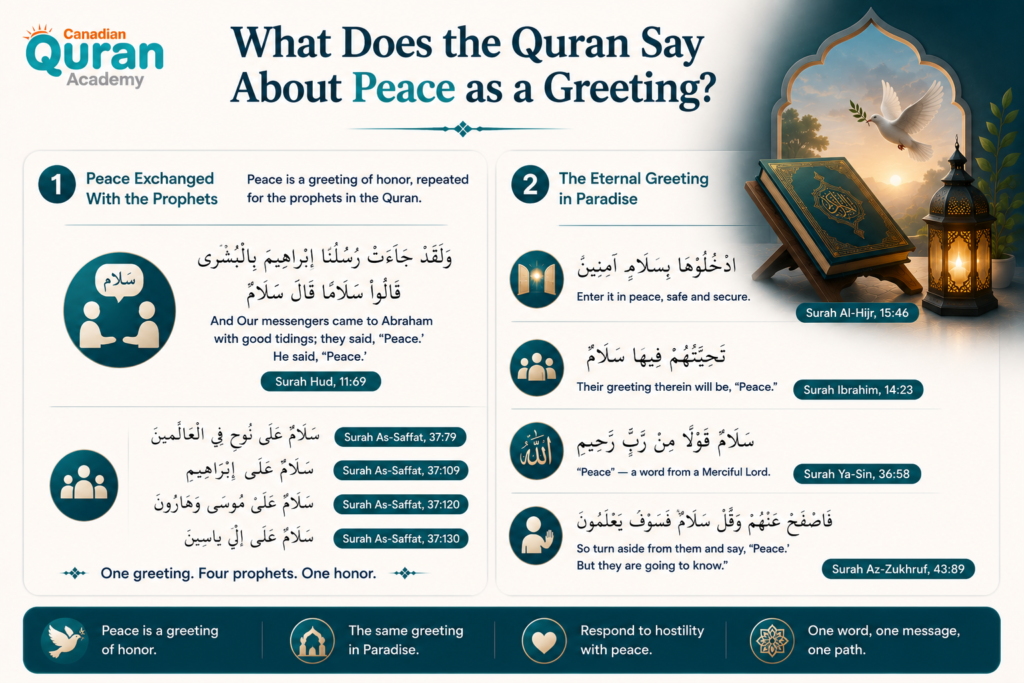
1. Peace Exchanged With the Prophets
Peace is one of the Quran’s recurring greetings for the prophets. By repeating the same expression across multiple prophets, the Quran emphasizes their shared honor, righteousness, and the continuity of Allah’s message throughout history.
وَلَقَدْ جَاءَتْ رُسُلُنَا إِبْرَاهِيمَ بِالْبُشْرَىٰ قَالُوا سَلَامًا قَالَ سَلَامٌ
“And certainly did Our messengers come to Abraham with good tidings; they said, ‘Peace.’ He said, ‘Peace.'” (Surah Hud, 11:69)
The exchange is symmetrical — the greeting is offered and returned in the same word, which is the pattern the Quran repeats for Noah, Moses, Aaron, and Elias in close succession:
سَلَامٌ عَلَىٰ نُوحٍ فِي الْعَالَمِينَ … سَلَامٌ عَلَىٰ إِبْرَاهِيمَ … سَلَامٌ عَلَىٰ مُوسَىٰ وَهَارُونَ … سَلَامٌ عَلَىٰ إِلْ يَاسِينَ
“Peace upon Noah among the worlds… Peace upon Abraham… Peace upon Moses and Aaron… Peace upon Elias.” (Surah As-Saffat, 37:79, 37:109, 37:120, 37:130)
The repetition of the exact phrase سَلَامٌ عَلَىٰ across four separate prophets is a structural signature, not a stylistic accident — it links these figures together under one shared honor.
2. The Eternal Greeting in Paradise
The same greeting appears again as the permanent condition of Paradise, repeated across several surahs with slightly different speakers each time:
ادْخُلُوهَا بِسَلَامٍ آمِنِينَ
“Enter it in peace, safe and secure.” (Surah Al-Hijr, 15:46)
تَحِيَّتُهُمْ فِيهَا سَلَامٌ
“Their greeting therein will be, ‘Peace.'” (Surah Ibrahim, 14:23)
سَلَامٌ قَوْلًا مِّن رَّبٍّ رَّحِيمٍ
“‘Peace’ — a word from a Merciful Lord.” (Surah Ya-Sin, 36:58)
فَاصْفَحْ عَنْهُمْ وَقُلْ سَلَامٌ ۚ فَسَوْفَ يَعْلَمُونَ
“So turn aside from them and say, ‘Peace.’ But they are going to know.” (Surah Az-Zukhruf, 43:89)
The last verse is worth pausing on: it is not set in Paradise at all. It instructs the Prophet ﷺ to respond to hostility with the same word Paradise’s residents hear from Allah. The Quran does not reserve “salaam” for peaceful situations only — it applies the same word as a response to provocation, which is a distinct and demanding instruction.
Verses that carry this much layered meaning across dozens of appearances are exactly where a structured, certified curriculum makes a measurable difference over self-study. The Al-Azhar-affiliated program at Canadian Quran Academy pairs Quranic Arabic with classical tafsir, so a verse like 43:89 is read alongside the reasoning classical scholars gave for why “peace” was the commanded response.

Start Your Quranic Journey in Canada
Join our vibrant community and learn with expert tutors through our flexible online platform.
Claim Your Free TrialRead More: Quranic Verses About Tawheed in Arabic
What Does the Quran Say About Peace During Conflict?
The Quran’s verses on peace are not limited to calm settings. Several of the clearest instructions on peace appear in passages that also discuss fighting — which answers a question readers often ask directly: does the Quran’s emphasis on peace still apply during conflict?
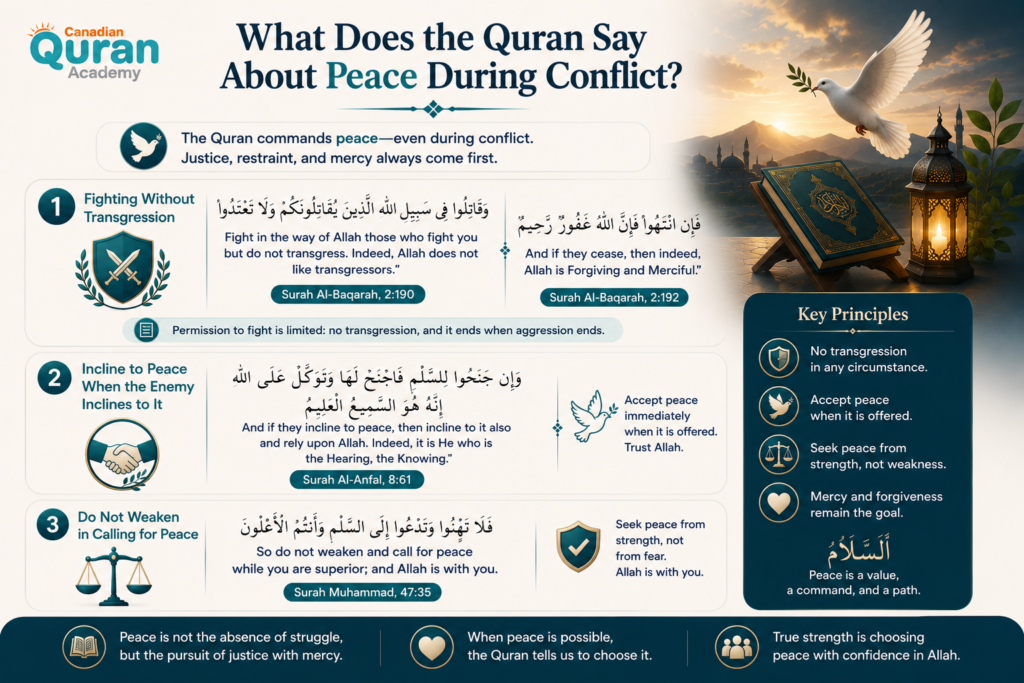
1. Fighting Without Transgression
The Quran permits fighting only within clear moral limits. Even during conflict, it prohibits transgression, restricts the use of force to those who initiate aggression, and commands that fighting end once the aggression ceases.
وَقَاتِلُوا فِي سَبِيلِ اللَّهِ الَّذِينَ يُقَاتِلُونَكُمْ وَلَا تَعْتَدُوا ۚ إِنَّ اللَّهَ لَا يُحِبُّ الْمُعْتَدِينَ
“Fight in the way of Allah those who fight you but do not transgress. Indeed, Allah does not like transgressors.” (Surah Al-Baqarah, 2:190)
فَإِنِ انتَهَوْا فَإِنَّ اللَّهَ غَفُورٌ رَّحِيمٌ
“And if they cease, then indeed, Allah is Forgiving and Merciful.” (Surah Al-Baqarah, 2:192)
The two verses are read together: permission to fight is bound immediately by a condition (لَا تَعْتَدُوا — do not transgress) and closed immediately once hostility stops. Neither verse describes conflict as an open-ended state.
2. Incline to Peace When the Enemy Inclines to It
The Quran does not treat peace as a sign of weakness. When the opposing side genuinely seeks reconciliation, Muslims are instructed to accept that opportunity, placing their trust in Allah while choosing peace over continued conflict.
وَإِن جَنَحُوا لِلسَّلْمِ فَاجْنَحْ لَهَا وَتَوَكَّلْ عَلَى اللَّهِ ۚ إِنَّهُ هُوَ السَّمِيعُ الْعَلِيمُ
“And if they incline to peace, then incline to it also and rely upon Allah. Indeed, it is He who is the Hearing, the Knowing.” (Surah Al-Anfal, 8:61)
The verb اجْنَحْ (incline) is an active instruction, not passive tolerance — the Quran commands moving toward peace the moment the other side offers it, without hesitation or renegotiation.
3. Do Not Weaken in Calling for Peace
The Quran distinguishes between seeking peace from confidence and seeking it out of fear. It discourages surrender driven by weakness while remaining fully consistent with its command to accept genuine peace when it serves justice and is offered sincerely.
فَلَا تَهِنُوا وَتَدْعُوا إِلَى السَّلْمِ وَأَنتُمُ الْأَعْلَوْنَ
“So do not weaken and call for peace while you are superior; and Allah is with you.” (Surah Muhammad, 47:35)
This verse is often mistranslated in casual summaries as “don’t call for peace.” Read in context, it says the opposite: it warns against calling for peace only out of weakness or fear — while still commanding peace when it is pursued from a position of strength and sincerity, matching the same principle set out in 8:61.
Live Class in Action
Watch how our instructors interact with students in real-time, focusing on interactive methods.
Start Your Quranic Journey in Canada
Join our vibrant community and learn with expert tutors through our flexible online platform.
Claim Your Free TrialRead More: Quranic Verses About Arabic Language
Learn These Verses in Their Original Arabic with The Canadian Quran Academy
Reading about these verses is a starting point. Reading them yourself, understanding the grammar behind why salaam appears where it does, and reciting them correctly takes guided instruction.
Canadian Quran Academy offers:
- Qualified instructors specializing in Quranic Arabic and Tafsir
- Personalized 1-on-1 online lessons matched to your level
- Flexible scheduling across all Canadian time zones
- Programs for adults, children, beginners, and advanced learners
- A FREE trial class with no commitment required
Book your FREE trial class today and start reading these verses the way they were revealed.

Our Quran Courses
- Quran Online Academy
- Quran Recitation Classes
- Quran Reading Classes
- Online Quran Classes for Kids
- Quran Classes for Adults
- Quran Classes for Female/Sisters
- Learn Quran for Beginners
- Quran Memorization (Hifz) Course
- Hifz Classes for Adults
- Quran Memorization and Hifz for Kids
- Quran Hifz for Ladies
Start Your Quranic Journey in Canada
Join our vibrant community and learn with expert tutors through our flexible online platform.
Claim Your Free TrialConclusion
The Quran’s verses on peace build a consistent structure rather than a scattered collection of pleasant phrases. Peace begins as one of Allah’s own names in Surah Al-Hashr, extends to Paradise itself as Dar As-Salam, becomes a concrete instruction for settling disputes between spouses and between groups, repeats as the greeting exchanged with the prophets and in the Hereafter, and holds firm even inside verses that discuss fighting — where the instruction is consistently to incline toward peace the moment it is offered.
Reading these Quran verses about peace in Arabic, rather than through translation alone, is where their consistency becomes visible — the same root, س-ل-م, threads through As-Salaam, Dar As-Salam, and every greeting of “salaam” in between, tying the Quran’s language of peace into a single, deliberate pattern.
Frequently Asked Questions
What does the Quran say about peace in Arabic?
The Quran presents peace (السَّلَام) as a name of Allah, a name for Paradise (Dar As-Salam), a required greeting, and a standing instruction during conflict. Central verses include Surah Al-Hashr, 59:23, where As-Salaam is listed among Allah’s names, and Surah Al-Anfal, 8:61, which commands inclining to peace once it is offered.
What is Allah’s name related to peace?
As-Salaam (السَّلَام) is one of Allah’s names, mentioned in Surah Al-Hashr, 59:23. It describes Allah as free of every defect or disturbance — the source peace comes from, rather than peace as humans experience it.
What does “Dar As-Salam” mean in the Quran?
Dar As-Salam (دَارُ السَّلَام) means “the Home of Peace” and is one of the Quran’s names for Paradise, used in Surah Al-An’am, 6:127, and Surah Yunus, 10:25. Both verses describe Allah as inviting people toward this home rather than it being earned through negotiation alone.
Does the Quran say to make peace even during conflict?
Yes. Surah Al-Anfal, 8:61 instructs believers to incline toward peace the moment the other side offers it. Surah Al-Baqarah, 2:190 and 2:192 place strict limits on fighting itself — permission ends as soon as hostility stops.
What hadith talks about spreading peace?
Abu Hurairah narrated that the Prophet ﷺ instructed believers to “spread salam between yourselves” as the practical step toward loving one another, recorded in Sahih Muslim, Hadith 54. A second hadith, in Sunan Abi Dawud 4919, ranks reconciling between people above voluntary fasting, prayer, and charity.
Why is peace used as a greeting between the prophets in the Quran?
The Quran repeats the exact phrase سَلَامٌ عَلَىٰ (“peace upon”) for Noah, Abraham, Moses, Aaron, and Elias in Surah As-Saffat, 37:79–130. The identical wording across several separate figures signals a shared honor rather than a coincidence of phrasing.






Leave a Reply