 Quran
Quran
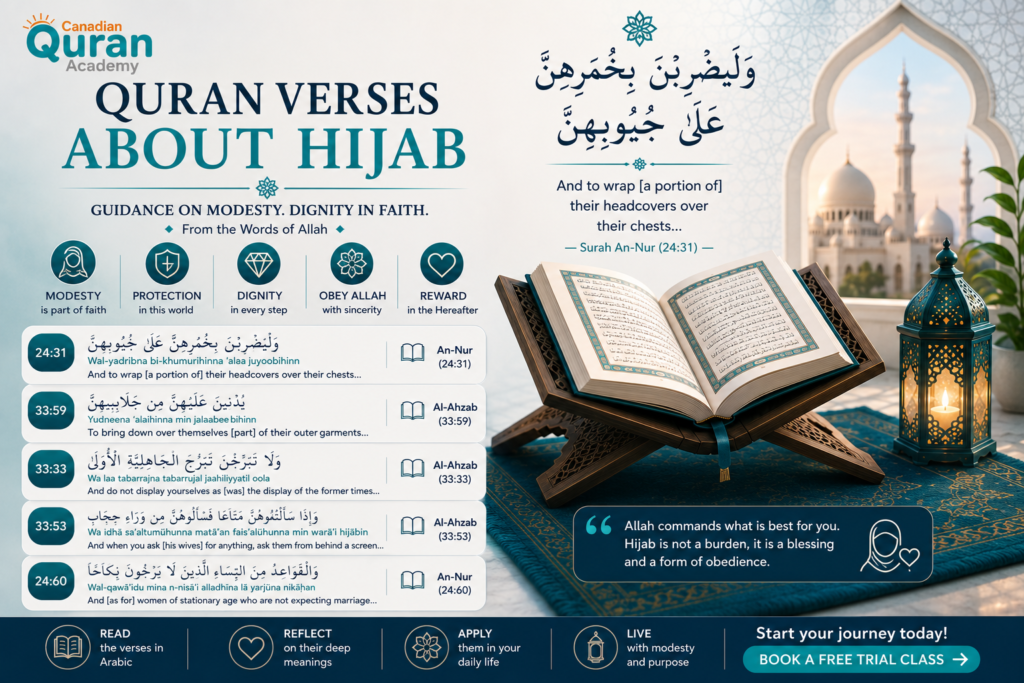
Hijab is one of the most repeated topics in Islamic modesty rulings — not confined to a single verse, but addressed from several angles across three surahs. If you’re looking for quran verses about hijab in arabic, this guide brings together the verses that matter most: the command to draw the khimar over the chest, the jilbab as an outer garment, the verse where the word “hijab” itself appears, the warning against tabarruj, and the concession given to women past the age of marriage.
Each verse below appears in Arabic with tashkeel, a transliteration, an English translation, and a reference linked directly to Quran.com so you can verify the wording yourself.
What Does the Quran Say About Hijab?
Hijab in the Quran covers two related but distinct commands: the khimar (خِمار), a head-covering drawn over the chest, and the jilbab (جِلْباب), a looser outer garment covering the body over regular clothes. A third term, hijab (حِجاب) itself, appears once in the text with a narrower meaning — a screen or partition.
Rather than presenting hijab in a single passage, the Quran develops the subject through multiple verses revealed in different contexts. Some verses focus on personal modesty, others explain appropriate public dress, while others establish guidelines for social interaction and privacy. Reading these verses together provides a more complete understanding of the Quran’s approach to modesty than relying on one verse in isolation.
This distinction matters before reading further, because several verses below address the khimar and jilbab as separate garments with separate commands, while a later verse uses “hijab” in a household context that’s often mistakenly merged with the two.
Read also: How to Learn Quran for Kids in Canada
The Main Quran Verse That Explains the Khimar
Surah An-Nur 24:31 contains the Quran’s most detailed instruction regarding the khimar and modest dress for believing women. The verse also begins by emphasizing inner modesty before addressing outward appearance.
وَقُل لِّلۡمُؤۡمِنَٰتِ يَغۡضُضۡنَ مِنۡ أَبۡصَٰرِهِنَّ وَيَحۡفَظۡنَ فُرُوجَهُنَّ وَلَا يُبۡدِينَ زِينَتَهُنَّ إِلَّا مَا ظَهَرَ مِنۡهَاۖ وَلۡيَضۡرِبۡنَ بِخُمُرِهِنَّ عَلَىٰ جُيُوبِهِنَّ
Wa qul lilmu’minaati yaghdudna min absaarihinna wa yahfazna furoojahunna wa laa yubdeena zeenatahunna illaa maa zahara minhaa wal-yadribna bi-khumurihinna ‘alaa juyoobihinn
“And tell the believing women to reduce [some] of their vision and guard their private parts and not expose their adornment except that which [necessarily] appears thereof and to wrap [a portion of] their headcovers over their chests…” — Surah An-Nur 24:31
The verse opens with the inward instruction — lowering the gaze — before the outward one. That ordering matters: hijab, in the Quran’s own structure, isn’t presented as a rule about fabric first; it’s one part of a wider modesty that begins with how a person looks at others.
Khumur (خُمُر) is the plural of khimar (خِمَار) — a head-covering Arab women already wore before this verse was revealed. The command wasn’t to start wearing one; it was to draw it forward (yadribna) over the juyub, the neckline and chest, which had previously been left uncovered while the khimar hung down the back. That’s a specific verb acting on a specific garment, a precision that’s easy to lose reading only a translation — the kind of distinction that becomes clear once you’re reading the Arabic root system directly, which a structured Quran reading course builds gradually, verse by verse.

Read also: Quran Verses About Hardship in Arabic
Quran Verse About Jilbab (Outer Garment)
This verse introduces the jilbab as an outer garment and explains the wisdom behind wearing it. It connects modest dress with dignity, recognition, and protection in society.
يَـٰٓأَيُّهَا ٱلنَّبِيُّ قُل لِّأَزۡوَٰجِكَ وَبَنَاتِكَ وَنِسَآءِ ٱلۡمُؤۡمِنِينَ يُدۡنِينَ عَلَيۡهِنَّ مِن جَلَٰبِيبِهِنَّۚ ذَٰلِكَ أَدۡنَىٰٓ أَن يُعۡرَفۡنَ فَلَا يُؤۡذَيۡنَ
Yaaa aiyuhan Nabiyyu qul li azwaajika wa banaatika wa nisaaa’il mu’mineena yudneena ‘alaihinna min jalaabee bihinn; zaalika adnaaa ai yu’rafna falaa yu’zain
“O Prophet, tell your wives and your daughters and the women of the believers to bring down over themselves [part] of their outer garments. That is more suitable that they will be known and not be abused.” — Surah Al-Ahzab 33:59
Jalabib (جَلَابِيب) is the plural of jilbab — a loose, non-transparent outer garment covering the body over the everyday clothes underneath, distinct from the khimar addressed above. The verse gives its own reasoning: “adnaaa ai yu’rafna” (more likely that they will be recognized) — as modest, believing women — which it links directly to protection: “falaa yu’zain” (so they will not be harmed).
Telling khimar and jilbab apart matters, because they’re two different garments doing two different jobs in the text — one covers the chest, the other covers the body. That’s exactly what a focused Intensive Quran Course in Canada is built to teach, rather than leaving readers to guess from translation alone.

The Quranic Warning Against Tabarruj
The Quran not only teaches modest clothing but also warns against intentionally displaying beauty and adornment. This verse explains the principle behind avoiding tabarruj.
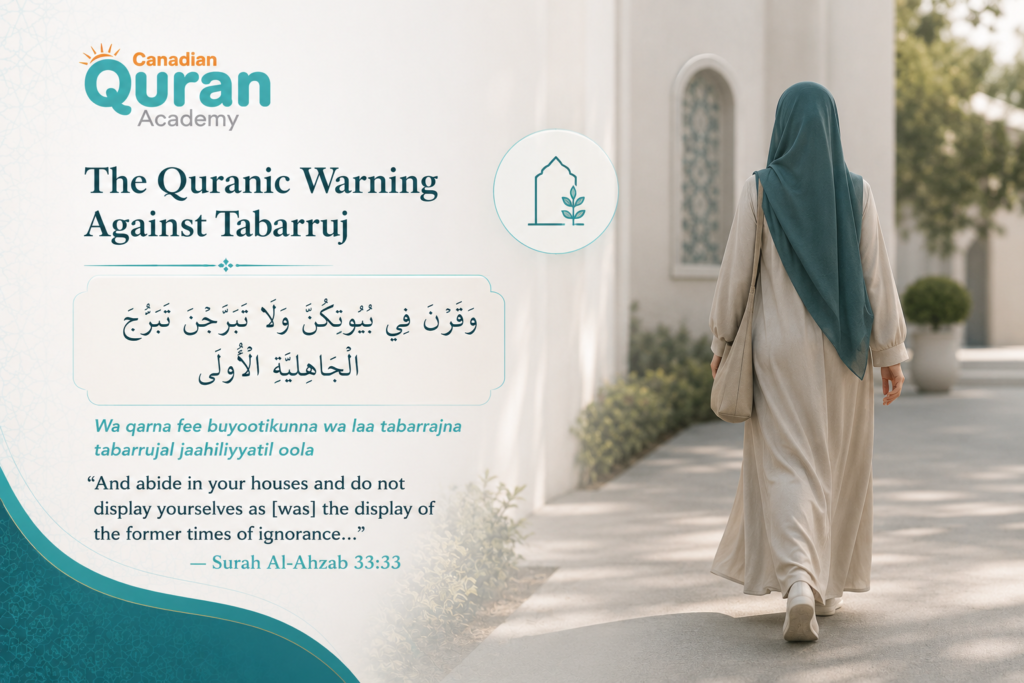
وَقَرۡنَ فِي بُيُوتِكُنَّ وَلَا تَبَرَّجۡنَ تَبَرُّجَ ٱلۡجَٰهِلِيَّةِ ٱلۡأُولَىٰ
Wa qarna fee buyootikunna wa laa tabarrajna tabarrujal jaahiliyyatil oola
“And abide in your houses and do not display yourselves as [was] the display of the former times of ignorance…” — Surah Al-Ahzab 33:33
Tabarruj (تَبَرُّج) means deliberately showing off one’s beauty or adornment in public. The verse names a historical reference point — jaahiliyyah, the pre-Islamic period — as the standard of display being rejected, which frames the command as a correction of an existing practice, not an entirely new restriction invented for the occasion. Read alongside 24:31 and 33:59, this verse supplies the “why” behind covering: the goal is avoiding deliberate display, not covering for its own sake.
Live Class in Action
Watch how our instructors interact with students in real-time, focusing on interactive methods.
Start Your Quranic Journey in Canada
Join our vibrant community and learn with expert tutors through our flexible online platform.
Claim Your Free TrialWhere Does the Word “Hijab” Appear in the Quran?
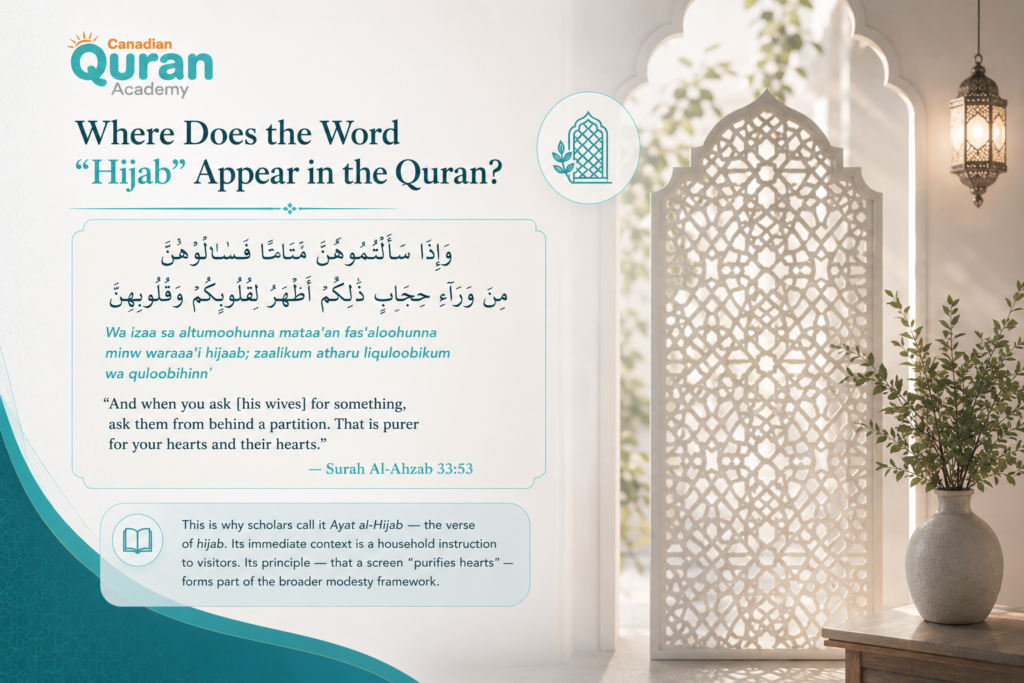
Many people are surprised to learn that the word “hijab” itself appears in a different context from the verses about khimar and jilbab. This verse explains the original Quranic usage of the word.
وَإِذَا سَأَلۡتُمُوهُنَّ مَتَٰعٗا فَسۡـَٔلُوهُنَّ مِن وَرَآءِ حِجَابٖۚ ذَٰلِكُمۡ أَطۡهَرُ لِقُلُوبِكُمۡ وَقُلُوبِهِنَّ
Wa izaa sa altumoohunna mataa’an fas’aloohunna minw waraaa’i hijaab; zaalikum atharu liquloobikum wa quloobihinn
“And when you ask [his wives] for something, ask them from behind a partition. That is purer for your hearts and their hearts.” — Surah Al-Ahzab 33:53
This is why scholars call it Ayat al-Hijab — the verse of hijab. Its immediate context is a household instruction: how visitors were to interact with the Prophet’s ﷺ wives when calling at his home. Over time, jurists extended the underlying principle — that a screen “purifies hearts” — into the broader modesty framework that includes the khimar and jilbab verses above, though the verse itself speaks specifically to the Prophet’s household, not women in general.
The Quran’s Teaching on Clothing and Taqwa
Beyond dress regulations, the Quran reminds all believers that the finest garment is righteousness. This verse connects physical clothing with inner faith and God-consciousness
يَٰبَنِيٓ ءَادَمَ قَدۡ أَنزَلۡنَا عَلَيۡكُمۡ لِبَاسٗا يُوَٰرِي سَوۡءَٰتِكُمۡ وَرِيشٗاۖ وَلِبَاسُ ٱلتَّقۡوَىٰ ذَٰلِكَ خَيۡرٞ
Yaa Baneee Aadama qad anzalnaa ‘alaikum libaasany yuwaaree saw aatikum wa reeshanw wa libaasut taqwaa zaalika khair
“O children of Adam, We have bestowed upon you clothing to conceal your private parts and as adornment. But the clothing of righteousness – that is best.” — Surah Al-A’raf 7:26
This verse widens the lens beyond women’s dress specifically. It addresses “children of Adam” — all people — and names two functions of clothing: covering the body, and adornment. Then it adds a third, non-physical layer: “libaas at-taqwa,” the clothing of righteousness, described as better than either. Read against the earlier verses, this is the verse that supplies the underlying principle — physical covering and inward God-consciousness are meant to work together, not stand in for each other.
Read also: Quran Verses About Forgiveness in Arabic
Can You Recite the Quran Without Hijab?
Yes, women can recite the Quran without wearing hijab. The Quran does not contain a verse that makes a khimar or jilbab a condition for reciting its words. The verses on modest dress address general standards of modesty and public conduct rather than the act of Quran recitation itself.
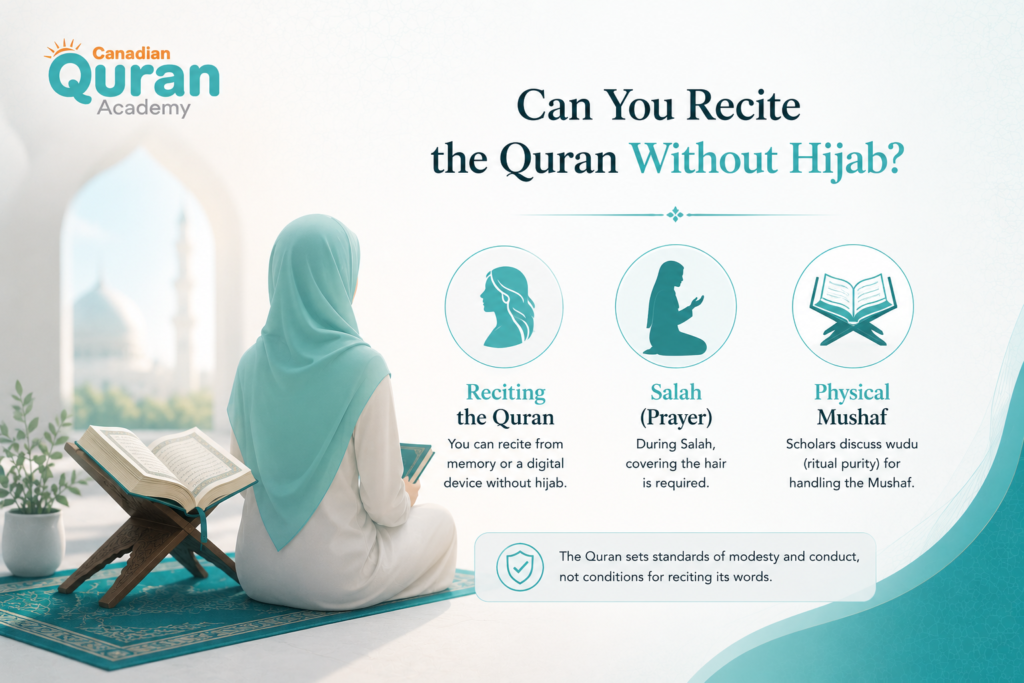
It is important, however, to distinguish between reciting the Quran, performing Salah, and handling the physical Mushaf. During Salah (formal prayer), a woman is required to observe the proper dress for prayer, including covering her hair according to the majority of Islamic scholars. Outside of prayer, she may recite the Quran from memory or read it from a phone or other digital device without wearing hijab.
When it comes to reading directly from the physical Mushaf, many scholars discuss the requirement of wudu (ritual purity) rather than head covering. Because scholarly opinions differ on some related details, Muslims who wish to follow a specific school of Islamic jurisprudence should consult a qualified scholar for guidance.
Why Should Children Learn Quran Verses About Hijab?
Teaching children Quran verses about hijab from an early age helps them understand modesty as a Quranic value rather than simply a dress code. Learning the verses with their meanings introduces concepts such as humility, respect, and self-discipline in a way that is easy for young learners to understand and remember. It also gives children a strong foundation before they encounter different cultural opinions about hijab later in life.
A structured Quran course makes this learning experience even more meaningful by combining correct recitation, simple Tafsir, and practical lessons that children can apply in their daily lives. Instead of memorizing verses without context, they learn why Allah revealed them and how they fit into the Quran’s broader teachings on faith, character, and modesty. This balanced approach helps children develop a lifelong connection with the Quran and its guidance.
Experience Our Classrooms
Don’t just take our word for it—take a look inside! Watch the videos below to experience our engaging teaching methods and vibrant online classrooms firsthand.
Start Your Quranic Journey in Canada
Join our vibrant community and learn with expert tutors through our flexible online platform.
Claim Your Free TrialDeepen Your Quran Learning with The Canadian Quran Academy
Reading Quran verses about hijab in Arabic is only the beginning. Understanding the difference between khimar and jilbab, reciting each verse with proper Tajweed, and following the reasoning behind each ruling takes guided study. At The Canadian Quran Academy, qualified Quran teachers provide personalized one-on-one instruction so students build recitation, understanding, and memorization at their own pace.
The Canadian Quran Academy offers:
- Qualified, experienced Quran teachers with Ijazah and Tajweed expertise
- Personalized 1-on-1 online lessons for every age and skill level
- Step-by-step Quran recitation with live pronunciation correction
- Quran memorization and Tafsir programs to deepen your understanding
- Flexible scheduling for students across Canadian time zones
- A free trial lesson with no commitment required
Book your free trial lesson today and start learning Quran verses about hijab in Arabic with confidence, proper Tajweed, and expert guidance.

Our Arabic Courses
- Online Arabic Academy
- Online Arabic Course
- Classical Arabic Course
- Arabic Course for Beginners
- Advanced Arabic Course
- Quranic Arabic Course
- Arabic Grammar Course
- Modern Standard Arabic Course
- Arabic Conversation / Speaking Course
- Intensive Arabic Course
- Online Arabic Classes for Kids
- Arabic Classes for Adults
- Arabic Classes for Ladies
- Fusha Arabic Course
- Business Arabic Course
- Al-Azhar Arabic Course
- Madinah Arabic Course
- Learning Arabic for Non-Arabic Speakers
- Arabic Elementary School
- Arabic Intermediate School
- Arabic Lessons for Kindergarten
Start Your Quranic Journey in Canada
Join our vibrant community and learn with expert tutors through our flexible online platform.
Claim Your Free TrialConclusion
Quran verses about hijab in Arabic cover more than a single command repeated in different words — the gaze and the khimar (24:31), the jilbab as an outer garment (33:59), the warning against tabarruj (33:33), the verse where the word “hijab” itself appears in a household context (33:53), a concession for women past the age of marriage (24:60), and the broader principle of clothing and taqwa (7:26).
Reading these verses in Arabic — the specific verb in 24:31, the specific word in 33:53, the repeated root in 33:33 and 24:60 — is where the meaning sits most precisely. Start with 24:31, since it’s the most direct instruction, then move to 33:59 and 33:33 once the core vocabulary of khimar and tabarruj feels familiar.
Frequently Asked Questions
What is the difference between khimar and jilbab in the Quran?
Khimar is a head-covering drawn over the chest, commanded in Surah An-Nur 24:31. Jilbab is a separate, looser outer garment covering the body over regular clothes, commanded in Surah Al-Ahzab 33:59 — two different garments addressed in two different verses.
Which verse is called “Ayat al-Hijab”?
Surah Al-Ahzab 33:53 is called Ayat al-Hijab because it’s the verse where the word “hijab” (a screen or partition) appears directly, in the context of visiting the Prophet’s ﷺ household.
What does tabarruj mean in the Quran?
Tabarruj means deliberately displaying one’s beauty or adornment in public. It’s named directly in Surah Al-Ahzab 33:33 as the practice being rejected, using the pre-Islamic period as the point of comparison.
Does the Quran give any exception to hijab rules?
Yes. Surah An-Nur 24:60 permits women past the age of marriage to set aside the outer garment specifically, while still noting that continued modesty — avoiding tabarruj — is better for them. It’s a narrow concession, not a general exemption.
Is hijab required to recite the Quran?
No. There is no verse requiring hijab simply to recite the Quran from memory or from a phone. Covering is required for Salah, the formal prayer, based on separate instruction, not for recitation on its own.






Leave a Reply