 Quran
Have you ever opened the Mushaf, looked at the Arabic script, and quietly wondered where a person is even supposed to begin? You are not alone. Thousands of Muslim families in Toronto, Calgary, Montreal, and Ottawa ask that exact question every year.
The Quran learning journey is not one lesson or one course. It is a sequence of stages, and each stage builds on the one before it. When you know the order, the whole path stops feeling overwhelming and starts feeling achievable.
This guide walks through the five stages of that journey — from your first Arabic letter to living by the guidance you recite — with realistic timelines for each and the role a qualified teacher plays throughout.
Whether you are an adult starting from zero or a parent planning your child’s path, this roadmap will help you take the next step with clarity.

Key Takeaways: What You Will Learn
- The five stages of the Quran learning journey and the correct order to move through them.
- Realistic timelines for reading, Tajweed, Tafsir, and Hifz.
- Why Tajweed is the bridge stage that protects everything you learn afterwards.
- How to choose an Ijazah-certified teacher and why the chain of transmission matters.
The Quran Learning Journey: What It Actually Looks Like
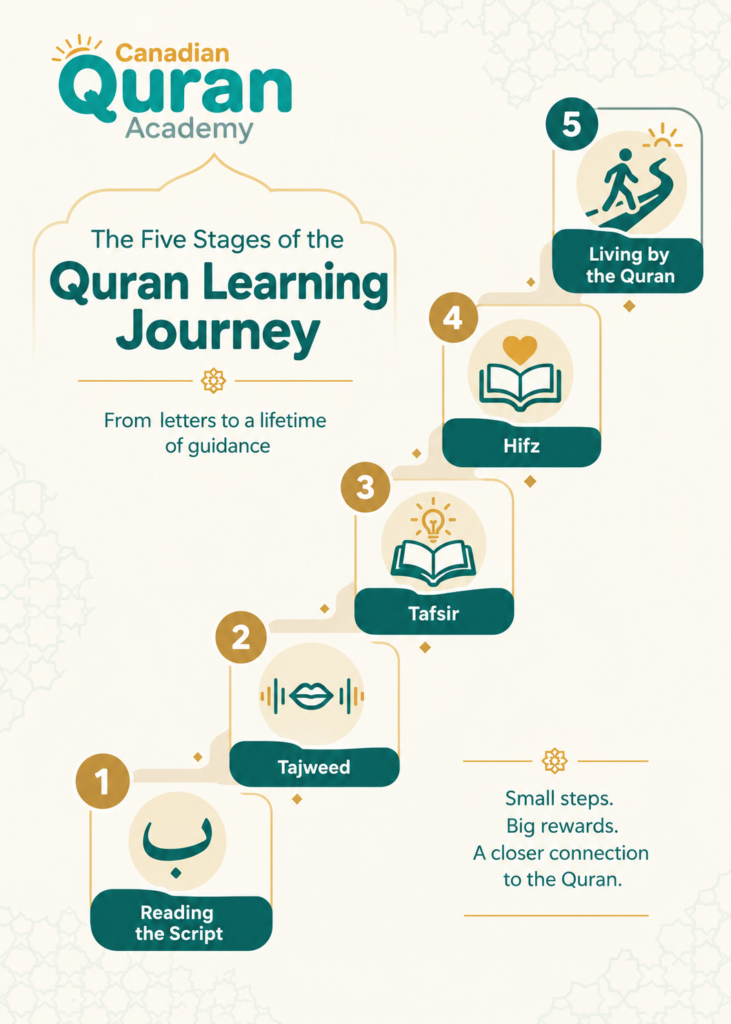
The Quran learning journey is the structured progression from decoding Arabic letters, to reciting with Tajweed, to understanding meaning, to memorization, and finally to applying the guidance in daily life.
Most people who stall skip a stage. Memorize before fixing pronunciation, and you memorize mistakes; chase meaning before mastering the script, and you depend on transliteration forever.
The order below follows centuries of traditional Quranic instruction, and it is the sequence our teachers use with students across Canada.
The five stages at a glance:
| Stage | Focus | Typical timeframe |
| 1. Reading | Letters, vowels, joining words | 3–6 months |
| 2. Tajweed | Makharij, Sifat, Madd, Ghunnah | 6–12 months |
| 3. Tafsir | Meaning and context | Ongoing |
| 4. Hifz | Memorization and revision | 2–5 years |
| 5. Application | Fiqh, Sunnah, character | Lifelong |
Timeframes assume two 30-minute one-to-one sessions per week plus short daily practice. Individual pace varies with age and prior exposure.
Read Also: Quran Learning Tools For Kids
Stage 1: Learning to Read the Quranic Script
This first stage turns unfamiliar symbols into sounds you can produce with your own voice. It is the foundation everything else rests on, and rushing it costs years later.
Master the shape and the sound together
Arabic has 28 letters, and each one has a shape to recognize and a point of articulation (makhraj) to produce. English speakers need extra attention to sounds with no English equivalent.
The pairs that cause the most trouble are ع (Ayn) versus ا (Alif), and ح (Haa) versus هـ (haa). Getting these right at the start prevents habits that take months to unlearn.
Learn letters in shape families, then add the vowels
Grouping letters by their skeleton beats memorizing 28 separate forms: ب, ت, and ث share one “boat” shape and differ only in the dots.
Letters on their own are silent. The Harakat — Fatha ( ــَــ ), Kasra ( ــِــ ) and Dammah ( ــُــ ) — give them movement, turning م into مَ (ma), مِ (mi) and مُ (mu).
Read your first Quranic word
Take قُلْ (Qul), the opening word of Surah Al-Ikhlas: ق with a Dammah, then ل with a Sukoon. Qu + l = Qul.
That is the moment the journey stops being theoretical. Structured Quran reading classes with a live teacher shorten this stage, because errors get corrected the day they appear rather than after they harden.
Read Also: Quran Learning Games
Stage 2: Beautifying Your Recitation With Tajweed
Tajweed is the science of giving every letter its due right in pronunciation and duration. This is the stage where recitation becomes accurate, measured, and beautiful — and it is the stage most self-taught learners skip.
Makharij and Sifat: light letters versus heavy letters
Each letter has an origin point and a set of characteristics. For non-Arab learners, the practical work is learning to physically separate sounds that feel identical at first.
Compare ت in التَّائِبُونَ (At-ta’iboon, “the repentant ones”, At-Tawbah 9:112) with ط in الطَّامَّةُ (At-taammah, “the overwhelming calamity”, An-Nazi’at 79:34).
The first is light, produced with a flat tongue. The second requires raising the back of the tongue, and the sound carries real weight.
Madd and Ghunnah: the timing of recitation
Madd is the measured elongation of a vowel; Ghunnah is the gentle nasal resonance on ن and م in specific situations. Together they create the Quran’s rhythm.
In قَالَ (qala), the “qaa” is held for two counts because the Fatha is followed by an Alif. In خَلَقَ (khalaqa), every vowel stays short. That difference is accuracy, not decoration.
Reciting with Tarteel
The goal of these rules is Tarteel: slow, clear recitation that leaves room for reflection — “وَرَتِّلِ الْقُرْآنَ تَرْتِيلًا”, “And recite the Qur’an with measured recitation” (Al-Muzzammil 73:4).
Tajweed cannot be learned reliably from video alone, because you cannot hear your own errors. This is precisely why our live online Tajweed classes run one-to-one — the teacher hears every letter and corrects it in the moment, with the Mushaf shared on screen.
Stage 3: Understanding the Meaning Through Tafsir
Once the tongue is trained, the journey moves to the mind. Understanding transforms recitation from a sound you produce into a message you receive.
Start with translation, then commentary
Read the verses you already recite in clear English — Saheeh International and Dr. Mustafa Khattab’s The Clear Quran are both free on Quran.com.
Translation gives you words; Tafsir gives you meaning. Abridged English editions of Tafsir Ibn Kathir or Tafsir As-Sa’di are the usual next step.
Learn the reasons for revelation
Asbab al-Nuzul — the circumstances in which a verse was revealed — often unlocks a meaning no translation carries.
Surah ‘Abasa opens with a gentle correction of the Prophet ﷺ when he turned from Abdullah ibn Umm Maktum, a blind man seeking knowledge, toward a Quraysh leader. Knowing the story changes how the verses land.
A guided Quran Tafsir course keeps this stage anchored to authentic scholarship rather than scattered online opinions.
Stage 4: Committing the Quran to Heart (Hifz)
Memorization moves the Quran from the page into the chest. The real skill here is not memorizing quickly — it is retaining permanently.
The three-part daily session
Every effective Hifz routine splits the daily session into three parts, and the balance between them determines success. New lesson is the small portion you memorize today, recited with correct Tajweed first. Recent review covers the last 7–10 days, moving those verses into medium-term memory. Old review covers at least one full Juz’ of earlier memorization. Students drop this part first, and it is the part that matters most.
Link verses incrementally
Do not memorize a page as one block. Perfect verse one, perfect verse two, then recite both together from memory 7–15 times before touching verse three.
In Surah Al-Fatiha, you master الْحَمْدُ لِلَّهِ رَبِّ الْعَالَمِينَ, then الرَّحْمَٰنِ الرَّحِيمِ, then join them — before you ever look at مَالِكِ يَوْمِ الدِّينِ.
Treat revision as the main task
The Prophet ﷺ said: “You must keep on reciting the Qur’an because it escapes from the hearts of men faster than camels do“ (Sahih al-Bukhari 5033).
اسْتَذْكِرُوا الْقُرْآنَ فَإِنَّهُ أَشَدُّ تَفَصِّيًا مِنْ صُدُورِ الرِّجَالِ مِنَ النَّعَمِ ” .
New memorization plants the seed; daily review is the water. Our Quran memorization (Hifz) program sets a realistic daily portion around school and work commitments.
Read Also: Quran Learning Apps
Stage 5: Living by the Guidance of the Quran
This stage never closes. It is where recitation, understanding, and memorization turn into character and action.
Fiqh translates broad Quranic principles into practical rulings. The command in Al-Baqarah 2:282 to write down debts, for example, becomes a working standard of fairness in everyday transactions.
Studying the Sirah and Sunnah shows the Quran embodied in a human life. And Tazkiyah — purification of the soul — is the inward half: sincerity (ikhlas), gratitude (shukr), and reliance on Allah (tawakkul).
Choosing a Teacher for Your Quran Learning Journey in Canada
A qualified teacher is not a luxury at any stage of this journey. They are the difference between progress and repetition.
What a teacher actually changes
A teacher hears the error you cannot hear yourself, sets a portion size that matches your capacity, and tests your memorization honestly. Their role shifts as you advance, but it never becomes optional.
Why Ijazah matters
An Ijazah confirms the teacher recited the whole Quran to a qualified master, who recited to theirs, in an unbroken chain (sanad) reaching the Prophet ﷺ. It is documented authorization, not a marketing label.
Before enrolling anywhere, ask three questions: Is the teacher Ijazah-certified? Are classes one-to-one? Can you schedule around Canadian time zones and the school calendar?
At Canadian Quran Academy, all three answers are yes — Ijazah-holding instructors, many trained at Al-Azhar, teaching students from Vancouver to Halifax at times that fit real family schedules.
Read Also: Quran Hifz Quotes
Live Class in Action
Watch how our instructors interact with students in real-time, focusing on interactive methods.
Start Your Quranic Journey in Canada
Join our vibrant community and learn with expert tutors through our flexible online platform.
Claim Your Free TrialStart Your Tajweed and Recitation Circles With a Free Trial Class
Take your place with one-to-one online lessons from ijazah-certified Al-Azhar teachers. Our Tajweed and recitation halaqat serve kids and adults across Toronto, Mississauga, Calgary, Vancouver, and Ottawa — with evening and weekend timings, female teachers for sisters, and a personalised plan from session one.
Correct your recitation letter by letter, earn a reward for each one of them, and gain the ability to teach your own family.
In your first 30-minute session, your teacher can listen to you live, identify mistakes you may not notice when studying alone, and learn how to apply Tajweed rules correctly in every verse.
Whether you are a beginner or already recite the Quran, your teacher will guide you at your level and help you build confidence through consistent, personalised practice.
Our Quran Courses
- Quran Online Academy
- Quran Recitation Classes
- Quran Reading Classes
- Online Quran Classes for Kids
- Quran Classes for Adults
- Quran Classes for Female
- Learn Quran Course for Beginners
- Quran Memorization (Hifz) Course
- Hifz Classes for Adults
- Quran Memorization and Hifz Course for Kids
- Quran Hifz Course for Ladies
- Quran Ijazah Program
- Quran Qirat Learning Course
- Quran Tafsir Course
- Noorani Qaida Course
- Noorani Qaida Course for Kids
- Weekend Quran Classes
- Intensive Quran Course
- Al-Azhar Quran Course
- Online Tajweed Classes
- Tajweed Course for Kids
- Tajweed Course for Adults
- Tajweed Course for Ladies

Conclusion
The Quran learning journey moves through five stages: reading the script, refining recitation with Tajweed, understanding meaning through Tafsir, memorizing with disciplined revision, and living by the guidance.
None of them can be safely skipped. Reading without Tajweed produces errors, memorization without review produces loss, and recitation without understanding stops short of the purpose.
Takeaway message: progress here is decided not by how fast you move, but by how consistently you show up — with a qualified teacher correcting you at every stage.
FAQs
How long does it take to learn to read the Quran as an adult beginner?
Most adult beginners read basic Quranic Arabic within three to six months, studying two 30-minute sessions weekly with 10–15 minutes of daily practice. Prior exposure to the Arabic alphabet shortens this noticeably.
Do I need to learn Arabic before starting the Quran learning journey?
No. Reading the Quran and speaking Arabic are separate skills, and Quran reading comes first. Many students add Quranic Arabic later, once recitation is fluent.
Can I learn Tajweed on my own from videos?
Videos explain the rules but cannot correct your pronunciation. Tajweed is transmitted orally, so a live teacher who hears your recitation is required for accuracy.
What age should a child start Quran classes?
Most children can begin letter recognition around age five, once they can sit through a short focused session. Two 20–30 minute lessons a week work better than long classes at this age.
Should I memorize the Quran before or after learning Tajweed?
Learn Tajweed first, or at minimum alongside memorization. Memorizing with incorrect pronunciation means re-learning those verses later.
How much daily time does Hifz realistically require?
A sustainable adult routine takes 45–60 minutes daily, split between new memorization, recent review, and old review. Consistency beats occasional long sessions.






Leave a Reply