 Quran
Quran
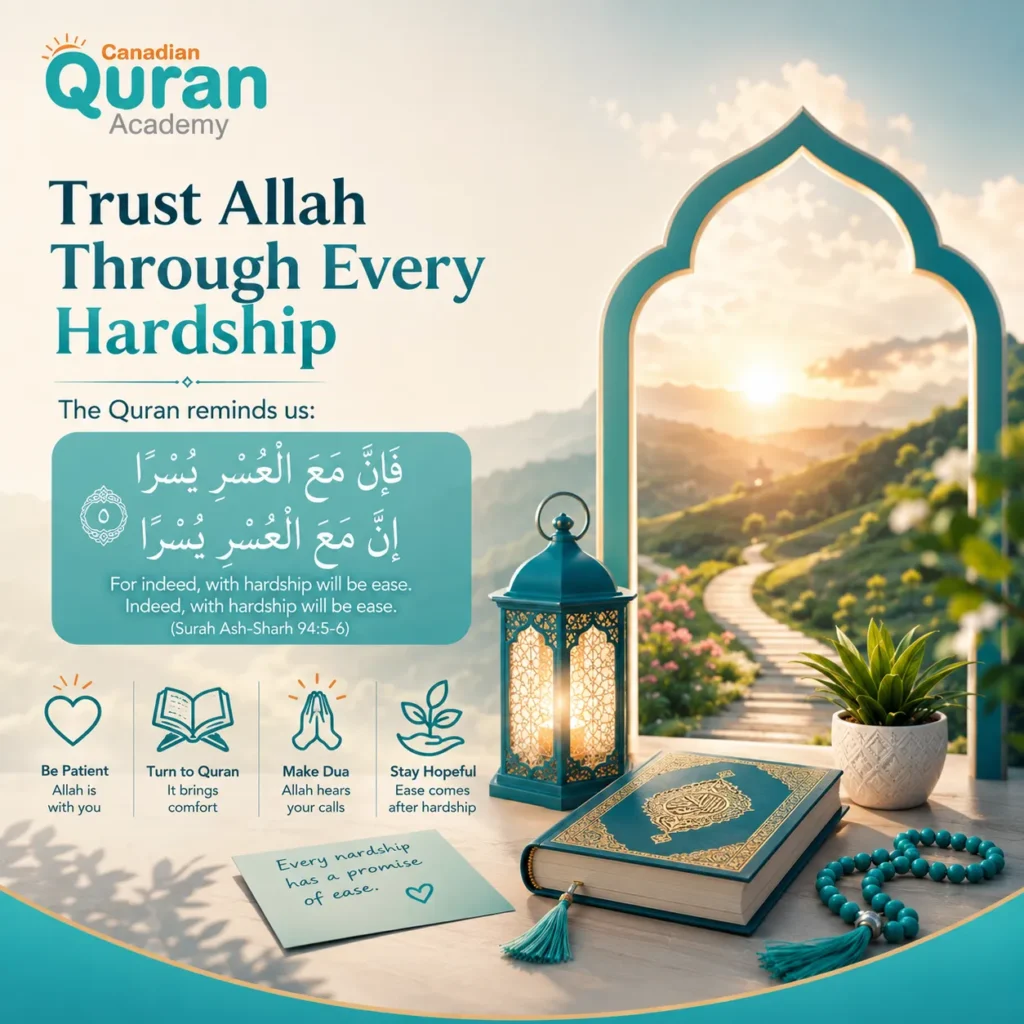
Hardship (عُسْر) is one of the most repeated themes in the Quran — tied again and again to patience, testing, and the promise of relief. Quran verses about hardship in Arabic don’t offer a single comforting line and move on. Read together, they explain why hardship happens, what a believer is expected to say and do while it’s happening, and what tends to go wrong once it passes.
This guide groups the core verses on this theme by what each one is actually addressing — testing, the promise of ease, the right response, and the pattern of forgetting Allah after relief — each shown with full tashkeel, a transliteration, an English translation, and the exact surah and ayah. Two authentic hadith are included as well, since the Prophet ﷺ addressed hardship directly in his own words.
What Does the Quran Say About Hardship?
The Quran treats hardship (الضَّرَّاء / البَأْسَاء / العُسْر) as a fixed part of human life, not an exception to it. Verses about hardship appear across more than a dozen surahs, and they follow a consistent pattern: Allah names the hardship, reminds the reader that it is a test, and follows it with a promise of relief or reward.
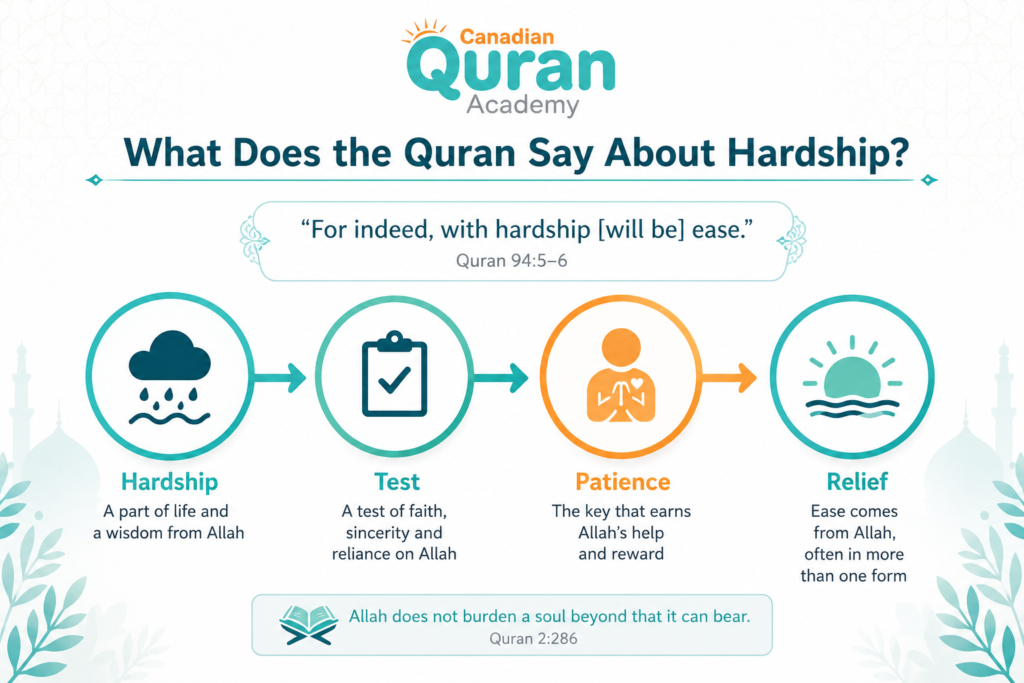
This pattern matters because it shapes how a believer is meant to respond. The Quran does not present hardship as random misfortune. It frames it as something with purpose — for testing sincerity, for burning off sin, or for turning a person back toward Allah.
1. Hardship as a Test of Faith
Surah Al-Baqarah asks directly whether anyone expects to enter Paradise without first being tested “as came to those who passed on before you” (2:214). The verse lists poverty, hardship, and being “shaken” as part of what earlier believers endured before help arrived. This is one of the clearest verses in the Quran connecting hardship to faith itself, rather than to punishment.
2. The Promise That Ease Follows Hardship
The most quoted verse on this subject is Surah Ash-Sharh 94:5–6, where the phrase is repeated twice in a row: “For indeed, with hardship [will be] ease.” Classical commentators, including Ibn Kathir, note that repeating the sentence with a definite noun (العُسْر, “the hardship”) followed by an indefinite noun (يُسْرًا, “an ease”) signals that one hardship can be followed by more than one form of relief. This grammatical detail is one of the reasons the verse is memorized so widely — the promise is stated twice for emphasis, not for redundancy.
Read also: Quran Verses About Forgiveness in Arabic
Why Does the Quran Treat Hardship as a Test, Not a Punishment?
Sometimes the hardest part of hardship isn’t the difficulty itself — it’s wondering whether faith should have prevented it. The Quran answers that question directly.
أَمْ حَسِبْتُمْ أَن تَدْخُلُوا الْجَنَّةَ وَلَمَّا يَأْتِكُم مَّثَلُ الَّذِينَ خَلَوْا مِن قَبْلِكُم ۖ مَّسَّتْهُمُ الْبَأْسَاءُ وَالضَّرَّاءُ وَزُلْزِلُوا حَتَّىٰ يَقُولَ الرَّسُولُ وَالَّذِينَ آمَنُوا مَعَهُ مَتَىٰ نَصْرُ اللَّهِ ۗ أَلَا إِنَّ نَصْرَ اللَّهِ قَرِيبٌ
(Am ḥasibtum an tadkhulū-l-jannata wa lammā yaʾtikum mathalul-ladhīna khalaw min qablikum, massat-humul-baʾsāʾu waḍ-ḍarrāʾu wa zulzilū ḥattā yaqūlar-rasūlu wal-ladhīna āmanū maʿahū matā naṣrullāh, alā inna naṣrallāhi qarīb)
“Or do you think that you will enter Paradise while such [trial] has not yet come to you as came to those who passed on before you? They were touched by poverty and hardship and were shaken until [even their] messenger and those who believed with him said, ‘When is the help of Allah?’ Unquestionably, the help of Allah is near.” (Surah Al-Baqarah 2:214)
Read that again — even a messenger and the people who believed alongside him asked when relief would come. The Quran records that question rather than treating it as weak faith. Asking “when will this end” is part of the test, not a failure of it.
Students working through a structured Intensive Quran Course often meet this cluster of verses early, since it sets the frame for how the rest of the Quran discusses trials.
Book a FREE trial class in the Intensive Quran Course in Canada

Verses on the Promise That Ease Follows Hardship
Once the Quran establishes hardship as a test rather than a punishment, a second group of verses answers the question that naturally follows it: does it end, and how?
The most quoted answer is the doubled promise in Surah Ash-Sharh:
فَإِنَّ مَعَ الْعُسْرِ يُسْرًا ﴿٥﴾ إِنَّ مَعَ الْعُسْرِ يُسْرًا
Fa-inna maʿal-ʿusri yusrā. Inna maʿal-ʿusri yusrā.” (Surah Ash-Sharh 94:5-6)
“For indeed, with hardship [will be] ease. Indeed, with hardship [will be] ease.
Ibn Kathir points to a grammatical detail here: al-‘usr (“the hardship”) is definite both times, while yusr (“ease”) is indefinite each time. Read this way, one definite hardship is answered by an open-ended ease — the repetition widens the promise rather than simply restating it.
The same promise is attached to a specific, everyday hardship in Surah At-Talaq:
سَيَجْعَلُ اللَّهُ بَعْدَ عُسْرٍ يُسْرًا
Sa-yajʿalullāhu baʿda ʿusriny yusrā.” (Surah At-Talaq 65:7)
“Allah will bring about, after hardship, ease.
This line closes a passage on spending during financial strain — the promise here is spoken directly into the pressure of providing for a family, not left as spiritual comfort alone.
And when hardship feels like too much to carry, this is the verse most often recited:
لَا يُكَلِّفُ اللَّهُ نَفْسًا إِلَّا وُسْعَهَا
Lā yukallifullāhu nafsan illā wusʿahā.” (Surah Al-Baqarah 2:286)
“Allah does not charge a soul except [with that within] its capacity.
This is stated as a fact, not a comforting turn of phrase. Whatever is being carried, however heavy it feels, is described as falling within what the person can bear.
Verses this short are usually the first students commit to memory in a Hifz Program — a free trial session is the easiest way to begin.

Live Class in Action
Watch how our instructors interact with students in real-time, focusing on interactive methods.
Start Your Quranic Journey in Canada
Join our vibrant community and learn with expert tutors through our flexible online platform.
Claim Your Free TrialVerses on How to Respond During Hardship
Knowing why hardship exists is different from knowing what to actually do while in it. This group of verses gives specific instructions — exact words, sustained conduct, and outward action.
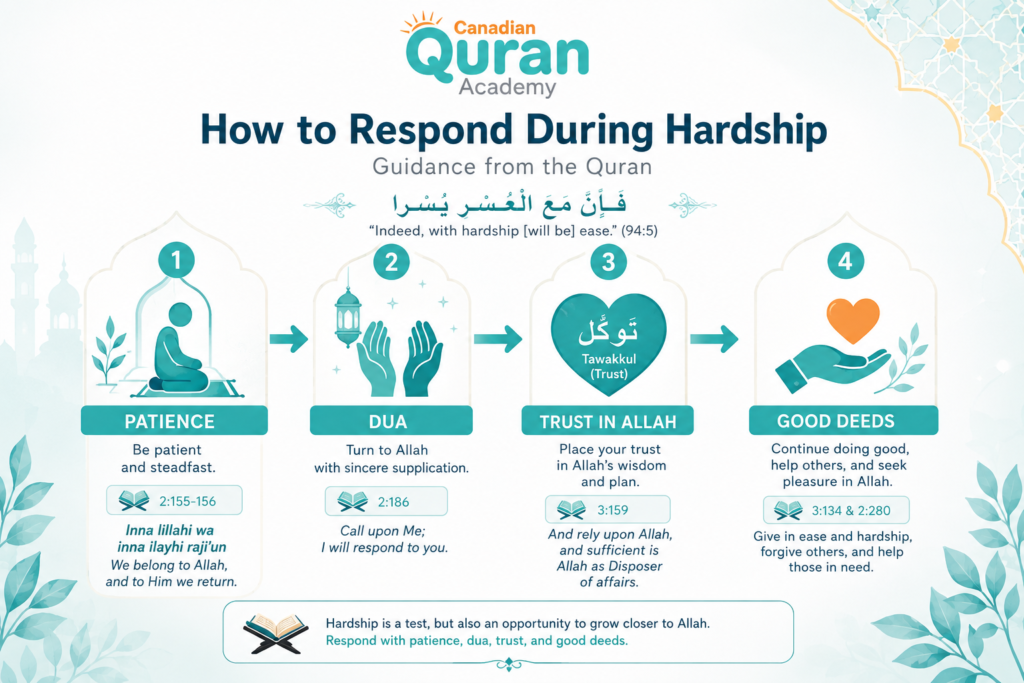
When hardship strikes as sudden loss, the Quran gives exact words to say, not just an instruction to “be strong”:
وَلَنَبْلُوَنَّكُم بِشَيْءٍ مِّنَ الْخَوْفِ وَالْجُوعِ وَنَقْصٍ مِّنَ الْأَمْوَالِ وَالْأَنفُسِ وَالثَّمَرَاتِ ۗ وَبَشِّرِ الصَّابِرِينَ الَّذِينَ إِذَا أَصَابَتْهُم مُّصِيبَةٌ قَالُوا إِنَّا لِلَّهِ وَإِنَّا إِلَيْهِ رَاجِعُونَ
Wa lanabluwannakum bishayʾim-minal-khawfi wal-jūʿi wa naqṣim-minal-ʾamwāli wal-ʾanfusi wath-thamarāt, wa bashshiriṣ-ṣābirīn. Alladhīna idhā aṣābat-hum muṣībah, qālū innā lillāhi wa innā ilayhi rājiʿūn.‘” (Surah Al-Baqarah 2:155-156)
“And We will surely test you with something of fear and hunger and a loss of wealth and lives and fruits, but give good tidings to the patient — who, when disaster strikes them, say, ‘Indeed we belong to Allah, and indeed to Him we will return.
This is where Inna lillahi wa inna ilayhi raji’un comes from. The verse defines “the patient” by exactly what they say in that moment — not resignation, but a declaration that places the loss inside a larger, deliberate framework.
Beyond words, the Quran also describes conduct sustained during hardship rather than restored after it:
الَّذِينَ يُنفِقُونَ فِي السَّرَّاءِ وَالضَّرَّاءِ وَالْكَاظِمِينَ الْغَيْظَ وَالْعَافِينَ عَنِ النَّاسِ ۗ وَاللَّهُ يُحِبُّ الْمُحْسِنِينَ
Alladhīna yunfiqūna fis-sarrāʾi waḍ-ḍarrāʾi wal-kāẓimīnal-ghayẓa wal-ʿāfīna ʿanin-nās, wallāhu yuḥibbul-muḥsinīn.” (Surah Aal-e-Imran 3:134)
“Who spend [in the cause of Allah] during ease and hardship and who restrain anger and who pardon the people — and Allah loves the doers of good.
Giving, restraining anger, and forgiving others are named together, and none of them wait for the hardship to end first.
The Quran then turns the instruction outward, toward how a believer treats someone else’s hardship:
وَإِن كَانَ ذُو عُسْرَةٍ فَنَظِرَةٌ إِلَىٰ مَيْسَرَةٍ ۚ وَأَن تَصَدَّقُوا خَيْرٌ لَّكُمْ إِن كُنتُمْ تَعْلَمُونَ
Wa in kāna dhū ʿusratin fa-naẓiratun ilā maysarah, wa an taṣaddaqū khayrul-lakum in kuntum taʿlamūn.” (Surah Al-Baqarah 2:280)
“And if someone is in hardship, then [let there be] postponement until [a time of] ease. But if you give [from your right as] charity, then it is better for you, if you only knew.
‘Usrah here shares its root with al-‘usr in Ash-Sharh 94:5 — the same family of words used for hardship in general is applied to a debtor’s private financial strain.
And finally, the Quran shifts the focus from divine capacity to human responsibility:
إِنَّ اللَّهَ لَا يُغَيِّرُ مَا بِقَوْمٍ حَتَّىٰ يُغَيِّرُوا مَا بِأَنفُسِهِمْ
Inna-llāha lā yughayyiru mā biqawmin ḥattā yughayyirū mā bi-anfusihim.” (Surah Ar-Ra’d 13:11)
“Indeed, Allah will not change the condition of a people until they change what is in themselves.
Sitting with hardship passively is a different response than meeting it with patience, effort, and a return to Allah.
Reciting verses like these accurately, not just reading the translation, is where a Quran Reading Course starts.

Read also: Quran Verses About Not Giving Up In Arabic and English
Read also: How to Learn Quran for Kids in Canada
Verses Warning Against Forgetting Allah After Relief
A final group of verses isn’t comforting on its own — it’s honest about a pattern the Quran wants the reader to notice and correct in themselves.
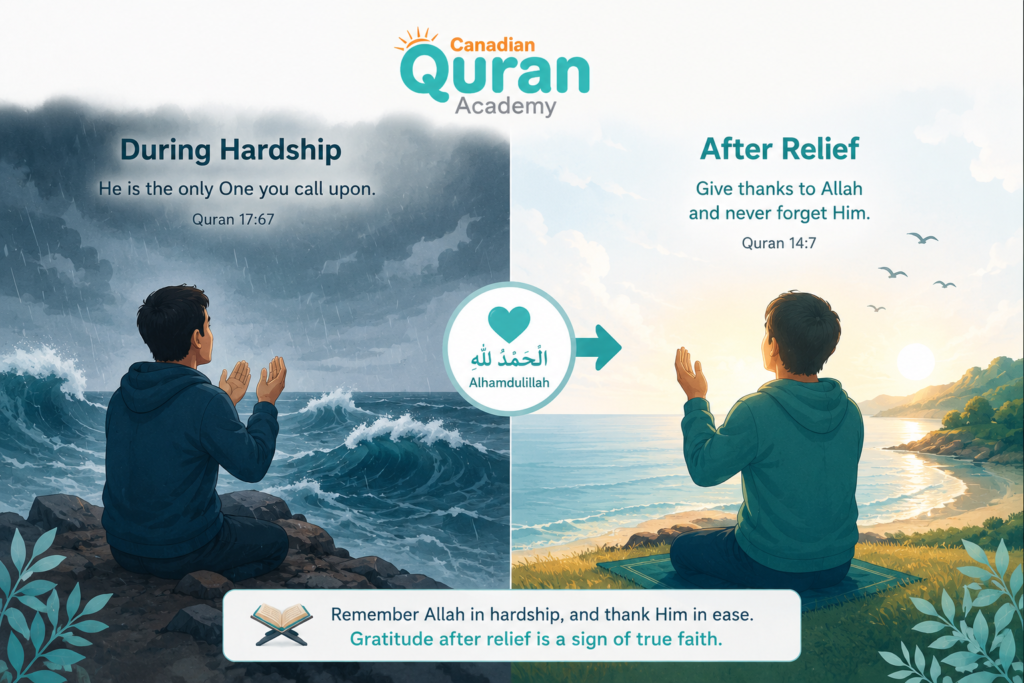
وَإِذَا مَسَّكُمُ الضُّرُّ فِي الْبَحْرِ ضَلَّ مَن تَدْعُونَ إِلَّا إِيَّاهُ ۖ فَلَمَّا نَجَّاكُمْ إِلَى الْبَرِّ أَعْرَضْتُمْ ۚ وَكَانَ الْإِنسَانُ كَفُورًا
Wa idhā massakumuḍ-ḍurru fil-baḥri ḍalla man tadʿūna illā iyyāh, fa-lammā najjākum ilal-barri aʿraḍtum, wa kānal-insānu kafūrā.” (Surah Al-Isra 17:67)
“And when adversity touches you at sea, lost are [all] those you invoke except for Him. But when He delivers you to the land, you turn away [from Him]. And ever is man ungrateful.
Danger at sea is the specific image, but the point isn’t about the sea — it’s about how quickly sincerity built during real fear can fade once the danger is gone. A closely related verse describes the same weakness in broader terms:
وَإِذَا مَسَّ النَّاسَ ضُرٌّ دَعَوْا رَبَّهُم مُّنِيبِينَ إِلَيْهِ
Wa idhā massan-nāsa ḍurrun daʿaw rabbahum munībīna ilayhi.” (Surah Ar-Rum 30:33)
“And when adversity touches the people, they call upon their Lord, turning in repentance to Him.
The verse continues by noting that once relief comes, some people drift back to old habits. Calling on Allah during hardship is common; sincerity that outlasts it is the harder standard the Quran keeps returning to.
Introducing children to short, memorable verses like these early gives them the language for patience before they need it — something built into a Quran Course for Kids from the very first lesson.

Experience Our Classrooms
Don’t just take our word for it—take a look inside! Watch the videos below to experience our engaging teaching methods and vibrant online classrooms firsthand.
Start Your Quranic Journey in Canada
Join our vibrant community and learn with expert tutors through our flexible online platform.
Claim Your Free TrialStart Your Journey to Mastering These Verses with The Canadian Quran Academy
The verses above carry their full weight only when read, recited, and memorized in the Arabic they were revealed in — every repetition, every root word, every subtlety the classical commentators unpack.
The Canadian Quran Academy offers:
- Qualified, certified Quran teachers experienced in Tajweed and Hifz
- Personalized 1-on-1 sessions focused on correct pronunciation and meaning
- Flexible scheduling across all Canadian time zones — morning, evening, and weekends
- Programs for adults, children, women, and new reverts at every level
- A dedicated Hifz Program to help you memorize verses like 94:5–6 and 2:155–156 with confidence
- A free trial class — no commitment required
Book your free trial today and start learning these verses the way they were meant to be understood — in the language, rhythm, and depth of the original Arabic.

Our Quran Courses
- Quran Online Academy
- Quran Recitation Classes
- Quran Reading Classes
- Online Quran Classes for Kids
- Quran Classes for Adults
- Quran Classes for Female/Sisters
- Learn Quran for Beginners
- Quran Memorization (Hifz) Course
- Hifz Classes for Adults
- Quran Memorization and Hifz for Kids
- Quran Hifz for Ladies
- Quran Ijazah Program
- Quran Qirat Learning Course
- Quran Tafsir Course
- Noorani Qaida Course
- Noorani Qaida Course for Kids
- Weekend Quran Classes
- Intensive Quran Course
- Al-Azhar Quran Course
- Online Tajweed Classes
- Tajweed Course for Kids
- Tajweed Course for Adults
- Tajweed Course for Ladies/Sisters
Start Your Quranic Journey in Canada
Join our vibrant community and learn with expert tutors through our flexible online platform.
Claim Your Free TrialConclusion
Quran verses about hardship in Arabic build a complete picture when grouped by what they’re actually addressing, not read as isolated quotes. They explain hardship as a test rather than a punishment (2:214, 29:2, 6:42), promise ease in terms specific enough to include financial strain (94:5-6, 65:7, 2:286), instruct exact words and conduct during loss and difficulty (2:155-156, 3:134, 2:280, 13:11), and warn honestly about sincerity that fades once relief arrives (17:67, 30:33). The two hadith cited here — Sahih Muslim 2999 and Sahih al-Bukhari 5641 — confirm the same principle from the Prophet’s ﷺ own words: hardship met with patience carries benefit, down to something as small as a thorn’s prick.
Reading these verses in Arabic, with a teacher who can walk through their meaning and correct recitation, is what turns this list into something you can actually return to the moment you need it.
Frequently Asked Questions
What is the main Quran verse about hardship?
The verse most commonly cited is Surah Ash-Sharh 94:5-6: “For indeed, with hardship [will be] ease. Indeed, with hardship [will be] ease.” Its repetition, and the shift from “the hardship” (definite) to “an ease” (indefinite), are why scholars treat it as the Quran’s central statement on the topic.
Does the Quran say hardship is a punishment?
No. Verses including Surah Al-Baqarah 2:214 and Surah Al-Ankabut 29:2 describe hardship as a test connected to faith, not a punishment. Surah Al-An’am 6:42 frames hardship as a means of humbling a people toward Allah, not punishing them for its own sake.
What hadith talks about patience during hardship?
Sahih Muslim 2999 records the Prophet ﷺ saying a believer’s affairs are entirely good — thankful during ease, patient during hardship — and both responses bring benefit. Sahih al-Bukhari 5641 adds that even minor hardships, down to a thorn’s prick, carry spiritual benefit for a Muslim.
Is it better to recite hardship verses in Arabic or read them in translation?
Both have value, but reciting the Arabic preserves the rhythm and repetition built into verses like 94:5-6, which scholars believe is part of how the verse was meant to be internalized. Translation supports meaning; recitation supports memorization and daily recall.
What does the Quran say about complaining during hardship?
The Quran doesn’t ask believers to suppress how they feel — 2:214 records a messenger and his companions asking “when is the help of Allah?” without correction. What the Quran repeatedly asks for instead is the response modeled in 2:155-156: acknowledging that everything belongs to Allah and returns to Him, even while the hardship is still being felt.






Leave a Reply