 Quran
Quran
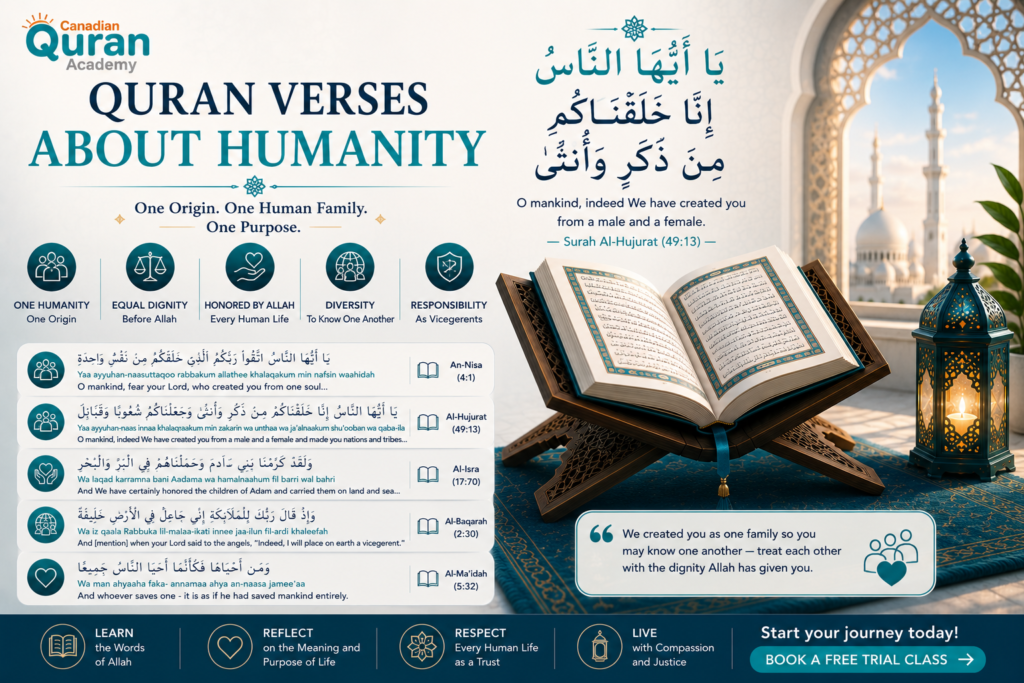
Long before the Quran speaks to any single nation or community, it speaks to humanity as a whole. Throughout its chapters, Allah repeatedly opens with the words “يَا أَيُّهَا النَّاسُ” (O mankind), addressing every human being regardless of belief, background, or nationality.
If you’re searching for Quran verses about humanity in Arabic, this guide collects the clearest verses on the subject in one place. Each verse appears in Arabic with full tashkeel, alongside its English translation, Surah and Ayah reference, a direct link to the verse on Quran.com, and a short explanation of its meaning.
Rather than treating humanity as one topic among many, these verses reveal a consistent pattern: one shared origin, equal dignity before Allah, and a responsibility that every person carries toward every other person.
What Does the Quran Say About Humanity?
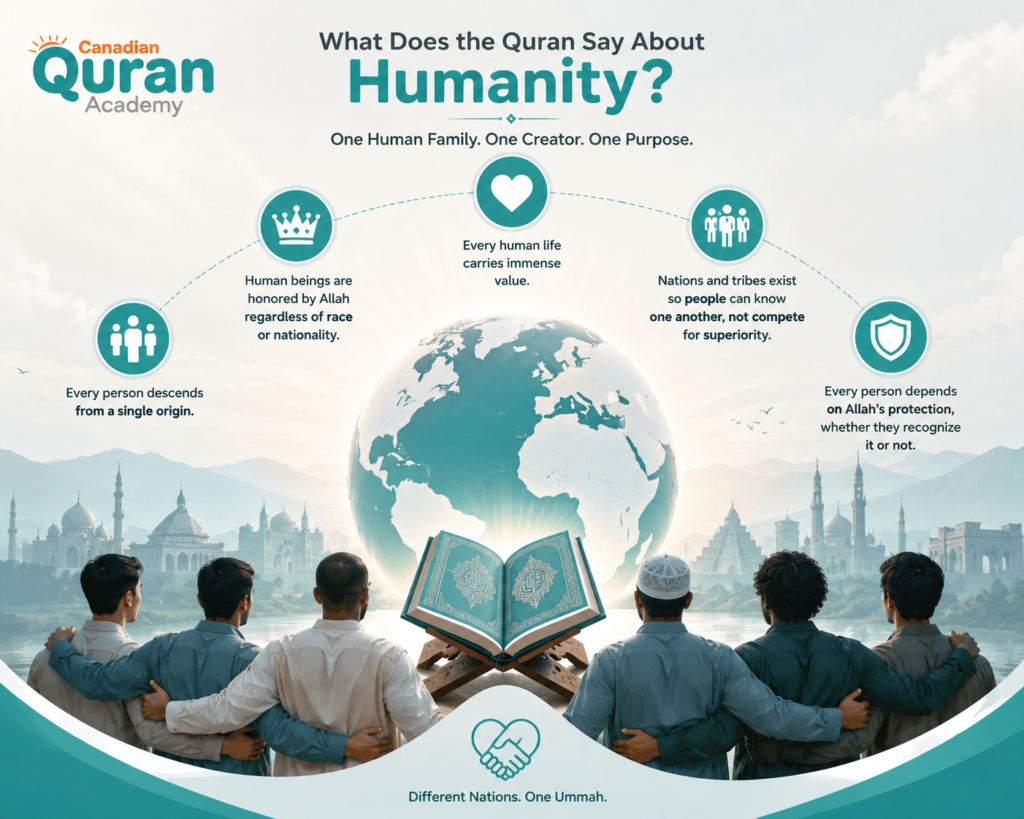
The Quran presents humanity as one creation with a shared purpose. Before it discusses differences in language, nationality, or tribe, it establishes that every human being comes from the same source and answers to the same Creator.
Across its chapters, a few themes repeat consistently:
- Every person descends from a single origin.
- Human beings are honored by Allah regardless of race or nationality.
- Every human life carries immense value.
- Nations and tribes exist so people can know one another, not compete for superiority.
- Every person depends on Allah’s protection, whether they recognize it or not.
These five ideas form the backbone of the Quranic view of humanity, and they explain why so many verses open by addressing all people rather than only believers.
Quran Verse About Humanity Created From One Soul
Surah An-Nisa opens by reminding every reader, believer or not, that they share a single point of origin. It’s a fitting starting point for any study of what the Quran says about humanity.
يَا أَيُّهَا النَّاسُ اتَّقُوا رَبَّكُمُ الَّذِي خَلَقَكُم مِّن نَّفْسٍ وَاحِدَةٍ وَخَلَقَ مِنْهَا زَوْجَهَا وَبَثَّ مِنْهُمَا رِجَالًا كَثِيرًا وَنِسَاءً
“O mankind, fear your Lord, who created you from one soul and created from it its mate and dispersed from both of them many men and women.” — Surah An-Nisa, 4:1
This verse opens Surah An-Nisa by addressing all of humanity, not a specific group of believers. It reminds readers that every person alive today traces back to one soul, making human equality part of creation itself rather than a social ideal added later.
The Quran never suggests that one race, tribe, or nation has a separate origin from another. This verse rules that idea out at the level of creation, not just ethics.
Read also: Quran Verses About Hope In Arabic
Quran Verse About Human Equality Through Nations and Tribes
This is the verse most students meet first when studying what Islam teaches about race and nationality, and for good reason: it states the principle directly, without needing interpretation.
يَا أَيُّهَا النَّاسُ إِنَّا خَلَقْنَاكُم مِّن ذَكَرٍ وَأُنثَىٰ وَجَعَلْنَاكُمْ شُعُوبًا وَقَبَائِلَ لِتَعَارَفُوا ۚ إِنَّ أَكْرَمَكُمْ عِندَ اللَّهِ أَتْقَاكُمْ
“O mankind, We created you from a male and a female and made you peoples and tribes so that you may know one another. Indeed, the most honored of you in the sight of Allah is the most righteous of you.” — Surah Al-Hujurat, 49:13
Rather than treating differences in nationality or ethnicity as grounds for superiority, this verse explains that people were divided into nations and tribes simply so they could recognize and cooperate with one another.
It then replaces every worldly measure of status with one standard: taqwa, or God-consciousness. Wealth, race, language, and family background carry no weight before Allah — only righteousness does. This is the verse most commonly cited when discussing Islam’s position on racism and tribalism.
If you’re building this verse into a child’s Quran study, a class made specifically for young learners helps the meaning land alongside correct recitation. Canadian Quran Academy’s kids’ courses are structured around exactly this: age-appropriate explanation paired with Tajweed practice, rather than memorization on its own.
Book a FREE trial class in the Online Quran Classes for Kids in Canada

Quran Verse About Allah Honoring the Children of Adam
Unlike verses addressed only to believers, this ayah speaks about Bani Adam — the children of Adam — a phrase that covers humanity as a whole, without exception.
وَلَقَدْ كَرَّمْنَا بَنِي آدَمَ وَحَمَلْنَاهُمْ فِي الْبَرِّ وَالْبَحْرِ وَرَزَقْنَاهُم مِّنَ الطَّيِّبَاتِ وَفَضَّلْنَاهُمْ عَلَىٰ كَثِيرٍ مِّمَّنْ خَلَقْنَا تَفْضِيلًا
“And We have certainly honored the children of Adam and carried them on land and sea, provided them with good things, and favored them above much of what We have created.” — Surah Al-Isra, 17:70
The Quran teaches that human dignity is a gift from Allah, not something earned through achievement or social standing. Every person carries this honor simply by being part of the human family, before they do anything to deserve it.
The verse also notes specific blessings: transportation across land and sea, lawful provisions, and abilities that set humans apart from many other creations. Because this honor is given by Allah rather than earned, believers are expected to treat every human being’s dignity as something to protect, not something to rank.
Read also: Quran Verses About Hijab in Arabic With Translation and Meaning
Quran Verse About Human Responsibility as Allah’s Vicegerent on Earth
From the very beginning of the Quran, humanity is introduced as a creation entrusted with a unique mission. This verse explains that people were appointed to act responsibly on earth, making accountability part of human purpose.
وَإِذْ قَالَ رَبُّكَ لِلْمَلَائِكَةِ إِنِّي جَاعِلٌ فِي الْأَرْضِ خَلِيفَةً
“And [mention] when your Lord said to the angels, ‘Indeed, I will place upon the earth a successive authority (vicegerent).'” — Surah Al-Baqarah (2:30)
This verse introduces one of the Quran’s defining descriptions of humanity: people were created to serve as Allah’s vicegerents on earth. Human life is therefore not random or purposeless. Every person has been entrusted with responsibility, moral choice, and stewardship over the world Allah created.
Why Does Human Dignity Come With Responsibility?
The Quran connects dignity with responsibility rather than separating the two. Being honored by Allah does not exempt a person from being judged for their actions—it means they were entrusted with intellect, free will, and moral awareness. These unique gifts elevate human beings above many other creations, but they also make every person accountable for how those gifts are used. In the Quran, honor is not simply a privilege; it is a trust that carries moral obligations.
This balance between honor and accountability shapes the Islamic understanding of justice, human rights, and compassion. A common misunderstanding is to treat human dignity as a status that protects people from consequences. The Quran teaches the opposite: because human beings have been honored, they are expected to uphold justice, show mercy, fulfill their responsibilities, and answer for their choices. Every action matters, and no one is beyond accountability.
Adult learners who want to explore this balance in more depth — how honor, free will, and accountability connect across the Quran — often move beyond individual verses into structured study. The academy’s Islamic studies courses for adults cover exactly this kind of thematic study, built around a learner’s pace rather than a fixed curriculum.
Begin your Islamic Studies journey in Canada with a FREE trial class.
Quran Verse About the Value of a Single Human Life
Few verses in the Quran express the weight of human life as directly as this one, and it’s frequently cited outside religious study too, in discussions of justice and humanitarian ethics.
مَن قَتَلَ نَفْسًا بِغَيْرِ نَفْسٍ أَوْ فَسَادٍ فِي الْأَرْضِ فَكَأَنَّمَا قَتَلَ النَّاسَ جَمِيعًا ۖ وَمَنْ أَحْيَاهَا فَكَأَنَّمَا أَحْيَا النَّاسَ جَمِيعًا
“Whoever kills a soul unless for a soul or for corruption in the land — it is as if he had killed all mankind. And whoever saves one — it is as if he had saved all mankind.” — Surah Al-Ma’idah, 5:32
Instead of measuring a person’s worth by position or influence, this verse teaches that every innocent life carries the same immense value before Allah. Taking one innocent life is described as an attack on humanity itself, while preserving a single life reflects the same mercy that benefits everyone.
This comparison is deliberately extreme, and that’s the point: it removes any scale on which one life could be weighed as worth more than another.
Live Class in Action
Watch how our instructors interact with students in real-time, focusing on interactive methods.
Start Your Quranic Journey in Canada
Join our vibrant community and learn with expert tutors through our flexible online platform.
Claim Your Free TrialQuran Verse About Humanity Being Created in the Best Form
The Quran doesn’t only describe how humans were created—it also highlights the excellence of that creation. This verse reminds readers that every person was fashioned with dignity, ability, and the potential to fulfill a higher purpose.
لَقَدْ خَلَقْنَا الْإِنسَانَ فِي أَحْسَنِ تَقْوِيمٍ
“We have certainly created mankind in the best of stature.” — Surah At-Tin (95:4)
The Quran reminds readers that human beings were created in the finest form, combining physical abilities, intellect, and moral awareness. This honor reflects Allah’s wisdom and reinforces the value He has placed upon every human being before differences in wealth, race, or social status are considered.
Quran Verses About Allah’s Protection of Humanity
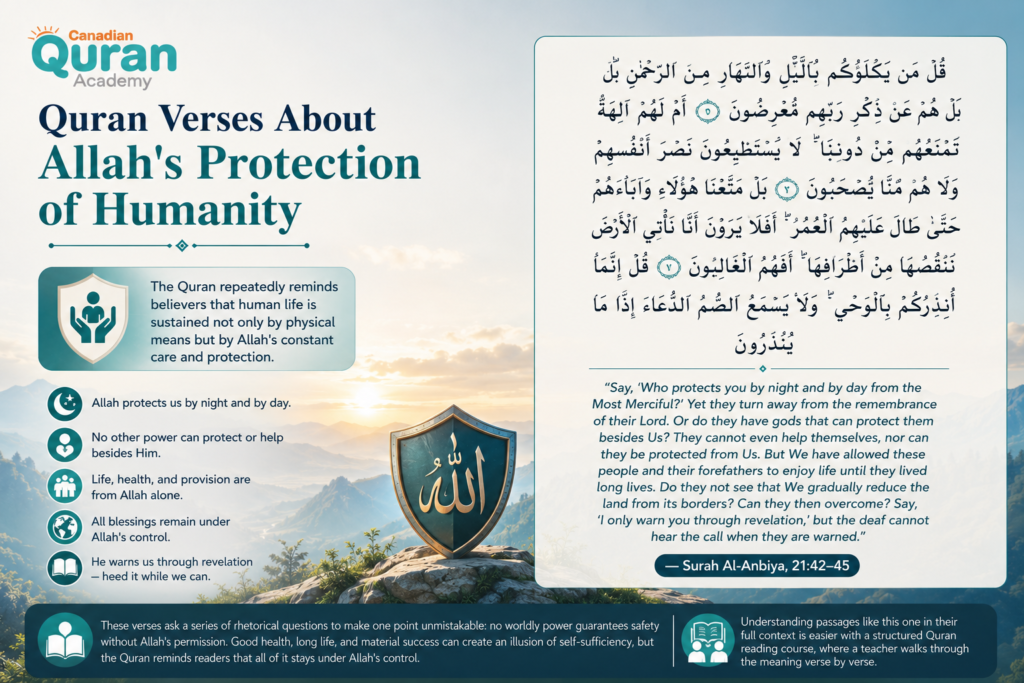
The Quran repeatedly reminds believers that human life is sustained not only by physical means but by Allah’s constant care and protection. Every moment of safety, health, and security is ultimately a blessing from Him, even when people become accustomed to these blessings and overlook their true source.
قُلْ مَن يَكْلَؤُكُم بِاللَّيْلِ وَالنَّهَارِ مِنَ الرَّحْمَٰنِ ۚ بَلْ هُمْ عَن ذِكْرِ رَبِّهِم مُّعْرِضُونَ أَمْ لَهُمْ آلِهَةٌ تَمْنَعُهُم مِّن دُونِنَا ۚ لَا يَسْتَطِيعُونَ نَصْرَ أَنفُسِهِمْ وَلَا هُم مِّنَّا يُصْحَبُونَ بَلْ مَتَّعْنَا هَٰؤُلَاءِ وَآبَاءَهُمْ حَتَّىٰ طَالَ عَلَيْهِمُ الْعُمُرُ ۚ أَفَلَا يَرَوْنَ أَنَّا نَأْتِي الْأَرْضَ نَنقُصُهَا مِنْ أَطْرَافِهَا ۚ أَفَهُمُ الْغَالِبُونَ قُلْ إِنَّمَا أُنذِرُكُم بِالْوَحْيِ ۚ وَلَا يَسْمَعُ الصُّمُّ الدُّعَاءَ إِذَا مَا يُنذَرُونَ
“Say, ‘Who protects you by night and by day from the Most Merciful?’ Yet they turn away from the remembrance of their Lord. Or do they have gods that can protect them besides Us? They cannot even help themselves, nor can they be protected from Us. But We have allowed these people and their forefathers to enjoy life until they lived long lives. Do they not see that We gradually reduce the land from its borders? Can they then overcome? Say, ‘I only warn you through revelation,’ but the deaf cannot hear the call when they are warned.” — Surah Al-Anbiya, 21:42–45
These verses ask a series of rhetorical questions to make one point unmistakable: no worldly power guarantees safety without Allah’s permission. Good health, long life, and material success can create an illusion of self-sufficiency, but the Quran reminds readers that all of it stays under Allah’s control.
This passage balances the earlier verses on human honor. Human beings are honored by Allah, yet that honor was never meant to produce arrogance — it comes with total dependence on the One who granted it. Understanding passages like this one in their full context is easier with a structured Quran reading course, where a teacher walks through the meaning verse by verse rather than leaving the reader to interpret rhetorical questions like these alone.
Experience Our Classrooms
Don’t just take our word for it—take a look inside! Watch the videos below to experience our engaging teaching methods and vibrant online classrooms firsthand.
Start Your Quranic Journey in Canada
Join our vibrant community and learn with expert tutors through our flexible online platform.
Claim Your Free TrialDeepen Your Understanding of the Quran with The Canadian Quran Academy
Learning what the Quran says about human dignity, honor, and responsibility is the beginning of a lifelong journey. Studying these verses with qualified teachers helps you understand their context, meaning, and practical guidance while strengthening your connection with Allah’s words.
The Canadian Quran Academy offers:
- Qualified Quran and Islamic Studies teachers with authentic scholarly training
- Personalized 1-on-1 online classes tailored to your level and learning goals
- Step-by-step Quran study with Tafsir alongside accurate recitation
- Flexible scheduling for adults, children, and busy families across Canadian time zones
- A free trial class with no commitment required
Book your free trial with The Canadian Quran Academy and begin exploring the Quran with structured guidance that helps you understand its message—not just read its words.

Our Quran Courses
- Quran Online Academy
- Quran Recitation Classes
- Quran Reading Classes
- Online Quran Classes for Kids
- Quran Classes for Adults
- Quran Classes for Female/Sisters
- Learn Quran for Beginners
- Quran Memorization (Hifz) Course
- Hifz Classes for Adults
- Quran Memorization and Hifz for Kids
- Quran Hifz for Ladies
- Quran Ijazah Program
- Quran Qirat Learning Course
- Quran Tafsir Course
- Noorani Qaida Course
- Noorani Qaida Course for Kids
- Weekend Quran Classes
- Intensive Quran Course
- Al-Azhar Quran Course
- Online Tajweed Classes
- Tajweed Course for Kids
- Tajweed Course for Adults
- Tajweed Course for Ladies/Sisters
Start Your Quranic Journey in Canada
Join our vibrant community and learn with expert tutors through our flexible online platform.
Claim Your Free TrialConclusion
The Quran presents a complete view of humanity. It begins by teaching that every person comes from the same origin, removing any basis for racial or ethnic superiority. It then reminds readers that Allah has honored every child of Adam, making human dignity part of creation itself rather than something earned through worldly success.
The Quran also insists on the sanctity of every human life, and it reminds humanity that every blessing — including safety itself — ultimately comes from Allah alone. Read together, these Quran verses about humanity in Arabic describe one Creator, one shared dignity, and one responsibility: to treat every human life with the value the Quran assigns it.
Studying these verses in Arabic alongside their translation and context is what turns a passing read into lasting understanding.
Frequently Asked Questions About Quran Verses on Humanity
What is the main Quran verse about humanity?
Surah Al-Hujurat (49:13) is widely regarded as the Quran’s central verse on humanity. It explains that all people were created from a single man and woman, and that nations and tribes exist so people can know one another, not claim superiority. Read it at https://quran.com/49/13.
Does the Quran teach that all people are equal?
Yes. The Quran teaches that all human beings share the same origin and possess equal dignity. People differ in culture, language, and background, but the Quran states that the only measure of honor before Allah is righteousness (taqwa), not race or nationality.
Which Quran verse talks about human dignity?
Surah Al-Isra (17:70) declares that Allah has honored the children of Adam. Because the verse refers to all descendants of Adam, it is read as describing the inherent dignity of humanity as a whole. Read it at https://quran.com/17/70.
What does the Quran say about the value of human life?
Surah Al-Ma’idah (5:32) teaches that killing one innocent person is like killing all of humanity, while saving one life is like saving all people. It’s one of the clearest statements in the Quran on the value of a single human life.
Why does the Quran mention different nations and tribes?
According to Surah Al-Hujurat (49:13), diversity exists so people can know and cooperate with one another. The Quran presents cultural and ethnic differences as a sign of Allah’s design, not a reason for pride or discrimination.
Can children learn these Quran verses about humanity?
Yes. These verses teach values like kindness, mercy, fairness, and respect for others in language simple enough for young learners once explained by a teacher. Introducing them early helps children connect Quran study with everyday character.



Leave a Reply