 Quran
Quran
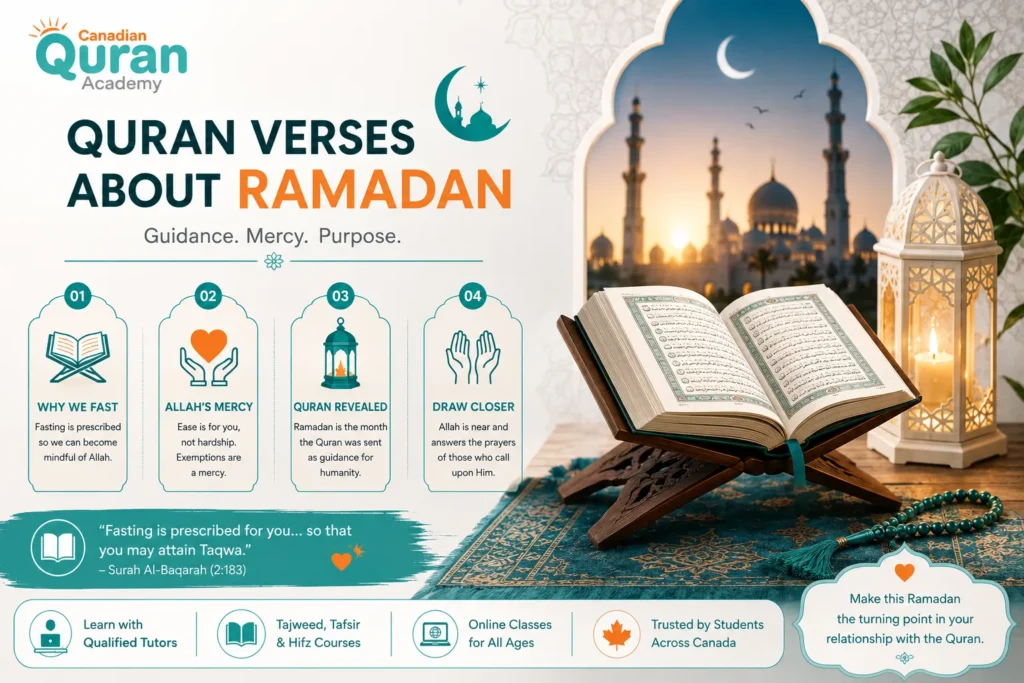
Every Ramadan, Muslims search for the same thing: the actual Quran verses about Ramadan in Arabic and English, so they can read them correctly, understand their meaning, and reflect on them during the month of fasting.
This guide brings together the core Ramadan verses from the Quran with the Arabic text, an English translation, and a clear explanation of what each verse means for how you fast, pray, and grow spiritually this month.
At Canadian Quran Academy, our instructors teach these verses as part of Tajweed, Tafsir, and Hifz classes every Ramadan, so the explanations here reflect how the verses are actually taught, not just how they’re translated.
The main verses about Ramadan appear together in Surah Al-Baqarah (2:183–187), a single passage that covers why fasting was prescribed, who is exempt, and how the fast works day to day.
1. Why Fasting Was Prescribed
This verse is the origin point for the obligation of fasting in Ramadan, the first place in the Quran where the command is stated directly rather than implied. It opens with a direct address to believers, then immediately ties the practice to the nations before them, framing fasting as a continuation of established worship rather than something new to the Muslim Ummah.
يَا أَيُّهَا الَّذِينَ آمَنُوا كُتِبَ عَلَيْكُمُ الصِّيَامُ كَمَا كُتِبَ عَلَى الَّذِينَ مِن قَبْلِكُمْ لَعَلَّكُمْ تَتَّقُونَ
“O believers! Fasting is prescribed for you, as it was for those before you, so perhaps you will become mindful [of Allah].” (Surah Al-Baqarah, 2:183)
The Arabic word كُتِبَ (“kutiba”) means decreed or ordained, not simply suggested. The verse also states the goal directly: تَتَّقُونَ, “so that you may attain Taqwa,” meaning God-consciousness. Fasting is not framed as an endurance test; it is framed as training for awareness of Allah in daily life.
2. Who Is Exempt From Fasting
Right after establishing the obligation, the Quran addresses hardship cases directly rather than leaving them to later interpretation. This sequencing matters: the exemption isn’t a separate ruling added on afterward, it’s built into the very next verse, showing that flexibility for illness and travel was part of the command from the start, not an afterthought.
أَيَّامًا مَّعْدُودَاتٍ ۚ فَمَن كَانَ مِنكُم مَّرِيضًا أَوْ عَلَىٰ سَفَرٍ فَعِدَّةٌ مِّنْ أَيَّامٍ أُخَرَ ۚ وَعَلَى الَّذِينَ يُطِيقُونَهُ فِدْيَةٌ طَعَامُ مِسْكِينٍ
“[Fasting for] a limited number of days. So whoever among you is ill or on a journey, then an equal number of other days. And upon those who are able [to fast, but with hardship], a ransom of feeding a needy person.” (Surah Al-Baqarah, 2:184)
This is one of the most commonly misapplied verses of Ramadan: it does not exempt anyone who simply finds fasting inconvenient. It applies specifically to illness and travel, with fidyah (feeding a needy person) reserved for those who genuinely cannot fast at all, such as the chronically ill or elderly.
Read also: 15 Quran Verses About Prayer In Arabic And English
Read Also: Quran Verses About Death in Arabic
3. Revelation, Guidance, And Ease
This is the longest and most quoted of the Ramadan verses, and it does three things in one breath: names the month, describes the Quran’s revelation, and restates the illness/travel rule.
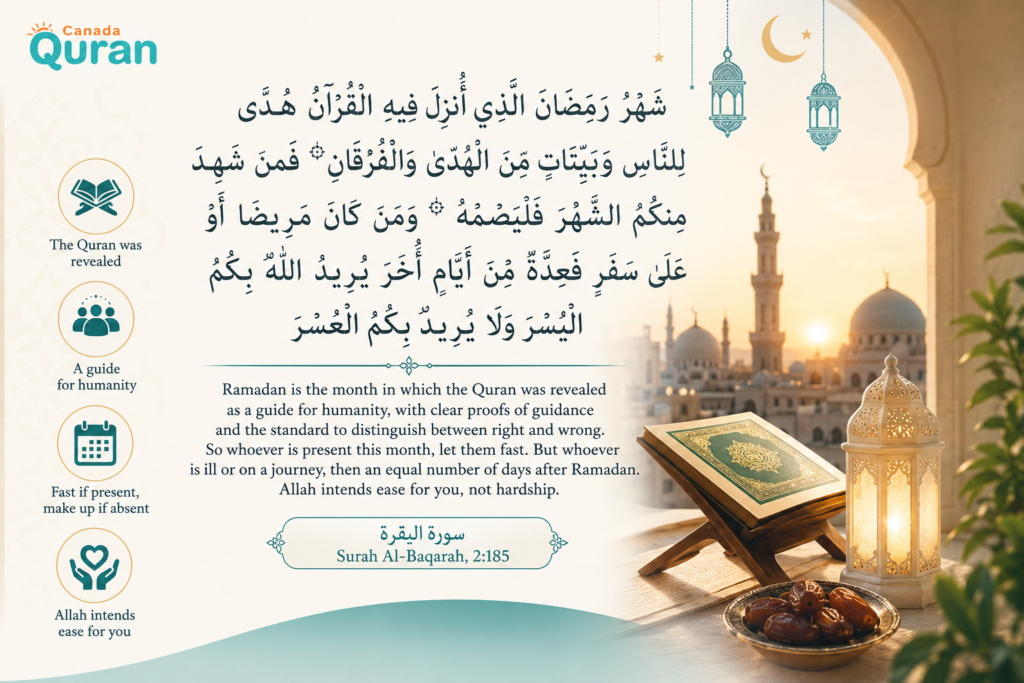
شَهْرُ رَمَضَانَ الَّذِي أُنزِلَ فِيهِ الْقُرْآنُ هُدًى لِّلنَّاسِ وَبَيِّنَاتٍ مِّنَ الْهُدَىٰ وَالْفُرْقَانِ ۚ فَمَن شَهِدَ مِنكُمُ الشَّهْرَ فَلْيَصُمْهُ ۖ وَمَن كَانَ مَرِيضًا أَوْ عَلَىٰ سَفَرٍ فَعِدَّةٌ مِّنْ أَيَّامٍ أُخَرَ ۗ يُرِيدُ اللَّهُ بِكُمُ الْيُسْرَ وَلَا يُرِيدُ بِكُمُ الْعُسْرَ
“Ramadan is the month in which the Quran was revealed as a guide for humanity, with clear proofs of guidance and the standard to distinguish between right and wrong. So whoever is present this month, let them fast. But whoever is ill or on a journey, then an equal number of days after Ramadan. Allah intends ease for you, not hardship.” (Surah Al-Baqarah, 2:185)
The phrase “Allah intends ease for you, not hardship” is the governing principle behind every fasting exemption in Islamic law. When a ruling on illness, travel, pregnancy, or nursing feels like it’s making an exception, it’s actually applying this exact verse.
If you’d rather study a verse like this with a qualified instructor who can explain the tafsir line by line, the Quran Tafsir Course at Canadian Quran Academy goes through passages like Al-Baqarah 185 in full context rather than as an isolated quote.
4. Closeness to Allah During Ramadan
This verse sits between the fasting rulings, which is why scholars connect it directly to Ramadan even though it doesn’t mention fasting by name.
وَإِذَا سَأَلَكَ عِبَادِي عَنِّي فَإِنِّي قَرِيبٌ ۖ أُجِيبُ دَعْوَةَ الدَّاعِ إِذَا دَعَانِ
“And when My servants ask you [O Prophet] about Me: I am truly near. I respond to one’s prayer when they call on Me.” (Surah Al-Baqarah, 2:186)
Its placement matters: right after the command to fast, and right before the timing rules in verse 187, Allah reassures believers that their fasting and prayer during Ramadan bring them closer to Him and that dua made during this month is heard.
Live Class in Action
Watch how our instructors interact with students in real-time, focusing on interactive methods.
Start Your Quranic Journey in Canada
Join our vibrant community and learn with expert tutors through our flexible online platform.
Claim Your Free Trial5. The Daily Fasting Window
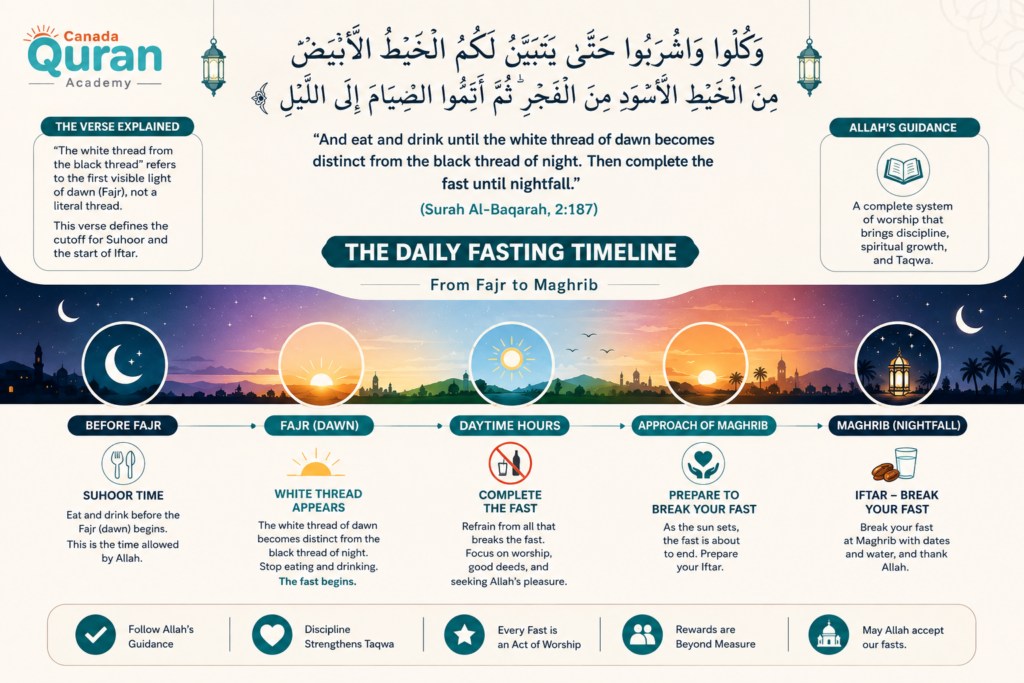
This verse sets the mechanics of the daily fast, from what’s permitted at night to exactly when the fast begins and ends.
وَكُلُوا وَاشْرَبُوا حَتَّىٰ يَتَبَيَّنَ لَكُمُ الْخَيْطُ الْأَبْيَضُ مِنَ الْخَيْطِ الْأَسْوَدِ مِنَ الْفَجْرِ ۖ ثُمَّ أَتِمُّوا الصِّيَامَ إِلَى اللَّيْلِ
“And eat and drink until the white thread of dawn becomes distinct from the black thread of night. Then complete the fast until nightfall.” (Surah Al-Baqarah, 2:187)
“The white thread from the black thread” is a description of the first visible light of dawn (Fajr), not a literal thread. This is the verse scholars use to define Suhoor’s cutoff and Iftar’s start, the two points that structure the entire Ramadan day.
Reciting a passage like 2:183–187 correctly, with the right pauses and pronunciation, takes practice. Canadian Quran Academy’s Online Tajweed Classes are built specifically around passages like this one, where a small mispronunciation can change meaning.
Read also: 12 Quran Verses About Patience In Arabic And English
Quran Verses About Laylat Al-Qadr in Ramadan
The Quran verses about Ramadan in Arabic and English wouldn’t be complete without Laylat al-Qadr: Ramadan is significant partly because the Quran itself was revealed during it, a connection stated explicitly in Surah Al-Qadr.
إِنَّا أَنزَلْنَاهُ فِي لَيْلَةِ الْقَدْرِ ﴿١﴾ وَمَا أَدْرَاكَ مَا لَيْلَةُ الْقَدْرِ ﴿٢﴾ لَيْلَةُ الْقَدْرِ خَيْرٌ مِّنْ أَلْفِ شَهْرٍ ﴿٣﴾ تَنَزَّلُ الْمَلَائِكَةُ وَالرُّوحُ فِيهَا بِإِذْنِ رَبِّهِم مِّن كُلِّ أَمْرٍ ﴿٤﴾ سَلَامٌ هِيَ حَتَّىٰ مَطْلَعِ الْفَجْرِ ﴿٥﴾
“Indeed, We sent it down during the Night of Decree. And what will make you realize what the Night of Decree is? The Night of Decree is better than a thousand months. The angels and the Spirit descend during it, by the permission of their Lord, for every matter. It is peace until the emergence of dawn.” (Surah Al-Qadr)
Laylat al-Qadr is defined here, not described vaguely: it is the night the Quran began its revelation, it carries the weight of worship done over a thousand months (roughly 83 years), and it is sought within the last ten nights of Ramadan, most commonly on the odd nights.
Students preparing to search for Laylat al-Qadr often spend the last ten nights of Ramadan in extended recitation and memorization.
If that’s your goal this year, the Quran Memorization and Hifz Course for Adults is structured around exactly this kind of focused, night-based practice.
Read also: The Arabic Letter K (ك)
A Simple Framework for Studying the Ramadan Verses
Rather than memorizing translations in isolation, a more useful approach for retention is a four-step method we use with students: Read, Understand, Recite, Reflect.
Read the Arabic text aloud first, even slowly. Understand the English meaning and the historical context of the verse. Recite it again from memory once the meaning is clear, this time focusing on Tajweed.
Reflect on how the verse applies to your fast that specific day, whether it’s the exemption rules, the timing of Suhoor, or the reminder that Allah is near.
This sequence works because it separates pronunciation practice from comprehension, instead of trying to do both at once, which is where most self-taught reciters get stuck.
If you’re studying with children, the Quran Memorization and Hifz Course for Kids applies a simplified version of this same method, and the Noorani Qaida Course for Kids builds the foundational letter recognition needed before a child can read these verses independently.
Read Also: Quran Verses About Forgiveness in Arabic
Experience Our Classrooms
Don’t just take our word for it—take a look inside! Watch the videos below to experience our engaging teaching methods and vibrant online classrooms firsthand.
Start Your Quranic Journey in Canada
Join our vibrant community and learn with expert tutors through our flexible online platform.
Claim Your Free TrialLearn To Recite And Understand These Verses With Canadian Quran Academy
Reading Quran verses about Ramadan in Arabic and English is a strong start, but reciting them correctly and understanding their tafsir is what turns reading into worship.
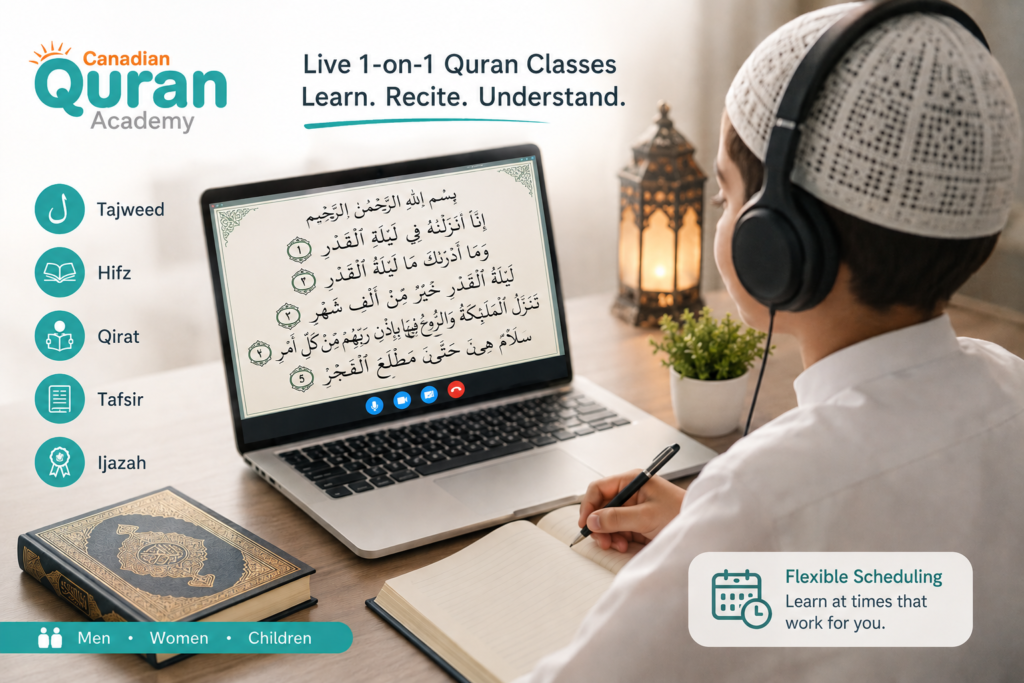
Canadian Quran Academy offers live, one-on-one classes with certified instructors covering Tajweed, Hifz, Qirat, Tafsir, and Ijazah, for men, women, and children, at times that work around your schedule.
Whether you want to correct your recitation of Surah Al-Baqarah, memorize Surah Al-Qadr before the last ten nights, or start a full Hifz journey this Ramadan, our instructors build a plan around where you are right now.
Our Quran Courses:
- Quran Recitation Classes
- Quran Reading Classes
- Online Quran Classes for Kids
- Quran Classes for Adults
- Quran Classes for Female
- Learn Quran Course for Beginners
- Quran Memorization (Hifz) Course
- Hifz Classes for Adults
- Quran Memorization and Hifz Course for Kids
- Quran Hifz Course for Ladies
- Quran Ijazah Program
- Quran Qirat Learning Course
- Quran Tafsir Course
Start Your Quranic Journey in Canada
Join our vibrant community and learn with expert tutors through our flexible online platform.
Claim Your Free TrialRead also: Letter A (أ) In Arabic – The Complete Guide To Alif
Conclusion
The core Quran verses about Ramadan in Arabic and English, Surah Al-Baqarah 2:183–187 and Surah Al-Qadr 97:1–5, cover everything from why fasting was prescribed to exactly when it starts and ends each day. Read together, they show a consistent theme: fasting is demanding, but Allah built ease, clear exemptions, and closeness into the same verses that command it.
The most useful way to hold onto these verses is to study them the way they were meant to be studied, in Arabic first, with the English meaning alongside it, and with real Tajweed practice rather than silent reading.
That’s the difference between knowing what the verses say and being able to recite them properly during your own fast. Canadian Quran Academy’s instructors are available year-round, including through Ramadan itself, to help with exactly that.

Frequently Asked Questions
The questions below cover what people most often ask after reading these Ramadan verses, from historical background to how the verses are counted in the Quran.
1. In which year was fasting in Ramadan first prescribed?
Fasting was first prescribed in the 2nd year after Hijrah (migration to Madinah). This places the command in Surah Al-Baqarah 2:183 among the earliest legal obligations revealed in Madinah.
2. How many times is fasting mentioned in the Quran?
The word for fasting (صِيَام, “Siyam”) and its variations appear across roughly 11 verses in the Quran. Most of the direct rulings on Ramadan fasting are concentrated in Surah Al-Baqarah, verses 183 to 187.
3. What is the difference between reading the Arabic and the English translation?
The Arabic is the actual revealed text and carries the exact wording used in Tajweed and recitation. The English translation conveys the meaning for understanding but can’t fully capture words like Taqwa or Furqan, which is why studying both together gives a fuller picture.
4. Is anyone exempt from fasting in Ramadan?
Yes. Surah Al-Baqarah 2:184–185 exempts those who are ill or traveling, requiring make-up days afterward, and allows fidyah (feeding a needy person) for those permanently unable to fast, such as the chronically ill or elderly.
5. What is Laylat al-Qadr and why is it tied to these verses?
Laylat al-Qadr is the Night of Decree described in Surah Al-Qadr, the night the Quran’s revelation began, described as better than a thousand months of worship. It falls within the last ten nights of Ramadan and is directly linked to Ramadan because of Al-Baqarah 2:185, which states the Quran was revealed in this month.
6. Can I recite these verses correctly without formal Tajweed training?
You can read them, but correct pronunciation of elongations, letter points, and stopping rules typically requires guided practice. A structured Tajweed course with a live instructor is the most reliable way to catch errors that self-study usually misses.






Leave a Reply