 Quran
Quran
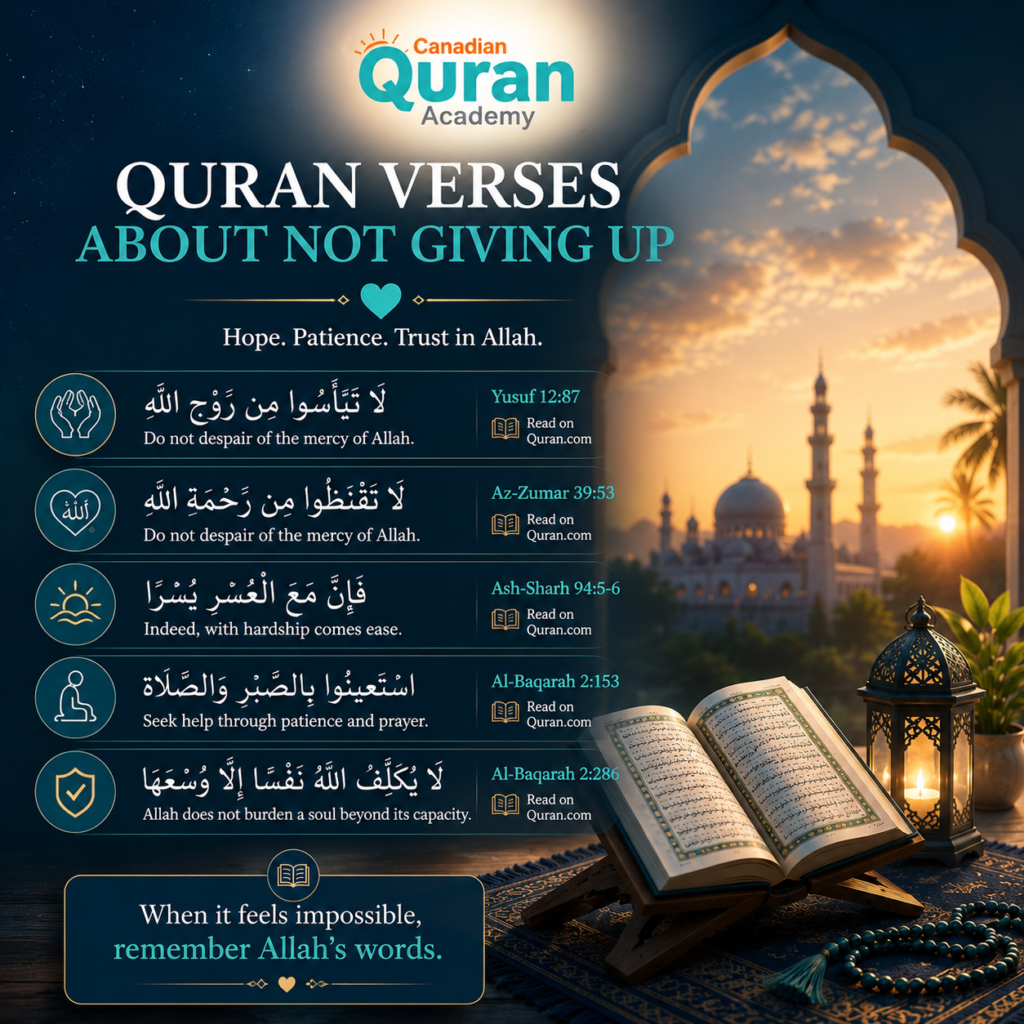
There is a moment almost every believer reaches — a moment where the effort feels too heavy and the outcome feels too far away. The Quran speaks directly to that moment. Across many surahs, Allah addresses despair by name and answers it with a promise: relief follows hardship, and giving up is never the answer He asks for.
This article gathers the clearest Quran verses about not giving up in Arabic, each shown with the original Arabic text, an accurate English translation, the exact surah and ayah reference, and a link to the verse on Quran.com so you can read it in full context.
You will not find hadith here — only verses of the Quran itself, presented the way a student memorizing or reflecting on them would want to see them.
Why Does the Quran Address Despair So Directly?
Despair (al-qunoot) is treated in the Quran as a state to actively resist, not just an emotion to feel. Several verses use the imperative form — a direct command not to lose hope — rather than a gentle suggestion. This matters because it tells the reader that hope in Allah’s mercy is a duty, not an option.
The verses below are grouped by what they specifically speak to: despair itself, patience under hardship, the promise of ease, personal capacity, and community-level setbacks. Reading them in that order builds a complete picture rather than a list of unrelated quotes.
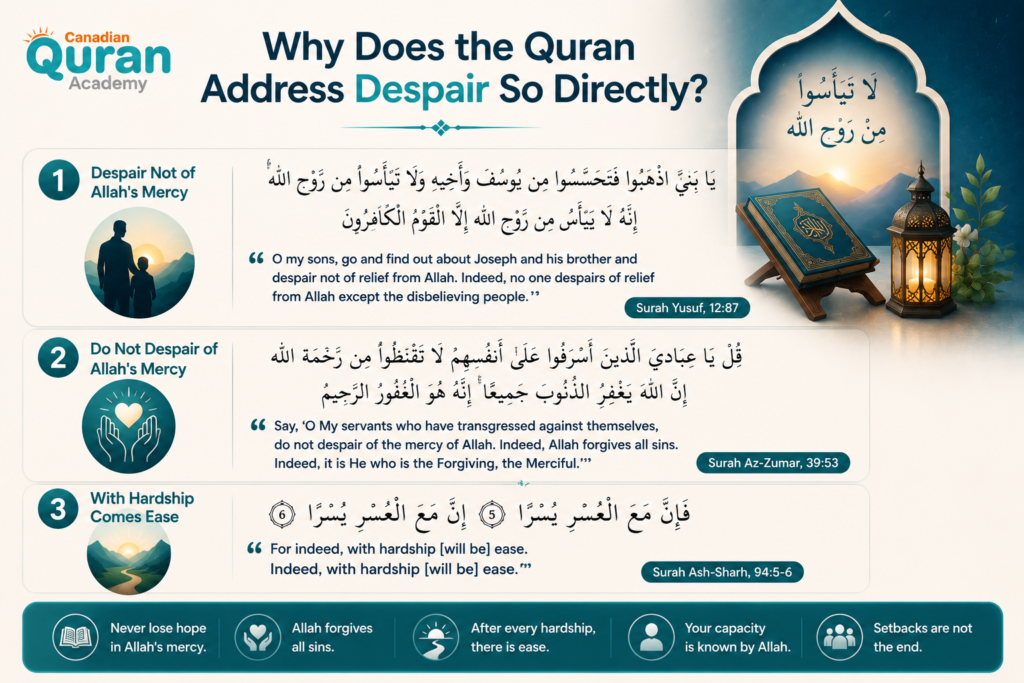
1. Despair Not of Allah’s Mercy
The Quran presents hope as an essential part of faith, even in life’s darkest moments. Through the example of Prophet Ya’qub (peace be upon him), it teaches that a believer never gives up on Allah’s mercy, no matter how long the trial or how difficult the circumstances.
يَا بَنِيَّ اذْهَبُوا فَتَحَسَّسُوا مِن يُوسُفَ وَأَخِيهِ وَلَا تَيْأَسُوا مِن رَّوْحِ اللَّهِ ۖ إِنَّهُ لَا يَيْأَسُ مِن رَّوْحِ اللَّهِ إِلَّا الْقَوْمُ الْكَافِرُونَ
“O my sons, go and find out about Joseph and his brother and despair not of relief from Allah. Indeed, no one despairs of relief from Allah except the disbelieving people.” Surah Yusuf, 12:87
Prophet Ya’qub (peace be upon him) says this after losing two sons and years of not knowing their fate. The verse links despair directly to a lack of faith, which is why it is one of the strongest Quran verses about not giving up in Arabic — the instruction comes from a father who had every human reason to lose hope and still refused to.
2. Do Not Despair of Allah’s Mercy
No matter how great a person’s mistakes may be, the Quran never closes the door to repentance. This verse reassures every believer that Allah’s mercy is greater than any sin and that sincere repentance is always met with the opportunity for forgiveness.
قُلْ يَا عِبَادِيَ الَّذِينَ أَسْرَفُوا عَلَىٰ أَنفُسِهِمْ لَا تَقْنَطُوا مِن رَّحْمَةِ اللَّهِ ۚ إِنَّ اللَّهَ يَغْفِرُ الذُّنُوبَ جَمِيعًا ۚ إِنَّهُ هُوَ الْغَفُورُ الرَّحِيمُ
“Say, ‘O My servants who have transgressed against themselves, do not despair of the mercy of Allah. Indeed, Allah forgives all sins. Indeed, it is He who is the Forgiving, the Merciful.'” Surah Az-Zumar, 39:53
This verse addresses a different kind of giving up — the point where someone assumes their own mistakes have closed the door to Allah’s mercy. It is addressed to “My servants,” a direct and personal address, which is why students often memorize it alongside 12:87 rather than instead of it.
3. With Hardship Comes Ease
The Quran reminds believers that hardship is never permanent. By repeating this promise twice in succession, it emphasizes that every difficulty is accompanied by relief, encouraging patience, resilience, and trust in Allah’s plan.
فَإِنَّ مَعَ الْعُسْرِ يُسْرًا (٥) إِنَّ مَعَ الْعُسْرِ يُسْرًا (٦)
“For indeed, with hardship [will be] ease. Indeed, with hardship [will be] ease.” Surah Ash-Sharh, 94:5-6
The repetition here is not stylistic filler — classical commentators note that the same phrase appears twice with two separate instances of hardship and ease, reinforcing that the promise is not a one-time exception but a pattern. Many people memorize this surah early precisely because it is short, direct, and answers “not giving up” without any surrounding narrative needed.
For those who want to hold these verses in memory permanently rather than looking them up each time, memorization is the more durable path. Our hifz program is structured around spaced repetition and daily revision, so verses like Ash-Sharh 94:5-6 or Aal-Imran 3:139 become part of what you carry, not just what you read.

How Patience Fits Into These Verses?
The Quran does not ask for hope without also asking for a method to sustain it. Patience (sabr) and prayer are presented as the practical tools that make “not giving up” possible day to day, not just a mindset to hold in the abstract.
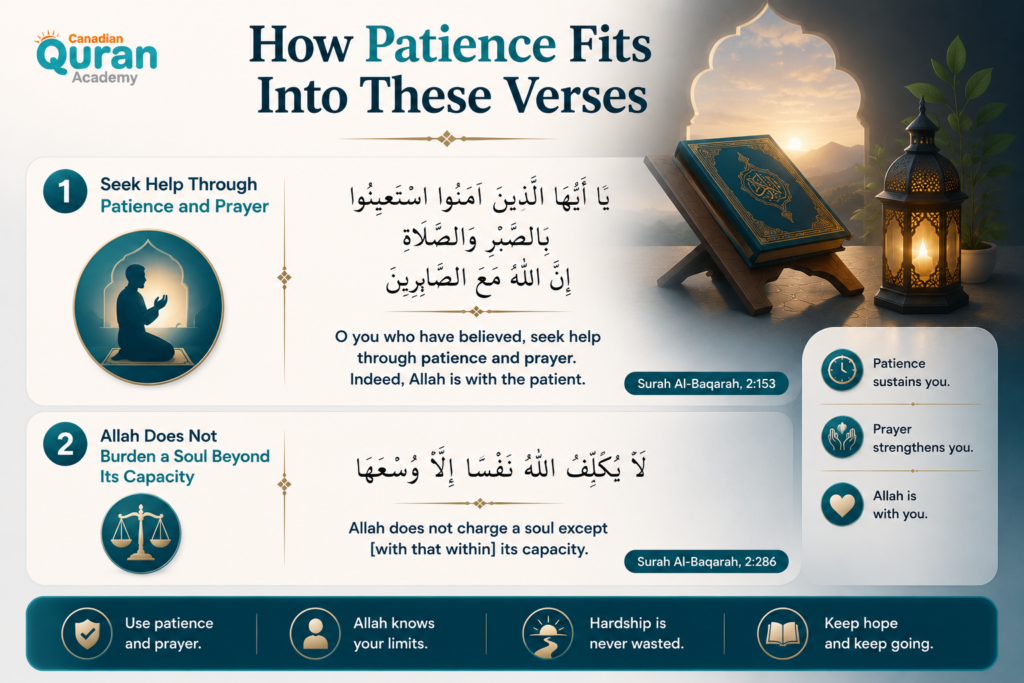
1. Seek Help Through Patience and Prayer
The Quran teaches that strength comes through action, not simply intention. In times of difficulty, it directs believers to combine patience with sincere prayer, offering a practical path to resilience and a constant reminder that Allah is with those who remain steadfast.
يَا أَيُّهَا الَّذِينَ آمَنُوا اسْتَعِينُوا بِالصَّبْرِ وَالصَّلَاةِ ۚ إِنَّ اللَّهَ مَعَ الصَّابِرِينَ
“O you who have believed, seek help through patience and prayer. Indeed, Allah is with the patient.” Surah Al-Baqarah, 2:153
This verse gives two specific actions — patience and prayer — rather than a vague call to “stay strong.” Prayer, in particular, gives a fixed structure to the day even when motivation is low, which is one reason students often build a habit of reciting this verse before starting Quran study or hifz revision.
2. Allah Does Not Burden a Soul Beyond Its Capacity
This verse reassures believers that every trial comes with the ability to endure it. Rather than offering vague comfort, the Quran affirms that Allah, in His perfect wisdom, never places a burden on a person beyond their true capacity.
لَا يُكَلِّفُ اللَّهُ نَفْسًا إِلَّا وُسْعَهَا
“Allah does not charge a soul except [with that within] its capacity.” Surah Al-Baqarah, 2:286
A common mistake when reading this verse is treating it only as comfort during hardship, when it is also a statement of fact about design — the difficulty itself has already been measured against what a person can bear. That distinction matters when the feeling is “this is too much,” because the verse answers that specific thought rather than offering general encouragement.
If you’re guiding a child through their own moments of frustration with memorization or reading, our Quran courses for kids are built around this same principle — pacing lessons to what a young learner can genuinely absorb, rather than pushing past capacity and causing burnout.

Live Class in Action
Watch how our instructors interact with students in real-time, focusing on interactive methods.
Start Your Quranic Journey in Canada
Join our vibrant community and learn with expert tutors through our flexible online platform.
Claim Your Free TrialRead also: Quran Verses About Marriage in Arabic
Verses About Not Giving Up as a Community
Not every instruction to keep going in the Quran is addressed to an individual. Some verses speak to a group facing a setback together, which matters for anyone leading a class, a family, or a community project that has hit resistance.
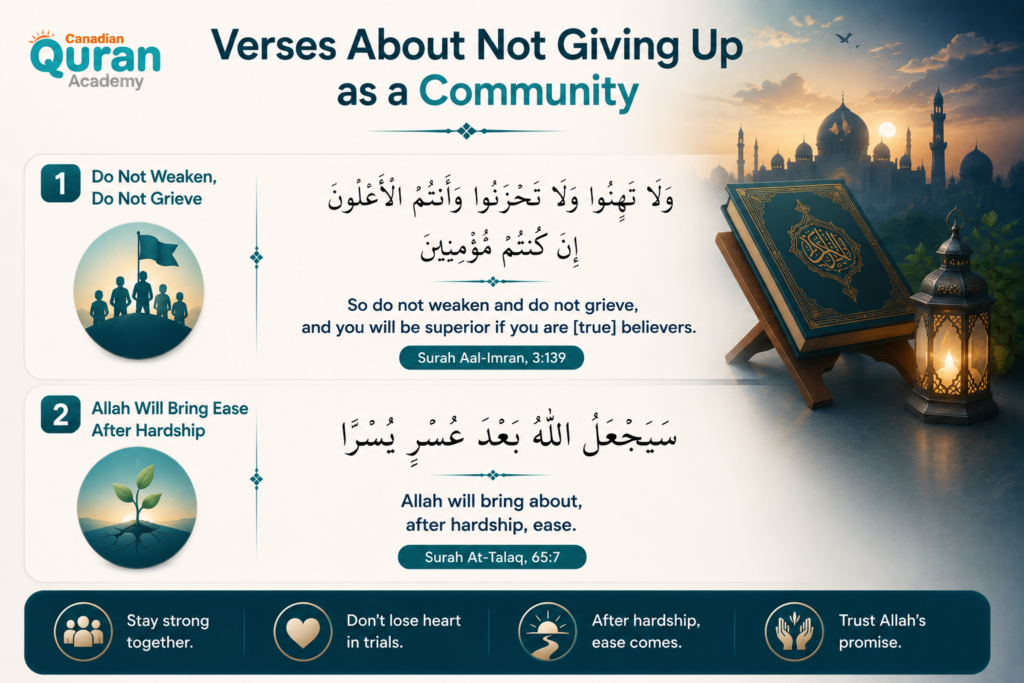
1. Do Not Weaken, Do Not Grieve
The Quran acknowledges that believers will experience setbacks and moments of sorrow. Rather than allowing defeat to define them, it calls them to remain steadfast, renew their determination, and place their confidence in Allah despite temporary hardships.
وَلَا تَهِنُوا وَلَا تَحْزَنُوا وَأَنتُمُ الْأَعْلَوْنَ إِن كُنتُم مُّؤْمِنِينَ
“So do not weaken and do not grieve, and you will be superior if you are [true] believers.” Surah Aal-Imran, 3:139
This verse was revealed after the Muslims faced losses at the Battle of Uhud — a setback, not a total defeat, but a real one. The verse pairs two instructions together: do not weaken (a call against giving up on effort) and do not grieve (a call against giving up emotionally). Both are needed; addressing only one leaves the other unresolved.
2. Allah Will Bring Ease After Hardship
The Quran repeatedly reminds believers that hardship is never the final chapter. This verse offers a direct promise that Allah will bring relief in its proper time, encouraging patience, trust, and confidence in His perfect plan.
سَيَجْعَلُ اللَّهُ بَعْدَ عُسْرٍ يُسْرًا
“Allah will bring about, after hardship, ease.” Surah At-Talaq, 65:7
Unlike 94:5-6, which states the general pattern, this verse uses the future tense — “will bring about” — making it a direct promise tied to a specific timeframe rather than a description of how things generally work. Students often place this verse alongside Ash-Sharh 94:5-6 when memorizing, since the two reinforce each other from different angles.
Read also: Quran Verses About Lying in Arabic
How to Actually Use These Verses When You Feel Like Giving Up?
Reading a verse once rarely changes a mindset by itself. What tends to work is repetition with understanding — reciting the verse, knowing what it answers, and returning to it specifically at the moment the same feeling comes back.
A practical way to apply this:
- Pick one verse that matches your specific struggle (despair, patience, capacity, or setback) rather than trying to hold all seven in mind at once.
- Recite it in Arabic even if your fluency is limited — the rhythm and repetition build retention faster than reading the translation alone.
- Pair it with a fixed time, such as after Fajr or before starting a task you’ve been avoiding.
- Revisit the surah or ayah reference on Quran.com to read the surrounding verses for full context, not just the single line.
If you want to build real fluency with the Arabic itself rather than relying on transliteration, structured lessons make a measurable difference. Our Quran reading course starts with correct letter pronunciation and builds toward reading verses like these directly from the mushaf, with a teacher correcting you in real time.

Experience Our Classrooms
Don’t just take our word for it—take a look inside! Watch the videos below to experience our engaging teaching methods and vibrant online classrooms firsthand.
Start Your Quranic Journey in Canada
Join our vibrant community and learn with expert tutors through our flexible online platform.
Claim Your Free TrialStart Learning These Verses with Qualified Guidance at The Canadian Quran Academy
Reading these verses is a valuable first step. Reciting them correctly with Tajweed, understanding their meanings, and committing them to memory requires consistent guidance from a qualified Quran teacher. The Canadian Quran Academy provides structured online Quran classes that help students develop accurate recitation, strengthen memorization, and build a deeper understanding of the Quran at a pace that suits their level.
The Canadian Quran Academy offers:
- Qualified, experienced Quran teachers with strong backgrounds in Tajweed and Quran memorization
- Personalized 1-on-1 online lessons tailored to your reading, memorization, and learning goals
- Structured Quran programs that combine recitation, Tajweed, memorization, and regular revision
- Flexible scheduling across Canadian time zones, including morning, evening, and weekend classes
- Programs for children, adults, beginners, and students continuing their Hifz journey
- A free trial lesson with no commitment required
Book your free trial at The Canadian Quran Academy and take the first step toward reciting, understanding, and memorizing the Quran with confidence.

Our Quran Courses
- Quran Online Academy
- Quran Recitation Classes
- Quran Reading Classes
- Online Quran Classes for Kids
- Quran Classes for Adults
- Quran Classes for Female/Sisters
- Learn Quran for Beginners
- Quran Memorization (Hifz) Course
- Hifz Classes for Adults
- Quran Memorization and Hifz for Kids
- Quran Hifz for Ladies
- Quran Ijazah Program
- Quran Qirat Learning Course
- Quran Tafsir Course
- Noorani Qaida Course
- Noorani Qaida Course for Kids
- Weekend Quran Classes
- Intensive Quran Course
- Al-Azhar Quran Course
- Online Tajweed Classes
- Tajweed Course for Kids
- Tajweed Course for Adults
- Tajweed Course for Ladies/Sisters
Start Your Quranic Journey in Canada
Join our vibrant community and learn with expert tutors through our flexible online platform.
Claim Your Free TrialConclusion
The Quran does not leave the reader to face despair alone. Across Surah Yusuf, Az-Zumar, Ash-Sharh, Al-Baqarah, Aal-Imran, and At-Talaq, the message repeats in different forms: do not despair of Allah’s mercy, hardship is paired with ease, no burden exceeds capacity, and setbacks are not permission to weaken. Together, these are the clearest Quran verses about not giving up in Arabic available to a reader looking for guidance in a difficult season.
Whether you read them for comfort, memorize them for reflection, or study them for the grammar and rhetoric behind the words, each verse rewards a second and third reading. The promise they share is consistent: relief comes, capacity is respected, and giving up was never the instruction.
FAQs
What is the main Quran verse about not giving up?
Surah Yusuf, 12:87 is the verse most directly about not giving up — it commands “despair not of relief from Allah” and links despair to a lack of faith. Surah Ash-Sharh, 94:5-6 is a close second, since it states twice that ease accompanies hardship.
Is “with hardship comes ease” repeated in the Quran?
Yes. Surah Ash-Sharh, 94:5-6, states the phrase “with hardship comes ease” twice in direct succession. Classical commentators explain this as emphasis through repetition, not two separate promises.
What does Surah Aal-Imran 3:139 mean?
Surah Aal-Imran, 3:139 tells believers not to weaken and not to grieve, promising they will be superior if their faith is genuine. It was revealed after a battlefield setback and addresses giving up both in effort and in emotion.
Are there Quran verses specifically about giving up on someone’s mercy or forgiveness?
Yes. Surah Az-Zumar, 39:53 addresses this directly, telling those who have sinned not to despair of Allah’s mercy, since Allah forgives all sins for those who turn back to Him.
How can I memorize these verses effectively?
Start with shorter verses like Ash-Sharh 94:5-6, recite them daily at a fixed time, and use spaced repetition rather than reading them once. A structured hifz program with daily revision produces far more durable memorization than occasional reading on your own.






Leave a Reply