 Arabic
If you’ve started learning the Arabic alphabet, you’ve probably noticed that some letters sound almost identical in English but are completely different in Arabic. The letter Sad in Arabic (ص) is one of the clearest examples of this. At Canadian Quran Academy, this is one of the letters new students ask about most, because it looks similar to Seen (س) but sounds nothing like it once you know what to listen for.
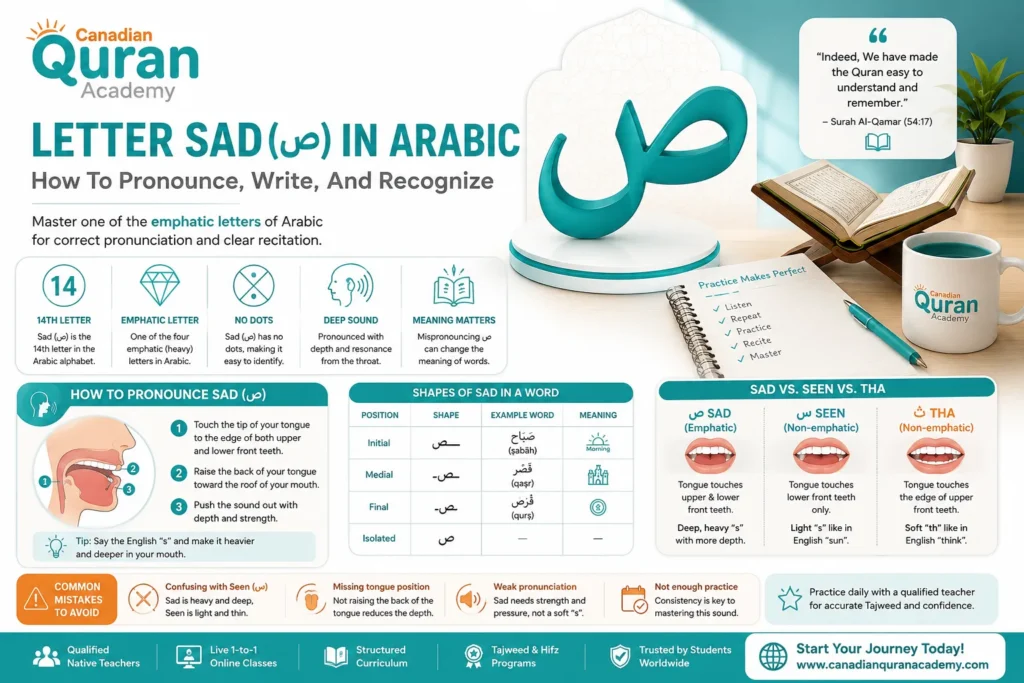
Sad (ص) is the 14th letter of the Arabic alphabet and belongs to a small group of “emphatic” or heavy letters that give Arabic its distinctive depth. Getting this letter right matters for more than just conversation — mispronouncing ص can change the meaning of a word entirely, and in Quranic recitation, precision with this letter is part of correct Tajweed.
Understanding the letter Sad in Arabic properly from the start saves learners from having to unlearn bad habits later.
This guide walks you through exactly how ص is pronounced, how its shape changes depending on where it sits in a word, and how to tell it apart from the letters it’s most often confused with.
What you’ll learn in this article
- What the letter Sad (ص) is and where it sits in the Arabic alphabet
- How to physically position your tongue and mouth to pronounce ص correctly
- How the shape of ص changes at the start, middle, and end of a word
- How to combine ص with the short vowels (harakat)
- The real difference between ص, س, and ث
- Common mistakes beginners make with this letter, and how to fix them
What Is The Letter Sad In Arabic?
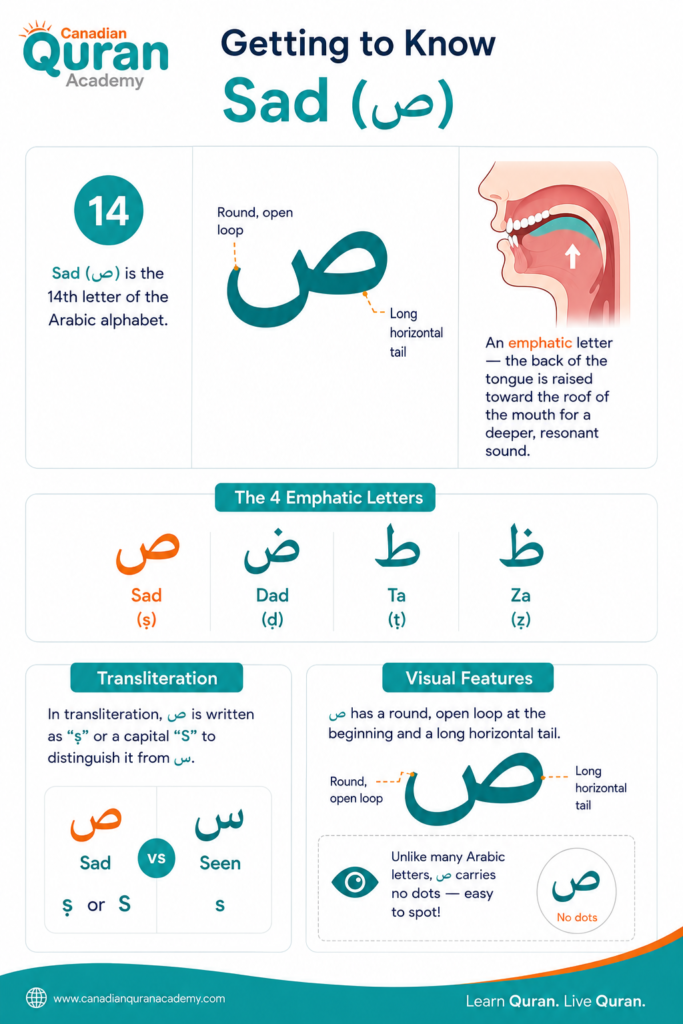
Sad (ص) is the 14th letter of the Arabic alphabet and one of the four “emphatic” consonants, alongside Dad (ض), Ta (ط), and Za (ظ). Emphatic letters are pronounced with the back of the tongue raised toward the roof of the mouth, which gives them a heavier, more resonant sound than their non-emphatic counterparts.
In transliteration, ص is usually written as “ṣ” or a capital “S” to distinguish it from the regular Seen (س). Visually, ص has a round, open loop at the beginning and a long horizontal tail. Unlike many Arabic letters, it carries no dots — which actually makes it easier to spot once you’re familiar with its shape.
How Is Sad Different From Seen And Tha?
Arabic has three letters that a new learner might hear as “s”: ص, س, and ث. The bridge paragraph below explains the mechanics; the two sections after it break down each pair.
The difference isn’t in the letter itself — it’s in exactly where your tongue touches and how much air and depth go into the sound. Learning to feel this difference physically, rather than just hearing it, is what separates students who read Arabic fluently from those who keep mixing words up.
For ث (tha), the tip of the tongue touches the edge of the upper front teeth, producing a soft “th” sound similar to English “think.”
For س (seen), the tongue touches the lower front teeth for a light, thin “s,” much like the English “s” in “sun.” For ص (sad), the tongue touches both the upper and lower front teeth at once, and the back of the tongue lifts toward the palate, producing a thicker, rounder sound with more depth in the mouth.
Because Arabic uses these letters to distinguish entirely different words, swapping ص for س isn’t a minor accent issue — it can change what you’re saying.
صَبَر (ṣabar, “he was patient”) and a word built on س carry different roots and different meanings entirely.
This is one reason our Arabic Grammar Course spends real time on emphatic letters early on, rather than treating pronunciation as an afterthought.
Read also: Letter Kh خ In Arabic – How To Read, Write, And Pronounce It?
How Do You Pronounce The Letter Sad (ص)?
Start by touching the tip of your tongue to the edge of your upper front teeth, while also letting the edge of your lower front teeth make contact.
At the same time, raise the back of your tongue slightly toward the roof of your mouth and tighten your throat a little. Push the sound out with more depth than a normal “s” — you should feel it resonate lower in your mouth, not just at the front of your lips and teeth.
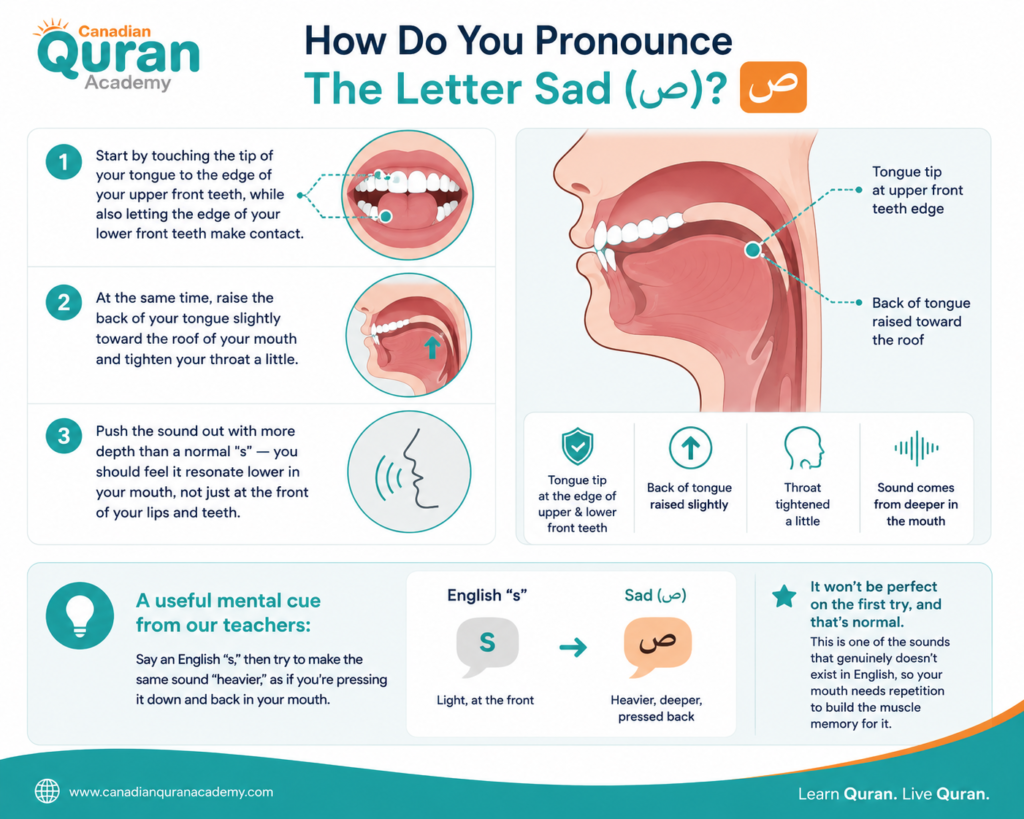
A useful mental cue we give students at Canadian Quran Academy: say the English “s,” then try to make the same sound “heavier,” as if you’re pressing it down and back in your mouth.
It won’t be perfect on the first try, and that’s normal — mastering the letter Sad in Arabic is one of the sounds that genuinely doesn’t exist in English, so your mouth needs repetition to build the muscle memory for it.
How Does The Shape Of Sad Change In A Word?
Like every connecting letter in Arabic, ص changes shape depending on whether it appears at the beginning, middle, or end of a word.
| Position | Shape | Example word | Meaning |
| Isolated | ص | — | — |
| Initial | صـ | صَبَاح (ṣabāḥ) | Morning |
| Medial | ـصـ | قَصْر (qaṣr) | Palace |
| Final | ـص | قُرْص (qurṣ) | Disc / tablet |
At the beginning of a word, ص opens with its rounded loop and connects forward with a short line. In the middle, it sits joined on both sides, with the loop still visible in the center of the word. At the end, it stretches out along the baseline, closing the word with its distinct tail.
Recognizing these shapes quickly is a skill that comes from repetition, not memorization alone — which is why students in our Arabic Course for Beginners practice reading real words in all three positions from the very first lessons, rather than studying letters in isolation.
Seeing the letter Sad in Arabic across all three positions early on builds recognition speed much faster than studying it in isolation.
Read also: The Arabic Letter S (Seen س) – Pronunciation, Shapes, And Words To Practice
How Do You Combine Sad With Short Vowels?
Arabic short vowels, or harakat, sit above or below a letter and change how it’s pronounced without changing the letter itself. This section covers how each one works with ص specifically.
- Fatha (َ): a small diagonal line above the letter, producing an “a” sound — صَ is pronounced “sa.”
- Kasrah (ِ): a small diagonal line below the letter, producing an “i” sound — صِ is pronounced “si.”
- Dammah (ُ): a small comma-like mark above the letter, producing a “u” sound — صُ is pronounced “su.”
- Sukoon (ْ): a small circle above the letter, meaning it carries no vowel and is pronounced flat and joined to the letter before it, as in صْ.
- Shadda (ّ): a mark showing the letter is doubled, pronounced by holding the sound slightly longer, as in صَّ.
Once you can read ص confidently with each of these, you can read it in almost any word you’ll encounter. This is a natural bridge into a full study of Tajweed rules, since correct vowel pronunciation is exactly where most recitation mistakes with emphatic letters start.
Read also: The Arabic Letter S (Seen س) – Pronunciation, Shapes, And Words To Practice
What Are Common Mistakes With The Letter Sad?
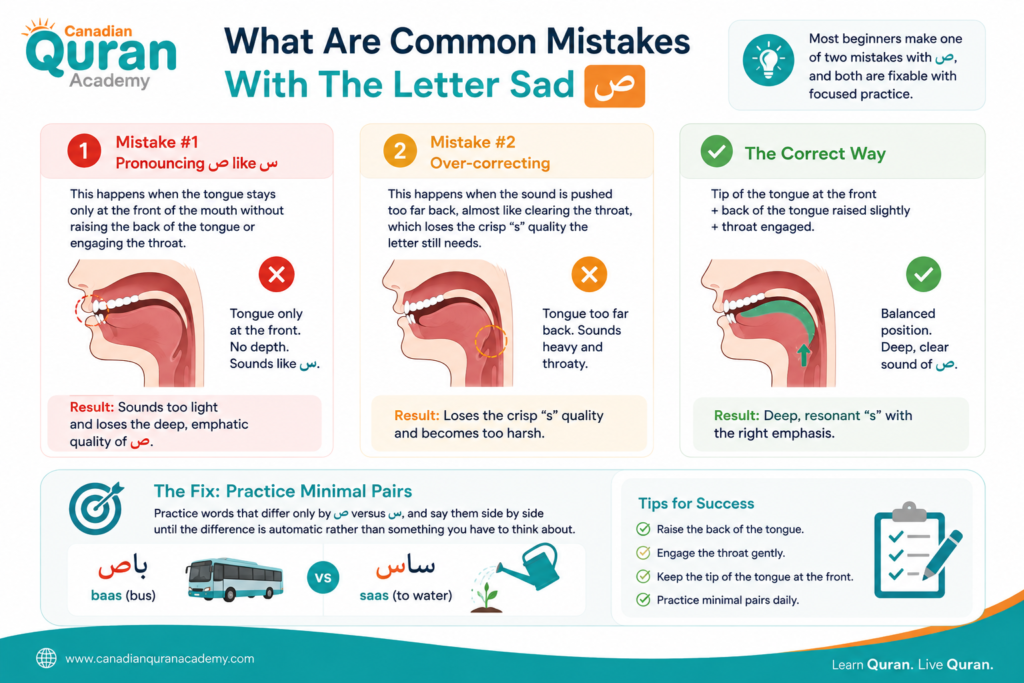
Most beginners make one of two mistakes with ص, and both are fixable with focused practice rather than more theory.
The first is pronouncing ص exactly like س, which happens when a learner keeps the tongue only at the front of the mouth without raising the back of the tongue or engaging the throat. The second is over-correcting into a sound that’s too far back, almost like clearing the throat, which loses the crisp “s” quality the letter still needs.
The fix for both is the same: practice minimal pairs — words that differ only by ص versus س, like باص (bus) against a س-based word — and say them side by side until the difference is automatic rather than something you have to think about.
If you’re working through the Quran and want this precision to carry into recitation specifically, our instructors correct this exact pattern often in the early stages of the Quranic Arabic Course, where getting emphatic letters right affects how correctly a verse is recited.
Practicing the letter Sad in Arabic against its lighter counterpart is one of the fastest ways to fix this pattern for good.
Read Also: How To Learn Arabic For Quran In Canada?
Experience Our Classrooms
Don’t just take our word for it—take a look inside! Watch the videos below to experience our engaging teaching methods and vibrant online classrooms firsthand.
Start Your Quranic Journey in Canada
Join our vibrant community and learn with expert tutors through our flexible online platform.
Claim Your Free TrialBuild Real Fluency With The Letter Sad And Beyond
Reading about how to pronounce ص is a starting point, but fluency comes from hearing corrections in real time and repeating words until the sound becomes automatic — something no article can fully replace.

Canadian Quran Academy’s live, instructor-led classes are built around exactly this kind of feedback loop, whether you’re a complete beginner or working toward reading the Quran with confidence.
Our Arabic Courses:
- Online Arabic Academy
- Online Arabic Course
- Classical Arabic Course
- Arabic Course for Beginners
- Advanced Arabic Course
- Quranic Arabic Course
- Arabic Grammar Course
- Modern Standard Arabic Course
- Arabic Conversation / Speaking Course
- Intensive Arabic Course
- Online Arabic Classes for Kids
- Arabic Classes for Adults

Start Your Quranic Journey in Canada
Join our vibrant community and learn with expert tutors through our flexible online platform.
Claim Your Free TrialConclusion
The letter Sad in Arabic (ص) is the 14th letter of the alphabet and one of four emphatic consonants that give Arabic its distinct depth of sound. It’s pronounced by touching the tongue to both the upper and lower front teeth while raising the back of the tongue, producing a heavier “s” than English speakers are used to.
Like other Arabic letters, ص changes shape depending on its position in a word — opening with a loop at the start, joining smoothly in the middle, and stretching along the baseline at the end. Paired with the short vowels, it forms the basis for reading hundreds of common Arabic words correctly.
The most reliable way to master ص is consistent, corrected practice: reading it in real words, comparing it side by side with س, and repeating it in context until your tongue finds the position without conscious effort. That’s exactly the kind of practice Canadian Quran Academy builds into every lesson.
Frequently Asked Questions About The Letter Sad In Arabic
The questions below cover what learners most often ask after first encountering ص, based on common points of confusion with this letter.
1. Is Sad the same sound as Seen in Arabic?
No, Sad (ص) and Seen (س) are different sounds. Seen is a light “s” pronounced at the front of the mouth, while Sad is a heavier, emphatic “s” pronounced with the tongue touching both rows of front teeth and the back of the tongue raised.
2. Does the letter Sad have dots?
No, ص has no dots in any of its four forms — isolated, initial, medial, or final. This makes it easier to distinguish from dotted letters once you’re familiar with its rounded, open shape.
3. Why is Sad called an emphatic letter?
Sad is called emphatic because it’s pronounced with extra weight and depth, using the back of the tongue and a slightly tightened throat. Arabic has four emphatic letters — ص, ض, ط, and ظ — and each has a lighter counterpart with a similar base sound.
4. Where does Sad appear in Quranic Arabic?
Sad appears frequently throughout the Quran, including in words tied to core concepts, and it’s also the name of Surah Sad. Correct pronunciation of ص is treated as a Tajweed essential in Quranic recitation.
5. How long does it take to master the letter Sad?
Most students can pronounce Sad accurately within a few focused practice sessions, though full comfort in fast reading takes longer. Consistent practice with minimal pairs against Seen speeds this up considerably.
6. Can mispronouncing Sad change a word’s meaning?
Yes, mispronouncing Sad as Seen can change a word’s meaning entirely, since Arabic treats them as separate letters with separate roots. This is one reason correct pronunciation of ص is emphasized early in structured Arabic learning






Leave a Reply