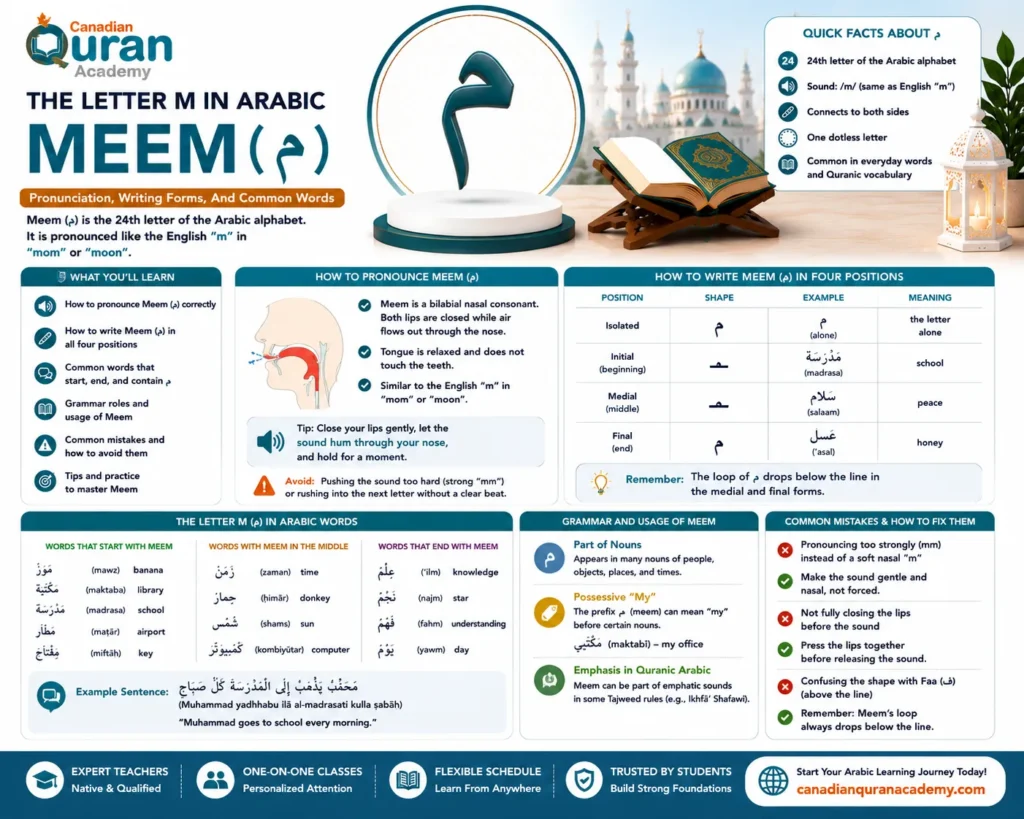
 Arabic
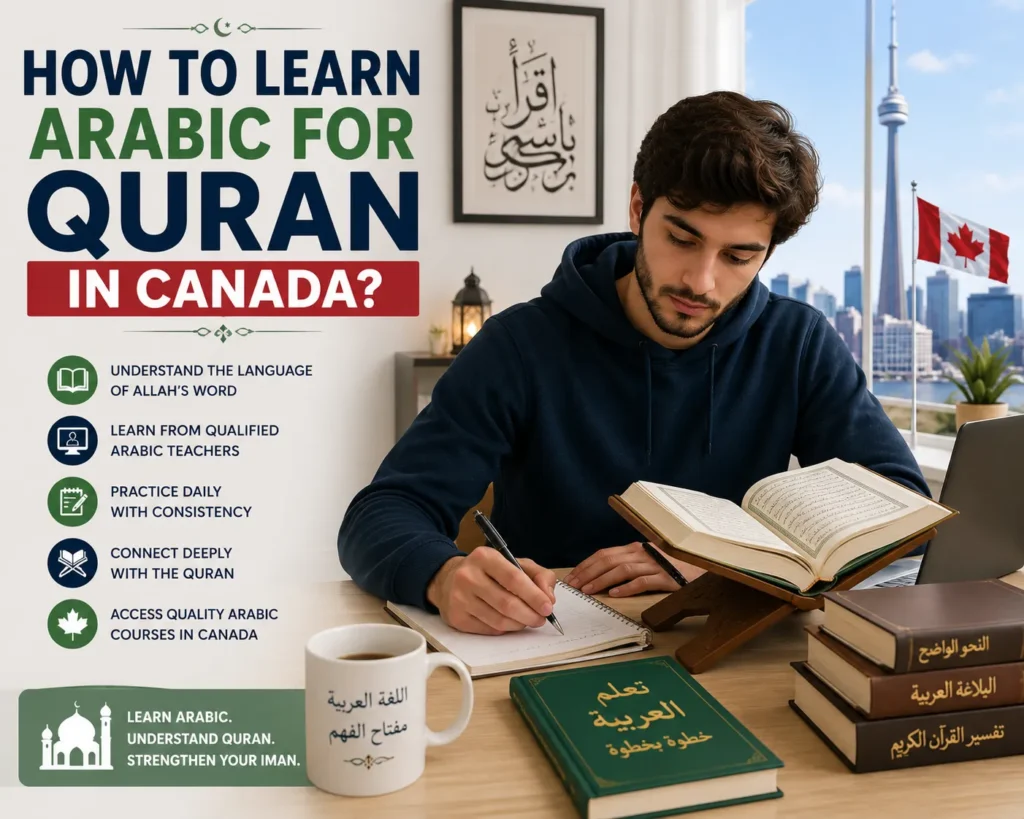
| Key Takeaways |
| Quranic Arabic uses a vocabulary of roughly 1,750 core root words; mastering the top 300 covers over 70% of Quranic text. |
| Canadian Muslim learners benefit most from structured online instruction pairing Quranic Arabic grammar with live recitation practice. |
| Adult beginners in Canada typically reach functional Quranic reading comprehension within 12–18 months of consistent structured study. |
| Noorani Qaida and basic Tajweed must precede Arabic grammar study — correct pronunciation anchors all future comprehension gains. |
| Qualified 1-on-1 instruction corrects pronunciation errors and grammar misconceptions that self-study consistently leaves unaddressed. |
To learn Arabic for the Quran in Canada, you need a structured sequence: first build correct Quranic pronunciation through Tajweed, then systematically study Quranic Arabic grammar and vocabulary. Most Canadian learners who struggle have skipped one of these two pillars — and the gap shows immediately when they try to read with understanding.
The practical path combines verified pronunciation work, root-word vocabulary acquisition, and consistent exposure to Quranic text — ideally with qualified instruction to catch errors that self-study cannot. Whether you are in Toronto managing a full-time career, a student in Calgary, or a new revert in Montreal, the sequence is the same. What varies is your pace — and that is perfectly fine.
1. Fix Your Arabic Pronunciation Before Learning Quranic Grammar
To learn Quranic Arabic effectively, correct Arabic pronunciation must come before grammar — without it, comprehension built on mispronounced words will always be unstable. A student who reads ض as د is not reading the same word the Quran contains, regardless of how well they understand the grammar structure.
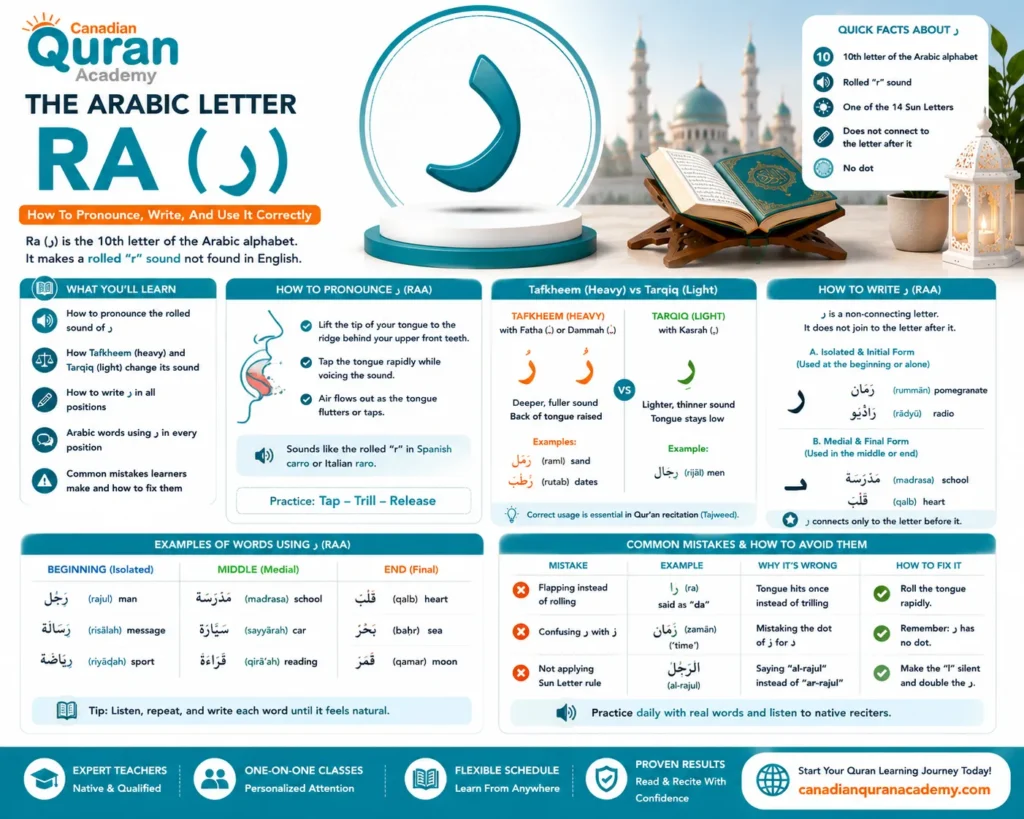
Start with Noorani Qaida or an equivalent foundational Tajweed program. This covers the Arabic alphabet, vowel marks (harakat), sukoon, shaddah, and basic Makharij al-Huroof (articulation points).
Most adult beginners working consistently — three to four sessions per week — move through foundational pronunciation work in six to ten weeks.
At The Canadian Quran Academy, our Noorani Qaida Course in Canada integrates pronunciation correction from the first lesson, so students never build comprehension habits on a mispronounced foundation.
Book a FREE trial class in our Noorani Qaida classes

Why Tajweed and Arabic Pronunciation Are Inseparable
Tajweed is the applied science of reciting the Quran as revealed — governing the precise articulation of every letter and the rules governing their interaction.
Students sometimes treat Tajweed as optional or decorative. It is neither. When ن before certain letters produces Idghaam (assimilation), a student who cannot hear or produce the distinction will misread meaning entirely.
The most consistent error our instructors observe in adult beginners is conflating ح and ه — two distinct letters from different articulation points.
In our Tajweed classes correcting this typically takes two to three focused sessions once a student understands the physical mechanics of the pharyngeal versus glottal distinction.
Start learning Tajweed with a FREE trial session

2. Learn to Read Quranic Arabic Script Fluently Before Studying Meaning
Reading Quranic Arabic fluently — decoding script, vowel marks, and recitation rules in real time — must precede vocabulary and grammar study. Attempting to parse grammar while still slow-decoding letters creates a cognitive overload that stalls both skills simultaneously.
Target: Read any short Surah — Al-Ikhlas, Al-Falaq, An-Nas — at a steady pace with correct vowelling before moving to formal grammar instruction. Most students reach this milestone in eight to twelve weeks of consistent practice.
This is the stage where short daily practice outperforms long weekly sessions. Fifteen minutes of Quranic reading daily builds fluency faster than a two-hour session once a week.
The neurological reinforcement of daily exposure is well-documented in language acquisition research, and our instructors see this pattern clearly in session-by-session progress tracking.
Read also: IS ARABIC WORTH LEARNING IN CANADA?
Shots Videos from Our Courses
Start Your Quranic Journey in Canada
Join our vibrant community and learn with expert tutors through our flexible online platform.
Claim Your Free Trial3. Know How to Learn Quranic Arabic Grammar Without Getting Lost
To learn Quranic Arabic grammar, begin with Sarf (morphology — how words change form) before Nahw (syntax — how words relate in a sentence). Quranic Arabic is a root-based language: most words derive from three-letter roots.
Understanding how roots transform into nouns, verbs, and particles gives you the ability to decode unfamiliar words directly from the text.
The three core grammar concepts every Quranic Arabic beginner must master are:
- Root identification: Recognizing the three-letter root beneath a word’s form
- Verb conjugation patterns: Knowing how past, present, and command forms change
- Case endings (I’raab): Understanding how final vowels signal a word’s grammatical role
Classical texts like Al-Ajroomiyyah and modern structured courses teach these in sequence. At The Canadian Quran Academy, our Fusha Arabic course in Canada follows a verified pedagogical sequence — grammar introduced only after pronunciation and script fluency are established.
Book a FREE trial class in the Fusha Arabic course in Canada

What is The Difference Between Quranic Arabic and Modern Standard Arabic?
Quranic Arabic (Classical Arabic) differs from Modern Standard Arabic (MSA) in vocabulary, stylistic register, and occasional grammatical construction. MSA simplifies some case-ending distinctions that Quranic Arabic preserves fully.
For learners whose goal is Quranic comprehension specifically, a dedicated Quranic Arabic program is more efficient than a general MSA course.
Heritage Arabic speakers from Egypt, Lebanon, or Morocco face a specific challenge: their spoken dialect has internalized different grammar patterns.
Our instructors consistently see heritage speakers overconfident in reading speed but inconsistent on case endings — a gap that structured Quranic Arabic grammar study resolves directly.
How to Learn Quranic Arabic for Beginners?
Quranic Arabic for beginners centers on root-based vocabulary acquisition — the Quran contains approximately 77,800 words, but these reduce to roughly 1,800 distinct roots. Learning the top 300 high-frequency roots gives a beginner access to over 70% of the Quranic text by word count.
Build vocabulary in three layers:
- Frequency-first: Start with the most repeated words — الله, رب, قل, آمن, كافر, رحمة — appearing hundreds to thousands of times
- Root families: Learn one root and its noun, verb, and adjective forms together — not isolated words
- Contextual review: Return to already-studied Surahs after each vocabulary milestone to reinforce retention in real text
Allah says in the Quran:
وَلَقَدْ يَسَّرْنَا الْقُرْآنَ لِلذِّكْرِ فَهَلْ مِن مُّدَّكِرٍ
Wa laqad yassarnal-Qur’āna lidh-dhikri fahal min muddakir
“And We have certainly made the Quran easy for remembrance, so is there any who will remember?” (Surah Al-Qamar 54:17)
This verse — repeated four times in Surah Al-Qamar — is itself a promise embedded in the language. The Quran was designed to be internalized. Vocabulary acquisition, approached systematically, is the tool that opens that internalization.
How to Learn Quranic Arabic Online as a Canadian Learner?
To learn Quranic Arabic online effectively, Canadian Muslims need three elements: a verified instructor with Arabic linguistics credentials, a structured curriculum that progresses from pronunciation through grammar, and scheduling that fits Canadian time zones and work-family demands.
Self-paced video courses and apps provide exposure but cannot replace real-time correction. An instructor watching a student read catches the softened Qalqalah, the collapsed Ghunnah, and the incorrect case ending — errors that compound invisibly in solo study.
The Canadian Quran Academy’s Quranic Arabic course delivers 1-on-1 sessions with qualified instructors — morning, evening, and weekend slots available across Eastern, Central, and Pacific time zones.
Book a FREE trial class in the Quranic Arabic course in Canada

Adult learners managing full-time work in Toronto or Calgary consistently find that one to two structured online sessions per week, combined with daily independent review, produces measurable progress within the first four to six weeks.
For learners who want to extend into Modern Standard Arabic for broader Islamic studies, The Canadian Quran Academy also offers a Modern Standard Arabic (Fusha) course and an Al-Azhar Arabic program for those pursuing formal Islamic education pathways.
Book a FREE trial class in Al-Azhar Arabic course in Canada

Can I Learn Quranic Arabic by Myself?
Self-directed Quranic Arabic learning is possible for motivated adults, but it carries two consistent failure points: pronunciation errors that go uncorrected and grammar gaps that accumulate silently.
Learners who study entirely alone often reach a plateau — they can decode words but cannot parse sentence structure — and mistake that plateau for the limit of their ability.
Effective self-study requires:
- A verified pronunciation reference (recorded by a qualified Tajweed instructor — not a general YouTube search)
- A structured grammar text with answer keys — Madinah Arabic Reader series or Gateway to Arabic are widely used
- Regular self-testing against Quranic text — not just exercises
The honest practitioner’s answer: self-study works best as a supplement to instruction, not a replacement. Even monthly check-in sessions with a qualified instructor catch the errors that self-assessment cannot see.
Read also: WHY LEARN ARABIC IN CANADA?
How Long Does It Take to Learn Arabic Enough to Understand the Quran?
Adult learners with no prior Arabic background typically reach functional Quranic reading comprehension — following the meaning of familiar Surahs and parsing new short verses — within 8 to 16 months of consistent structured study. Reaching deeper comprehension of longer, grammatically complex Surahs is a 2–3 year commitment at a realistic pace.
These are instructional estimates, not guarantees — pace varies significantly based on:
| Factor | Impact on Timeline |
| Prior exposure to Arabic script | Reduces pronunciation phase by 4–8 weeks |
| Session frequency (sessions per week) | 3+ sessions per week roughly halves early-stage timeline |
| Daily independent review | 15 min/day compresses vocabulary acquisition significantly |
| Heritage Arabic background | Speeds vocabulary; may require extra grammar correction |
| Age of learner | Adults learn grammar faster; children internalize pronunciation faster |
The Prophet ﷺ said, as narrated in Sahih al-Bukhari 5027:
«خَيْرُكُمْ مَنْ تَعَلَّمَ الْقُرْآنَ وَعَلَّمَهُ»
“Khayrakum man ta’allamal-Qur’āna wa ‘allamah”
“The best among you are those who learn the Quran and teach it.”
The timeline matters less than the consistency. A student who studies two sessions a week for two years will always outperform someone who attends intensively for three months and then stops.
How to Learn Arabic Fast from the Quran?
To learn Arabic fast from the Quran, use Surah-based immersion — study one short Surah deeply rather than broad vocabulary lists in isolation. Take Surah Al-Fatiha: seven verses, 29 unique words, containing noun-adjective agreement, possessive construction, verb forms, and prepositions — an entire grammar lesson embedded in the Surah Muslims recite seventeen times daily.
The accelerated approach:
- Select a target Surah — Al-Fatiha, Al-Ikhlas, Al-Kawthar for beginners
- Parse every word — identify root, grammatical category, and case ending
- Memorize the Surah — recitation anchors vocabulary in working memory
- Move to the next Surah only when parsing feels automatic
This method builds vocabulary and grammar simultaneously, using the text as both the lesson and the reinforcement.
Our Students Reviews
Start Your Quranic Journey in Canada
Join our vibrant community and learn with expert tutors through our flexible online platform.
Claim Your Free TrialStart Your Quranic Arabic Learning with Qualified Instruction at The Canadian Quran Academy
The path to Quranic Arabic comprehension is structured and learnable — the right sequence, combined with qualified instruction, makes the difference between genuine progress and years of spinning in place.
The Canadian Quran Academy offers:
- Qualified, experienced Arabic and Quran instructors
- Personalized 1-on-1 sessions tailored to your current level and goals
- Flexible scheduling — morning, evening, and weekend across Canadian time zones
- Programs for adults, children, women, and new reverts — all levels welcome
- Courses in Quranic Arabic, Modern Standard Arabic, and Al-Azhar pathways
- Free trial lesson — no commitment required
Book your free trial lesson and begin with an instructor who meets you exactly where you are.
Check out our top Arabic courses
Book your FREE trial session today

Conclusion
Quranic Arabic is not beyond reach for Canadian Muslims — it is a structured discipline with a clear path. Pronunciation first, then fluent reading, then grammar, then vocabulary: each stage builds on the last, and each stage is teachable.
For adult learners across Ontario, Alberta, Quebec, and British Columbia, the real obstacle is rarely ability — it is inconsistency and lack of real-time correction. Those two problems are exactly what structured 1-on-1 instruction solves.
The Quran was described by Allah as made easy for remembrance. Approaching its language with the right method and qualified guidance is how that ease becomes accessible — Insha’Allah.
Frequently Asked Questions About Learning Arabic for the Quran in Canada
What is the best way to start learning Quranic Arabic as a complete beginner in Canada?
The best starting point for a complete beginner in Canada is a structured foundational course covering Arabic script, pronunciation, and basic vowelling — before any grammar instruction begins. Online 1-on-1 sessions with a qualified instructor allow real-time error correction that self-paced apps cannot provide. Most beginners reach confident script-reading within eight to twelve weeks of consistent practice.
How is Quranic Arabic different from the Arabic spoken in Arab countries?
Quranic Arabic is Classical Arabic — a formal, standardized register distinct from Egyptian, Levantine, Gulf, or Moroccan spoken dialects. It preserves full case-ending systems and grammatical features that modern spoken dialects have simplified or dropped. A learner targeting Quranic comprehension specifically should study Quranic Arabic grammar rather than a dialect course or purely conversational Arabic program.
Can an adult who never learned Arabic as a child still reach Quranic comprehension?
Yes — adult learners frequently reach solid Quranic comprehension, and in some respects learn grammar faster than children because they can process abstract rules analytically. The realistic timeline is 12–18 months for functional comprehension with consistent study. Adults face a steeper pronunciation curve than children but overcome it with targeted Tajweed instruction focused on Arabic articulation points.





Leave a Reply