 Arabic
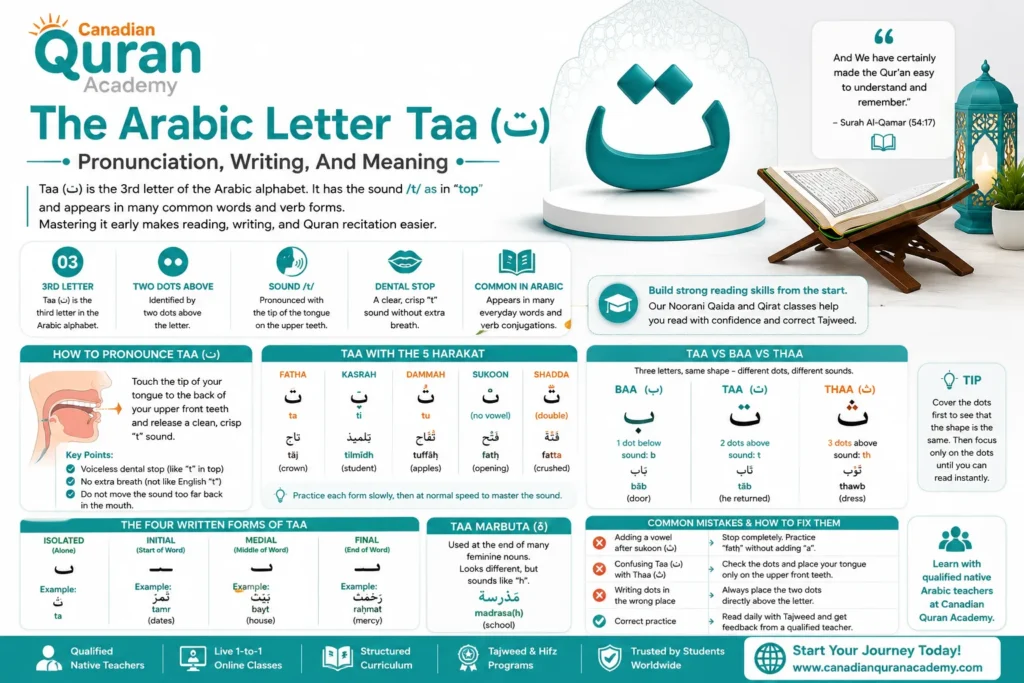
If you’ve started learning the Arabic alphabet, you’ve likely already met the Arabic letter Taa (ت) — it’s one of the first letters new readers learn, right after Alif and Baa.
Taa carries the familiar /t/ sound, appears in some of the most common words in the language, and shows up constantly in verb conjugations. Getting it right early makes everything that follows — reading, writing, and eventually Quran recitation — noticeably easier.
This guide walks through how Taa sounds, how it’s written in each position of a word, how it changes with the five harakat, and the mistakes English speakers make most often when reading it.
At Canadian Quran Academy, this is exactly the kind of foundational letter work we cover in the early stages of our Noorani Qaida and Qirat lessons, so students build correct habits from day one rather than fixing them later.
What you’ll learn in this article:
- What the letter Taa (ت) is and how it sounds
- How to pronounce Taa correctly, including with each harakah
- The four written forms of Taa: isolated, initial, medial, and final
- What Taa marbuta (ة) is and how it differs from regular Taa
- The most common mistakes learners make with Taa, and how to fix them
What Is The Arabic Letter Taa (ت)?
Taa (ت) is the third letter of the Arabic alphabet. It represents a voiceless dental stop, meaning the sound is produced without vibrating the vocal cords while the tongue makes contact with the teeth — similar to the “t” in the English word “top.”
Written form, Taa is a small curved base sitting on the line, marked by two dots placed directly above it. Those two dots are the letter’s single most important identifying feature, since several Arabic letters share the same basic body shape.
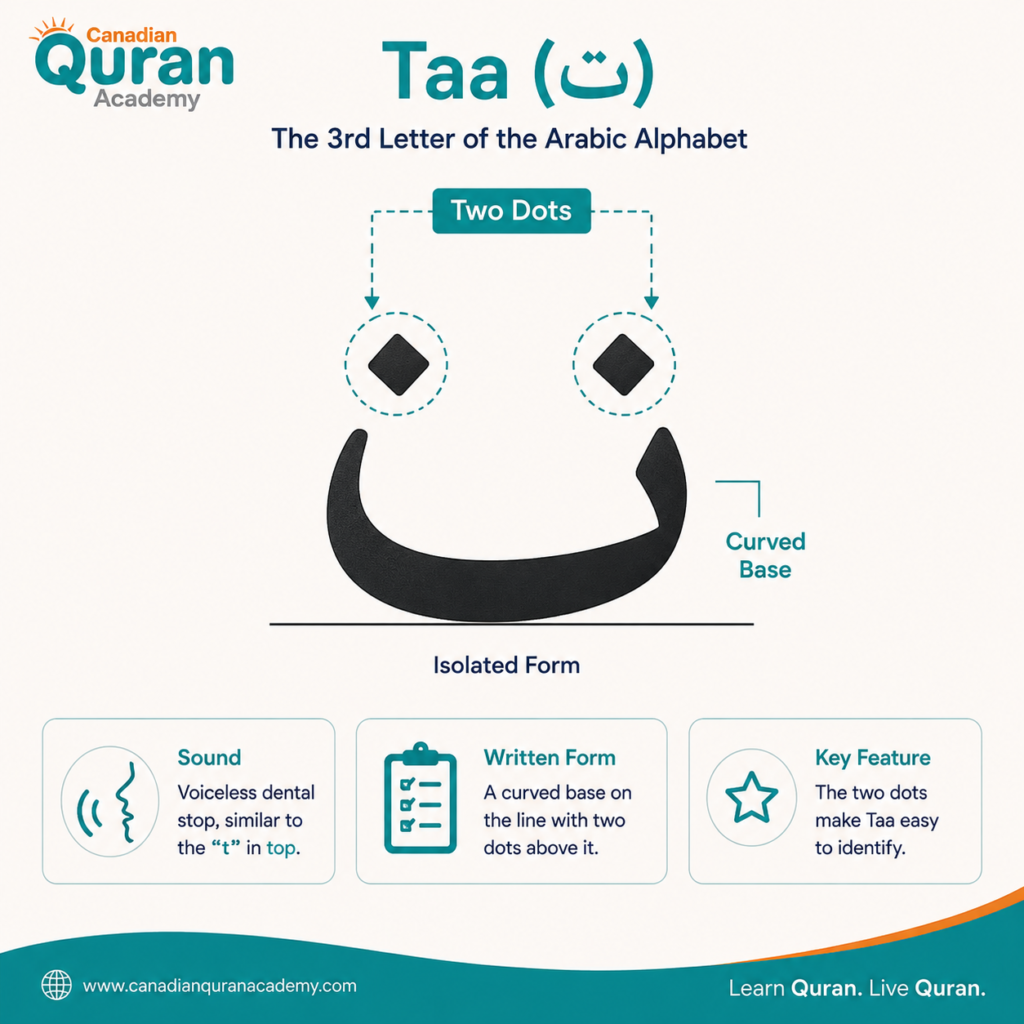
Taa is pronounced by touching the tip of the tongue to the back of the upper front teeth (in Arabic, ثنايا العليا, “the upper front teeth”) and releasing a clean, unaspirated “t” sound. Unlike the English “t,” which is often released with a small puff of air, Arabic Taa is crisp and stops quickly, without that extra breath.
This distinction matters most for Quran reciters, where correct articulation point (makhraj) is part of proper tajweed. A Taa pronounced too far back in the mouth starts to drift toward the heavier letter ط, which changes both the sound and, in Quranic recitation, the meaning of the word.
Taa Vs Baa And Thaa: Reading The Dots Correctly
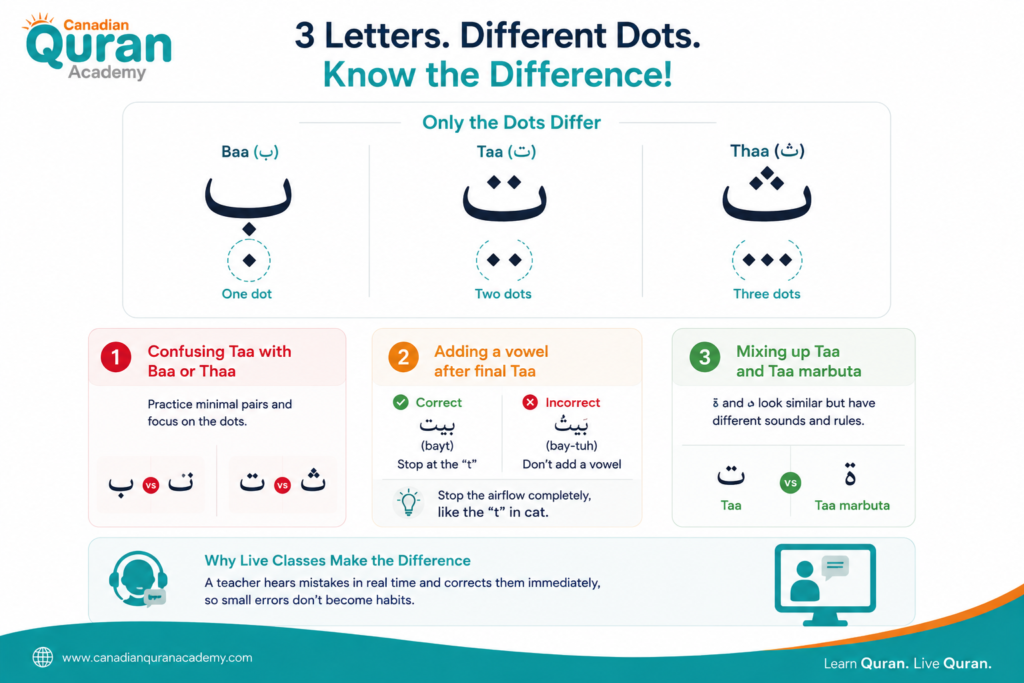
Three Arabic letters share the exact same base shape and differ only by their dots: Baa (ب) has one dot below the line, Taa (ت) has two dots above, and Thaa (ث) has three dots above. Because the shapes are identical, this trio causes more misreading among beginners than almost any other letter group.
The fastest way to fix this is targeted drilling, not passive reading. Flashcards built specifically around minimal pairs — words that differ only by Baa, Taa, or Thaa — force the eye to register the dots rather than guess from the shape alone.
A common practitioner tip: cover the dots with your finger first, confirm you can’t tell the letter apart from the shape alone, then uncover them one at a time until the difference becomes automatic.
Read Also: How To Learn Arabic In 6 Months In Canada?
How To Pronounce The Letter Taa (ت)?
Reading the shape correctly is only half the letter. The other half is producing the sound accurately with each of the five Arabic vowel marks, known as harakat.
Taa With Fatha, Kasrah, And Dammah:
Each short vowel mark changes Taa’s sound in a specific, predictable way:
- Taa with Fatha ( تَ ): a small diagonal stroke above the letter produces the sound “ta,” as in تاج (tāj, crown) or تمر (tamr, dates).
- Taa with Kasrah ( تِ ): a diagonal line beneath the letter produces “ti,” as in تِلميذ (tilmīdh, student).
- Taa with Dammah ( تُ ): a small curl above the letter produces “tu,” as in تُفّاح (tuffāḥ, apples).
Taa With Sukoon and Shadda:
Taa with Sukoon ( تْ ): a small circle above the letter removes the vowel entirely, leaving a plain, stopped “t” sound, as in فَتْح (fatḥ, opening). English speakers often add a vowel here by habit — more on that mistake below.
Taa with Shadda ( تّ ): the letter is doubled and pronounced with slightly extra emphasis, articulated as two identical letters in one tongue movement, as in فَتَّة (fatta).
Reciting each of these forms out loud, slowly and then at normal speed, is the single most effective drill for locking in Taa’s pronunciation before moving on to full words.
This kind of guided, corrected practice is exactly what a live instructor adds that a book or app can’t — which is why Canadian Quran Academy’s Noorani Qaida Course builds each letter and haraka combination under direct teacher feedback before students move to word-level reading.
Read also: Letter Sad ص In Arabic – How To Pronounce, Write, And Recognize
Live Class in Action
Watch how our instructors interact with students in real-time, focusing on interactive methods.
Start Your Quranic Journey in Canada
Join our vibrant community and learn with expert tutors through our flexible online platform.
Claim Your Free TrialThe Four Written Forms of Taa
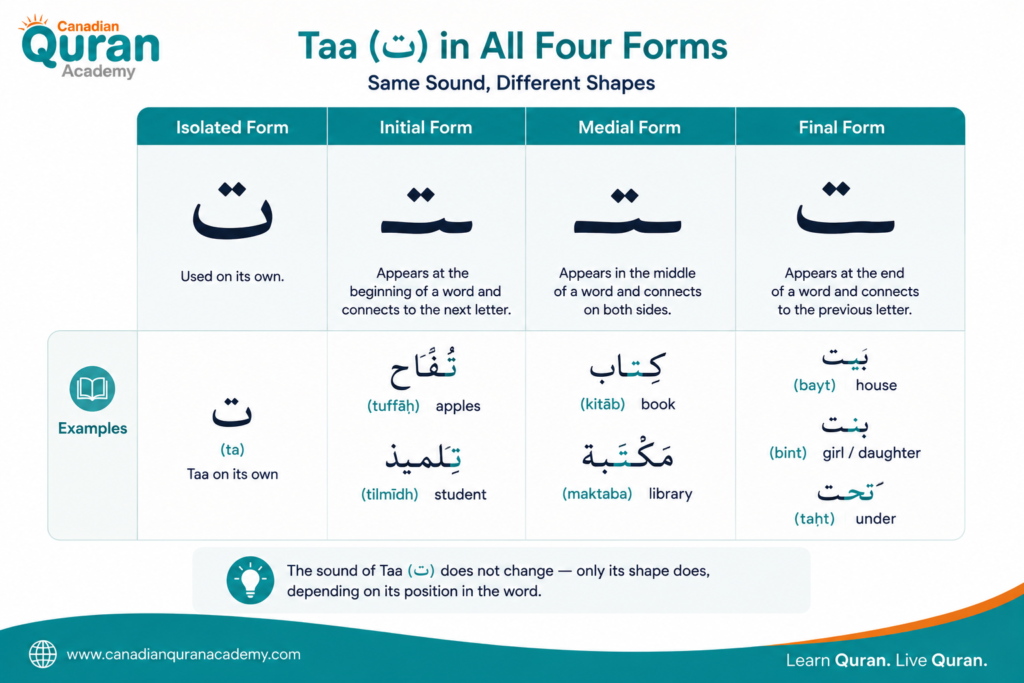
Like most Arabic letters, Taa changes shape depending on where it sits in a word, even though the sound stays the same. Recognising all four forms is what separates a learner who can sound out isolated letters from one who can actually read connected Arabic text.
A. Isolated And Initial Forms
The isolated form (ت) is the letter’s full, standalone shape — a curved base with both dots clearly visible above it. You’ll see this form used when the alphabet is taught letter by letter, or when Taa appears on its own.
The initial form (تـ) appears when Taa opens a word and connects to the letter that follows. The connecting stroke extends toward the following letter, as in تُفّاح (tuffāḥ, apples) and تِلميذ (tilmīdh, student).
B. Medial And Final Forms
The medial form (ـتـ) appears when Taa sits between two other letters, connecting on both sides. This is the most compact of the four shapes, often reduced to a small tooth-like bump, as seen in كتاب (kitāb, book) and مكتبة (maktaba, library).
The final form (ـت) appears when Taa ends a word, connecting only to the letter before it. Common examples include بيت (bayt, house), بنت (bint, girl/daughter), and تحت (taḥt, under).
Read also: Letter Kh خ In Arabic – How To Read, Write, And Pronounce It?
Taa Marbuta: The Feminine Ending
Taa marbuta (ة) is a special variant of Taa that appears only at the end of words and marks feminine nouns and adjectives — for example, مدرسة (madrasa, school) or جميلة (jamīla, beautiful, feminine form).
Visually, Taa marbuta looks like the letter Haa (ه) with two dots added above it, which is exactly where many learners misread it. In pronunciation, it’s usually a soft “h” sound when the word ends a sentence or phrase, but shifts to a clear “t” sound when the word connects to what follows in continuous speech.
Confusing Taa marbuta with either regular Taa or with Haa is a frequent early-stage error, and it’s worth drilling as its own category rather than assuming it will sort itself out with general reading practice.
Grammar details like this one are where structured Arabic instruction pays off, since a self-taught learner can read past a Taa marbuta for months without noticing the gender agreement it signals. Courses that build reading and grammar together, like our Quran Qirat Learning Course, catch this kind of gap early.
Read also: The Arabic Letter S (Seen س) – Pronunciation, Shapes, And Words To Practice
Common Words That Use The Letter Taa
Seeing Taa across a range of everyday words reinforces both its shape and its sound faster than studying the letter in isolation.
| Position | Word | Pronunciation | Meaning |
| Initial | تفاح | tuffāḥ | apple(s) |
| Initial | تمر | tamr | dates |
| Medial | كتاب | kitāb | book |
| Medial | مكتبة | maktaba | library |
| Final | بيت | bayt | house |
| Final | بنت | bint | girl / daughter |
| Final | تحت | taḥt | under / below |
Taa also carries real grammatical weight beyond vocabulary. It marks the second-person prefix in present-tense verbs — تكتب (taktub, you write), تذهب (tadhhab, you go) — and appears as a suffix in past-tense conjugation, as in كتبتَ (katabta, you wrote).
Because of this dual role in both nouns and verb grammar, Taa is one of the highest-frequency letters a new reader will encounter.
Read also: Quran Verses About Ramadan In Arabic And English
Common Mistakes When Learning Taa
Three mistakes account for most of the confusion learners run into with this letter.
1. Confusing Taa with Baa or Thaa
As covered above, the fix is dedicated minimal-pair drilling on the dots, not more general reading.
2. Adding a vowel after final Taa
Many English speakers pronounce بيت (bayt) as “bay-tuh” instead of stopping cleanly on the “t.” Practice positioning the tongue for the stop and holding the airflow completely rather than releasing it, the way a British speaker pronounces the “t” in “cat.”
3. Mixing up Taa and Taa marbuta
Because ة and ه look almost identical, learners sometimes misread one for the other, which affects both pronunciation and grammatical understanding of the word’s gender.
A structured class setting catches these patterns immediately, because a teacher hears the mispronunciation in real time rather than a learner repeating an error unnoticed through weeks of solo study. This is one of the clearest advantages of live, teacher-led classes over app-only learning.
If fitting regular practice into your week feels difficult, Canadian Quran Academy’s Weekend Quran Classes and Intensive Quran Course are both built around correcting exactly these kinds of letter-level habits before they turn into long-term reading errors.
Experience Our Classrooms
Don’t just take our word for it—take a look inside! Watch the videos below to experience our engaging teaching methods and vibrant online classrooms firsthand.
Start Your Quranic Journey in Canada
Join our vibrant community and learn with expert tutors through our flexible online platform.
Claim Your Free TrialStart Reading Arabic With Confidence Today
Mastering one letter at a time — starting with fundamentals like Taa — is how real Arabic reading fluency is built, not by rushing ahead before the basics are solid.
Canadian Quran Academy’s certified instructors teach the Arabic alphabet, harakat, and correct pronunciation step by step, with live correction at every session so mistakes get fixed immediately instead of becoming habits.

Whether you’re starting completely from scratch or want a refresher on your foundations, our Noorani Qaida Course and Noorani Qaida Course for Kids are designed to take you from single letters to confident reading.
Our Arabic Courses
- Online Arabic Academy
- Online Arabic Course
- Classical Arabic Course
- Arabic Course for Beginners
- Advanced Arabic Course
- Quranic Arabic Course
- Arabic Grammar Course
- Modern Standard Arabic Course
- Al-Azhar Arabic Course
- Madinah Arabic Course
- Learning Arabic for Non-Arabic Speakers
- Arabic Elementary School
- Arabic Intermediate School
- Arabic Lessons for Kindergarten

Start Your Quranic Journey in Canada
Join our vibrant community and learn with expert tutors through our flexible online platform.
Claim Your Free TrialConclusion
The Arabic letter Taa (ت) is a small letter with an outsized role in the language: it opens common nouns like تفاح and بيت, sits at the center of words like كتاب, and drives verb conjugation across the second person.
Learning to recognize its four In written forms, pronounce it accurately with each haraka, and tell it apart from Baa, Thaa, and Taa marbuta gives you one of the strongest foundations you can build early in Arabic reading.
Practiced consistently — ideally with a teacher who can correct pronunciation in real time — Taa quickly becomes second nature, and the rest of the alphabet gets easier to learn on top of it.

Frequently Asked Questions About the Letter Taa
Here are direct answers to the questions learners ask most often about the Arabic letter Taa, based on common searches and points this guide hasn’t fully covered elsewhere.
1. How do you pronounce the Arabic letter Taa?
Taa is pronounced by touching the tip of the tongue to the back of the upper front teeth and releasing a quick, unaspirated “t” sound, similar to the “t” in “top” but crisper and without a puff of air.
2. What are the four forms of the letter Taa?
Taa has an isolated form (ت), an initial form (تـ) used at the start of a word, a medial form (ـتـ) used in the middle, and a final form (ـت) used at the end, with the two dots present above the letter in every form.
3. Why do English speakers mispronounce Taa at the end of words?
English speakers often add an extra vowel sound after final Taa, turning بيت (bayt) into “bay-tuh,” because English tends to release final consonants with a slight vowel quality that Arabic does not use.
4. What are some common words that contain the letter Taa?
Common words include تفاح (apples), تمر (dates), كتاب (book), بيت (house), بنت (girl/daughter), and تحت (under), covering all four positional forms of the letter.
5. How is Taa different from Baa and Thaa?
Taa, Baa, and Thaa share the same base shape and differ only by their dots: Baa has one dot below the letter, Taa has two dots above it, and Thaa has three dots above it.
6. What is Taa marbuta and how does it differ from regular Taa?
Taa marbuta (ة) is a feminine-noun ending that appears only at the end of words and is pronounced as a soft “h” in pause or a “t” in connected speech, unlike regular Taa, which keeps a consistent “t” sound in every position.






Leave a Reply