 Arabic
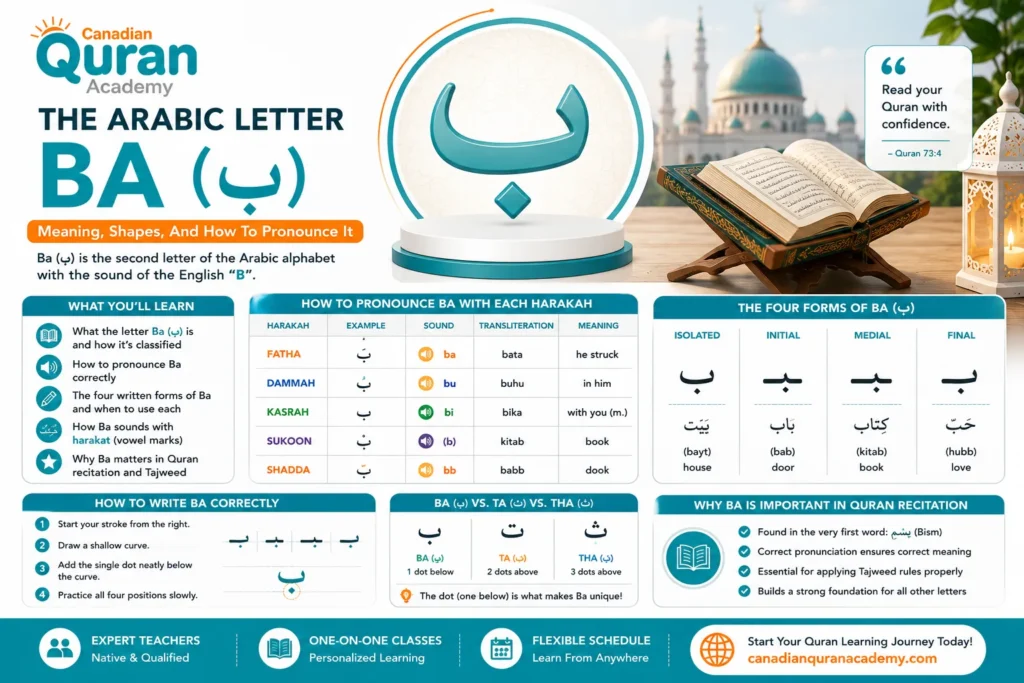
Every Arabic letter you learn brings you one step closer to reading the Quran with confidence, and the Arabic letter Ba (ب) is one of the first and most important letters you’ll master. It’s the second letter of the Arabic alphabet, and it opens the very first word of the Quran: بِسْمِ (in the name of).
At Canadian Quran Academy, we see students light up when they realize how quickly this letter becomes familiar — its sound matches the English “B” almost exactly, so there’s no new mouth movement to learn, only a new shape to recognize.
This guide walks you through everything you need to know about the ب – Arabic letter ba: how it’s pronounced, its four written forms, how it changes with vowel marks (harakat), and how it behaves specifically in Quran recitation.
Whether you’re a parent teaching a child, an adult beginner, or a student preparing for Tajweed lessons, you’ll leave this article able to identify, write, and pronounce Ba correctly.
What you’ll learn in this article
- What the Arabic letter Ba (ب) is and how it’s classified
- How to pronounce Ba correctly, including the mistake most English speakers make
- The four written forms of Ba: isolated, initial, medial, and final
- How Ba sounds and changes when combined with Fatha, Damma, Kasra, and Sukoon
- Why Ba matters specifically in Quran recitation and Tajweed
- Common words and sentences that use Ba, so you can start reading immediately
What Is The Arabic Letter Ba (ب)?
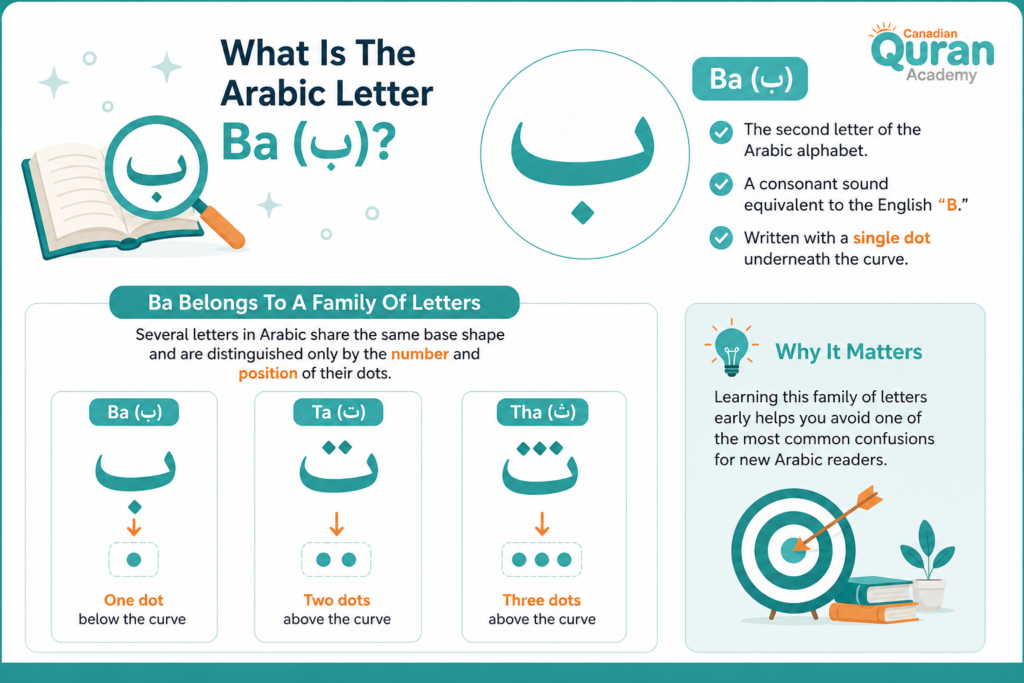
The ب – Arabic letter ba is the second letter of the Arabic alphabet, a consonant sound equivalent to the English “B.” It is written with a single dot placed underneath a shallow, curved stroke, and this dot is the single detail that identifies it.
Ba belongs to the group of “dotted letters” in Arabic, meaning several letters share the exact same base shape and are distinguished only by the number and position of their dots.
Ba has one dot below the curve. Its close relatives, Ta (ت) and Tha (ث), share the identical curve but carry two dots and three dots above it instead. Recognizing this family of letters early prevents a confusion that trips up almost every new reader.
The Dot That Sets Ba Apart From Ta And Tha
Because Ba, Ta, and Tha look identical apart from their dots, the position and count of the dot is the only reliable way to tell them apart at a glance.
Ba’s dot sits below the letter; Ta’s two dots sit above; Tha’s three dots sit above. When you’re learning to read Quranic text, training your eye to check dot placement first — before trying to sound out the word — will save you from misreading entire words, since a single misplaced dot changes both the letter and the meaning.
Ba is what’s known as a connector letter, meaning it joins smoothly to the letters before and after it within a word. Not every Arabic letter does this: letters like Alif (أ), Waw (و), Dal (د), Dhal (ذ), Ra (ر), and Zay (ز) connect only from the right side, which is why words containing them often look more segmented.
Ba, by contrast, flows continuously into its neighbors on both sides, which is one reason its shape looks noticeably different depending on where it falls in a word.
Read also: How To Pronounce And Write The Arabic Letter Ya (ي)
How To Pronounce The Letter Ba (ب)?
Ba is pronounced by bringing both lips together completely, letting air pressure build up briefly, then releasing it in a short, voiced burst — the same physical motion English speakers already use for the letter “B” in words like “book” or “ball.”
There is no new sound to learn here, which makes Ba one of the more approachable letters for English speakers starting Quran reading.
Technically, Ba is classified as a voiced bilabial stop: “bilabial” because both lips do the work, and “voiced” because the vocal cords vibrate while the sound is produced.
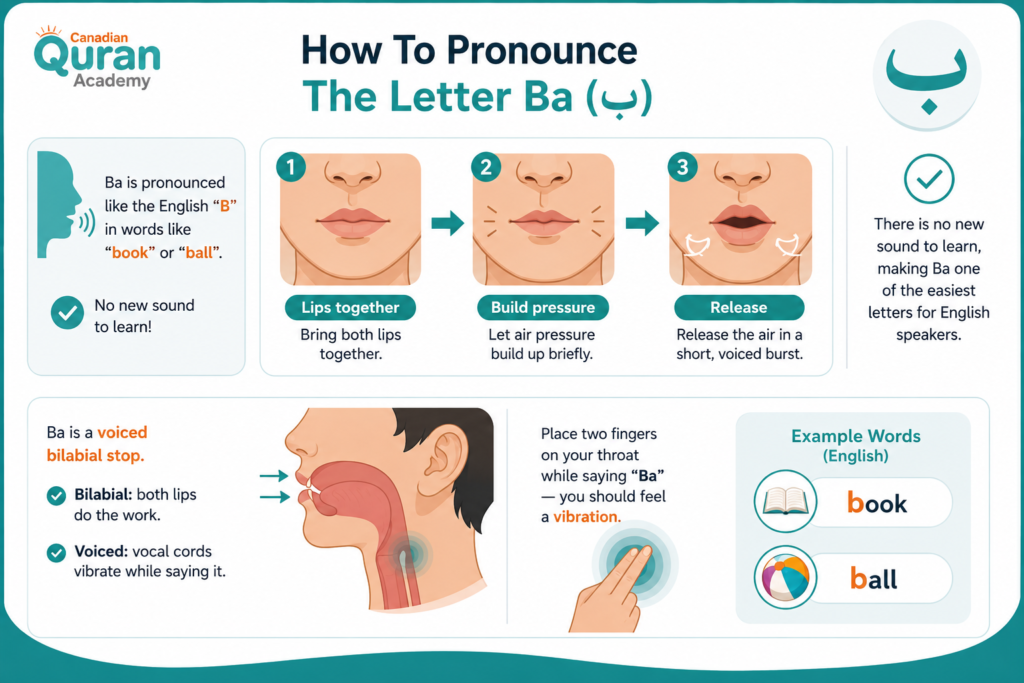
You can check this yourself by placing two fingers lightly on your throat while saying Ba — you should feel a vibration, which is what separates a voiced sound like Ba from an unvoiced one.
The Mistake Almost Every Beginner Makes
The most common pronunciation mistake is confusing Ba with the sound of “P,” which does not exist as a standalone letter in Arabic.
Learners whose native language uses “P” heavily sometimes soften Ba toward a “P” sound without realizing it, especially at the start of a word. Arabic listeners will hear this as a mispronunciation, since Ba is always fully voiced, never the unvoiced puff of a “P.”
A private tutor catches this instantly during live recitation, which is one reason our Quran Recitation Classes at Canadian Quran Academy include real-time correction rather than pre-recorded lessons alone.
Live Class in Action
Watch how our instructors interact with students in real-time, focusing on interactive methods.
Start Your Quranic Journey in Canada
Join our vibrant community and learn with expert tutors through our flexible online platform.
Claim Your Free TrialThe Four Forms Of Ba: Isolated, Initial, Medial, And Final
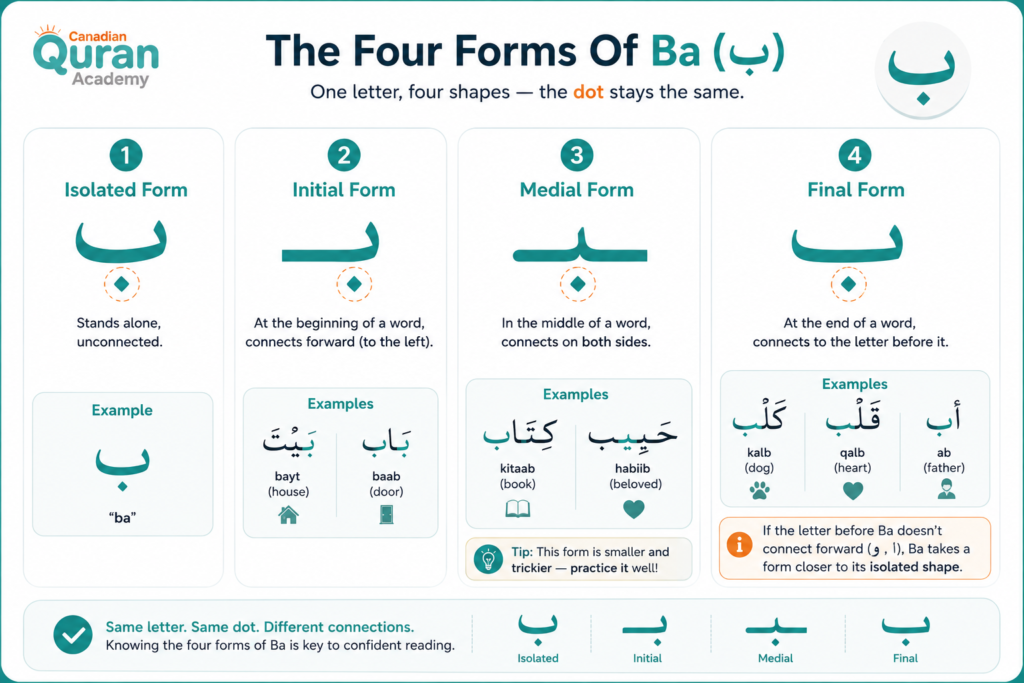
Like most Arabic letters, Ba does not keep one fixed shape — it adapts depending on whether it stands alone or connects to neighboring letters. The underlying curve and dot stay recognizable throughout, but the connecting strokes change the letter’s silhouette in each position.
1. Ba in Its Isolated Form
When Ba stands alone, unconnected to any letter, it appears as a shallow horizontal curve with a single dot beneath it: ب. This is the form you’ll see in alphabet charts and the version most learners memorize first.
2. Ba at the Beginning of a Word
At the start of a word, Ba connects forward into the next letter, extending a short baseline stroke to the left: بـ. You can see this in بَيْت (bayt, meaning “house”) and بَاب (baab, meaning “door”) — both begin with the initial form of Ba.
3. Ba in the Middle of a Word
In the middle of a word, Ba connects on both sides, compressing into a smaller, tooth-like shape that sits just above the baseline with the dot still placed beneath it: ـبـ. You’ll find this in كِتَاب (kitaab, “book”) and حَبِيب (habiib, “beloved”).
This medial form is often the hardest for beginners to spot quickly, since it’s smaller and surrounded by other connected letters — practicing it in isolation before reading full words helps.
4. Ba at the End of a Word
At the end of a word, Ba connects to the letter before it and finishes with a descending tail: ـب. Examples include كَلْب (kalb, “dog”) and قَلْب (qalb, “heart”).
When a word ends in Ba but the letter before it doesn’t connect forward (such as Waw or Alif), Ba instead takes a form closer to its isolated shape, as in أَب (ab, “father”).
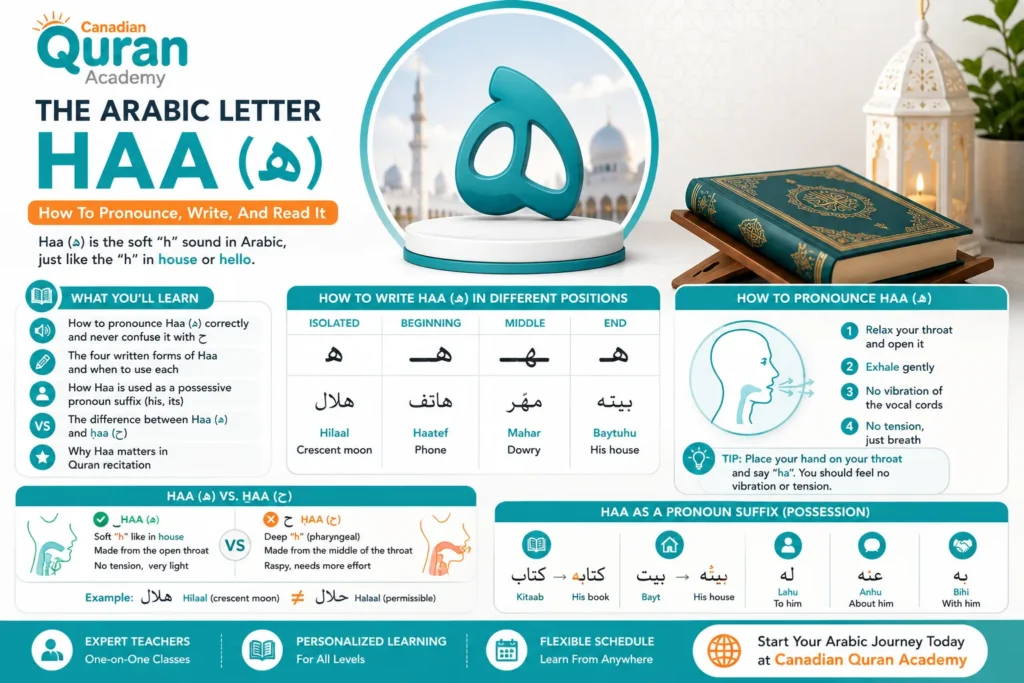
Read Also: The Arabic Letter Haa (ه)
How To Write The Letter Ba Step By Step
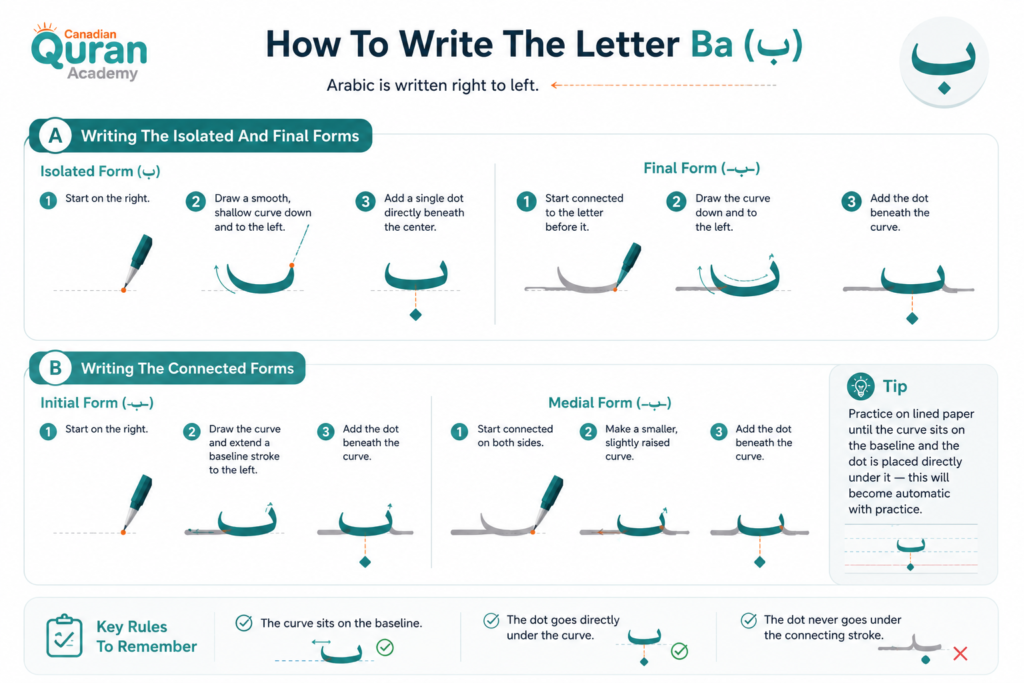
Learning to write Ba correctly is less about memorizing a shape and more about training a consistent hand motion, since Arabic is written right to left and every form of Ba follows the same underlying stroke.
A. Writing The Isolated And Final Forms
Start at the right side of the letter’s space and draw a smooth, shallow curve moving down and to the left, similar to a wide, flat smile sitting on the writing line. Once the curve is complete, add a single dot directly beneath its center — close enough to clearly belong to the letter, but distinct enough not to touch the curve itself.
B. Writing The Connected Forms
For the initial form, extend the same curve into a connecting stroke along the baseline toward the left, so it flows into whatever letter comes next.
For the medial form, keep the shape smaller and slightly raised, since it needs to connect cleanly to strokes arriving from both directions. In every case, the dot goes beneath the curved body of the letter, never beneath the connecting stroke itself.
A useful habit for beginners: practice on lined paper until placing the curve on the baseline and the dot directly under it becomes automatic, rather than something you have to think about mid-word.
Ba With Arabic Vowel Marks (Harakat)
Arabic letters carry no vowel sound by default — the short vowel marks, or harakat, placed above or below a letter determine how it’s actually pronounced.
Ba changes sound predictably with each one, and mastering these combinations is what allows you to sound out full Quranic words rather than just recognizing isolated letters.
Ba With Fatha, Damma, and Kasra
With a Fatha ( َ ), a small diagonal stroke above the letter, Ba is pronounced “ba” with a short “a” sound, as in بَاب (baab, “door”). With a Damma ( ُ ), a small comma-like mark above the letter, Ba becomes “bu,” as in بُومَة (buumah, “owl”). With a Kasra ( ِ ), a small diagonal stroke placed below the letter, Ba becomes “bi,” as in بِنْت (bint, “girl”).
Notice that the mark’s position — above or below — tells you immediately which vowel sound applies, even before you sound out the syllable.
Ba With Sukoon and Shadda
A Sukoon ( ْ ), a small circle above the letter, means Ba carries no vowel at all and is pronounced as a quick, closed consonant, as in أَبْ (ab, “father”) or حَبْ (habb, “seed”).
A Shadda ( ّ ) indicates the letter is doubled and pronounced with slightly more emphasis, as in the classical example دَبَّ (dabba). Recognizing Sukoon in particular matters for Quran recitation, since it signals a stop rather than a flowing vowel sound, which directly affects rhythm and pacing during recitation.
Structured practice with these combinations is exactly what a guided curriculum builds toward — our Quran Reading Classes walk students through harakat systematically, letter by letter, before moving into full verses.
Read Also: How to Write Quran in Arabic?
Ba in Quran Recitation and Tajweed
Ba isn’t just an alphabet letter to memorize in isolation — it’s one of the most frequently occurring letters in the Quran, and getting its pronunciation precisely right matters for correct Tajweed.
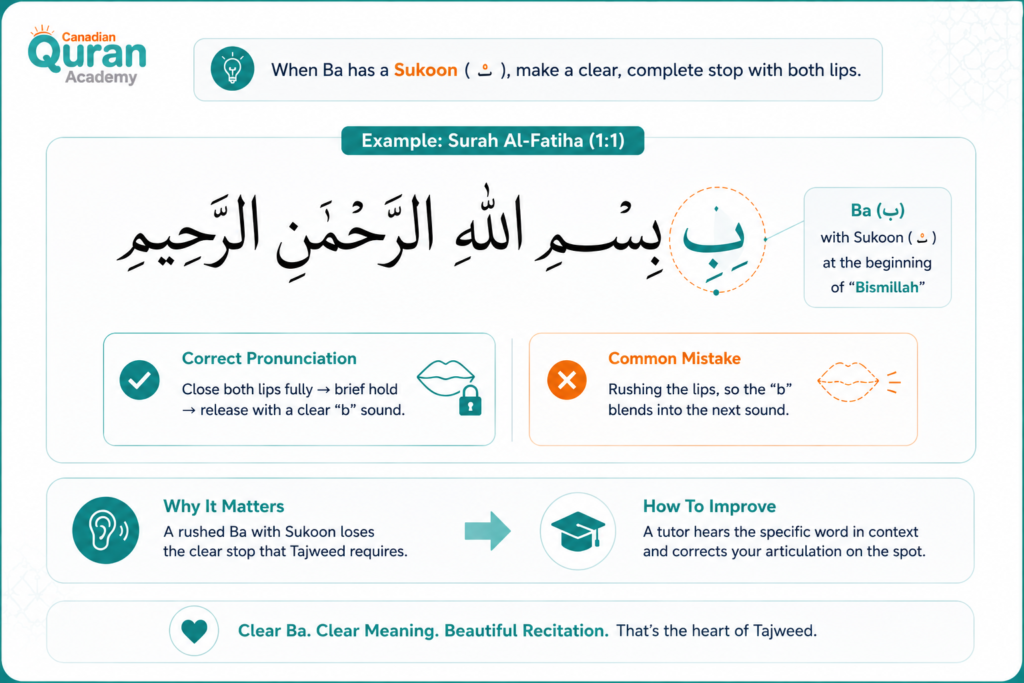
The Quran opens with بِسْمِ اللَّهِ الرَّحْمَٰنِ الرَّحِيمِ (Bismillah ir-Rahman ir-Raheem), and the very first letter a reader encounters is Ba.
Because this phrase is recited before nearly every surah and before countless daily actions in Islamic practice, Ba is arguably the single most-repeated letter in a practicing Muslim’s recitation.
Getting its bilabial closure and voicing correct here sets the tone, literally, for everything that follows.
A Common Tajweed Mistake With Ba
A mistake we see often in early recitation is rushing the lip closure on Ba when it carries a Sukoon, which causes the sound to blur into the surrounding letters instead of landing as a distinct, closed stop.
This is easy to miss when reading silently but stands out immediately in guided recitation. Correcting it isn’t about memorizing a rule — it’s about a tutor hearing the specific word in context and adjusting the student’s articulation on the spot, which is the core of how Tajweed is traditionally taught.
Example Words And Sentences With Ba
Seeing Ba inside real words and sentences is what turns letter recognition into actual reading ability.
| Position | Arabic Word | Pronunciation | Meaning |
| Initial | بَيْت | bayt | house |
| Initial | بَاب | baab | door |
| Medial | كِتَاب | kitaab | book |
| Medial | حَبِيب | habiib | beloved |
| Final | كَلْب | kalb | dog |
| Final | قَلْب | qalb | heart |
Ba in Full Sentences
Reading Ba inside complete sentences reinforces recognition in context: بَابُ البَيْتِ مَفْتُوحٌ (the door of the house is open) shows Ba in its initial form at the start of the sentence, while قَرَأْتُ كِتَابًا جَدِيدًا (I read a new book) shows the medial form mid-word.
Practicing short, complete sentences like these — rather than isolated vocabulary lists — is what carries over most directly into reading actual Quranic verses.
If you’re guiding a child through these early letters, our Online Quran Classes for Kids are built around exactly this kind of gradual, word-by-word progression, paced for younger learners.
Read Also: How To Improve Your Arabic Language Skills In Canada?
Experience Our Classrooms
Don’t just take our word for it—take a look inside! Watch the videos below to experience our engaging teaching methods and vibrant online classrooms firsthand.
Start Your Quranic Journey in Canada
Join our vibrant community and learn with expert tutors through our flexible online platform.
Claim Your Free TrialStart Learning Arabic Letters The Right Way
Reading about the letter Ba is a strong start, but real fluency comes from hearing it corrected in real time, not from information alone.
A live tutor catches the small mispronunciations and misplaced dots that self-study tends to miss, and fixes them before they turn into habits.

Canadian Quran Academy offers one-on-one classes for adults and female learners with qualified, experienced instructors, structured around your pace and schedule.
Our Arabic Courses
- Online Arabic Academy
- Online Arabic Course
- Classical Arabic Course
- Arabic Course for Beginners
- Advanced Arabic Course
- Quranic Arabic Course
- Arabic Grammar Course
- Modern Standard Arabic Course
- Arabic Conversation / Speaking Course
- Intensive Arabic Course
- Online Arabic Classes for Kids
- Arabic Classes for Adults
- Arabic Classes for Ladies

Start Your Quranic Journey in Canada
Join our vibrant community and learn with expert tutors through our flexible online platform.
Claim Your Free TrialConclusion
The ب – Arabic letter ba is a straightforward starting point precisely because its sound already exists in English — the real work lies in learning its four written forms, its behavior with harakat, and its specific role at the opening of Bismillah. Once you can spot Ba’s single dot beneath the curve in any position, isolated, initial, medial, or final, you’ve built a skill that carries directly into reading full Quranic text.
At Canadian Quran Academy, this is exactly the kind of letter-by-letter foundation our instructors build with every new student, so that recognizing Ba becomes automatic long before you reach your first full surah.

Frequently Asked Questions
These are some of the questions students and parents ask most often about the Arabic letter Ba, gathered from real class discussions and common search queries.
1. How many dots does the letter Ba have?
The letter Ba has exactly one dot, placed beneath its curved base shape. This single dot distinguishes it from Ta (ت), which has two dots above, and Tha (ث), which has three dots above.
2. What are the four forms of Ba?
Ba has an isolated form (ب), an initial form (بـ) used at the start of a word, a medial form (ـبـ) used in the middle of a word, and a final form (ـب) used at the end of a word. Each form keeps the same dot placement but changes how the letter connects to its neighbors.
3. Is the Arabic letter Ba the same as the English letter B?
Yes, the ب – Arabic letter ba is pronounced almost identically to the English “B,” as a voiced bilabial stop made by closing both lips and releasing a voiced sound. There is no separate “P” sound in Arabic, so English speakers can use their existing pronunciation of “B” directly.
4. What’s the best way to learn Ba and the rest of the Arabic alphabet for Quran reading?
Reading letter descriptions helps, but hearing the sounds corrected live and practicing inside real Quranic words is what builds lasting fluency. Structured, one-on-one classes with a qualified tutor — like those offered through Canadian Quran Academy’s Quran Reading Classes — move learners from individual letters to full verses at a guided pace.
5. Why does Ba matter so much in Quran recitation?
Ba is the very first letter of Bismillah, the phrase recited before nearly every surah and countless daily actions in Islamic practice, which makes it one of the most frequently pronounced letters in Quran recitation. Correct lip closure and voicing on Ba, especially with Sukoon, directly affects Tajweed accuracy.
6. How can I practice writing Ba correctly?
Practice each form on lined paper, starting with the isolated shape: a shallow curve on the baseline with a single dot beneath it. Then practice the connected forms in real words like بَاب (door) and كِتَاب (book), paying attention to where the connecting stroke starts and ends in each position.






Leave a Reply