 Arabic
Anyone learning how to write Quran in Arabic quickly discovers that the spelling in the Mushaf does not always follow standard Arabic. Some letters are omitted, others are added without being pronounced, and the hamzah changes form according to established rules. These are not mistakes but features of the preserved writing system known as Rasm Uthmani.
Writing the Quran correctly means copying every letter, spelling pattern, and diacritical mark exactly as it appears in the Mushaf. This guide explains the essential rules of Quranic writing—including deletion, addition, hamzah placement, and complete tashkeel—along with common mistakes and practical tips for accurate transcription.
1. Understanding the Difference Between Standard Arabic and Quranic Writing
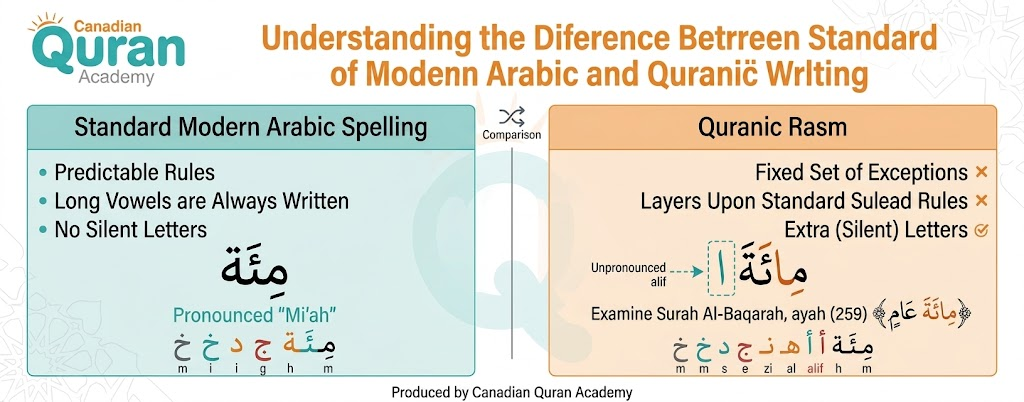
Standard modern Arabic spelling follows regular, predictable rules: every long vowel is written with its corresponding letter (alif, waw, or ya), and no extra silent letters appear. Quranic rasm follows a separate, fixed set of exceptions layered on top of that base system.
A clear example is the word for “hundred.” In everyday Arabic writing it would simply be مِئَة. In the Quran, an extra alif is written after the meem: مِائَةَ — as it appears in Surah Al-Baqarah, ayah (259: ﴿مِائَةَ عَامٍۢ . The alif is written but not pronounced; it is a feature of the script, not the recitation.
2. Learn the Arabic Alphabet Before Writing the Quran
Before you begin writing the Quran in Arabic, you should be able to recognize and write all 28 Arabic letters in their different forms. Each letter changes its shape depending on whether it appears at the beginning, middle, end, or stands alone in a word, and becoming familiar with these forms is essential for accurate Quranic transcription.
It is equally important to distinguish between letters with similar shapes and sounds, such as ب، ت، ث or ح، خ، ج, since confusing even a single letter changes the written word. Practice writing each letter repeatedly until you can reproduce it confidently without hesitation.
Read also: Quran Verses About Death in Arabic
3. Learn Why Rasm Uthmani Is the Standard for Every Printed Mushaf
Every standard printed Mushaf in circulation today — regardless of country or publisher — follows Rasm Uthmani rather than modern spelling, because the script was fixed by consensus during the compilation overseen by the third caliph and has been transmitted, letter for letter, ever since.
Scholars of Quranic sciences have offered several explanations for why certain irregular spellings were preserved rather than corrected: some argue it protects the Mushaf from being confused with ordinary Arabic writing, others note that certain spellings point toward accepted variant recitations (qira’at). No single explanation is treated as final — the spelling itself is what has been preserved and agreed upon.
If you are working through Quranic script for the first time, a structured Fusha foundation makes the irregular spellings far easier to recognize, because you already know what the “regular” version of a word looks like before you learn the exception. Canadian Quran Academy’s Fusha Arabic course is built around exactly this progression — standard grammar and spelling first, so Quranic exceptions make sense rather than feeling arbitrary.
Book a FREE trial class in the Fusha Arabic Course in Canada

4. Learn the Core Rules of Rasm Uthmani
Rasm Uthmani is governed by a defined set of categories: deletion (al-hadhf), addition (al-ziyadah), substitution (al-badal), and the specific rules for writing the hamzah. Each category has its own conditions, and a correct Quranic transcription follows all of them together, not just one.
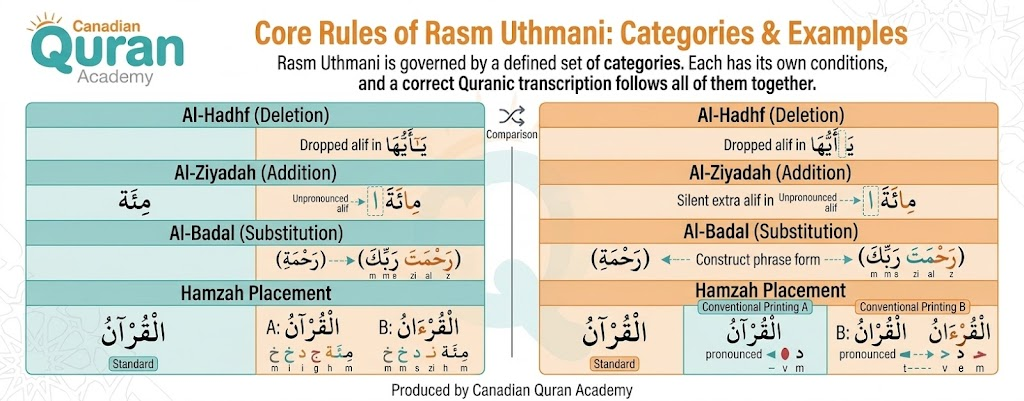
The table below summarizes the main categories, with the intent behind each and a concrete example from the Quranic text.
| Rasm category | What it means | Example |
| Al-Hadhf (deletion) | A letter that would appear in standard spelling is dropped from the Quranic script | The alif is dropped in يَٰٓأَيُّهَا |
| Al-Ziyadah (addition) | A silent letter is added that is not pronounced | The alif after meem in مِائَة |
| Al-Badal (substitution) | One letter is written in place of another for a specific reason | Ta marbutah written as an open ta in words like (رَحْمَتَ) in construct phrases |
| Hamzah placement | The hamzah is written using the letter shape matching its vowel and the vowel before it | (الْقُرْآنُ) or, in some copies, (الْقُرْءَانُ) depending on the printing convention |
5. Apply Tashkeel Correctly in Quranic Writing
Full tashkeel — fathah, dammah, kasrah, tanwin, shaddah, sukoon, and madd marks — must be applied to every letter of Quranic text, with no exceptions, because the meaning and correct pronunciation of the word depend entirely on these marks being present and accurate.
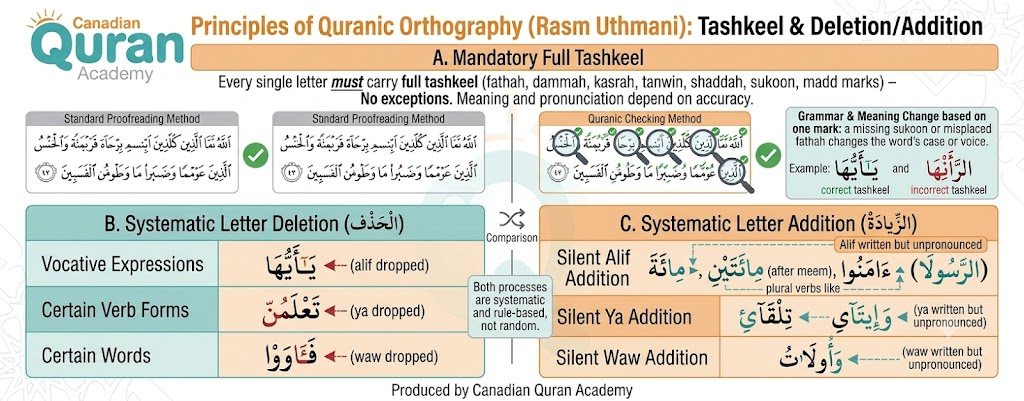
This is the single most common point where new learners make errors: a missing sukoon or a fathah placed on the wrong letter changes the grammatical reading of the word, which is why Quranic transcription is checked letter by letter rather than proofread the way ordinary Arabic text is proofread.
A. Letters Removed From Standard Spelling
Deletion in Rasm Uthmani follows recognizable patterns rather than occurring at random. Three of the most frequent deletion patterns are:
- The alif is dropped in vocative expressions such as يَٰٓأَيُّهَا
- The ya is dropped in certain verb forms, such as in تَعلَمُنِّ where a full spelling would otherwise include it
- The waw is dropped in words like فَـَٔاوَوْا where the base verb form would ordinarily carry it
B. Letters Added Beyond Standard Spelling
Addition works in the opposite direction: a letter is written into the script even though it carries no sound. This happens with the alif, the ya, and the waw, each under specific conditions.
- Alif addition — after the meem in “hundred” (مِائَةَ, مِائَتَيْنِ), after certain plural verb forms such as ءَامَنُوا and in a small set of fixed words like (الرَّسُولَا)
- Ya addition — in words such as تِلْقَآئِ and وَإِيتَآئ where the ya appears in the script but not in the spoken word
- Waw addition — in four specific words, including وَأُو۟لَٰتُ
Live Class in Action
Watch how our instructors interact with students in real-time, focusing on interactive methods.
Start Your Quranic Journey in Canada
Join our vibrant community and learn with expert tutors through our flexible online platform.
Claim Your Free Trial6. Write the Hamzah Correctly in Quranic Arabic
The hamzah is written according to its vowel and the vowel of the letter before it, using the shape of alif, waw, or ya as a carrier — never as a free-standing hamzah symbol alone, except in specific medial and final positions defined by the rasm rules.
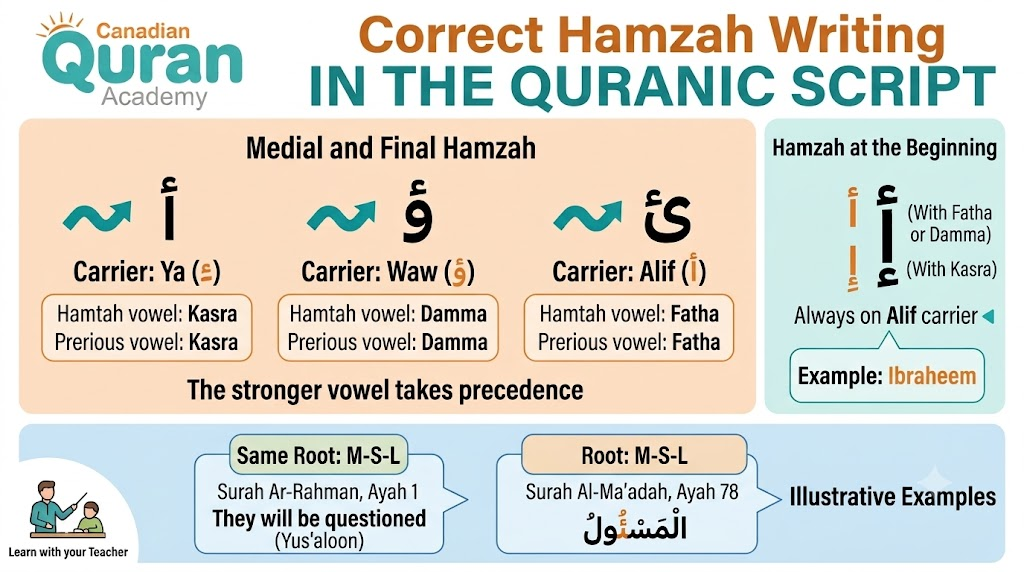
A beginning hamzah is always written on an alif, as in إِبْرَٰهِيمَ. A medial or final hamzah follows one of three patterns depending on its own vowel and the vowel preceding it — which is precisely why the same root can appear with a different hamzah carrier in different verses. This is one of the areas where learners benefit most from direct instructor correction rather than self-study, since the pattern requires recognizing vowel combinations quickly rather than memorizing a fixed list.
Read also: Quran Verses About Charity in Arabic With Translation and Meaning
7. Use the Right Tools for Writing the Quran
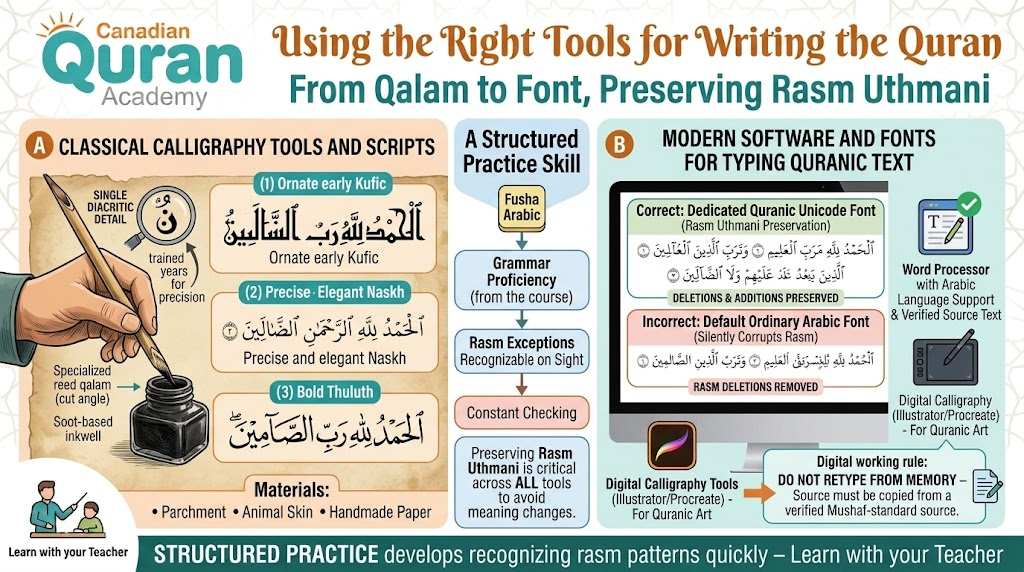
Writing the Quran accurately has always depended on the right tools, and the available options today range from centuries-old calligraphic instruments to modern Unicode-compliant Quranic fonts.
A. Classical Calligraphy Tools and Scripts
Historically, Quranic transcription was performed using a qalam (a reed or bamboo pen cut to a specific angle), ink made from soot and natural gum, and writing surfaces that ranged from parchment and animal skin to early handmade paper. Calligraphers trained for years in scripts such as Naskh, Thuluth, and Kufic before being trusted to transcribe Quranic text, because a single misplaced diacritic changes meaning.
B. Modern Software and Fonts for Typing Quranic Text
Digital Quranic fonts built specifically to reproduce Rasm Uthmani — rather than standard Arabic typefaces — are the correct choice whenever the Quran is typed rather than handwritten, because ordinary Arabic fonts default to modern spelling and will silently “correct” the deletions and additions that the rasm requires.
Common modern approaches include:
- Dedicated Quranic Unicode fonts that preserve rasm spelling by default
- Word processors with Arabic language support, used alongside verified Quranic text sources rather than freehand typing
- Digital calligraphy tools such as Illustrator or Procreate, used by trained calligraphers producing decorative Quranic art rather than working Mushaf copies
A working rule for any digital tool: the source text must be copied from a verified Mushaf-standard source, never retyped from memory, because retyping from memory is where rasm errors most often enter digital Quranic content.
Recognizing these patterns quickly — rather than looking each one up — is a skill that develops through structured practice rather than casual reading. Canadian Quran Academy’s Fusha Arabic course builds the grammatical base that makes rasm exceptions recognizable on sight, which is the difference between transcribing the Quran accurately and needing to check every line against a reference copy.
Book a FREE trial class in the Fusha Arabic Course in Canada

8. Write Slowly and Compare Your Work
Accuracy is far more important than speed when learning how to write Quran in Arabic. Instead of trying to copy long passages at once, write one word or one verse at a time, then compare your work carefully with the original Mushaf. Check every letter, every diacritical mark (tashkeel), and every detail of the Uthmani spelling before moving on.
Pay close attention to letters that are intentionally added or omitted, the placement of the hamzah, and the position of shaddah, sukoon, and madd signs. Even a small difference can change the written text, so developing the habit of reviewing your work letter by letter is one of the most effective ways to improve your accuracy.
Read also: How to Improve Your Arabic Language Skills

9. Practice Under a Qualified Teacher
While independent practice is valuable, learning under a qualified teacher helps you progress much faster and avoid developing mistakes that are difficult to correct later. An experienced instructor can identify errors in letter formation, tashkeel, hamzah placement, and the application of Rasm Uthmani that you may not notice on your own.
If your goal is to write Quranic Arabic accurately, studying through a structured program is one of the most effective approaches. At Canadian Quran Academy, our Quranic Arabic and Advanced Arabic courses combine live instruction with personalized feedback, helping students master Quranic spelling, Uthmani script conventions, and accurate transcription through guided practice. Regular correction ensures that mistakes are identified early, allowing you to build confidence and write the Quran with greater accuracy over time.
Book a FREE trial class in the Quranic Arabic Course in Canada

Common Mistakes When Writing the Quran in Arabic
Three mistakes account for the majority of errors seen in learner-produced Quranic transcription, and all three are avoidable with the right sequence of practice.
1. Applying standard Arabic spelling instead of rasm
The most frequent error is “correcting” what looks like a spelling mistake — removing an added alif or adding a dropped one — because the writer is applying modern Arabic conventions instead of the fixed Uthmani script.
2. Incomplete or inconsistent tashkeel
Partial vowelling, where some words carry full marks and others do not, is a common habit carried over from ordinary Arabic writing, where full tashkeel is often skipped. Quranic text does not tolerate this inconsistency.
3. Treating the Hamzah as One Fixed Symbol
Many beginners write every hamzah in the same form regardless of its position. In reality, the hamzah changes its carrier (أ، إ، ؤ، ئ، or standalone ء) according to established spelling rules based on the surrounding vowels. Using the wrong carrier often produces writing that appears nearly correct but contains genuine orthographic errors.
4. Neglecting the Etiquette of Writing the Quran
Writing the Quran is an act of worship as well as a writing exercise. Islamic tradition encourages treating the Mushaf with reverence and purity. The Prophet ﷺ instructed that the Quran should only be touched by one who is in a state of purity, and the Quran itself emphasizes the honor of the sacred text. For this reason, transcription practice should be approached with a clean writing surface, sincere intention, careful attention, and respect rather than haste.
Experience Our Classrooms
Don’t just take our word for it—take a look inside! Watch the videos below to experience our engaging teaching methods and vibrant online classrooms firsthand.
Start Your Quranic Journey in Canada
Join our vibrant community and learn with expert tutors through our flexible online platform.
Claim Your Free TrialBuild Accurate Quranic Writing Skills with Canadian Quran Academy
Learning to write the Quran correctly is a skill developed through consistent practice and expert guidance. At Canadian Quran Academy, our structured online courses help you master Rasm Uthmani, apply tashkeel accurately, and write Quranic Arabic with confidence.
When you learn with us, you’ll receive:
- Live instruction from qualified Arabic and Quran teachers
- Personalized lessons based on your current level
- Structured training in Quranic writing and Rasm Uthmani
- Individual feedback to improve accuracy and prevent common mistakes
- Flexible online classes that fit your schedule
- A free trial lesson to help you get started
Book your free trial today and take the first step toward writing the Quran with accuracy and confidence.

Our Arabic Courses
- Online Arabic Academy
- Online Arabic Course
- Classical Arabic Course
- Arabic Course for Beginners
- Advanced Arabic Course
- Quranic Arabic Course
- Arabic Grammar Course
- Modern Standard Arabic Course
- Arabic Conversation / Speaking Course
- Intensive Arabic Course
- Online Arabic Classes for Kids
- Arabic Classes for Adults
- Arabic Classes for Ladies
- Fusha Arabic Course
- Business Arabic Course
- Al-Azhar Arabic Course
- Madinah Arabic Course
- Learning Arabic for Non-Arabic Speakers
- Arabic Elementary School
- Arabic Intermediate School
- Arabic Lessons for Kindergarten
Start Your Quranic Journey in Canada
Join our vibrant community and learn with expert tutors through our flexible online platform.
Claim Your Free TrialConclusion
Learning how to write Quran in Arabic means learning a fixed script — Rasm Uthmani — rather than applying standard Arabic spelling rules to a sacred text. The deletions, additions, and hamzah conventions covered in this guide are not stylistic choices; they are the same rules followed in every printed Mushaf, preserved letter for letter since the compilation under Uthman ibn Affan.
Whether you’re working with a reed pen and classical calligraphy, typing with a verified Quranic font, or practicing transcription by hand for the first time, the same principle holds: check the source, check the rasm, check the tashkeel, and read it back. Writing the Quran in Arabic correctly is a skill built through careful, guided repetition — not something absorbed by reading the rules once and moving on.
Frequently Asked Questions
What does it mean to learn how to write Quran in Arabic?
Learning how to write the Quran in Arabic means mastering Rasm Uthmani — the fixed spelling system used in every Mushaf — including its rules for deleted letters, added letters, and hamzah placement, alongside complete and accurate tashkeel.
Do I need to be fluent in Arabic to start learning how to write Quran in Arabic?
No, fluency is not required to begin, but a solid grasp of the Arabic alphabet, basic grammar, and standard spelling is essential first, since Rasm Uthmani is understood as a set of exceptions to standard spelling rather than a separate alphabet.
Can I use modern Arabic fonts to write the Quran?
Standard modern Arabic fonts are not suitable, because they default to contemporary spelling and will not reproduce the deletions, additions, and hamzah conventions fixed in Rasm Uthmani. A dedicated Quranic font or a verified Mushaf-standard source text is required.
Is it permissible to practice writing Quranic verses for learning purposes?
Yes, practicing Quranic transcription for educational purposes is permitted, provided it is done with a clean writing surface, careful attention to accuracy, and the respect due to the text — consistent with the principle that only the purified should touch the Quran (Al-Waqi’ah 56:79).
How long does it take to write Quranic Arabic accurately?
The timeline depends on prior familiarity with Arabic script and consistency of practice. Learners with a working grammar foundation typically become confident with common rasm patterns — deletion, addition, and hamzah placement — within a few months of regular, guided practice.
Where can I get structured guidance on Quranic rasm rules?
Structured instruction that builds Arabic grammar first and then layers on Quranic rasm conventions is the most reliable path. Courses combining live correction with a defined progression, such as those offered through Canadian Quran Academy, allow learners to catch rasm errors in real time rather than discovering them later.






Leave a Reply