 Arabic
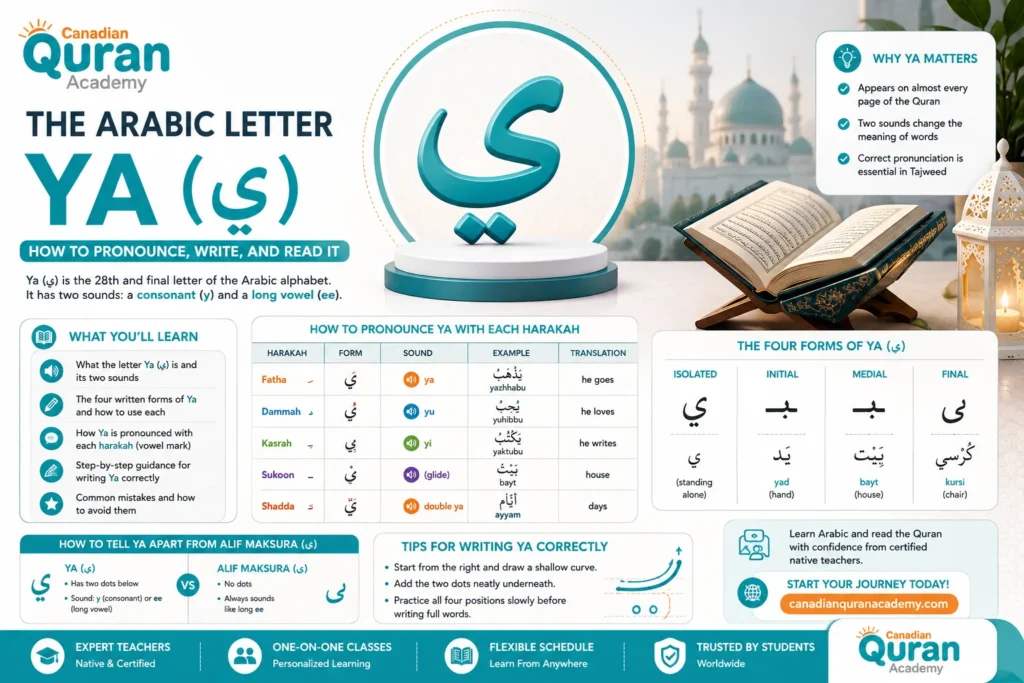
If you’re learning to read the Quran, the Arabic letter ya (ي) is one you’ll meet on almost every page. It’s the twenty-eighth and final letter of the Arabic alphabet, and it does double duty: sometimes it’s a consonant, sometimes it’s a long vowel, and getting the difference right changes how a word sounds and, in Quran recitation, whether it’s read correctly.
This guide walks you through pronouncing ya, writing its four shapes, and avoiding the mistakes that trip up most new learners.
At Canadian Quran Academy, ya is one of the first letters we slow down on with new students, because the two sounds it carries show up constantly in everyday words and in Quranic verses alike.
What You’ll Learn in This Article
- What the Arabic letter ya (ي) is and its two sounds
- The four written forms of ya and how to tell them apart
- How ya is pronounced with each harakah (vowel mark)
- Step-by-step guidance for writing ya correctly
- Why ya matters specifically for accurate Quran recitation
- The most common mistakes learners make with ya, and how to fix them
What Is The Arabic Letter Ya (ي)?
Ya (ي) is the last letter of the 28-letter Arabic alphabet. Its base shape is a shallow curve that sits on the writing line, and it is always marked with two dots placed underneath it — this is the single fastest way to identify it in any word.
Ya is unusual because it functions in two completely different ways. As a consonant, it makes the sound of the English “y” in “yes” or “yellow” (written in phonetic notation as /j/).
As a long vowel, it produces the stretched “ee” sound found in “see” or “machine” (written as /iː/). Which one you’re looking at depends on the vowel mark attached to it and its position in the word — a distinction covered in detail below.
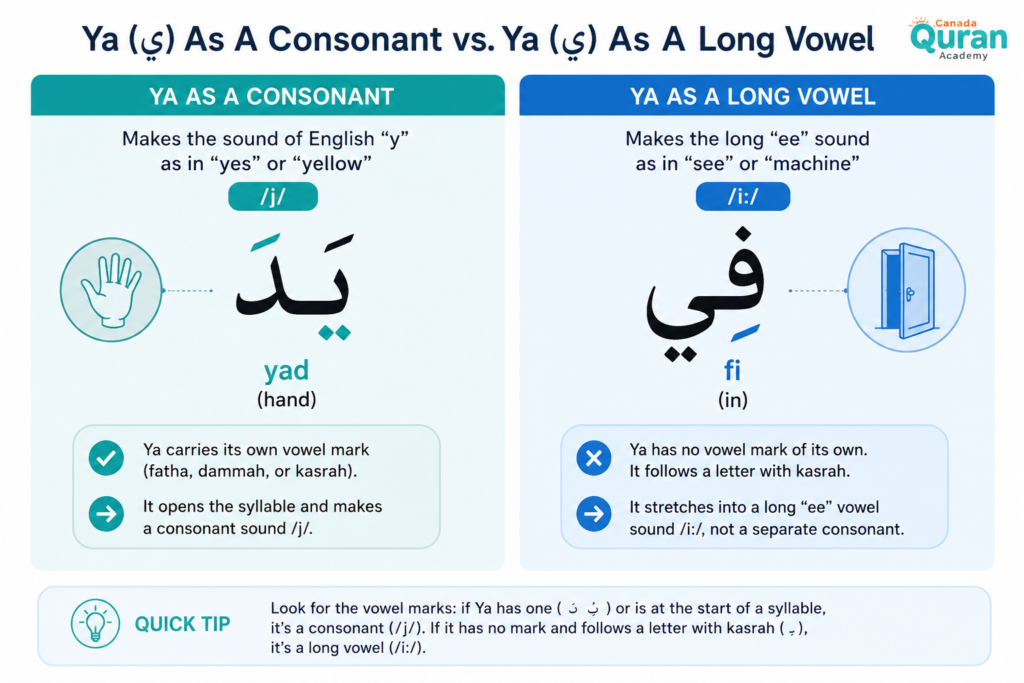
Ya As A Consonant Vs. Ya As A Long Vowel
When ya carries its own vowel mark (fatha, dammah, or kasrah) or opens a syllable, it behaves as a consonant. The word يَد (yad, “hand”) is a clear example — the ya at the start is a crisp “y” sound.
When ya has no vowel mark of its own and instead follows a letter carrying a kasrah, it stretches into the long “ee” vowel. The word فِي (fi, “in”) shows this: there’s no separate consonant sound, just one smooth “fee.”
Read Also: The Arabic Letter Haa (ه)
How To Pronounce Ya With Each Harakah?
The ي – Arabic letter ya’s sound shifts slightly depending on the harakah (vowel mark) placed on it. This section answers one question: what does ya sound like under each vowel mark?
- Fatha (ﯼَ): produces a short “ya” sound, as in يَذْهَب (yazhhab, “he goes”).
- Dammah (ﯼُ): produces a short “yu” sound, as in يُحِبّ (yuhibb, “he loves”). Don’t stretch this into “yoo” — that longer sound only happens when ya is followed by a waw.
- Kasrah (ﯼِ): produces a short “yi” sound, sharp and quick, as at the start of “yes.”
- Sukoon (ﯼْ): ya carries no vowel of its own and instead glides with the letter before it, as in بَيْت (bayt, “house”) or شَيْخ (shaykh, “sheikh”). This creates a diphthong — a single smooth glide, not two separate syllables.
- Shadda (ﯼّ): ya is pronounced twice in one motion, doubling its consonant sound before taking a vowel — as in أَيَّام (ayyam, “days”).
A common technique we use with beginners at Canadian Quran Academy is to say each harakah pair out loud back to back — kitab (short i) then kitabi (long ee) — until the ear can tell the two apart without hesitating.
This distinction matters because Arabic treats vowel length as meaningful: shortening a long vowel or stretching a short one can change a word’s meaning entirely, which is exactly why Tajweed rules are strict about it.
The Four Forms Of The Arabic Letter Ya
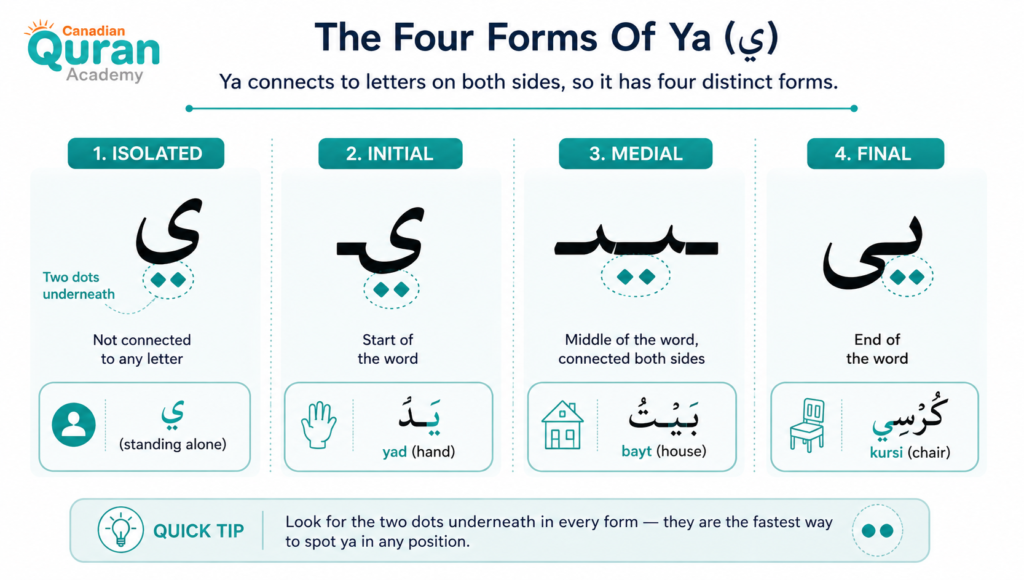
Like most letters in the Arabic alphabet, the Arabic letter ya (ي) changes shape depending on where it sits in a word, because Arabic script is a connected, cursive writing system. Ya connects to letters on both sides, so it has four distinct forms.
| Position | Shape | Example word | Where ya appears |
| Isolated | ي | ي (standing alone) | Not connected to any letter |
| Initial | يـ | يَد (yad – hand) | Start of the word |
| Medial | ـيـ | بَيْت (bayt – house) | Middle of the word, connected both sides |
| Final | ـي | كُرْسِي (kursi – chair) | End of the word |
The medial form is the one most learners stumble on first, because it loses the descending tail entirely and looks like a shallow tooth-shape with two dots underneath — nothing like the isolated letter shown in alphabet charts. The final form keeps the tail and stretches gracefully below the line.
How To Tell Ya Apart From Alif Maksura?
One point that confuses almost every new reader: a final ya without dots is not ya at all — it’s a separate letter called alif maksura (ى). Words like عَلَى (ala, “on”) and إِلَى (ila, “to”) end in alif maksura, not ya, even though both letters make a similar “ee”-ish sound at the end of a word.
The rule is simple and worth memorizing: if there are two dots underneath at the end of a word, it’s ya (ي); if there are no dots, it’s alif maksura (ى).
Read Also: Arabic Letter 3ayn (ع)
How To Write The Letter Ya Step By Step
Ya is written right to left, like all Arabic letters, and its construction changes slightly depending on which of the four forms you’re producing.
- Start at the baseline. Place your pen where the letter will sit on the writing line.
- Draw the body. For the isolated and final forms, draw a shallow curve that dips below the line into a rounded tail. For the initial and medial forms, keep the stroke shallow and level with the line — no tail.
- Add the connector. If ya is at the beginning or middle of a word, extend a short connecting stroke to the left to join the next letter.
- Place the two dots. Add them directly underneath the main body, evenly spaced. This is the step beginners skip most often, and it’s the one detail that makes the letter identifiable.
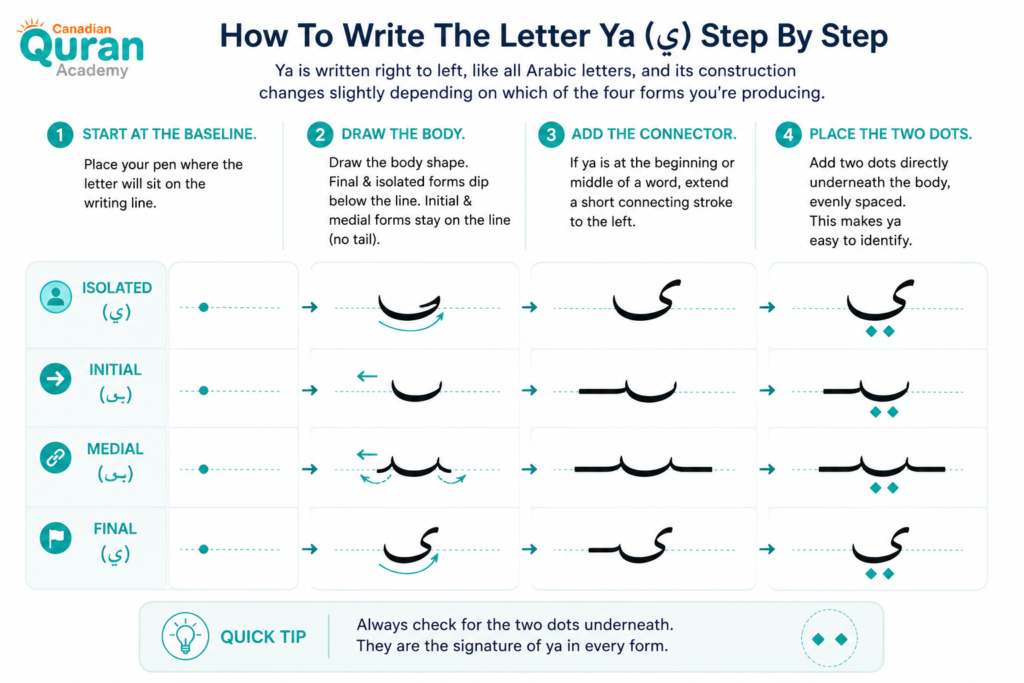
A practical tip from classroom experience: students who trace the medial and final forms in full words — بَيْت, كُرْسِي, سَيَّارَة — learn the shape faster than students who only practice the isolated letter on its own, because the isolated form barely resembles how ya actually looks inside real words.
Live Class in Action
Watch how our instructors interact with students in real-time, focusing on interactive methods.
Start Your Quranic Journey in Canada
Join our vibrant community and learn with expert tutors through our flexible online platform.
Claim Your Free TrialYa in Quranic Recitation: Why Precision Matters?
For Quran students specifically, the Arabic letter ya carries extra weight because it is one of the three huroof al-madd — the letters of elongation, alongside alif and waw.
When ya follows a letter carrying a kasrah and has no vowel mark of its own, it triggers a natural madd (madd tabee’i), which is held for the length of two harakat, roughly the time it takes to pronounce two short vowels.
Reading ya too short in this position shortens the madd and changes the recitation; reading it too long without a reason (a longer madd rule applying) over-extends it.
This is one reason a private reading teacher matters more for Quranic Arabic than for casual conversational Arabic — the letter’s timing is part of correct recitation, not just pronunciation style.
This is exactly the kind of detail our instructors focus on in Quran Reading Classes at Canadian Quran Academy — not just naming the letter, but training the ear and mouth to hold its vowel length correctly inside real verses.
Read Also: How to Write Quran in Arabic?
Common Mistakes With Ya And How To Avoid Them
Most learners run into the same handful of errors with the ي – Arabic letter ya, and all of them are fixable with a bit of targeted practice.
1. Confusing ya with alif maksura
Writing ى instead of ي (or vice versa) at the end of a word changes the letter entirely. Check for the two dots every time.
2. Dropping the dots
Writing ي without its two dots turns it into an unrecognizable mark, or makes it look like another letter. The dots are not optional decoration — they’re part of the letter’s identity.
3. Treating every ya as a long vowel
Some learners pronounce يَد (yad, “hand”) as “eed,” dropping the consonant sound entirely. Before pronouncing any ya, check whether it carries its own vowel mark (consonant) or follows a kasrah with no mark of its own (long vowel).
4. Adding an extra sound after the possessive ya
When ya means “my,” as in كِتَابِي (kitabi, “my book”), it should end the word cleanly. Saying “kitabee-ya” adds a syllable that isn’t there.
5. Using the wrong form in the wrong position
Writing the isolated form (ي) in the middle of a word instead of the connected medial form (ـيـ) breaks the flow of the script and is a common mistake in early handwriting practice.
If you’re building these habits on your own, structured feedback from a teacher speeds things up considerably — it’s easy to repeat a small pronunciation error for months without noticing it.
Canadian Quran Academy offers Online Quran Classes for Kids, Quran Classes for Adults, and Quran Classes for Female students, so learners at any age or stage get direct correction as they go rather than practicing mistakes into habits.
Read Also: Letter N In Arabic ن
Experience Our Classrooms
Don’t just take our word for it—take a look inside! Watch the videos below to experience our engaging teaching methods and vibrant online classrooms firsthand.
Start Your Quranic Journey in Canada
Join our vibrant community and learn with expert tutors through our flexible online platform.
Claim Your Free TrialStart Reading With Confidence Today
You don’t have to work through the Arabic alphabet alone. A qualified teacher can spot the exact moment you’re mispronouncing (ya) or misreading its form, and correct it before it becomes a habit — something no book or app can do on its own.
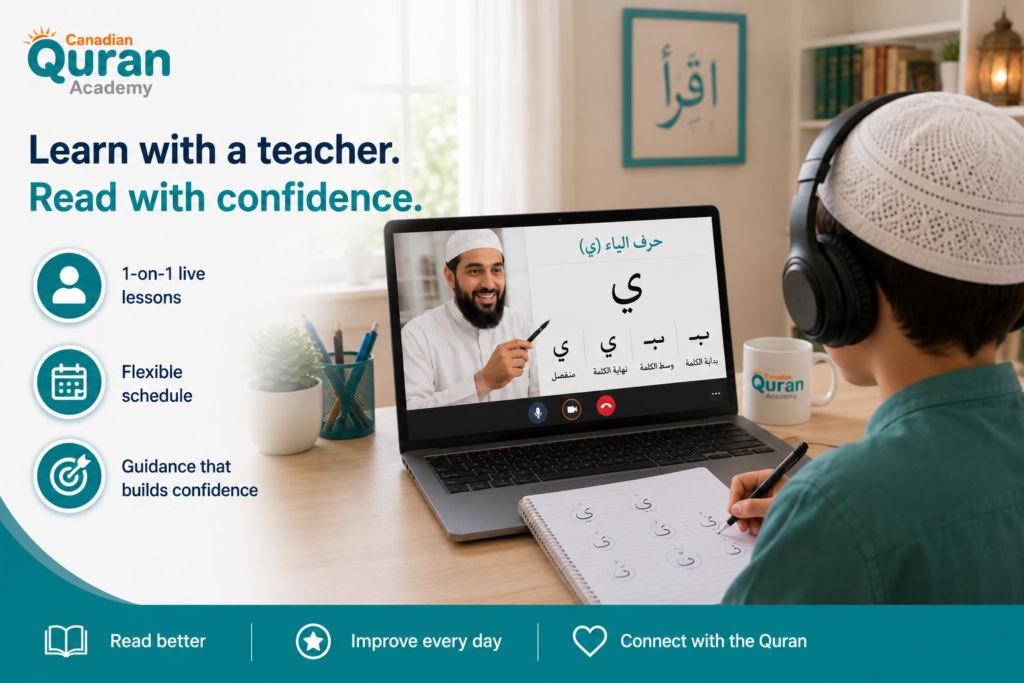
Canadian Quran Academy pairs you with a dedicated instructor for one-on-one lessons, at a schedule that fits your life, whether you’re a complete beginner or brushing up your Quran reading skills.

Our Quran Courses:
- Quran Online Academy
- Quran Recitation Classes
- Quran Reading Classes
- Online Quran Classes for Kids
- Quran Classes for Adults
- Quran Classes for Female
- Learn Quran Course for Beginners
- Quran Memorization (Hifz) Course
- Hifz Classes for Adults
- Quran Memorization and Hifz Course for Kids
- Quran Hifz Course for Ladies
- Quran Ijazah Program
- Quran Qirat Learning Course
- Quran Tafsir Course
Start Your Quranic Journey in Canada
Join our vibrant community and learn with expert tutors through our flexible online platform.
Claim Your Free TrialConclusion
The ي – Arabic letter ya is small but does a lot of work in the language: it’s a consonant, a long vowel, a possessive ending, and — in Quran recitation — a letter of elongation that has to be held for the right length.
Once you can recognize its four written forms, tell it apart from alif maksura, and hear the difference between its short and long sounds, ya stops being confusing and becomes one of the more predictable letters in the alphabet.
Keep practicing it in real words rather than isolation, and pay attention to its role in Quranic verses, where getting ya right is part of reading correctly, not just reading clearly.

Frequently Asked Questions
Here are quick answers to the questions Quran students ask most often about the Arabic letter ya, based on what actually trips learners up in lessons.
1. Is ya a vowel or a consonant in Arabic?
Ya is both, depending on context. It’s a consonant (like the English “y”) when it carries its own vowel mark or opens a syllable, and a long vowel (the “ee” sound) when it follows a kasrah with no vowel mark of its own.
2. What is the difference between ya and alif maksura?
Ya (ي) always has two dots underneath it; alif maksura (ى) looks similar at the end of a word but has no dots. Both can produce an “ee”-like sound, but they are separate letters used in different words.
3. How many forms does the letter ya have?
Ya has four forms: isolated (ي), initial (يـ), medial (ـيـ), and final (ـي). Each form keeps the two dots underneath the letter, but the shape and connecting strokes change based on position in the word.
4. What’s the fastest way to stop confusing ya’s two sounds?
Practice minimal pairs out loud — words like كِتَاب (short i) against كِتَابِي (long ee) — until your ear catches the length difference automatically. Direct correction from a teacher, such as in Canadian Quran Academy’s Quran Reading Classes, speeds this up significantly compared to self-study alone.
5. Why is ya important in Quran recitation specifically?
Ya is one of the three madd letters, meaning it can trigger a required elongation when it follows a kasrah. Reading it too short or too long changes the correct recitation, which is why Tajweed teachers give it focused attention.





Leave a Reply