 Arabic
The Arabic letter Lam (ل) is one of the first letters most learners memorize, and one of the easiest to get wrong once it starts connecting to other letters in a word. If you have ever paused mid-sentence wondering how the letter L in Arabic changes shape or sound depending on where it sits, you are not alone.
This guide breaks down the Arabic letter Lam completely: its place in the alphabet, its four written forms, how to pronounce it correctly (including the tricky “heavy” version), and the grammar roles it plays beyond being a simple letter.
At Canadian Quran Academy, this is exactly the kind of foundational letter recognition our instructors build before moving students into full Tajweed and fluent recitation.
What Is The Arabic Letter Lam (ل)?
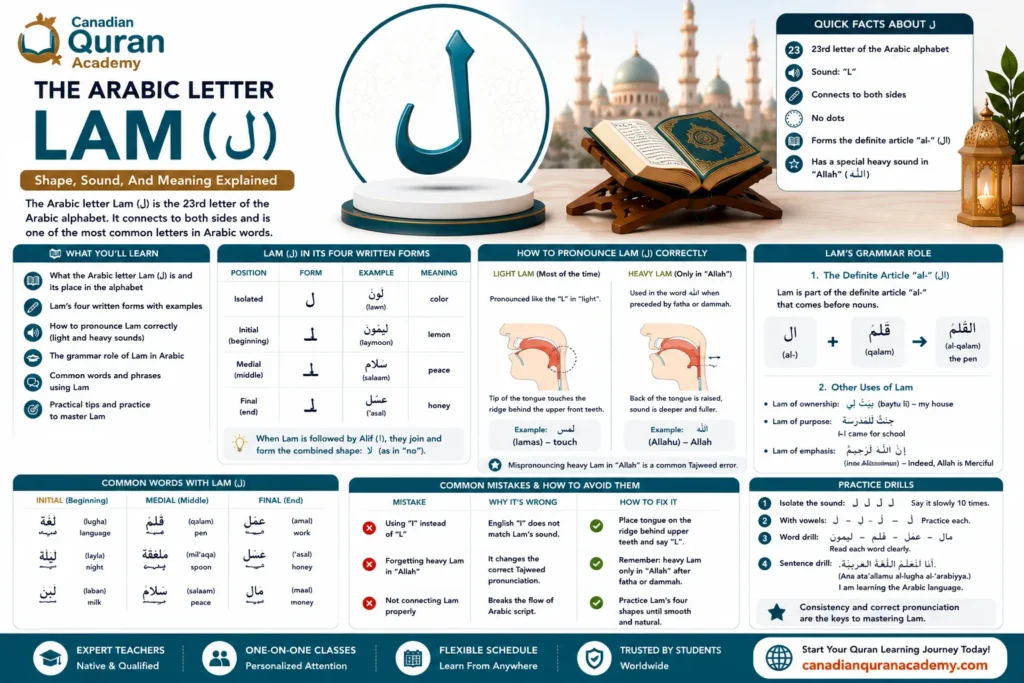
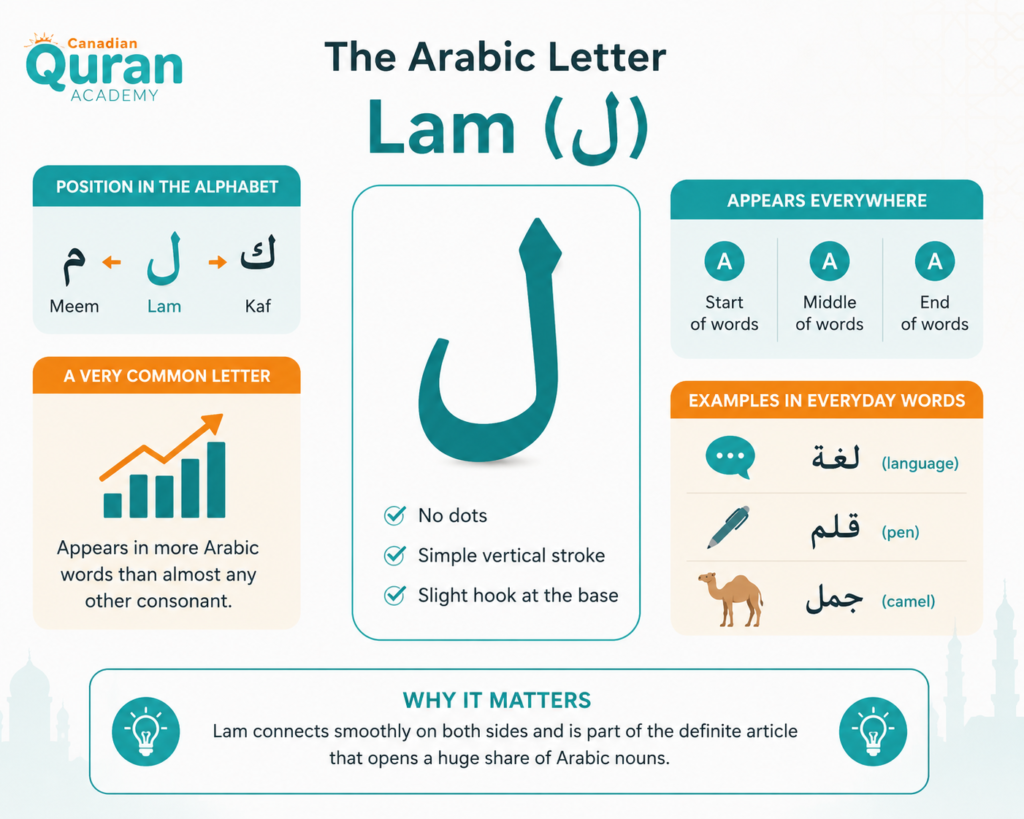
The Letter l in Arabic (ل) is the 23rd letter of the Arabic alphabet, positioned between Kaf (ك) and Meem (م). It has no dots, a simple vertical stroke, and a slight hook at the base — one of the more approachable letters for a beginner to recognize on the page.
Lam sits near the end of the traditional alphabet order, but it is far from a minor letter. It appears in more Arabic words than almost any other consonant, including the definite article that opens a huge share of Arabic nouns.
Because Lam connects smoothly on both sides, it shows up at the start, middle, and end of words without disrupting the flow of the script. This flexibility is part of why the Arabic letter Lam appears in everyday vocabulary as often as it does — from لغة (language) to قلم (pen) to جمل (camel).
Read Also: The Letter Qaf In Arabic ق
How Is Lam Written In Arabic?
Like every Arabic letter that connects to its neighbors, Lam changes shape depending on where it falls in a word. Recognizing these four forms is what separates a learner who can sound out a word from one who actually reads fluently.
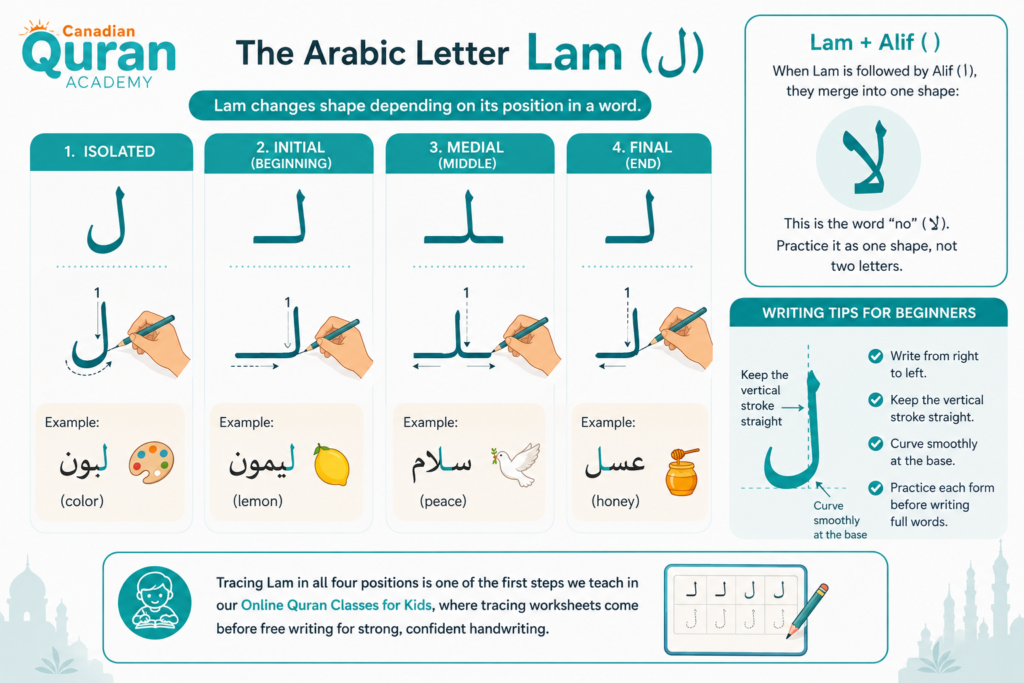
| Position | Form | Example | Meaning |
| Isolated | ل | لون | color |
| Initial (beginning) | لـ | ليمون | lemon |
| Medial (middle) | ـلـ | سلام | peace |
| Final (end) | ـل | عسل | honey |
When Lam is immediately followed by Alif (ا), the two letters do not stay separate. They merge into a single distinct shape: لا. This combined form is common enough — it is the word “no” (لا) on its own — that it deserves specific practice rather than being treated as two ordinary letters glued together.
Writing Tips for Beginners
Arabic is written right to left, and Lam’s vertical stroke should stay straight before curving at the base. Tracing the letter in each of its four positions before attempting full words builds the muscle memory needed for smooth, connected handwriting.
This is one of the first drills used in our Online Quran Classes for Kids, where tracing worksheets come before free writing.
How To Pronounce The Arabic Letter Lam Correctly?
Pronouncing Lam in Arabic starts from a sound close to the English “L,” but Arabic actually uses two distinct versions of this letter depending on context. Knowing the difference is what makes recitation sound natural instead of flat.
The standard, “light” Lam is pronounced with the tip of the tongue touching the ridge just behind the upper front teeth — similar to the L in the English word “light.” Most Arabic words with Lam use this light version, as in لمس (lamas, “touch”).
The “heavy” Lam is a specific exception reserved for the word الله (Allah) when it follows a fatha or damma vowel.
It is pronounced with the back of the tongue raised, giving it a fuller, deeper resonance than the standard sound. Mispronouncing this distinction is one of the most common corrections Tajweed teachers give new reciters.
Read Also: Letter Dha In Arabic ظ
Live Class in Action
Watch how our instructors interact with students in real-time, focusing on interactive methods.
Start Your Quranic Journey in Canada
Join our vibrant community and learn with expert tutors through our flexible online platform.
Claim Your Free TrialTips for Mastering the Sound
Practicing pronunciation in isolation rarely transfers to real reading. Progress comes faster when learners work through it methodically: say the sound slowly and deliberately, listen to a native speaker say the same word, repeat it aloud, then record yourself to compare.
Structured, guided correction — rather than self-study alone — is usually what closes the final gap between “close enough” and accurate. Our Quran Recitation Classes build this kind of listen-repeat-correct cycle directly into every session.
Common Arabic Words And Phrases With Lam
Seeing Lam inside real vocabulary makes the letter easier to remember than studying it in isolation.
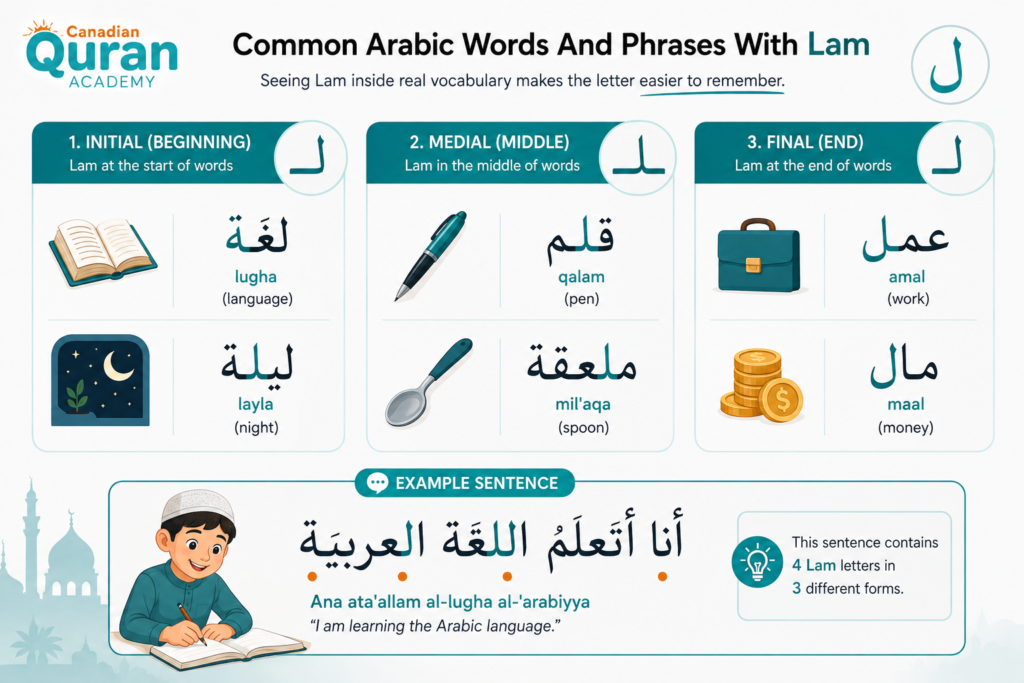
- In the initial position, Lam opens words like لغة (lugha, “language”) and ليلة (layla, “night”).
- In the medial position, it appears in the middle of قلم (qalam, “pen”) and ملعقة (mil’aqa, “spoon”).
- In the final position, it closes out words such as عمل (amal, “work”) and مال (maal, “money”).
Example Sentences:
Full sentences reinforce the letter better than word lists alone.
أنا أتعلم اللغة العربية (Ana ata’allam al-lugha al-‘arabiyya) means “I am learning the Arabic language” — and it contains four separate instances of Lam in three different forms within a single sentence.
Read Also: The Letter Ta In Arabic (ط)
Lam In Arabic Grammar: More Than Just A Letter
Lam is one of the few Arabic letters that also functions as a grammatical tool on its own, not just as part of a word’s spelling. Understanding this dual role is what takes a learner from letter recognition to reading comprehension.
1. The Definite Article: Lam al-Ta’rif
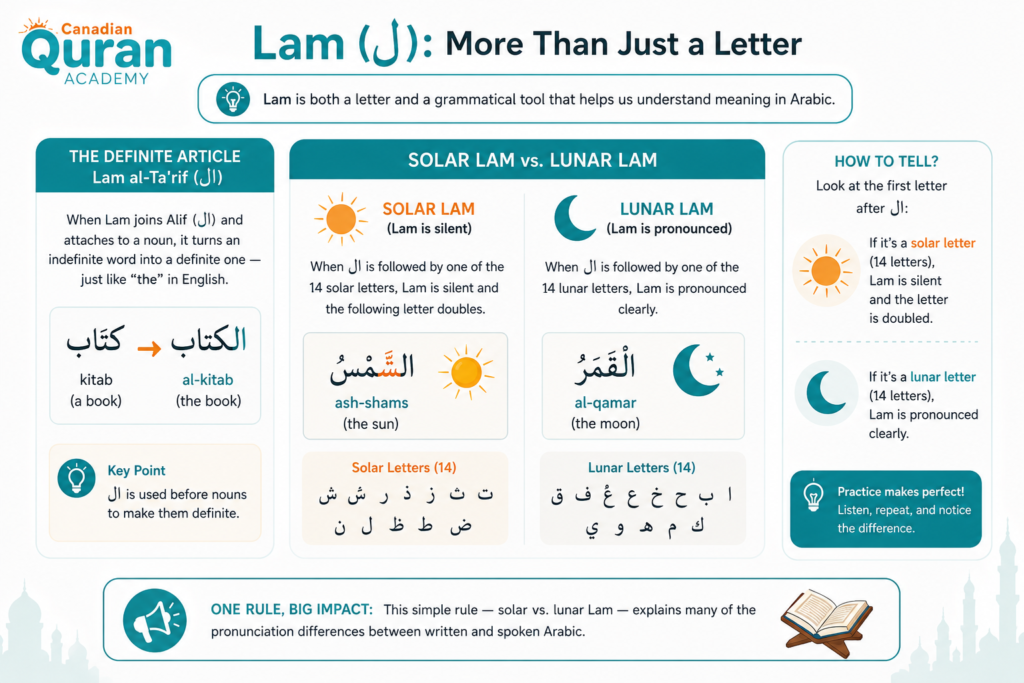
When Lam pairs with Alif to form ال and attaches to the front of a noun, it turns an indefinite word into a definite one — the same function “the” performs in English.
كتاب (kitab, “a book”) becomes الكتاب (al-kitab, “the book”).
2. Solar Lam vs. Lunar Lam
This is where many learners get tripped up. When “ال” is followed by one of the 14 “lunar” letters (such as ق or ب), the Lam is pronounced clearly, as in القمر (al-qamar, “the moon”).
When it’s followed by one of the 14 “solar” letters (such as ش or ت), the Lam itself goes silent and the following letter doubles instead, as in الشمس pronounced ash-shams (“the sun”) rather than al-shams.
This single rule explains a huge share of the pronunciation differences learners notice between written and spoken Arabic.
Read Also: The Arabic Letter Ha (ح)
Why Mastering Lam Matters for Reading the Qur’an?
Letter-level accuracy is not a formality in Quranic studies — it changes meaning and correctness in recitation.
Since Lam carries both a standard and a heavy pronunciation, and since it governs whether the letters following “ال” are voiced or absorbed, getting it wrong affects how correctly a verse is recited, not just how it sounds.
Tajweed rules build directly on top of letter fundamentals like this one, which is why our Quran Reading Classes treat letter mastery as a prerequisite, not an afterthought.
A Common Mistake To Watch For
One mistake we see often with newer students: they memorize the shape of “ال” as a fixed unit and stop paying attention to whether the letter after it is solar or lunar, so they pronounce every “the” the same way.
Catching this early prevents the habit from becoming permanent once a student moves into longer Surahs.
Whether you’re an adult starting from zero or a parent guiding a child through their first Arabic letters, this kind of individualized feedback is easier to get in a live class than from an app alone.
Canadian Quran Academy structures its Quran Classes for Adults and Quran Classes for Female around exactly this — one-on-one correction rather than passive video lessons.
Experience Our Classrooms
Don’t just take our word for it—take a look inside! Watch the videos below to experience our engaging teaching methods and vibrant online classrooms firsthand.
Start Your Quranic Journey in Canada
Join our vibrant community and learn with expert tutors through our flexible online platform.
Claim Your Free TrialStart Learning Arabic Letters The Right Way
Reading about Lam’s forms and sounds only goes so far — real progress comes from guided, corrected practice with someone who catches your mistakes in real time.
Canadian Quran Academy connects you with qualified instructors who take you letter by letter, from basic recognition through full Tajweed-accurate recitation, at a pace that fits your schedule. Explore the full Quran Online Academy and find the course track built for you.

Our Arabic Courses:
- Online Arabic Academy
- Online Arabic Course
- Classical Arabic Course
- Arabic Course for Beginners
- Advanced Arabic Course
- Quranic Arabic Course
- Arabic Grammar Course
- Modern Standard Arabic Course
- Online Arabic Classes for Kids
- Arabic Classes for Adults
- Arabic Classes for Ladies
- Arabic Elementary School
- Arabic Intermediate School
- Arabic Lessons for Kindergarten

Start Your Quranic Journey in Canada
Join our vibrant community and learn with expert tutors through our flexible online platform.
Claim Your Free TrialConclusion
The Letter l in Arabic (ل) is a simple-looking letter with real depth once you look past its shape: four written forms, two distinct pronunciations, and a grammatical role that shapes entire sentences through the definite article and the solar/lunar rule.
Getting comfortable with the letter L in Arabic early pays off directly in reading speed, pronunciation accuracy, and Tajweed correctness later on.
Consistent practice, guided correction, and exposure to real words and sentences — rather than isolated flashcards — is what actually moves the needle.
With structured lessons through Canadian Quran Academy, learners of any age can build that foundation with a qualified instructor rather than guessing alone.

Frequently Asked Questions About The Arabic Letter Lam
These are the questions learners ask most often once they start working with Lam in real words and verses — the kind of detail that usually only comes up once you’re a few lessons in.
1. What is the Arabic letter Lam?
The Arabic letter Lam (ل) is the 23rd letter of the Arabic alphabet, pronounced similarly to the English “L.” It appears in thousands of common words and also functions as the Arabic definite article when combined with Alif.
2. How do you pronounce Lam in Arabic?
Lam is pronounced by touching the tip of the tongue to the ridge behind the upper front teeth, producing a sound close to the English “L.” In one specific case — the word الله (Allah) — it is pronounced as a deeper “heavy” Lam instead.
3. What are the four written forms of Lam?
Lam has an isolated form (ل), an initial form (لـ), a medial form (ـلـ), and a final form (ـل). Each form connects differently to the letters around it depending on its position in the word.
4. Why does learning Lam matter for reading the Qur’an?
Lam’s dual pronunciation and its role in the definite article directly affect Tajweed accuracy during recitation. Getting it wrong can change how a verse is voiced, which is why letter-level mastery comes before full recitation training at Canadian Quran Academy.
5. What happens when Lam is followed by Alif?
When Lam is directly followed by Alif (ا), the two letters merge into a single combined shape: لا. This form also stands alone as a complete word meaning “no.”
6. What is the difference between solar and lunar Lam?
Lunar Lam is pronounced clearly when “ال” precedes one of 14 specific letters, as in القمر (“the moon”). Solar Lam goes silent and doubles the following letter instead, as in الشمس (“the sun”), pronounced ash-shams.






Leave a Reply