 Arabic
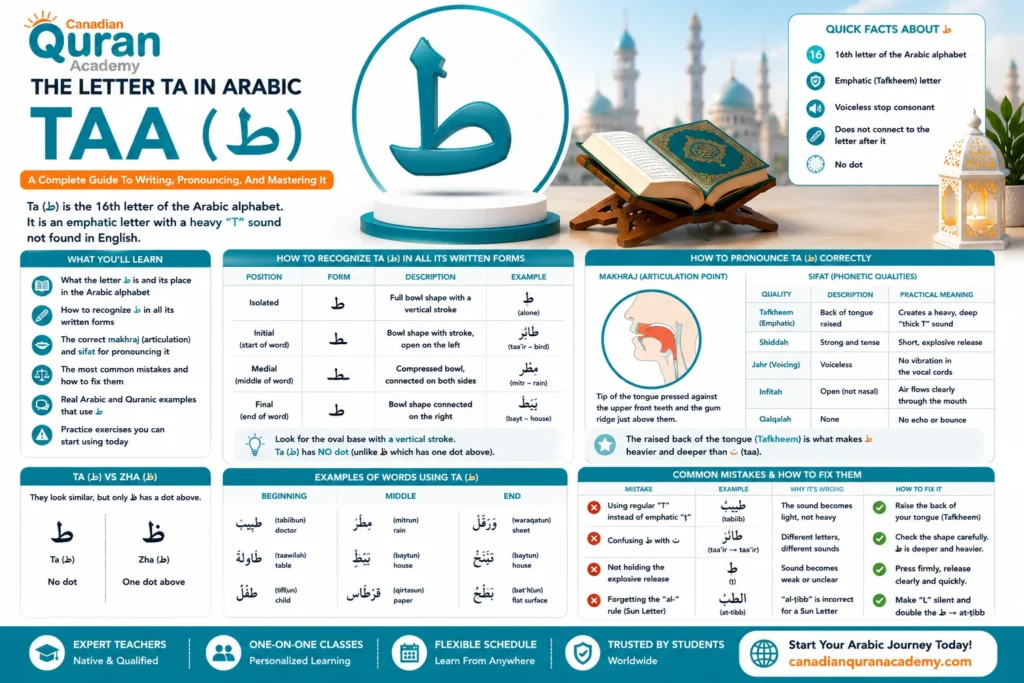
If you’ve started learning the Arabic alphabet, you’ve probably already noticed that two letters look almost identical but sound completely different: ت and ط. The letter Ta in Arabic — written ط — is the one that trips up most English-speaking beginners, and getting it wrong changes the meaning of words and affects Quranic recitation.
At Canadian Quran Academy, this is one of the letters we spend the most one-on-one correction time on with new students, because it can’t be learned from a chart alone. It needs to be heard, practiced, and corrected in real time.
This guide walks through what ط is, how to recognize it in every position of a word, how to pronounce it using its classical articulation rules, and how to avoid the mistakes that keep learners sounding like they’re reading rather than speaking.
What you’ll learn in this article:
- What the letter ط is and where it sits in the Arabic alphabet
- How to recognize ط in its four written forms
- The correct makhraj (articulation point) and sifat (phonetic traits) for pronouncing it
- The most common mistakes English speakers make with ط, and how to fix them
- Real Arabic and Quranic examples that use the letter
- Practice exercises you can start using today
What Is The Letter Ta (ط) In Arabic?
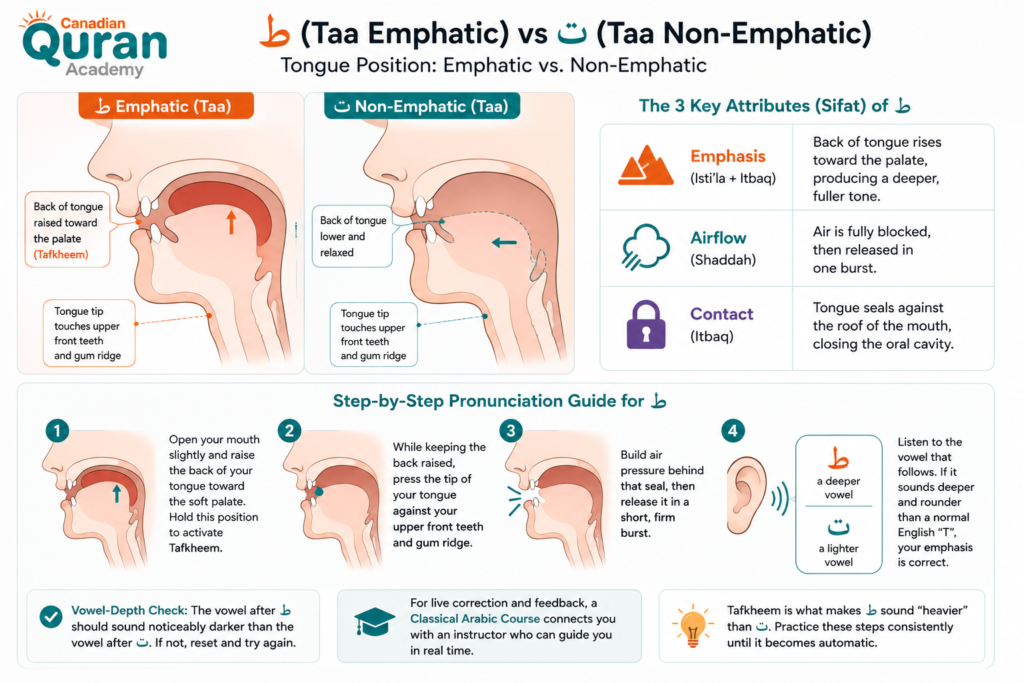
The letter ط is the sixteenth letter of the Arabic alphabet. It is classified as an emphatic, voiceless stop consonant — a sound produced by fully blocking airflow and then releasing it, with the back of the tongue raised toward the soft palate.
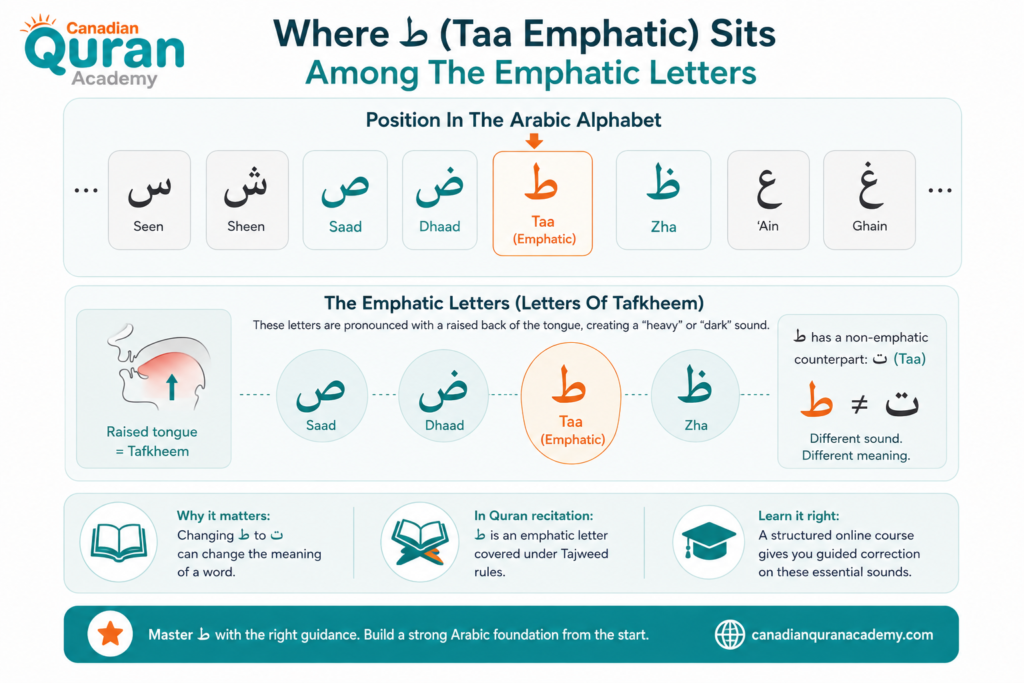
That raised-tongue quality is called Tafkheem, and it’s what makes ط sound “heavier” or “darker” than its non-emphatic counterpart, ت. English has no equivalent sound, which is exactly why learners need deliberate, guided practice rather than guesswork.
ط sits between ض (Dhaad) and ظ (Zha) in alphabet order, and it belongs to a small group of emphatic letters — along with ص, ض, and ظ — that Arabic phonetics group together because they share this same tongue-raising quality.
Why ط Matters Beyond The Alphabet Chart?
Mispronouncing ط isn’t a minor accent issue. In several word pairs, swapping ط for ت changes the meaning entirely — طين (clay) becomes something unrelated if the emphasis is dropped.
In Quranic recitation specifically, ط is one of the letters covered under Tajweed rules, since reciting it without its emphatic quality is considered a pronunciation error that affects the accuracy of the reading.
If you’re building your Arabic foundation from the start, working through a structured Online Arabic Course gives you guided correction on exactly these emphatic letters, rather than trying to self-teach a sound you’ve never heard modeled correctly.
Read Also: Arabic Letter Ra (ر)
How To Recognize The Letter Ta In All Its Written Forms?
Arabic letters change shape depending on where they fall in a word — at the start, in the middle, at the end, or standing alone.
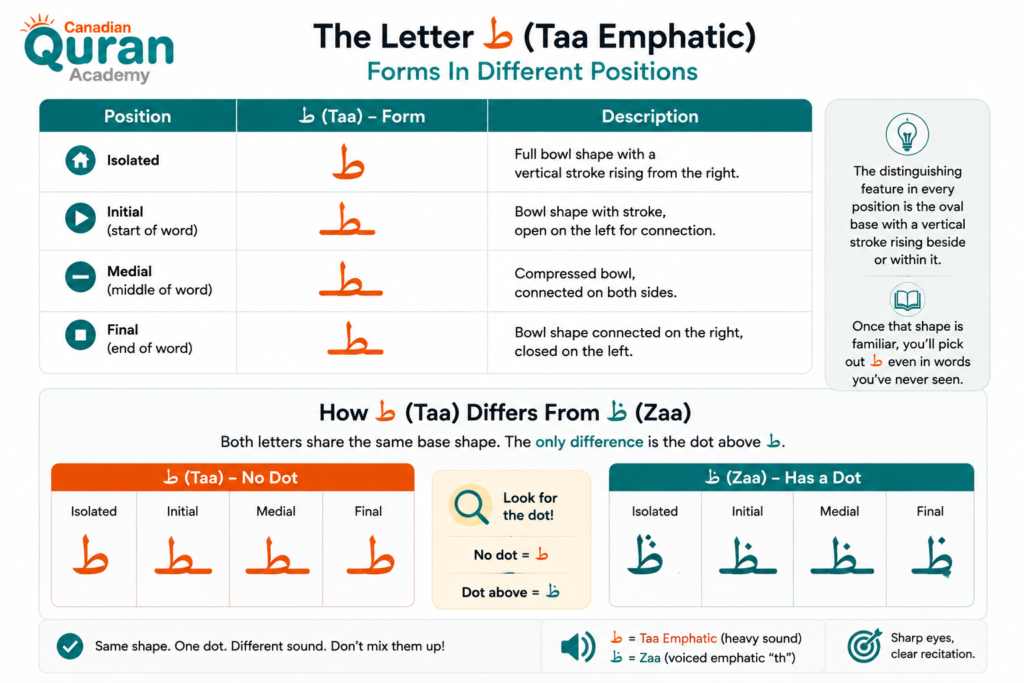
The letter Ta in Arabic keeps a recognizable bowl-and-stroke shape across all four positions, which makes it easier to spot than some other letters once you know what to look for.
| Position | Form | Description |
| Isolated | ط | Full bowl shape with a vertical stroke rising from the right |
| Initial (start of word) | طـ | Bowl shape with stroke, open on the left for connection |
| Medial (middle of word) | ـطـ | Compressed bowl, connected on both sides |
| Final (end of word) | ـط | Bowl shape connected on the right, closed on the left |
The distinguishing feature in every position is the oval base with a vertical stroke rising beside or within it. Once that shape is familiar, you’ll pick out ط even in words you’ve never seen.
How Ta (ط) Differs From Similar Letters?
Learners frequently confuse ط with ظ (Zha), since both share the identical bowl-and-stroke base. The only visual difference is a single dot above the stroke on ظ — ط has none.
Keeping this distinction sharp matters for both reading and writing accuracy, since the two letters represent different sounds despite their nearly identical shape.
How To Pronounce The Letter Ta (ط) Correctly?
Correct pronunciation of the letter Ta in Arabic depends on two areas of classical Arabic phonetics: makhraj, the physical point where the sound is articulated, and sifat, the set of qualities that describe how it’s produced.
The makhraj of ط is the tip of the tongue pressed firmly against the upper front teeth and the gum ridge just above them.
This is the same basic contact point used for ت, which is exactly why the two letters get confused — the difference isn’t where the tongue touches, it’s what the rest of the tongue is doing at the same time.
The Sifat Of Ta (ط) And What They Mean For Pronunciation
Knowing where ط is articulated is only half the picture — the makhraj alone doesn’t explain why ط sounds so different from ت, since both start from a similar tongue-tip contact point. That difference comes down to sifat, the set of phonetic attributes classical Arabic linguistics uses to describe how a letter behaves once contact is made.
For ط, three attributes work together to produce its distinctive tone, and understanding each one turns the sound from something you imitate by ear into something you can reproduce deliberately.
| Attribute (Sifah) | Classification | What It Means for the Sound |
| Emphasis | Emphatic (Isti’la + Itbaq) | Back of tongue rises toward the palate, producing a deeper, fuller tone |
| Airflow | Plosive (Shaddah) | Air is fully blocked, then released in one burst |
| Contact | Closed (Itbaq) | Tongue seals against the roof of the mouth, closing the oral cavity |
Tafkheem — the emphatic quality — is the single feature that separates ط from a plain English “T.” When you produce it correctly, the vowels immediately before and after the letter take on a deeper, rounder tone.
Read Also: Letter D In Arabic د
Step-by-Step Pronunciation Guide
Understanding the makhraj and sifat in theory is useful, but converting that knowledge into an actual sound takes a physical sequence you can repeat until it becomes automatic. Follow these four steps in order, and don’t move to the next one until you feel the previous step happening correctly.
- Open your mouth slightly and raise the back of your tongue toward the soft palate. Hold that position — this is what activates Tafkheem.
- While keeping the back of your tongue raised, press the tip of your tongue against your upper front teeth and gum ridge.
- Build a small amount of air pressure behind that seal, then release it in a short, firm burst.
- Listen to the vowel that follows. If it sounds deeper and rounder than a normal English “T” would produce, your emphasis is correct.
That fourth step is worth naming on its own, because it’s the fastest way to self-check without a teacher present.
Practitioners sometimes call this a vowel-depth check: if the vowel after your ط doesn’t sound noticeably darker than the vowel after a plain ت, the emphasis hasn’t engaged yet, and it’s worth resetting your tongue position before continuing.
For learners who want that correction happening live rather than through self-checking alone, a Classical Arabic Course pairs you with an instructor who can catch this in real time, session by session.
Common Pronunciation Mistakes English Speakers Make With Ta (ط)
Two errors show up consistently when English speakers practice the letter Ta in Arabic, and knowing them ahead of time makes them easier to catch before they turn into habits.
| Error Type | What the Learner Produces | What They Should Produce |
| Plain English “T” substitution | Non-emphatic ت sound | Emphatic ط sound with full Tafkheem |
| Forgetting back-tongue elevation | Flat tongue position | Raised back tongue toward the soft palate |
| Releasing too softly | Weak, breathy stop | Crisp, firm release |
The most common mistake is defaulting to a plain English “T,” which produces ت instead of ط — a different letter with a different sound. The second is releasing the stop too gently; ط is a strong consonant, and the release should be deliberate rather than tentative.
Practicing in front of a mirror to watch your jaw and tongue position is a simple, effective self-correction habit.
For children, instructors trained in phonetic feedback techniques can usually correct this pattern faster than an adult can self-diagnose it, which is one reason younger learners benefit from live class instruction from the start.
Read Also: The Arabic Letter Jeem (ج)
Live Class in Action
Watch how our instructors interact with students in real-time, focusing on interactive methods.
Start Your Quranic Journey in Canada
Join our vibrant community and learn with expert tutors through our flexible online platform.
Claim Your Free TrialCommon Arabic Words That Contain the Letter Ta (ط)
Vocabulary exposure helps the sound stick. Here are frequently used words containing ط across different positions in the word.
Words where ط appears at the beginning:
- طَالِب (Taalib) — student
- طَعَام (Ta’aam) — food
- طَرِيق (Tareeq) — road, way
- طَبِيب (Tabeeb) — doctor
Words where ط appears in the middle or end:
- مَطَر (Matar) — rain
- خَطَأ (Khata’) — mistake
- قِطّ (Qitt) — cat
- بَطَل (Batal) — hero
Read each word aloud three times: once slowly to locate exactly where ط falls, once at normal speaking speed, and once focused entirely on holding the Tafkheem through the whole word.
The Letter Ta (ط) In The Quran
The letter Ta in Arabic holds a distinct place in Quranic recitation. It opens several chapters as one of the Huroof Muqatta’at — disjointed letters recited individually by name rather than blended into a word — most notably in Surah Ta-Ha (Chapter 20), whose title is built entirely from the letter-names Ta and Ha.
طه ۚ مَا أَنزَلْنَا عَلَيْكَ الْقُرْآنَ لِتَشْقَىٰ
“Ta, Ha. We have not sent down to you the Qur’an that you be distressed.” (Ta-Ha 20:1–2)
Here, ط is recited by its letter-name “Taa,” and the emphatic quality still has to be maintained even though it isn’t attached to a following vowel in the usual way.
Getting this wrong is a recognized Tajweed error, which is why recitation-focused learners are usually advised to master the standalone letter sound before moving into full verses.
A Quranic Arabic Course is built specifically around this kind of letter-by-letter accuracy, so recitation practice starts from a correct foundation rather than reinforcing a mispronunciation.
Practice Exercises To Master The Letter Ta (ط)
Consistent, structured repetition is what moves the letter Ta in Arabic from “a letter you recognize” to “a sound you produce automatically.” Work through these in order.
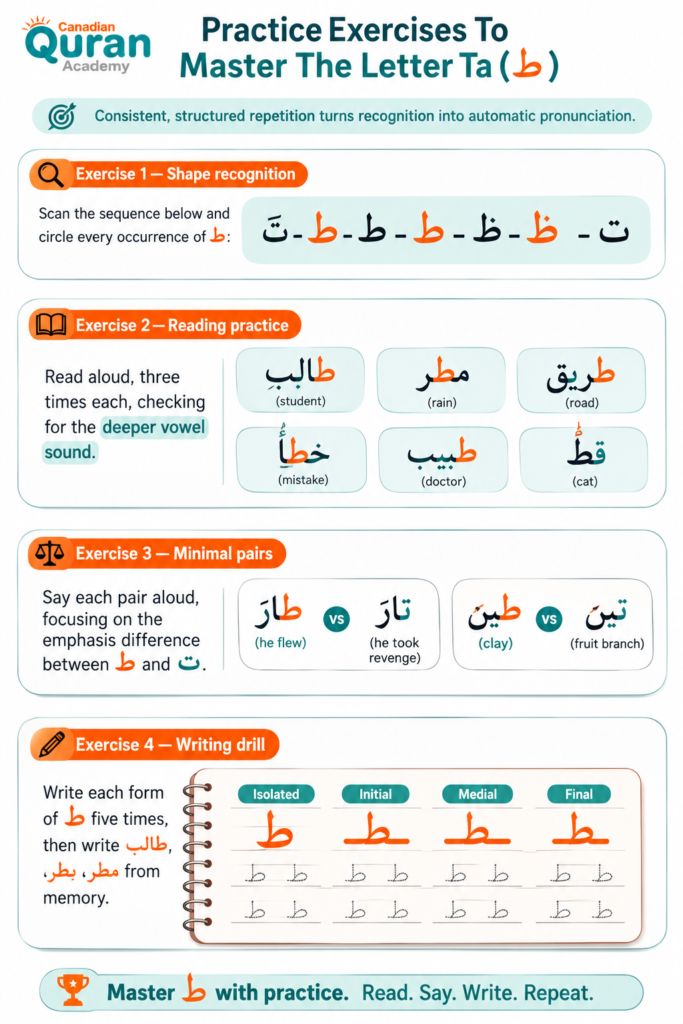
Exercise 1 — Shape recognition: Scan the sequence below and circle every occurrence of ط: ت ـط ظ طـ ـطـ ط ـظ ت ـط
Exercise 2 — Reading practice: Read aloud, three times each, checking for the deeper vowel sound described earlier: طَالِب — مَطَر — طَرِيق — خَطَأ — طَبِيب — قِطّ
Exercise 3 — Minimal pairs: Say each pair aloud, focusing on the emphasis difference between ط and ت: طَار (he flew) vs.
تَارَ (he took revenge); طين (clay) vs. a plain ت version of the same shape.
Exercise 4 — Writing drill: In a notebook, write each of the four forms of ط five times — isolated, initial, medial, final — then write طَالِب، مَطَر، بَطَل from memory without copying.
Learners who work through a full Arabic Grammar Course alongside pronunciation practice tend to retain letters like ط faster, since seeing the letter inside grammatical patterns reinforces the sound through repeated, varied exposure rather than isolated drilling.
Read Also: How To Improve Your Arabic Language Skills In Canada?
Experience Our Classrooms
Don’t just take our word for it—take a look inside! Watch the videos below to experience our engaging teaching methods and vibrant online classrooms firsthand.
Start Your Quranic Journey in Canada
Join our vibrant community and learn with expert tutors through our flexible online platform.
Claim Your Free TrialLearn The Letter Ta (ط) With Canadian Quran Academy
Reading about the letter Ta in Arabic gets you partway there. Producing it correctly, consistently, and without reverting to an English “T” under pressure takes live correction — which is exactly what a self-study guide can’t give you.

The Canadian Quran Academy pairs you with instructors trained in classical Arabic phonetics who can hear the difference between ط and ت in real time and correct it before it becomes a habit.
Our Arabic Courses:
- Online Arabic Academy
- Online Arabic Course
- Classical Arabic Course
- Arabic Course for Beginners
- Advanced Arabic Course
- Quranic Arabic Course
- Arabic Grammar Course
- Modern Standard Arabic Course
- Arabic Conversation / Speaking Course
- Intensive Arabic Course
- Online Arabic Classes for Kids

Start Your Quranic Journey in Canada
Join our vibrant community and learn with expert tutors through our flexible online platform.
Claim Your Free TrialConclusion
The letter Ta in Arabic stands apart from most consonants in the alphabet because its emphatic quality reshapes the vowels around it — a mispronounced ط doesn’t just affect one sound, it changes the character of the whole word.
Recognizing all four positional forms of ط, and understanding the makhraj and sifat that govern how it’s produced, gives you a precise, repeatable method for getting it right instead of approximating it.
Combine that with real vocabulary, minimal-pair practice, and Quranic examples, and the sound becomes automatic rather than something you have to think through every time.
Canadian Quran Academy builds exactly this kind of structured, corrected practice into every Arabic course, so learners move from recognizing the letter Ta in Arabic to producing it with confidence.

Frequently Asked Questions
The questions below cover what learners most often ask about the letter Ta in Arabic, from its sound to its role in Quranic recitation. Each answer gives you a direct response you can start applying right away.
1. What sound does the letter Ta (ط) make in Arabic?
ط makes an emphatic, “heavier” T sound produced by pressing the tongue tip against the upper teeth while raising the back of the tongue toward the soft palate. This raised-tongue quality, called Tafkheem, gives the surrounding vowels a deeper tone than a plain English “T” would.
2. How is Ta (ط) different from Taa (ت)?
ط is emphatic and ت is not, even though both share a similar tongue-tip contact point. Pronouncing ط requires raising the back of the tongue toward the palate, which produces a fuller, rounder sound than the light, flat tone of ت.
3. What is the most common mistake English speakers make with Ta (ط)?
The most frequent error is substituting a plain English “T,” which actually produces the Arabic letter ت instead of ط. The fix is raising the back of the tongue toward the soft palate before making contact with the teeth, which activates the emphatic Tafkheem quality.
4. Can adults learn to pronounce Ta (ط) correctly without a teacher?
Self-practice with minimal pairs and mirror checks can build awareness, but most adult learners correct the habit faster with live feedback, since it’s difficult to hear your own emphasis errors without an outside ear. A guided course gives that real-time correction from the first lesson.
5. What are the four written forms of the letter Ta (ط)?
The four forms are isolated (ط), initial (طـ), medial (ـطـ), and final (ـط). Across all four, ط keeps the same recognizable oval base with a vertical stroke, making it easier to identify than letters that change shape more drastically.
6. Why does the letter Ta (ط) matter in Quranic recitation?
ط is one of the emphatic letters governed by Tajweed rules, and it also opens Surah Ta-Ha as a Huroof Muqatta’ah, a disjointed letter recited by its own name. Reciting it without the correct emphatic quality is considered a Tajweed error that affects recitation accuracy.






Leave a Reply