 Quran
Most people who decide to learn the Quran begin at the wrong end. They open the Mushaf, pick a short surah, and try to memorize it — before they can pronounce a single letter from its correct articulation point.
If you want a reliable path into Quran recitation for beginners, order matters more than effort. The scholars of Qira’at settled this centuries ago: correct the tongue first, then memorize. Recitation is received from a teacher, mouth to ear, as the Prophet ﷺ received it from Jibreel.
This guide walks that path step by step: where a complete beginner starts, which Tajweed rules you need in the first months, why a qualified teacher is not optional, and how learners in Canada fit lessons around school and work.
Everything below reflects what our Ijazah-certified teachers at Canadian Quran Academy see weekly with new students, alongside the classical guidance of Imam Ibn al-Jazari and Imam Makki ibn Abi Talib.

What You Will Learn
- The correct order for beginners: letters → articulation points → guided reading → Tajweed → memorization.
- Why starting Hifz before fixing pronunciation creates errors that take years to undo.
- The five Tajweed chapters a beginner actually needs.
- What to look for in a Quran teacher, and whether self-study works.
- A realistic timeline for reading the Quran correctly.
How Beginners Should Learn Quran Recitation Step by Step
Beginners rarely struggle because the Quran is difficult. They struggle because no one gave them a sequence. This is the progression our teachers use with students who have never read an Arabic letter.
Step 1: Learn Arabic Letters and Short Vowels
Start with the Arabic alphabet in its isolated, initial, medial, and final forms, then add the harakat — fatha, kasra, damma, sukoon, and shaddah.
This is the entire purpose of Noorani Qaida, the classical primer used across the Muslim world. A structured Noorani Qaida course takes most adults six to twelve weeks and gives children a foundation they never rebuild.
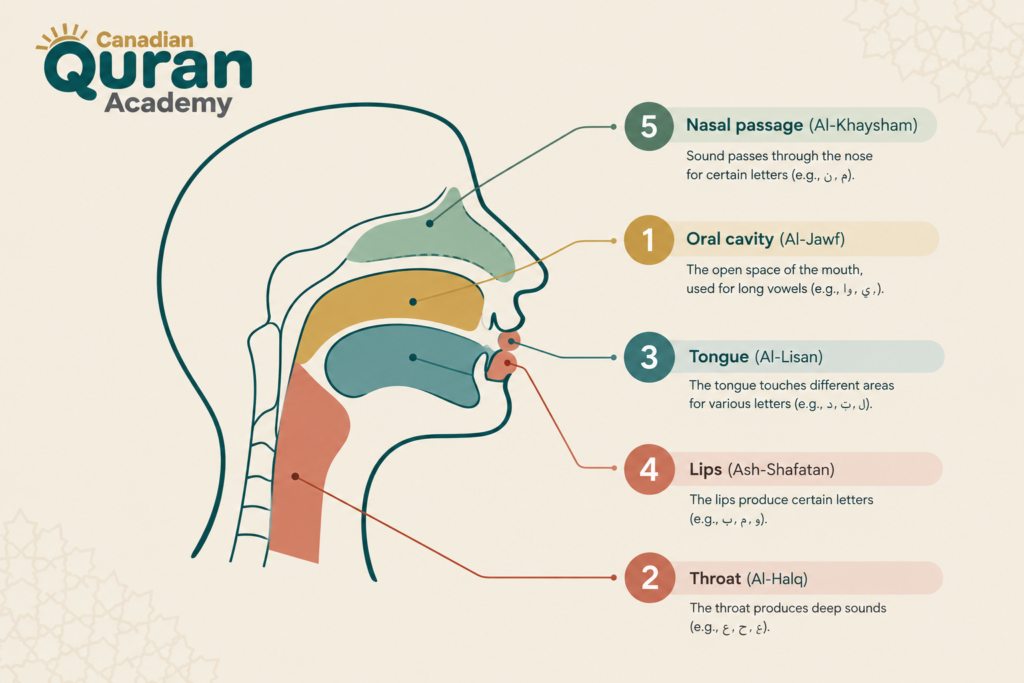
Step 2: Master the Articulation Points of Arabic Letters
Arabic has letter pairs English speakers hear as identical: ح and ه, س and ص, ت and ط, ذ and ظ. Each comes from a different point in the mouth or throat.
Getting these right protects the meaning of what you recite. Mixing up ق and ك changes words entirely — exactly the risk scholars warned about when they insisted recitation be learned by imitation, not from a page alone.
Step 3: Read Short Surahs Aloud With a Teacher
Once letters and vowels are stable, move to connected reading — Surah Al-Fatiha and the short surahs of Juz’ 30, read from the Mushaf rather than from memory.
Keeping your eyes on the text builds recognition of Quranic vocabulary while a teacher catches errors in real time. Most students find this stage far lighter than memorization, which keeps motivation high.
Step 4: Learn and Apply Tajweed Rules Gradually
Now the theory becomes useful. Introduce one ruling at a time — noon sakinah, then meem sakinah, then madd — applying each to verses you are already reading.
Learning every rule in one block and applying none is the most common problem we correct in adult Tajweed classes. Rules stick when practised inside real recitation.
Step 5: Begin Quran Memorization With Correct Pronunciation
Only now does Hifz make sense. Roughly a quarter of the Quran’s vocabulary is already familiar to you; your tongue no longer trips over unfamiliar sounds, and memorization becomes repetition rather than repair.
Read Also: The Best Way To Memorize Quran In Canada

Why Correct Quran Recitation Should Come Before Memorization
Because a memorization error is stored twice: once in the memory and once in the muscle. Undoing both is far harder than learning the first time correctly.
Allah commands in Surah Al-Muzzammil: “and recite the Quran ˹properly˺ in a measured way.” (73:4).
وَرَتِّلِ ٱلْقُرْءَانَ تَرْتِيلًا
When asked what tartil means, Ali ibn Abi Talib answered: “Tajweed of the letters and knowledge of the places of pausing.”
Put simply: not everyone must memorize the whole Quran, but everyone who recites must recite correctly. That is why our beginner track opens with recitation, not Hifz.
The Essential Tajweed Rules Every Beginner Needs
You do not need the whole science of Tajweed in your first year. Five chapters carry most of the practical weight.
- Learn Makharij and the Characteristics of Arabic Letters: The articulation points of the letters and their inherent qualities — heaviness, softness, whispering, echo. Everything else rests on this.
- Rules of noon sakinah and tanween: Four rulings: izhar (clear pronunciation), idgham (merging, with or without nasalisation), iqlab (noon becomes a light meem before ب), and ikhfa (partial hiding with a two-count nasal sound).
- Rules of meem sakinah: Three rulings: idgham when another meem follows, ikhfa shafawi before ب, and izhar shafawi before all other letters.
- Rules of madd (elongation): Natural madd is held for two counts. Secondary madd — caused by a hamza or a sukoon — stretches to four, five, or six counts, as in as-Samaa’ and ad-Daalleen.
- Rules of waqf and ibtida: Where to stop and where to resume. A pause in the wrong place can distort meaning, which is why the Mushaf carries pause marks and why this chapter is taught alongside reading practice.
Read Also: Best Online Quran Course In Canada
Why Beginners Should Learn Quran Recitation With a Qualified Teacher
Recitation is a transmitted skill, not a self-taught one. You cannot hear your own errors — that is the whole problem.
The Prophet ﷺ himself directed his Companions to specific reciters: “Take (learn) the Quran from four: Abdullah bin Mas’ud, Salim, Mu’adh and Ubai bin Ka’b” (Sahih al-Bukhari 4999).
“ خُذُوا الْقُرْآنَ مِنْ أَرْبَعَةٍ مِنْ عَبْدِ اللَّهِ بْنِ مَسْعُودٍ وَسَالِمٍ وَمُعَاذٍ وَأُبَىِّ بْنِ كَعْبٍ ”.
The chain of transmission mattered even in the first generation. So ask three questions: Do they hold an Ijazah? Can they diagnose your specific pronunciation errors? Will they listen to you recite every session? A teacher who only lectures is not teaching recitation.
Read Also: The Best Of You Are Those Who Learn Quran And Teach It
Can You Learn Quran Recitation Without a Teacher?
Partially — but not completely, and not safely. The default in Islamic scholarship is learning from a proficient teacher. When one is genuinely unavailable, the recognised alternatives are recorded Tajweed lessons, the Mushaf Mu’allim (teaching Mushaf), and online recitation circles. Islamweb’s fatwa is explicit: use these only if a teacher cannot be reached, never in place of one who is available.
Most of our students use a middle path. Self-study handles theory — a beginner-friendly Tajweed book, daily listening to precise reciters such as Al-Husary or Al-Minshawi, and a colour-coded Tajweed Mushaf. Then they bring the recitation itself to a teacher for correction.
Quran Recitation Tips for Beginners in Canada
Canada adds two real constraints: limited access to local halaqas outside major cities, and schedules split across school, work, and time zones. These habits work around both.
- Recite aloud daily, even for ten minutes: Silent reading builds no muscle memory; volume is what trains the tongue.
- Keep a fixed daily portion (wird): Students who hold a little daily wird progress roughly twice as fast as weekend crammers.
- Prepare before your lesson: so class time is spent correcting rather than decoding.
- Listen to one reciter repeatedly: Choose accuracy over melody, and let your ear absorb the pattern before your tongue attempts it.
- Match the format to the learner: Children need short, frequent sessions; adults usually do better with longer sessions twice a week.
Our Quran recitation course is structured separately for both, with female teachers available for sisters and girls.
Read Also: Quran Teacher On Skype In Canada
How Long Does It Take a Beginner to Recite the Quran Correctly?
With two to three lessons per week and daily practice, most adults read from the Mushaf with basic accuracy within six to nine months. Children who start young often get there faster.
Applied Tajweed — rules flowing naturally rather than consciously — typically takes twelve to eighteen months. Mastery leading toward an Ijazah is a multi-year commitment.
These ranges assume one thing: a teacher who listens to you recite every session. Progress without correction is not progress.
Live Class in Action
Watch how our instructors interact with students in real-time, focusing on interactive methods.
Start Your Quranic Journey in Canada
Join our vibrant community and learn with expert tutors through our flexible online platform.
Claim Your Free TrialStart Reciting the Quran Correctly — Book Your Free Trial Class Today
Every lesson is one-to-one, so nothing is missed and nothing is rushed. Your teacher listens to you recite in each session, corrects the letters as you say them, and keeps a written record of your progress so you always know what to work on next. Beginners follow a clear plan from the alphabet to fluent recitation — and you can change your schedule or your teacher at any time.
Stop guessing whether you are pronouncing the letters correctly. In one session, an Ijazah-certified teacher can tell you exactly where your recitation stands and what to fix first.
Canadian Quran Academy offers one-to-one Tajweed and recitation classes for children, adults, and sisters across every Canadian time zone — native Arabic-speaking teachers, male and female instructors, flexible scheduling, and a curriculum that starts exactly where you are.
Our Quran Courses
- Quran Online Academy
- Quran Recitation Classes
- Quran Reading Classes
- Online Quran Classes for Kids
- Quran Classes for Adults
- Quran Classes for Female
- Learn Quran Course for Beginners
- Quran Memorization (Hifz) Course
- Hifz Classes for Adults
- Quran Memorization and Hifz Course for Kids
- Quran Hifz Course for Ladies
- Quran Ijazah Program
- Quran Qirat Learning Course
- Quran Tafsir Course
- Noorani Qaida Course
- Noorani Qaida Course for Kids
- Weekend Quran Classes
- Intensive Quran Course
- Al-Azhar Quran Course
- Online Tajweed Classes
- Tajweed Course for Kids
- Tajweed Course for Adults
- Tajweed Course for Ladies
Your first class is free. Book your free trial lesson and start on the correct foundation.

Conclusion
The path into Quran recitation for beginners is not complicated, but it is ordered: learn the letters, fix your articulation points, read aloud with a teacher listening, layer in Tajweed rules gradually, and only then begin memorization.
Skipping those steps to reach Hifz faster is the most expensive shortcut in Quranic learning. Errors learned early become habits, and habits become the recitation you carry for life.
Take-away message: correct recitation is an individual obligation on every Muslim who recites; memorizing the entire Quran is not. Start where the obligation is — a qualified teacher, a small daily portion, and patience.
FAQs
Where should a complete beginner start with Quran recitation?
Start with the Arabic letters and short vowels through Noorani Qaida, then move to letter articulation points. Only after that should you attempt connected reading from the Mushaf with a teacher listening.
Can I learn Quran recitation online as effectively as in person?
Yes, for one-to-one recitation. What matters is that a qualified teacher hears you recite and corrects you in real time — which a live online session provides. Recorded videos alone cannot do this.
Do I need to learn Arabic before learning Quran recitation?
No. Reciting requires reading the Arabic script and pronouncing it correctly, not understanding grammar. Many students learn recitation first and study Arabic later, though basic Arabic does make progress smoother.
Am I too old to learn Quran recitation?
No. Adults often learn faster than children because they concentrate better and understand rules conceptually. Several Companions of the Prophet ﷺ learned the Quran after embracing Islam later in life.
What if I recite with difficulty and make many mistakes?
Keep going. The Prophet ﷺ said that one who recites the Quran with difficulty, stammering over it, receives two rewards (Sahih Muslim 798). Struggle is part of the process, not a sign you should stop





Leave a Reply