 Quran
Quran

Ask five huffaz how they finished the Quran, and you will hear five different routines — but almost never five different principles. The methods vary. The foundations don’t.
That gap is where learners get stuck. If you are searching for the best way to memorize the Quran in Canada, you are rarely short on motivation — you are short on a system that survives a Canadian week: school runs, shift work, and a Fajr time that moves nearly four hours between June and December.
Below are the Quran memorization methods teachers actually use, where Tajweed fits in, and how to build a home routine you can hold for years.

Muslim student in Canada memorizing Quran from an open Mushaf during an online Hifz class.
1. The Sequential Method (Al-Hifz At-Tasalsuli)
Repeat verse one about twenty times until it is solid, then recite it from memory. Memorize verse two the same way, then join both and recite them together three times. Add verse three, join all three, and continue like that to the end of your daily portion.
The point is that every new verse gets attached to the chain before you move on. This is the safest choice for a first-time memorizer and for long surahs where verses run into each other. It is the slowest of the seven, and it produces the most durable result — the links between verses are built in from day one rather than patched on later.
Who Is This Method Suitable For?
This method is especially valuable when accuracy between verses is a priority. By building the passage as one connected unit, it helps prevent hesitation when moving from one ayah to the next. It is particularly suitable for beginners who are still developing confidence in continuous recitation.
2. The Cumulative Method (Al-Hifz At-Tajmi’i)
Memorize each verse on its own without joining anything, read the full portion from the Mushaf several times, then recite the whole thing from memory. The linking happens once at the end instead of continuously.
This suits experienced memorizers with strong recall who want to cover more ground per session. The risk is specific rather than vague: short verses drop out unnoticed, which makes it a poor fit for surahs like Ash-Shu’ara or Ar-Rahman where verses are brief and structurally similar. Never make it your first method.
What Is The Advantage Of The Cumulative Method?
The main advantage of this approach is efficiency, making it useful when a learner already has a reliable memorization foundation. It gives confident students greater flexibility to work through larger portions without stopping after every verse. It is best reserved for learners who can recognize and correct their own weak spots during revision.
3. The Segmented Method
Select a few verses that share a single meaning, read a brief tafsir of them, then repeat them at least twenty times with full concentration. The next day, review from the beginning of the surah before adding anything new.
Meaning is the anchor here rather than sound, which is why the tafsir step is not optional. It is built for older adults, for learners returning after years away, and for anyone who forgets quickly. Progress per page is slower, but it holds far better for a memory that no longer absorbs through repetition alone.
This approach is important because understanding can give memorization a stronger mental framework. Connecting verses to their meaning can make the passage easier to recall and can also deepen the learner’s relationship with what they are memorizing. It is a good option for learners who benefit from reflection and context rather than relying on repetition alone.
Read Also: Best Online Quran Course In Canada
4. The Five Fortresses Method
A full daily system rather than a single technique, used in structured hifz programs where students have real time to give. Five activities run every day, each protecting the memorization from a different angle.
| Fortress | What it involves | Daily time |
| Continuous reading | Read up to two juz’ | ~40 min |
| Preparation | Listen to and read tomorrow’s page tonight | ~30 min |
| New memorization | One page, repeated with focus | ~15 min |
| Near review | The 20 pages before today’s | ~20 min |
| Far review | Everything older, weekly rotation | Varies |
Preparation is the strongest fortress: students who read and listen to a page the night before memorize it in a fraction of the time the next morning. The catch is the total commitment, which runs close to two hours a day. If you work full time, scale each fortress down rather than dropping one entirely.
The importance of this system lies in treating Quran memorization as an ongoing process rather than something completed when a new page is learned. Each part of the routine supports a different stage of retention, helping students maintain what they have already memorized while continuing to progress. It is most suitable for learners who can follow a consistent daily schedule.
5. The Twenty-Repetition Method
Attributed to Shaykh Abdul Muhsin Al-Qasim. Read verses one to four twenty times each, then all four together twenty times to link them. Repeat with verses five to eight, then read all eight together twenty times. Do not exceed one-eighth of a juz’ in a day.
This suits learners who stall without a fixed number to hit, because the count removes the daily judgement call about whether a verse is solid enough yet. It works particularly well for teenagers and for adults memorizing alone. Repetition here is not for memorizing but for not forgetting, so resist cutting the count once a verse starts to feel easy.
A fixed repetition structure can make memorization more disciplined and measurable. Instead of relying on how confident a verse feels at a particular moment, the learner follows a consistent standard before moving forward. This can be especially helpful for independent students who need a clear routine to keep their memorization sessions focused.
Read Also: The Best Of You Are Those Who Learn Quran And Teach It
6. The Talqeen Method: Listen, Repeat, Connect
The teacher recites a verse, the student repeats it until fluent, then the two verses are joined and recited together. This is the oldest transmission method in Islamic scholarship — the way the Prophet ﷺ received the Quran and the way he taught it to his Companions.
It is the most accurate method available, because the correction lands in the same second as the mistake rather than days later. It also requires no reading ability at all, which makes it the right choice for young children, new Muslims, and anyone still working through Noorani Qaida. Its only real limit is availability: it works only with a teacher present, in person or live online.
Its greatest importance is the direct connection between memorization and accurate oral recitation. A qualified teacher can identify pronunciation, articulation, and rhythm issues that may not be noticeable when studying alone. For learners who want their memorization to develop alongside correct recitation, regular teacher-led practice offers a strong foundation.
7. The Three-Part Daily Cycle: Sabaq, Sabqi, Manzil
Every session splits three ways — sabaq is the new memorization, sabqi is the recent pages from the past week, and manzil is the older completed portions. This is the standard structure in madrasahs across South Asia and is now common in online hifz programs.
A workable ratio for a part-time learner is five lines of new material, one page of recent review, and three to five pages of older revision. It suits anyone who has already memorized a few juz’ and is starting to feel ground slipping away. Students who quietly drop the manzil portion are the ones who lose their hifz.
The strength of this cycle is its balance between progress and preservation. It prevents a learner from becoming so focused on new pages that previously memorized portions receive too little attention. This makes it particularly suitable for anyone building a long-term Hifz routine and wanting to keep earlier portions active as the memorized Quran grows.
The Sabaq, Sabqi, and Manzil system has also been examined in contemporary research on Quran memorization, where the three stages are described as new memorization, reinforcement of recent material, and continuous review of older portions.
Live Class in Action
Watch how our instructors interact with students in real-time, focusing on interactive methods.
Start Your Quranic Journey in Canada
Join our vibrant community and learn with expert tutors through our flexible online platform.
Claim Your Free TrialWhat is The Best Way to Memorize Quran in Canada?
The best way to memorize Quran in Canada is a small daily portion, recited aloud, corrected by a qualified teacher, and reviewed more often than it is added to. That sentence is the whole system; everything else is scheduling.
Get these four foundations in place before comparing techniques — skipping them is the most common reason learners restart.
1. One Mushaf, Start to Finish
Choose a single printed Mushaf and never change it. Memorization leans on visual memory — where a verse sits on the page, which line it starts on.
Most students use the Madinah (Uthmani) Mushaf, where each page begins and ends with a complete verse. Switching editions scrambles that map. Avoid memorizing from a phone, where the layout reflows and notifications break your concentration.
2. Correct Recitation Comes First
Read the page correctly before you commit it to memory. A memorized mistake is far harder to remove than one caught on day one.
Self-taught learners skip this step most often, which is why a teacher is not optional. Our Tajweed and recitation circles at Canadian Quran Academy exist for exactly this — you correct the page with a certified reciter before memorizing it, not after.
3. A Teacher You Recite To Regularly
The Quran was transmitted orally, teacher to student, in an unbroken chain from the Prophet ﷺ. Reciting to a teacher — ideally one holding an ijazah — catches errors you cannot hear in yourself.
For families outside major Muslim centres, live online halaqas make that accessible in every province.
In addition, the teacher can monitor your progress and motivate you if you feel your enthusiasm waning. They can employ engaging strategies to make memorization easier and provide the right tools to help you improve.
Read Also: Quran Teacher On Skype In Canada
Do You Have to Memorize the Quran With Tajweed?
Yes, with one distinction. Reciting without clear errors that change letters or meanings (lahn jali) is obligatory, and that applies to memorized recitation. Mastering the finer rules of Tajweed as a science is strongly recommended and expected of a hafiz — but you need not finish a Tajweed course before you start.
Ibn al-Jazari’s line in his Muqaddimah states that applying Tajweed is binding, which scholars have understood as referring to those clear, meaning-altering errors.
So learn Tajweed alongside your hifz. Memorizing a juz’ with wrong pronunciation means learning it twice.
How to Memorize the Quran With Tajweed?
Learning both at once sounds like double work. In the right order, it is less — you memorize each page only once.
1. Listen to One Reciter Per Page
Before memorizing, listen to the page three to five times from one precise reciter. Al-Husary and Al-Minshawi are widely used in teaching because their articulation is deliberate.
Keep one reciter per page: your ear stores rhythm alongside words, and mixing voices weakens that recall cue.
2. Recite Aloud, Slowly, Every Time
Silent memorization produces students who know a page perfectly until they recite it aloud and stumble.
Reciting aloud engages tongue and hearing, exposes mispronunciations, and trains you for the real purpose of hifz — reciting in salah and for others.
3. Get Corrected Before the Page Sets
Recite the new page to a teacher within a day or two, while it is still flexible. Mark every corrected word, re-read those words two or three times, then recite from memory again.
Our Tajweed halaqas and Arabic classes are built around this loop — short sessions, certified teachers, same-day correction — at separate levels for children and adults. Learners who study Arabic alongside hifz memorize faster, because meaning gives the mind something to hold sound besides.
Read Also: Quran Recitation For Beginners
How to Hifz Quran at Home?
Home hifz succeeds or fails on structure, not willpower. Here is how to build a routine that survives a Canadian school year.
1. Anchor Sessions to Prayer Times
The strongest memorization window is before or just after Fajr, when the mind is clearest and interruptions are fewest.
Because Canadian prayer times shift so much by season, anchor your session to the prayer, not the clock. “After Fajr” survives June and December; “5:30 a.m.” does not. Add a shorter review slot after Maghrib.
2. Start Smaller Than You Think
Begin with half a page daily, six days a week. At that pace, with disciplined review, the full Quran is realistic in roughly four to five years.
Increase your portion only when you can recite all previous memorization accurately. If old pages are slipping, that is the signal to stop adding — not to push harder.
3. Review More Than You Memorize
This rule separates a hafiz from someone who once memorized. The Prophet ﷺ warned that the Quran slips away faster than tethered camels escape.
Split review into two. Near past is the 5 pages before today’s, reviewed daily, growing to 10 and then 20. Far past is everything older, about 10 pages daily on rotation.
Scholars have long cited the standard that whoever reviews all their memorization within seven days will not forget it. If your day gets cut short, cut the new memorization — never the review.
4. Recite to Someone and Keep a Log
Memorizing alone is the most common home-hifz mistake. Pair with a qarin at a similar level and recite to each other daily; for children, a parent holding the Mushaf works well even if they are not a hafiz.
Track three things daily: pages memorized, pages reviewed, words corrected. Written progress is the best defence against the plateau that hits around the third juz’.
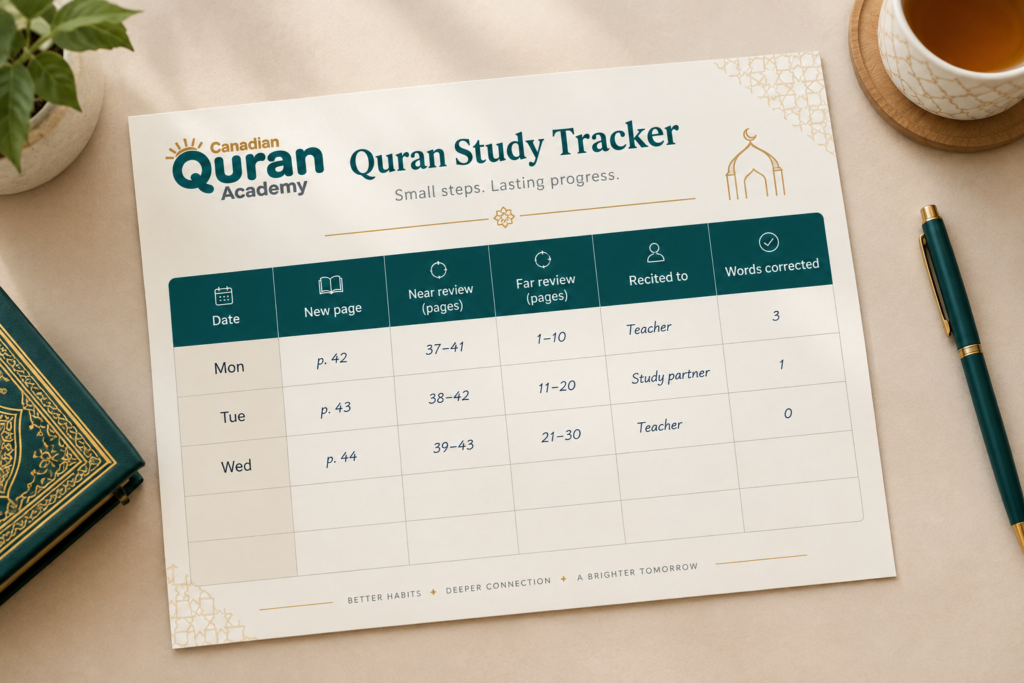
Daily hifz schedule and review tracker for memorizing Quran at home
Experience Our Classrooms
Don’t just take our word for it—take a look inside! Watch the videos below to experience our engaging teaching methods and vibrant online classrooms firsthand.
Start Your Quranic Journey in Canada
Join our vibrant community and learn with expert tutors through our flexible online platform.
Claim Your Free TrialStart Your Hifz Journey With a Certified Teacher This Week
Structure is what turns intention into a completed hifz. Canadian Quran Academy runs live one-on-one Tajweed circles, Quran recitation halaqas, and Arabic classes for children and adults across every Canadian time zone — with certified teachers who correct your recitation the same day you memorize it.
Pick your schedule, get placed at your real level, and start with a free trial.
Our Quran Courses
- Quran Online Academy
- Quran Recitation Classes
- Quran Reading Classes
- Online Quran Classes for Kids
- Quran Classes for Adults
- Quran Classes for Female
- Learn Quran Course for Beginners
- Quran Memorization (Hifz) Course
- Hifz Classes for Adults
- Quran Memorization and Hifz Course for Kids
- Quran Hifz Course for Ladies
- Quran Ijazah Program
- Quran Qirat Learning Course
- Quran Tafsir Course
- Noorani Qaida Course
- Noorani Qaida Course for Kids
- Weekend Quran Classes
- Intensive Quran Course
- Al-Azhar Quran Course
- Online Tajweed Classes
- Tajweed Course for Kids
- Tajweed Course for Adults
- Tajweed Course for Ladies

Conclusion
The best way to memorize Quran in Canada is not a secret technique. It is a small, protected daily habit built on four foundations: consistency, one Mushaf, correct recitation before memorization, and a teacher who hears you regularly.
From there, pick your method — sequential for beginners, twenty-repetition for strict structure, segmented for older learners. Learn Tajweed alongside your hifz, and anchor sessions to prayer times so shifting Canadian daylight never breaks the routine.
Takeaway Message: Memorize less, review more, and never memorize a page you haven’t had corrected. Consistency, not intensity, finishes the Quran.
FAQs
How long does it take to memorize the whole Quran?
Four to five years. Most students memorizing half a page daily with consistent review finish in that time. Full-time programs can do it in two to three years; adults balancing work often take five to seven.
Do I need to know Arabic to memorize the Quran?
No. Memorization depends on correct pronunciation, not comprehension, and many huffaz are not Arabic speakers. That said, learners studying Arabic alongside hifz memorize faster and confuse similar verses less often.
What is the best age for a child to start hifz?
Most teachers begin structured memorization between ages six and ten, once a child reads Arabic letters fluently. Before that, short surahs learned by listening build the foundation without pressure.
What should I do if I keep forgetting what I memorized?
Stop adding new pages and review only, for two to four weeks. Forgetting is almost always a review problem, not a memory problem. Aim to cycle through everything you know within seven days.
Can I do hifz online in Canada?
Yes. Live one-on-one classes replicate the essential element of traditional hifz — reciting to a qualified teacher who corrects you — and are often more consistent for families managing commutes or shift work.







Leave a Reply