 Arabic
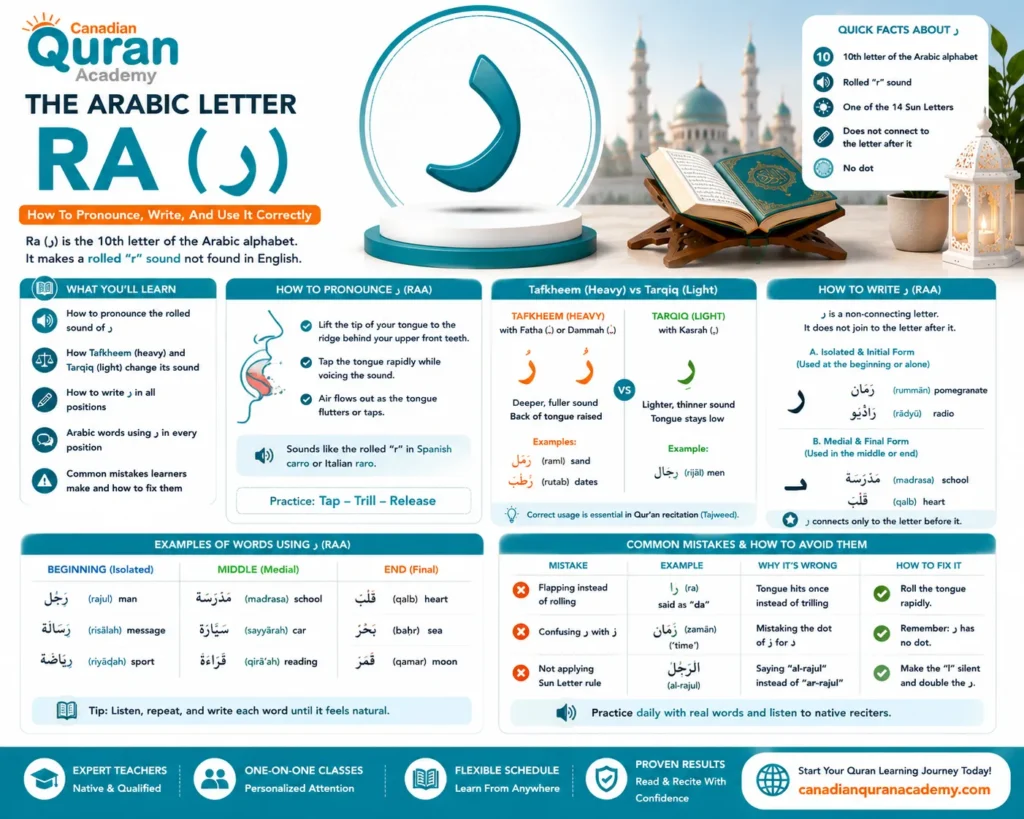
The ر – Arabic letter ra is the tenth letter of the Arabic alphabet and one of the first “rolled” sounds new learners encounter.
At Canadian Quran Academy, students often tell us this letter feels tricky at first because English has nothing quite like it — but once you understand the tongue movement and the letter’s writing rules, the ر – Arabic letter ra becomes one of the easiest letters to recognize on the page.
This guide walks you through exactly how to pronounce ر, how to write it in every position it can appear, the vocabulary you need to start using it, and the mistakes that slow most beginners down. By the end, you’ll be able to read, write, and say ر with confidence.
What you’ll learn in this article
- How to correctly pronounce the rolled sound of the ر – Arabic letter ra
- How ر changes between a heavy sound (Tafkheem) and a light sound (Tarqiq)
- How to write ر in its isolated, initial, medial, and final forms
- Real Arabic words using ر in every position, with pronunciation and meaning
- The most common mistakes learners make with this letter, and how to fix them
What Is The Arabic Letter ر (Raa)?
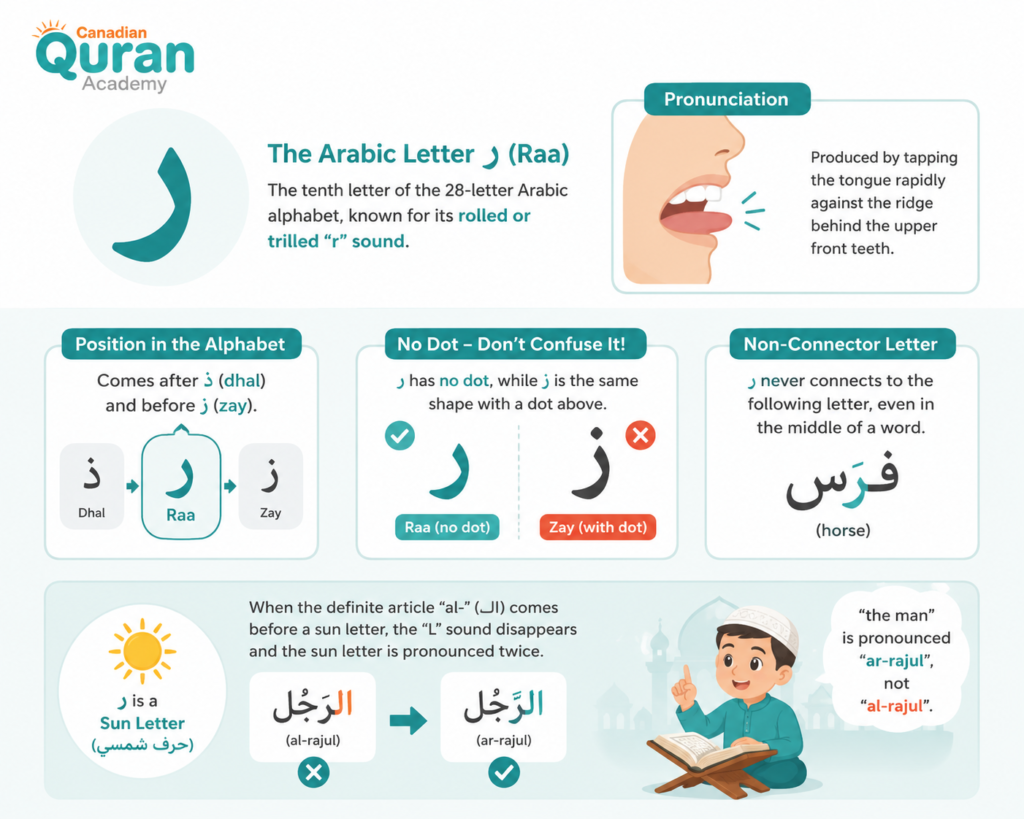
The Arabic letter ر (Raa) is the tenth letter of the 28-letter Arabic alphabet, positioned between ذ (dhal) and ز (zay). It represents a rolled or trilled “r” sound, produced by tapping the tongue rapidly against the ridge behind the upper front teeth.
Two features make ر distinctive among Arabic letters. First, it has no dot, unlike its neighbor ز, which is the same basic shape with a dot added above it — a detail worth remembering, since mixing up ر and ز is one of the most common beginner errors.
Second, ر is a non-connector letter, meaning it never joins to the letter that follows it, even in the middle of a word.
ر is also classified as a Sun Letter (حرف شمسي) in Arabic grammar. When the definite article “al-” (الـ) comes before a sun letter, the “L” sound disappears and the sun letter is pronounced twice instead. That’s why “the man” (الرجل) is pronounced “ar-rajul,” not “al-rajul” — the ل is absorbed into the ر that follows it.
Read Also: Letter D In Arabic د
How To Pronounce The Letter ر (Raa) Correctly?
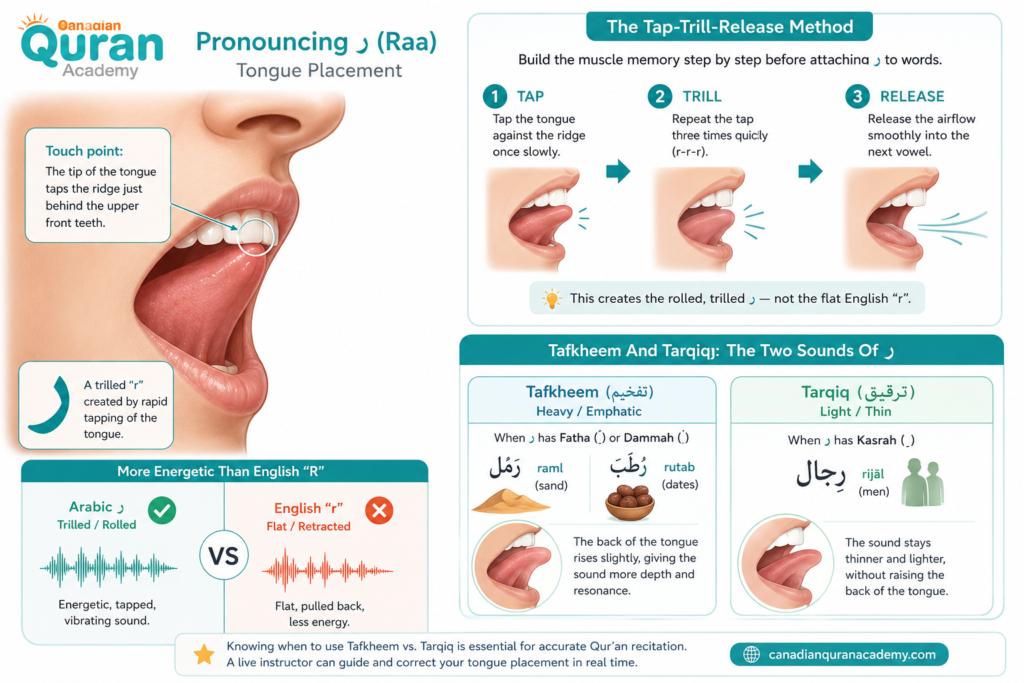
Pronouncing the ر – Arabic letter ra starts with the tip of the tongue, not the throat or the back of the mouth. Lift the tip of your tongue to lightly touch the ridge just behind your upper front teeth — the same spot English speakers use for a soft “d” or “t” sound.
As you push air out while voicing the sound, let the tongue flutter or tap rapidly against that ridge. This rapid tapping is what creates the trilled quality of ر, similar to the rolled “r” in Spanish “carro” or Italian “raro.”
It is noticeably more energetic than the flat, retracted “r” used in English words like “run” or “road.”
A practical way to build this muscle memory is what we call the tap-trill-release method at Canadian Quran Academy: tap the tongue against the ridge once slowly, then repeat the tap three times in quick succession without lifting the tongue too far away, then release the airflow smoothly into the next vowel.
Practicing this in isolation, before attaching ر to full words, prevents the flattened English-style “r” that many beginners default to under pressure.
Tafkheem And Tarqiq: The Two Sounds Of ر
In Tajweed, ر does not always sound identical — it shifts weight depending on the vowel around it. This is called Tafkheem (تفخيم), the heavy or emphatic pronunciation, and Tarqiq (ترقيق), the light pronunciation.
Tafkheem applies when ر carries a Fatha (an “a” sound) or a Dammah (a “u” sound), such as in raml (رَمل, sand) or rutab (رُطَب, dates). The back of the tongue rises slightly, giving the sound more depth and resonance.
Tarqiq applies when ر carries a Kasrah (an “i” sound), such as in rijāl (رِجال, men). Here the sound stays thinner and lighter, without the raised back-of-tongue quality.
Recognizing which version to use is a core Tajweed skill, and it’s a detail many self-study apps skip entirely — but it’s essential if your goal includes reciting the Qur’an accurately, since misapplying Tafkheem and Tarqiq changes how a word is traditionally recited.
If you want direct feedback on getting this distinction right, a live instructor in our Arabic Conversation / Speaking Course can correct your tongue placement in real time, which is difficult to self-diagnose from a video alone.
How To Write The Letter ر (Raa) In Its Different Forms?
Because the ر – Arabic letter ra never connects to the letter after it, it only has two visual shapes to learn instead of the four that most connecting letters require. Both shapes are a simple curved stroke: start at the baseline, move the pen in a small downward curve, and sweep slightly to the left, like drawing a soft hook.
A. The isolated and initial forms
When ر stands alone or begins a word, it takes its full independent shape: ر. You’ll see this shape in words like رمان (rummān, pomegranate) and راديو (rādyū, radio).
Since ر doesn’t connect forward, its “initial” form looks identical to its isolated form — there’s no separate letterform to memorize here, which is one less rule than most other Arabic letters require.
B. The medial form
In the middle of a word, ر connects to the letter before it but still doesn’t reach forward. You’ll see it written as ـرـ, hanging off the previous letter’s connector stroke, as in شجرة (shajarah, tree) or فراشة (farāshah, butterfly).
C. The final form
At the end of a word, ر connects only to what comes before it, appearing as ـر. Examples include مطر (maṭar, rain) and أحمر (aḥmar, red). Visually, the final form and the medial form look almost the same — the only real difference is that nothing follows it.
If you’re teaching this letter to a child, the “no dot, no forward connection” rule is usually the fastest way to help it stick.
Our Online Arabic Classes for Kids use exactly this kind of pattern-recognition approach, pairing each letter with tracing practice and short, high-frequency words so children build writing muscle memory alongside pronunciation.
Read Also: The Arabic Letter Jeem (ج)
Live Class in Action
Watch how our instructors interact with students in real-time, focusing on interactive methods.
Start Your Quranic Journey in Canada
Join our vibrant community and learn with expert tutors through our flexible online platform.
Claim Your Free Trial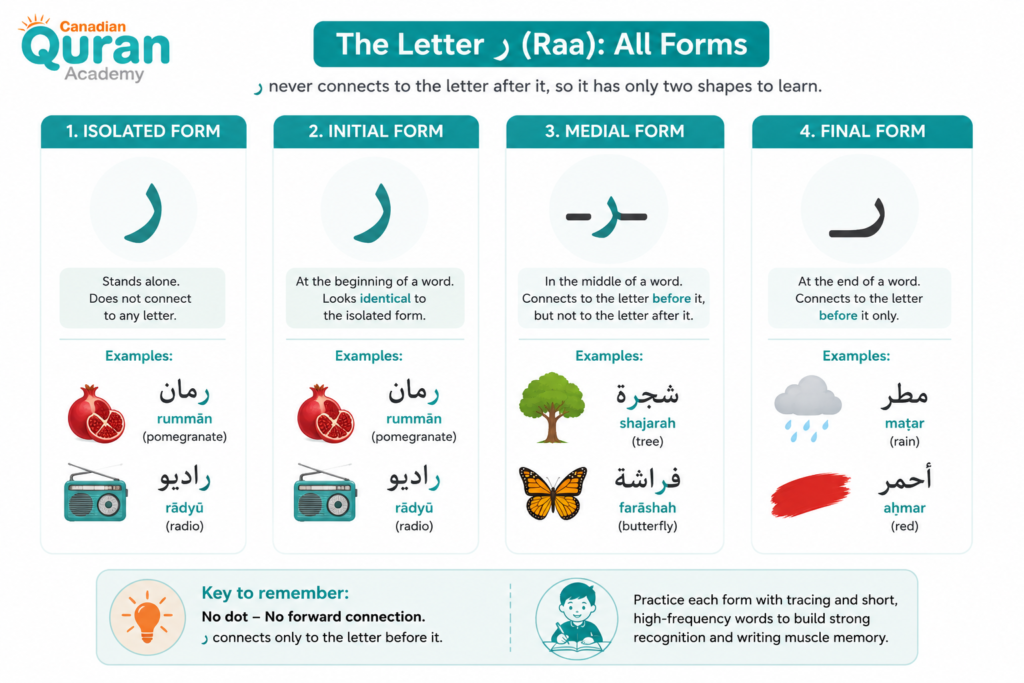
Common Words With The Letter ر In Each Position
Seeing the ر – Arabic letter ra inside real vocabulary is what makes the shape and sound memorable. Here are words organized by where ر appears in the word.
Words with ر at the beginning:
- رَمل (raml) — sand: “The children played in the sand” (لعِبَ الأطفالُ في الرَّملِ)
- رسم (rasm) — drawing: “The students love the drawing class” (يحِبُّ الطُّلابُ حِصّةَ الرَّسمِ)
- ريف (rīf) — countryside: “My grandmother lives in the countryside” (تَعيشُ جَدَّتي في ريف المَدينة)
- راية (rāyah) — flag: “The flag is red” (لونُ الرّايةِ أحمر)
- رياضة (riyāḍah) — sport: “Playing sports is good for health” (الرّياضةُ مُفيدةٌ لِلصِّحةِ)
Words with ر in the middle:
- شجرة (shajarah) — tree
- فراشة (farāshah) — butterfly
- سبورة (sabbūrah) — blackboard
- قمر (qamar) — moon
- بحر (baḥr) — sea
Words with ر at the end:
- مطر (maṭar) — rain
- أحمر (aḥmar) — red
- سكر (sukkar) — sugar
- تمر (tamr) — dates
- عصفور (ʻuṣfūr) — bird
Notice that several of these words — qamar, baḥr, tamr — place ر right after a consonant with no vowel between them (a sukūn), which is exactly the kind of cluster that trips up learners who haven’t drilled the trill in isolation first.
Building a working vocabulary like this is faster with structured, guided repetition rather than word lists alone, which is the format used throughout our Intensive Arabic Course for students who want to move past single letters into full conversational fluency.
Read Also: The Arabic Letter Waw (و)
Common Mistakes To Avoid When Learning ر (Raa)
Most learners run into the same handful of problems with this letter, and knowing them in advance saves weeks of reinforcing a bad habit.
The first mistake is flattening the trill into an English-style “r.” Because English has no rolled “r,” learners often substitute the familiar sound instead of tapping the tongue. The fix is deliberate isolation practice — say ر on its own, exaggerated, before ever placing it in a word.
The second mistake is applying Tafkheem everywhere, giving every ر a heavy sound regardless of the vowel. This is common among learners who picked up the “emphatic” version first because it sounds more dramatic, but it distorts words like rijāl (men) into an unnatural pronunciation.
The third mistake is forgetting the sun letter rule and pronouncing the “L” in الـ before a word starting with ر. Saying “al-rajul” instead of “ar-rajul” is a small error, but it’s one that immediately signals a non-native reading pattern.
The fourth mistake is confusing ر with ز, since the two letters share an identical base shape and differ only by the dot above ز. Slowing down to check for the dot before reading a word aloud prevents this mix-up entirely.
Adults returning to Arabic after years away, and women learning in a dedicated class setting, often find these habits easier to correct with focused, judgment-free repetition rather than solo study.
That’s the structure behind both our Arabic Classes for Adults and our Arabic Classes for Ladies, where an instructor listens for exactly these patterns and corrects them before they become permanent habits.
Experience Our Classrooms
Don’t just take our word for it—take a look inside! Watch the videos below to experience our engaging teaching methods and vibrant online classrooms firsthand.
Start Your Quranic Journey in Canada
Join our vibrant community and learn with expert tutors through our flexible online platform.
Claim Your Free TrialStart Speaking Arabic With Confidence Today
Reading about ر is a start, but pronunciation only becomes automatic through correction from someone who can hear the difference between Tafkheem and Tarqiq in real time.
Canadian Quran Academy pairs every student with a live instructor who tracks these details from the very first Arabic letter through full conversational fluency, whether you’re a complete beginner, a parent enrolling your child, or an adult picking Arabic back up after years away.

Our Arabic Courses:
- Online Arabic Academy
- Online Arabic Course
- Classical Arabic Course
- Arabic Course for Beginners
- Advanced Arabic Course
- Quranic Arabic Course
- Arabic Grammar Course
- Modern Standard Arabic Course
- Arabic Conversation / Speaking Course
- Intensive Arabic Course
- Online Arabic Classes for Kids

Start Your Quranic Journey in Canada
Join our vibrant community and learn with expert tutors through our flexible online platform.
Claim Your Free TrialConclusion
The Arabic letter ر (Raa) is the tenth letter of the Arabic alphabet, written as a simple downward curve that never connects to the letter following it.
Mastering it means learning three things together: the rolled tongue-tap pronunciation, the shift between Tafkheem and Tarqiq depending on the vowel, and the two visual shapes ر takes depending on its position in a word.
Practice it through real vocabulary — words like raml, qamar, and maṭar — rather than the letter in isolation, and the sound will settle into your speech far faster.
With consistent, corrected practice, the ر – Arabic letter ra moves from being one of the more intimidating Arabic sounds to one of the most recognizable letters on the page, and Canadian Quran Academy’s instructors are here to guide that practice at every step.

Frequently Asked Questions About The Arabic Letter ر (Raa)
Here are direct answers to the questions learners ask most often about the letter ر, mined from real search patterns and the details this guide didn’t fully cover above.
1. What does the letter ر sound like in Arabic?
The letter ر sounds like a rolled or trilled “r,” produced by rapidly tapping the tongue against the ridge behind the upper front teeth. It’s similar to the rolled “r” in Spanish or Italian, and noticeably more energetic than the English “r.”
2. Does ر connect to the letter after it?
No.
ر is a non-connector letter, meaning it never joins to the letter that follows it in a word, even though it can still connect to the letter before it. This gives it only two shapes to learn instead of four.
3. How many written forms does ر have?
ر has only two written forms: an isolated/initial shape (ر) used alone or at the start of a word, and a connected shape (ـر) used in the middle or at the end of a word after connecting to the previous letter.
4. What is the easiest way to stop mispronouncing ر?
Practice the sound in isolation before placing it in words, tapping the tongue against the ridge several times in a row to build the trill as a reflex. Getting direct feedback from a live instructor speeds this up significantly compared to self-study alone.
5. What is the difference between Tafkheem and Tarqiq for ر?
Tafkheem is the heavy, emphatic pronunciation of ر, used when it carries a Fatha or Dammah vowel. Tarqiq is the lighter pronunciation, used when ر carries a Kasrah vowel. The distinction matters most for accurate Qur’an recitation.
6. Why is ر called a Sun Letter?
ر is a Sun Letter because when the definite article “al-” (الـ) precedes it, the “L” sound is dropped and ر is pronounced twice instead. This is why الرجل is read as “ar-rajul,” not “al-rajul.”






Leave a Reply