 Arabic
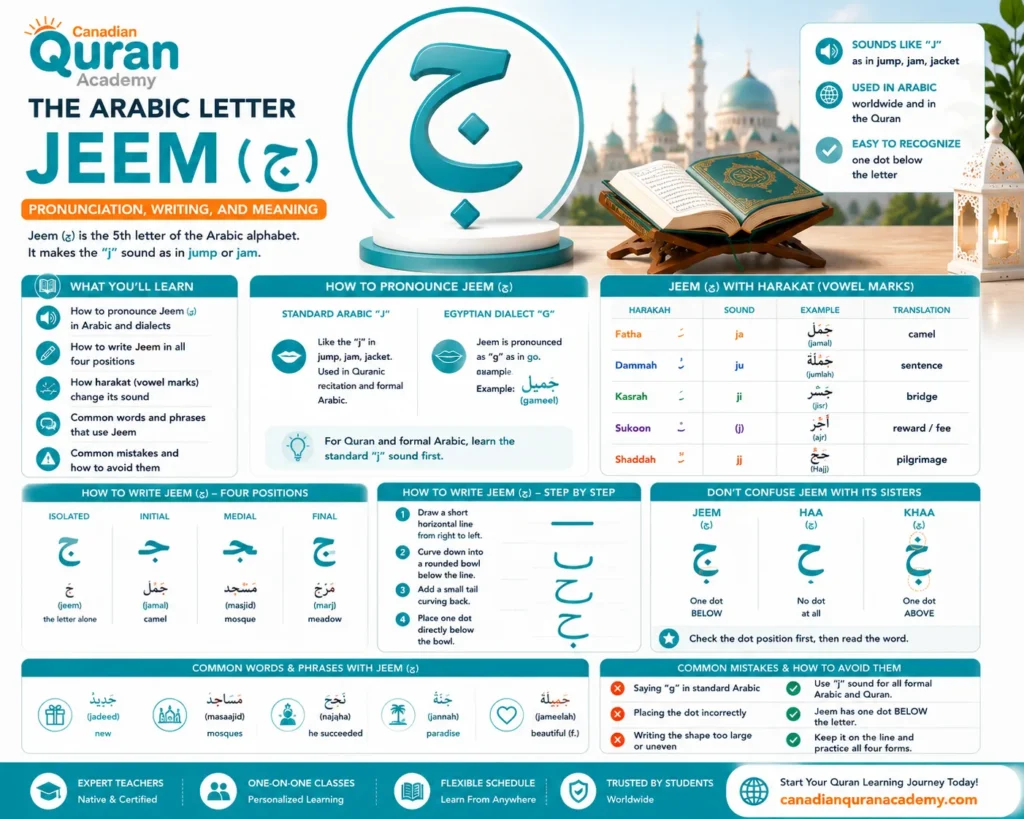
Learning the Arabic letter Jeem (ج) is one of the easier steps in mastering the Arabic alphabet, because English speakers already know its sound.
Jeem is the fifth letter of the alphabet, and at Canadian Quran Academy it’s one of the first letters new students recognize with confidence — because the “j” sound already exists in their own language.
This guide covers everything you need to read, write, and pronounce the ج – Arabic letter j correctly: its four positional forms, how the harakat (vowel marks) change its sound, common words that use it, and the mistakes most learners make when they first encounter it.
What you’ll learn in this article
- How to pronounce the letter Jeem (ج) in Modern Standard Arabic and in regional dialects
- How to write Jeem in its four positional forms: isolated, initial, medial, and final
- How the harakat — fatha, damma, kasra, sukoon, and shaddah — change Jeem’s sound
- Common words and simple phrases that use Jeem, placed at the start, middle, and end
- The most frequent mistakes learners make with Jeem, and how to avoid them
How Do You Pronounce The Arabic Letter Jeem (ج)?
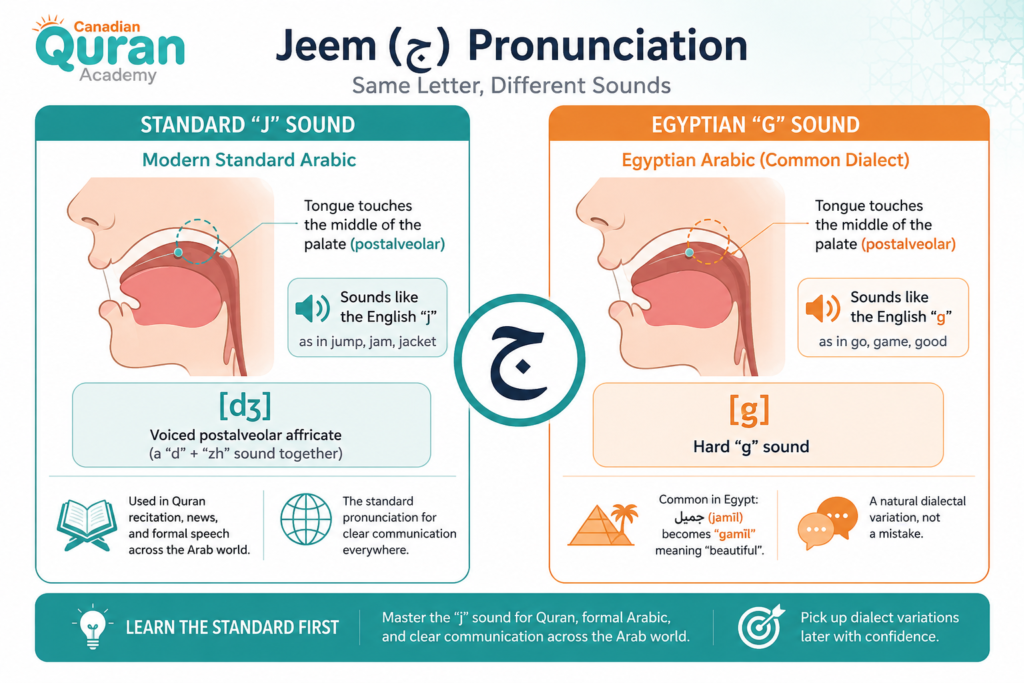
Jeem is pronounced from the middle of the tongue, which touches the middle of the palate to produce the sound. In the International Phonetic Alphabet, it’s written as [dʒ] — a voiced postalveolar affricate, which is a technical way of saying it combines a “d” sound with a “zh” sound released together.
The Standard “J” Sound
In Modern Standard Arabic, Jeem sounds exactly like the English “j” in words such as “jump,” “jam,” or “jacket.” If you can say those English words naturally, you can already produce the sound correctly. This is the pronunciation used in Quranic recitation, news broadcasts, and formal speech across the Arab world.
Regional Variation: The Egyptian “G” Sound
Jeem doesn’t sound identical everywhere. In Egyptian Arabic, it’s commonly pronounced as a hard “g,” as in “go” — so جميل (jamīl, “beautiful”) becomes “gamīl” in everyday Egyptian speech. This isn’t an error; it’s a recognized dialectal feature, and some linguists trace it to an older pronunciation that predates the standard Arabic form used today. In parts of the Levant and Gulf, you may also hear Jeem shift closer to a soft “zh” sound, similar to the “s” in “measure.”
The practical decision for a learner is simple: if your goal is Quran recitation, formal writing, or communicating across different Arabic-speaking countries, learn the standard “j” sound first. You can pick up dialect variations later once the standard sound is automatic.
Read Also: The Arabic Letter Waw (و)
How Does Jeem Sound With The Harakat (Vowel Marks)?
The harakat are short vowel marks placed above or below a letter, and they shift the sound of the ج – Arabic letter j in predictable ways.
Fatha, Damma, And Kasra
With fatha (ـَ), Jeem becomes “ja,” as in جَمَل (jamal, “camel”). With damma (ـُ), it becomes “ju,” as in جُمْلة (jumlah, “sentence”). With kasra (ـِ), it becomes “ji,” as in جِسْر (jisr, “bridge”).
Sukoon And Shaddah
With sukoon (ـْ), the letter carries no vowel sound and is pronounced as a quiet, closed “j,” as in أَجْر (ajr, “reward” or “fee”). With shaddah (ـّ), the sound doubles and is held slightly longer, as in حَجّ (Hajj, “pilgrimage”) — one of the most recognizable words in Islamic vocabulary built on this letter.
How Do You Write The Letter Jeem (ج)?
Jeem belongs to a family of three letters that share the same base shape: Jeem (ج), Haa (ح), and Khaa (خ). The only difference between them is dot placement. Jeem is the version with a single dot underneath the curve — no dot means Haa, and a dot above means Khaa.
Jeem’s Four Positional Forms
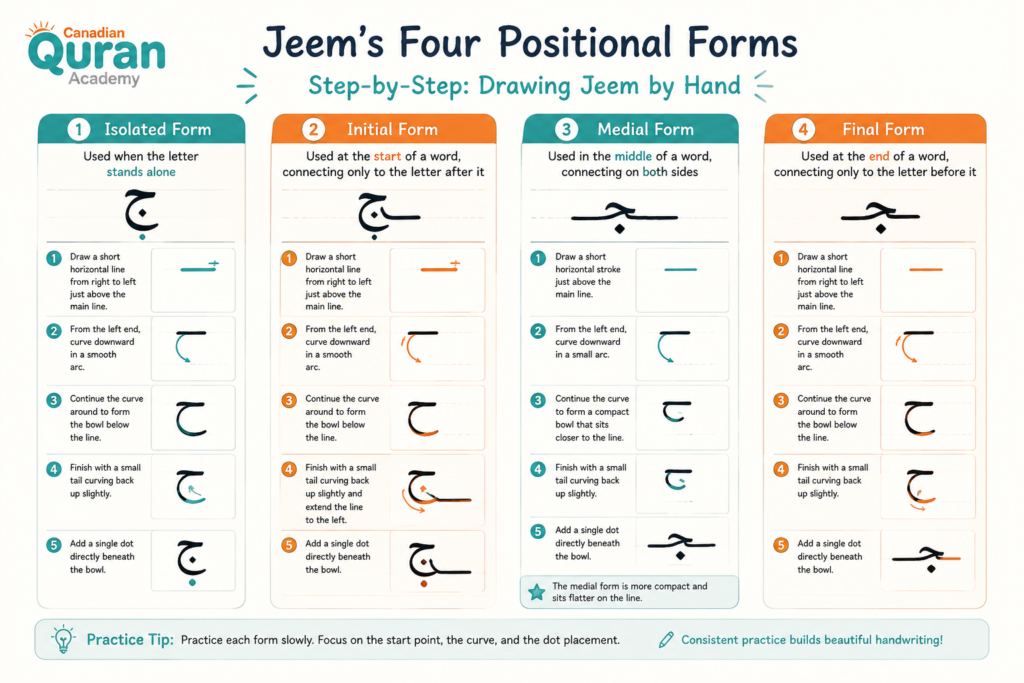
Like every Arabic letter, Jeem changes shape depending on where it sits in a word:
- Isolated form: ج — used when the letter stands alone
- Initial form: جـ — used at the start of a word, connecting only to the letter after it
- Medial form: ـجـ — used in the middle of a word, connecting on both sides
- Final form: ـج — used at the end of a word, connecting only to the letter before it
Step-by-Step: Drawing Jeem by Hand
To write the isolated form, draw a small horizontal line from right to left just above the main writing line.
From the left end of that line, curve downward into a rounded bowl shape that dips below the line, then finish with a small tail curving back. Add a single dot directly beneath the bowl, inside the curve.
The medial form is more compact and sits flatter on the line, which is why many learners find it the hardest of the four to recognize at first.
Because Jeem, Haa, and Khaa share the same body shape, this is the single most common point of confusion for new readers. Jeem has one dot below the curve, Haa has no dot at all, and Khaa has one dot above.
A practical fix that works well at Canadian Quran Academy: before reading a word aloud, pause on any letter with this bowl shape and check the dot position first — below, none, or above — rather than guessing from context.
Live Class in Action
Watch how our instructors interact with students in real-time, focusing on interactive methods.
Start Your Quranic Journey in Canada
Join our vibrant community and learn with expert tutors through our flexible online platform.
Claim Your Free TrialWords And Phrases That Use the Arabic Letter Jeem (ج)
Jeem appears constantly across everyday Arabic vocabulary. At the start of a word: جديد (jadid, “new”), جَبَل (jabal, “mountain”).
In the middle: مَسْجِد (masjid, “mosque”), رَجُل (rajul, “man”), فِنجان (finjan, “cup”). At the end: خُرُوج (khurūj, “exit”), ثَلْج (thalj, “snow”), مُنتَج (muntaj, “product”).
Simple Phrases To Practice
Try building full sentences once individual words feel comfortable: جلس على الكرسي (Jalasa ‘ala al-kursi — “He sat on the chair”), or أنا أحتاج إلى المساعدة (Ana ahtaju ila al-musa’adah — “I need help”).
Reading Jeem inside a full sentence, rather than as an isolated flashcard letter, is what makes the shape and sound stick.
This is exactly the stage where structured guidance makes the biggest difference — sounding out letters alone only gets a learner so far before grammar and sentence patterns take over.
Canadian Quran Academy’s Fusha Arabic Course is built around this transition, moving students from individual letters into full reading fluency with a live instructor correcting pronunciation in real time.
Read Also: The Letter Dh In Arabic ذ
Jeem In Arabic Word Roots
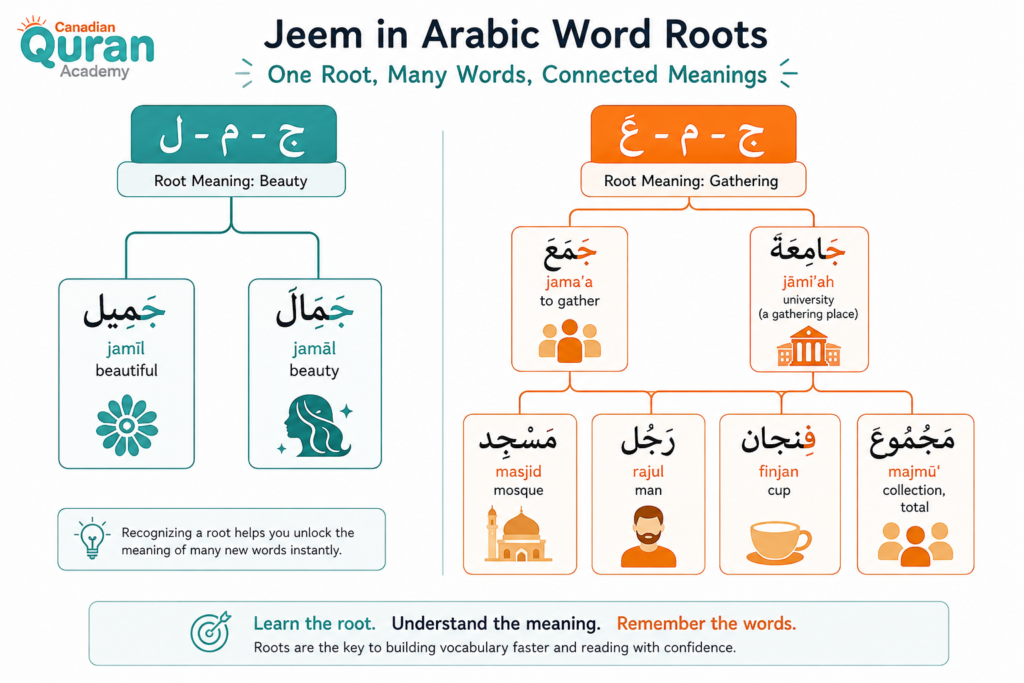
Arabic words are built from three-letter roots, and Jeem appears in several roots worth knowing early.
The root ج-م-ل relates to beauty, giving جَمِيل (jamīl, “beautiful”) and جَمَال (jamāl, “beauty”). The root ج-م-ع relates to gathering, giving جَمَعَ (jama’a, “to gather”) and جَامِعَة (jāmi’ah, “university” — literally, “a gathering place”).
Once you recognize a root, you can often guess the meaning of an unfamiliar word built from it, which speeds up vocabulary building considerably more than memorizing words one at a time.
Common Mistakes Learners Make with Jeem
Most mistakes with Jeem fall into three categories: mixing it up with its sister letters, carrying a dialect pronunciation into the wrong context, and rushing the medial form when writing quickly. Each one has a simple, deliberate fix.
1. Confusing Jeem with Haa and Khaa
This is the most frequent error among new readers, and it happens because all three letters share one body shape.
The fix is deliberate: build flashcards specifically for these three letters across all four positional forms, and train your eye to check the dot before attempting to sound out the word.
2. Mixing Up Dialect Pronunciations
Learners who first hear Arabic through Egyptian media sometimes carry the hard “g” pronunciation into formal or Quranic contexts without realizing it’s a regional variation rather than the standard form. Knowing which pronunciation you’re using, and why, prevents confusion later.
3. Rushing the Medial Form
Because the medial form (ـجـ) is smaller and connects on both sides, it’s easy to write the bowl too small or skip the dot when writing quickly. Slow, deliberate practice on words like سَجَدَ (sajada, “he prostrated”) builds the muscle memory that quick handwriting later depends on.
Experience Our Classrooms
Don’t just take our word for it—take a look inside! Watch the videos below to experience our engaging teaching methods and vibrant online classrooms firsthand.
Read Also: The Letter Fa In Arabic ف
Start Your Quranic Journey in Canada
Join our vibrant community and learn with expert tutors through our flexible online platform.
Claim Your Free TrialStart Learning Arabic Letters The Right Way With A Live Instructor
Reading about a letter only goes so far. Real progress with Jeem, and every other letter in the Arabic alphabet, comes from hearing it corrected in real time and practicing it in full words and sentences with someone who catches small mistakes before they become habits.
Canadian Quran Academy offers live, one-on-one Arabic instruction for every level and background.

Our Arabic Courses:
- Online Arabic Academy
- Online Arabic Course
- Classical Arabic Course
- Arabic Course for Beginners
- Advanced Arabic Course
- Quranic Arabic Course
- Arabic Grammar Course
- Modern Standard Arabic Course
- Arabic Conversation / Speaking Course
- Intensive Arabic Course
- Online Arabic Classes for Kids
- Arabic Classes for Adults
- Arabic Classes for Ladies

Start Your Quranic Journey in Canada
Join our vibrant community and learn with expert tutors through our flexible online platform.
Claim Your Free TrialConclusion
The ج – Arabic letter j is a natural starting point in the Arabic alphabet because its core sound already exists in English.
Once you can identify its four positional forms, distinguish it from Haa and Khaa by dot placement, and hear how the harakat shift its sound, Jeem becomes one of the most reliable letters in your reading toolkit.
With steady practice — and guidance from Canadian Quran Academy when you’re ready to move from individual letters into full sentences — reading and writing words containing Jeem will start to feel automatic.

Frequently Asked Questions
Here are quick answers to the questions learners ask most often about the letter Jeem, based on common searches and points this guide may not have fully covered above.
1. How do you pronounce the letter Jeem (ج)?
Jeem is pronounced like the English “j” in “jump” or “jacket,” produced by touching the middle of the tongue to the middle of the palate. In Egyptian Arabic, it’s commonly pronounced as a hard “g” instead.
2. How do you pronounce the word جميل in Arabic?
The word جميل is pronounced “jameel,” meaning “beautiful.” In Egyptian dialect, you may hear it pronounced “gameel” instead — both refer to the same word.
3. How many forms does the letter Jeem have?
Jeem has four positional forms: isolated (ج), initial (جـ), medial (ـجـ), and final (ـج). Each form connects differently depending on where it falls in a word.
4. Why does Jeem sometimes sound like “g” instead of “j”?
This is a recognized regional feature of Egyptian Arabic, not a mistake. Some linguists believe it reflects an older pronunciation preserved in Egypt, while Modern Standard Arabic and most other dialects retain the standard “j” sound.
5. Is the letter Jeem in the word جراد pronounced with fatha or damma?
It carries a fatha, so the word is pronounced “jaraad” (“locusts”), with the short “a” sound following the Jeem.
6. How is Jeem different from Haa (ح) and Khaa (خ)?
All three letters share the same curved body shape. Jeem has a single dot below the curve, Haa has no dot, and Khaa has a single dot above the curve — the dot is the only thing that tells them apart.






Leave a Reply