 Quran
Quran
When we stand to pray, we are not merely performing a ritual; we are answering a divine call to connect, to draw near, to speak with the One who created us.
The very word “Salah” in Arabic comes from the root ص-ل-و (Sad-Lam-Waw), which holds the meaning of “connection.” Is it any wonder then that its derivatives grace the pages of the Quran dozens of times? Allah (SWT) is continuously calling us back to this connection.
So let us, together, explore these divine invitations — complete with their Arabic text with full tashkeel, transliteration, translation, surah name, verse number, and a direct link to each verse — so you can understand the depth of what it truly means to connect with Him.
A Quranic Verse on Salah as a Foundation of Faith
We begin at the very foundation. In the opening verses of Surah Al-Baqarah, Allah describes the righteous, and the very first action He mentions after belief in the unseen is the prayer.
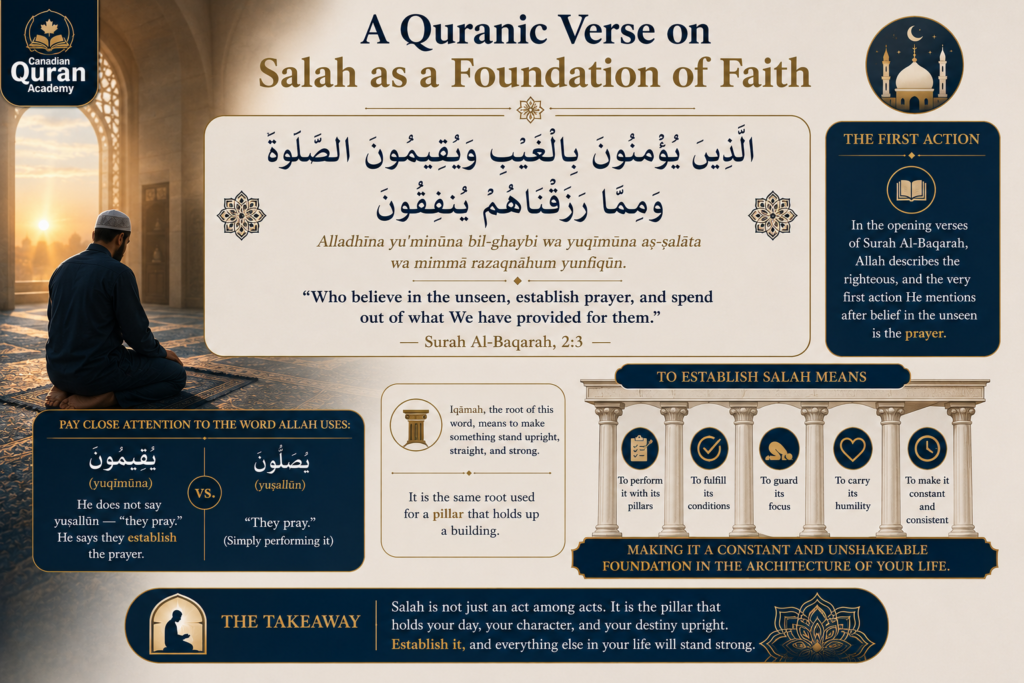
الَّذِينَ يُؤْمِنُونَ بِالْغَيْبِ وَيُقِيمُونَ الصَّلَاةَ وَمِمَّا رَزَقْنَاهُمْ يُنفِقُونَ
Alladhīna yu’minūna bil-ghaybi wa yuqīmūna aṣ-ṣalāta wa mimmā razaqnāhum yunfiqūn.
“Who believe in the unseen, establish prayer, and spend out of what We have provided for them.” — Surah Al-Baqarah, 2:3
Pay close attention to the word Allah uses: يُقِيمُونَ (yuqīmūna). He does not say yuṣallūn — “they pray.” He says they establish the prayer.
Iqāmah, the root of this word, means to make something stand upright, straight, and strong. It is the same root used for a pillar that holds up a building. To establish Salah means to perform it with its pillars, its conditions, its focus, and its humility — making it a constant and unshakeable foundation in the architecture of your life.
A Quranic Verse on the Soul of Prayer (Khushoo’)
Without its soul, the prayer is but a series of movements. Allah praises the believers whose hearts are alive with humility during their Salah.
قَدْ أَفْلَحَ الْمُؤْمِنُونَ ﴿١﴾ الَّذِينَ هُمْ فِي صَلَاتِهِمْ خَاشِعُونَ
Qad aflaḥa al-mu’minūn. Alladhīna hum fī ṣalātihim khāshi’ūn.
“Certainly will the believers have succeeded — they who are during their prayer humbly submissive.” — Surah Al-Mu’minun, 23:1-2
خَاشِعُونَ (Khāshi’ūn). Khushoo’ is a state where the heart is so filled with awe and reverence for Allah that the entire body becomes still and submissive. The scholars of tafsir explain that khushoo’ resides in the heart, but its light shines upon the limbs — when the heart is humble, the gaze is lowered, the voice is softened, and the fidgeting ceases.
One of the most effective ways to deepen your khushoo’ is to understand what you are reciting. If you recite Al-Fatiha seventeen times a day without knowing its meaning, your prayer will always remain at the surface. Studying Quranic Arabic directly addresses this gap — it transforms Salah from a recitation of sounds into a real conversation with Allah.
Understand the Quran Better with a FREE Quranic Arabic Trial Class
A Quranic Verse on Salah as a Divine Guard
Ever wonder why we pray? One of the most powerful answers is found in Surah Al-‘Ankabut.
اتْلُ مَا أُوحِيَ إِلَيْكَ مِنَ الْكِتَابِ وَأَقِمِ الصَّلَاةَ ۖ إِنَّ الصَّلَاةَ تَنْهَىٰ عَنِ الْفَحْشَاءِ وَالْمُنكَرِ ۗ وَلَذِكْرُ اللَّهِ أَكْبَرُ
Utlu mā ūḥiya ilayka mina al-kitābi wa aqimi aṣ-ṣalāh. Inna aṣ-ṣalāta tanhā ‘ani al-faḥshā’i wal-munkar, wa la-dhikru Allāhi akbar.
“Recite what has been revealed to you of the Book and establish prayer. Indeed, prayer prohibits immorality and wrongdoing, and the remembrance of Allah is greater.” — Surah Al-‘Ankabut, 29:45
A correctly established Salah — one with heart and presence — builds a spiritual barrier between you and sin. The operative insight here: the verse does not say prayer might prohibit immorality. It says prayer prohibits it, as a statement of fact. The condition is that the prayer is properly established. If you find yourself struggling with bad habits, examine the quality of your prayer first.
A Quranic Verse on Salah as a Source of Strength
Life is filled with tests. Allah, in His mercy, has given us the perfect tools to navigate them.
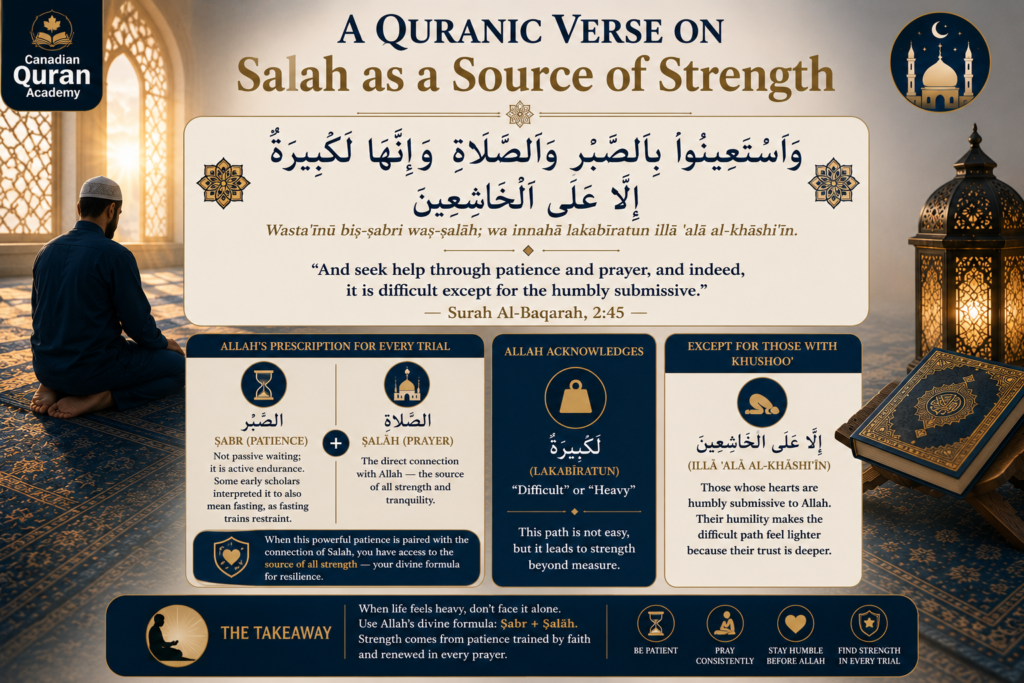
وَاسْتَعِينُوا بِالصَّبْرِ وَالصَّلَاةِ ۚ وَإِنَّهَا لَكَبِيرَةٌ إِلَّا عَلَى الْخَاشِعِينَ
Wasta’īnū biṣ-ṣabri waṣ-ṣalāh; wa innahā lakabīratun illā ‘alā al-khāshi’īn.
“And seek help through patience and prayer, and indeed, it is difficult except for the humbly submissive.” — Surah Al-Baqarah, 2:45
When the burdens of the world feel heavy, Allah’s prescription is precise: الصَّبْرِ (ṣabr — patience) combined with الصَّلَاةِ (Ṣalāh — prayer). Sabr here is not passive waiting; it is active endurance. Some early scholars interpreted it to also mean fasting, as fasting trains restraint. When this powerful patience is paired with the direct connection of Salah, you have access to the source of all strength — your divine formula for resilience.
Allah then acknowledges: this is لَكَبِيرَةٌ (lakabīratun), “difficult” or “heavy” — except for those with khushoo’, whose hearts are already softened before Him.
Read More: Quran Verses About Teachers in Arabic
A Quranic Verse on Salah as a Lifelong Commandment
Salah is not a phase of life. It is the central pillar that endures from the moment of accountability until our last breath.
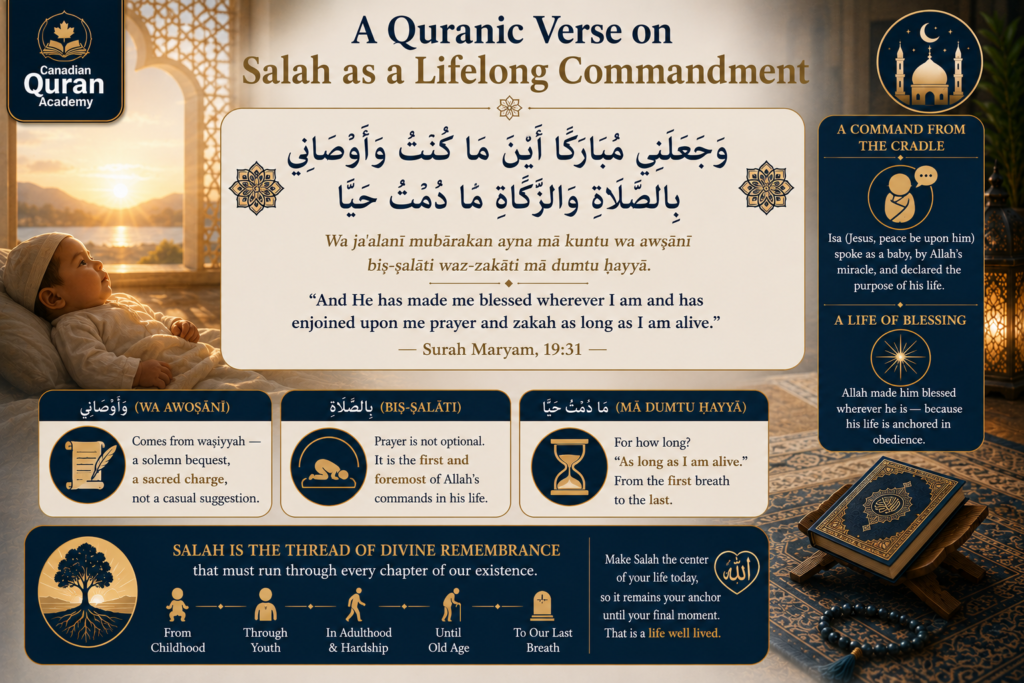
Look at what Allah commanded Isa (Jesus, peace be upon him) to declare from the cradle:
وَجَعَلَنِي مُبَارَكًا أَيْنَ مَا كُنتُ وَأَوْصَانِي بِالصَّلَاةِ وَالزَّكَاةِ مَا دُمْتُ حَيًّا
Wa ja’alanī mubārakan ayna mā kuntu wa awṣānī biṣ-ṣalāti waz-zakāti mā dumtu ḥayyā.
“And He has made me blessed wherever I am and has enjoined upon me prayer and zakah as long as I am alive.” — Surah Maryam, 19:31
A baby, speaking a miracle in his mother’s arms, names his life’s mission. The word وَأَوْصَانِي (wa awṣānī) comes from waṣiyyah — a solemn bequest, a sacred charge. And for how long does this charge last? مَا دُمْتُ حَيًّا (mā dumtu ḥayyā) — “as long as I am alive.” Salah is not something we do when young and leave when old. It is the thread of divine remembrance that must run through every chapter of our existence.
Experience Our Classrooms
Don’t just take our word for it—take a look inside! Watch the videos below to experience our engaging teaching methods and vibrant online classrooms firsthand.
Start Your Quranic Journey in Canada
Join our vibrant community and learn with expert tutors through our flexible online platform.
Claim Your Free TrialThe Divine Command to Guard Our Salah
Allah does not just tell us to pray — He commands us to actively guard our prayers. This implies a precious treasure under constant threat of being lost to the distractions of life.
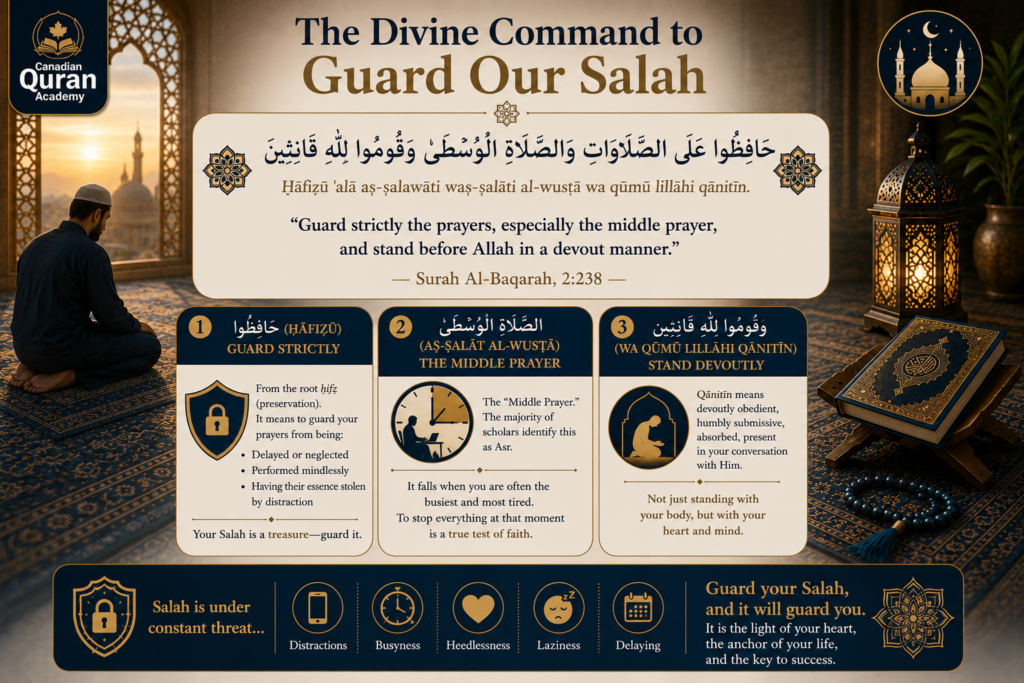
حَافِظُوا عَلَى الصَّلَوَاتِ وَالصَّلَاةِ الْوُسْطَىٰ وَقُومُوا لِلَّهِ قَانِتِينَ
Ḥāfiẓū ‘alā aṣ-ṣalawāti waṣ-ṣalāti al-wusṭā wa qūmū lillāhi qānitīn.
“Guard strictly the prayers, especially the middle prayer, and stand before Allah in a devout manner.” — Surah Al-Baqarah, 2:238
The word حَافِظُوا (Ḥāfiẓū) is from the same root as Hifdh — preserving and protecting. It means to guard your prayers from being delayed, performed mindlessly, or having their essence stolen by distraction. Allah then singles out الصَّلَاةِ الْوُسْطَىٰ (aṣ-Ṣalāt al-Wusṭā) — the “Middle Prayer.” The majority of scholars identify this as Asr, the prayer that falls when you are often busiest and most tired. To stop everything at that moment is a true test of faith.
Finally, He commands: stand قَانِتِينَ (qānitīn) — devoutly, absorbed, present in your conversation with Him.
Read More: Quranic Verses on Patience in Arabic
An Inviting Quranic Verse on Hastening to Salah
Salah is also a means of community. The weekly Jumu’ah prayer is a gift — a time for believers to gather, remember Allah, and be refreshed together.
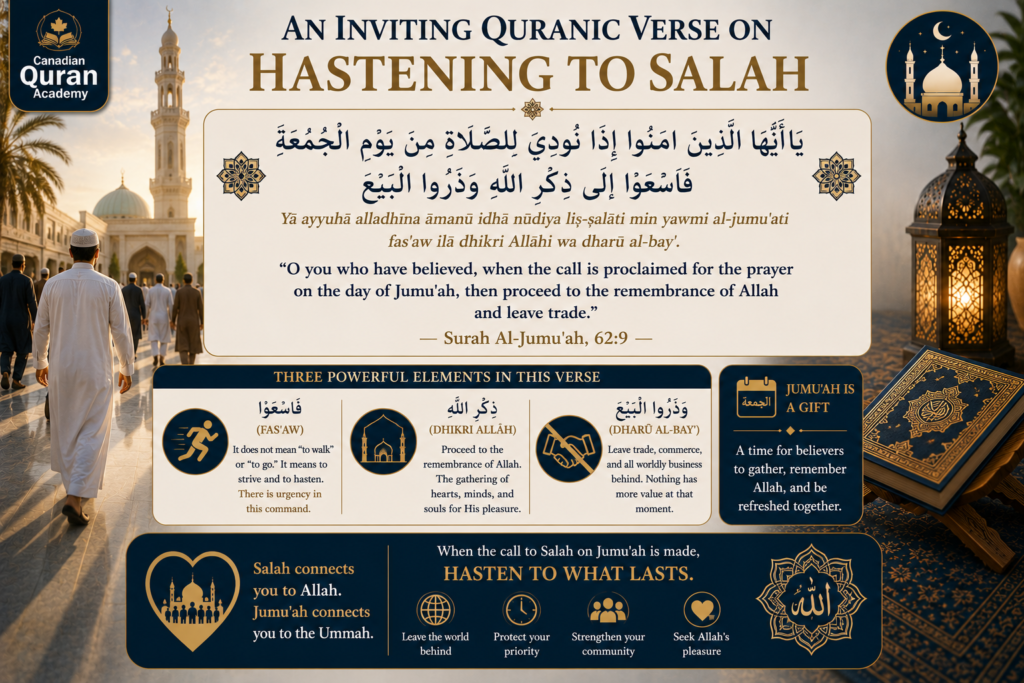
يَا أَيُّهَا الَّذِينَ آمَنُوا إِذَا نُودِيَ لِلصَّلَاةِ مِن يَوْمِ الْجُمُعَةِ فَاسْعَوْا إِلَىٰ ذِكْرِ اللَّهِ وَذَرُوا الْبَيْعَ
Yā ayyuhā alladhīna āmanū idhā nūdiya liṣ-ṣalāti min yawmi al-jumu’ati fas’aw ilā dhikri Allāhi wa dharū al-bay’.
“O you who have believed, when the call is proclaimed for the prayer on the day of Jumu’ah, then proceed to the remembrance of Allah and leave trade.” — Surah Al-Jumu’ah, 62:9
Notice the verb: فَاسْعَوْا (fas’aw). It does not mean “to walk” or “to go.” It means to strive and to hasten. There is urgency in this command. When the adhan for Jumu’ah is called, everything — الْبَيْعَ (trade, commerce, worldly business) — is left behind. This verse establishes that no worldly transaction has more value at that moment than your connection to Allah.
A Quranic Verse About Enjoining Prayer Upon Your Family
The light of Salah is not meant to be kept only for ourselves. It is meant to illuminate our homes.
وَأْمُرْ أَهْلَكَ بِالصَّلَاةِ وَاصْطَبِرْ عَلَيْهَا ۖ لَا نَسْأَلُكَ رِزْقًا ۖ نَّحْنُ نَرْزُقُكَ ۗ وَالْعَاقِبَةُ لِلتَّقْوَىٰ
Wa’mur ahlaka biṣ-ṣalāti waṣṭabir ‘alayhā; lā nas’aluka rizqan, naḥnu narzuquk, wal-‘āqibatu littaqwā.
“And enjoin prayer upon your family and be steadfast therein. We ask you not for provision; We provide for you, and the best outcome is for righteousness.” — Surah Ta-Ha, 20:132
The command is وَأْمُرْ (Wa’mur) — enjoin, instruct, take responsibility. But immediately after, Allah gives the key to success: وَاصْطَبِرْ (waṣṭabir). This is not ordinary sabr. It is a heightened, continuous form of it — implying that guiding a family to prayer, waking children for Fajr, and reminding gently and persistently requires a beautiful, sustained struggle.
Give Your Child a Strong Islamic Foundation with a FREE Trial Class

A Quranic Verse on the Reward of Those Who Are Constant in Their Prayer
Who are the people who will inherit the highest levels of Paradise? Allah describes their qualities, and Salah frames the entire description — mentioned at both its beginning and its end.
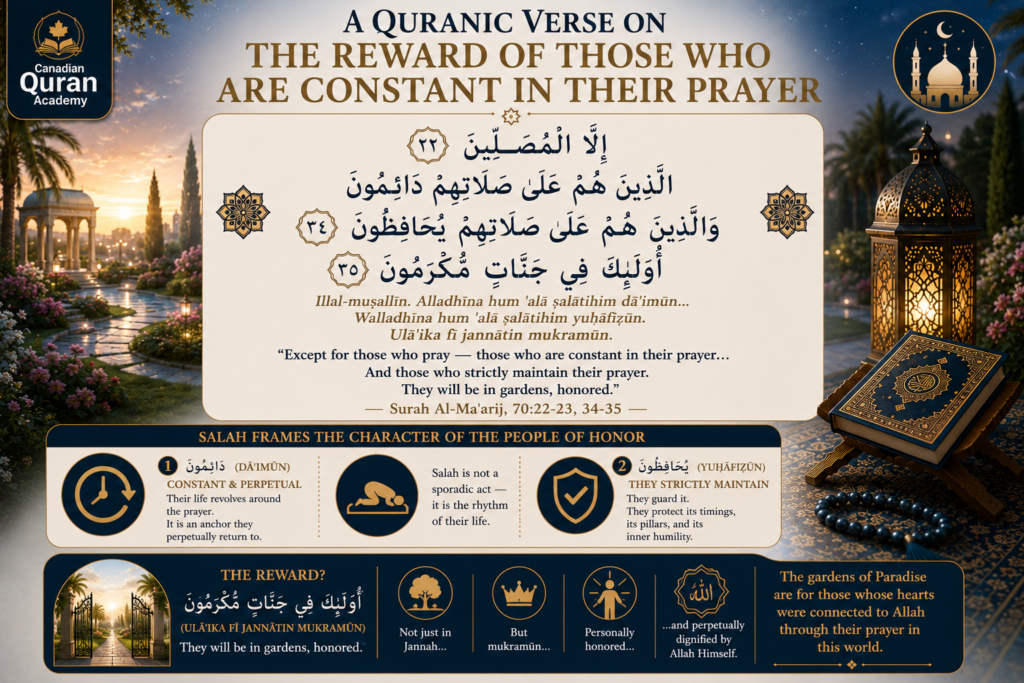
إِلَّا الْمُصَلِّينَ ﴿٢٢﴾ الَّذِينَ هُمْ عَلَىٰ صَلَاتِهِمْ دَائِمُونَ وَالَّذِينَ هُمْ عَلَىٰ صَلَاتِهِمْ يُحَافِظُونَ ﴿٣٤﴾ أُولَٰئِكَ فِي جَنَّاتٍ مُّكْرَمُونَ
Illal-muṣallīn. Alladhīna hum ‘alā ṣalātihim dā’imūn… Walladhīna hum ‘alā ṣalātihim yuḥāfiẓūn. Ulā’ika fī jannātin mukramūn.
“Except for those who pray — those who are constant in their prayer… And those who strictly maintain their prayer. They will be in gardens, honored.” — Surah Al-Ma’arij, 70:22-23, 34-35
First, they are دَائِمُونَ (dā’imūn) — constant and perpetual. Their life revolves around the prayer; it is an anchor they perpetually return to. Then, at the close of the list of their noble qualities, Allah says يُحَافِظُونَ (yuḥāfiẓūn) — they guard it. They protect its timings, its pillars, its inner humility.
The reward? أُولَٰئِكَ فِي جَنَّاتٍ مُّكْرَمُونَ (Ulā’ika fī jannātin mukramūn) — “They will be in gardens, honored.” Not just in Jannah — but mukramūn, personally and perpetually dignified by Allah Himself.
A Quranic Verse on the Consequence of Neglecting Salah
Just as Allah shows us the beauty of Salah, He warns us of the desolation of abandoning it.
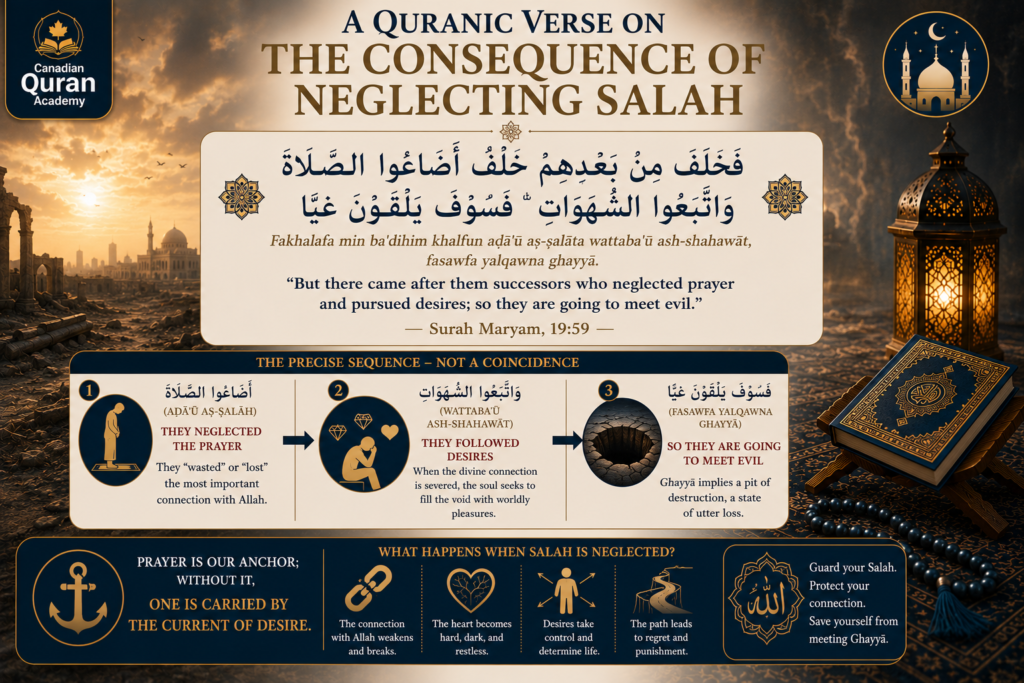
فَخَلَفَ مِن بَعْدِهِمْ خَلْفٌ أَضَاعُوا الصَّلَاةَ وَاتَّبَعُوا الشَّهَوَاتِ ۖ فَسَوْفَ يَلْقَوْنَ غَيًّا
Fakhalafa min ba’dihim khalfun aḍā’ū aṣ-ṣalāta wattaba’ū ash-shahawāt, fasawfa yalqawna ghayyā.
“But there came after them successors who neglected prayer and pursued desires; so they are going to meet evil.” — Surah Maryam, 19:59
Look at the precise sequence. First: أَضَاعُوا الصَّلَاةَ (aḍā’ū aṣ-ṣalāh) — they “wasted” or “lost” the prayer. Immediately after: وَاتَّبَعُوا الشَّهَوَاتِ (wattaba’ū ash-shahawāt) — they followed desires. The sequence is not coincidental. When the divine connection is severed, the soul seeks to fill the void with worldly pleasures. Prayer is our anchor; without it, one is carried by the current of desire. The consequence — غَيًّا (ghayyā) — implies a pit of destruction, a state of utter loss.
Read More: Quranic Verses on Helping the Needy in Arabic and English
A Quranic Verse Warning Those Who Are Heedless of Their Prayer
One of the most sobering verses in the Quran is not about those who abandon prayer entirely — but about those who pray, yet are completely detached from it.
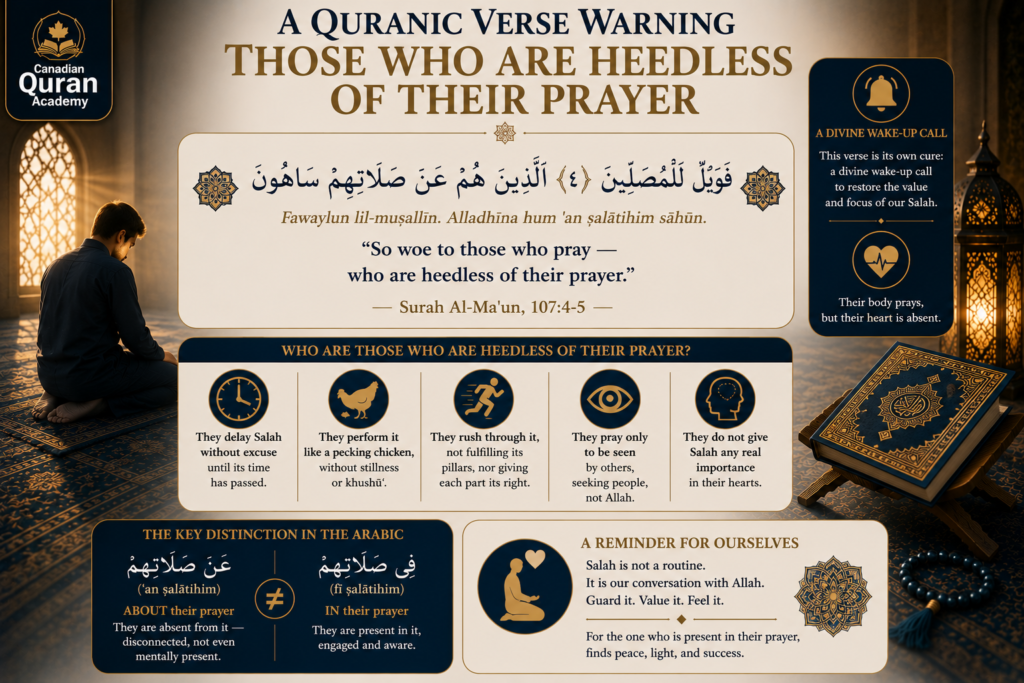
فَوَيْلٌ لِّلْمُصَلِّينَ ﴿٤﴾ الَّذِينَ هُمْ عَن صَلَاتِهِمْ سَاهُونَ
Fawaylun lil-muṣallīn. Alladhīna hum ‘an ṣalātihim sāhūn.
“So woe to those who pray — who are heedless of their prayer.” — Surah Al-Ma’un, 107:4-5
The scholars of tafsir explain this as those who do not give Salah any real importance — delaying it without excuse until its time has passed, performing it like a pecking chicken, rushing through it without stillness, or praying only to be seen by others. Their body prays, but their heart is absent. This verse is its own cure: a divine wake-up call to restore the value and focus of our Salah.
The key distinction in the Arabic: العبارة عَن صَلَاتِهِمْ (about their prayer) rather than فِي صَلَاتِهِمْ (in their prayer). They are absent from it — disconnected, not even mentally present.
Live Class in Action
Watch how our instructors interact with students in real-time, focusing on interactive methods.
Start Your Quranic Journey in Canada
Join our vibrant community and learn with expert tutors through our flexible online platform.
Claim Your Free TrialStrengthen Your Salah with Canadian Quran Academy
Every verse in this article points to one reality: the quality of your Salah is closely connected to how well you understand the words you recite. The deeper your connection with the Quran, the deeper your concentration, reflection, and khushūʿ in prayer become.
- Learn Quran recitation with proper Tajweed and pronunciation.
- Study Quranic Arabic to understand the verses you recite in every Salah.
- Memorize the Quran through structured Hifz programs with qualified teachers.
- Explore Islamic Studies that strengthen your knowledge and daily practice.
- Join live one-on-one online classes with experienced Al-Azhar graduates and Ijazah-certified instructors.
- Choose flexible lesson times that fit your schedule.
- Book a FREE trial lesson and experience the learning approach before enrolling.
Explore Our Courses at Canadian Quran Academy

Our Quran Courses
- Quran Online Academy
- Quran Recitation Classes
- Quran Reading Classes
- Online Quran Classes for Kids
- Quran Classes for Adults
- Quran Classes for Female
- Learn Quran Course for Beginners
- Quran Memorization (Hifz) Course
- Hifz Classes for Adults
- Quran Memorization and Hifz Course for Kids
- Quran Hifz Course for Ladies
- Quran Ijazah Program
Start Your Quranic Journey in Canada
Join our vibrant community and learn with expert tutors through our flexible online platform.
Claim Your Free TrialConclusion
As we have journeyed through these Quranic verses on Salah in Arabic and English, a single truth becomes undeniable: Allah (SWT) does not simply permit prayer — He calls us to it, commands us to establish it, charges us to guard it, and warns us of the cost of losing it.
From Surah Al-Baqarah’s command to establish prayer as a pillar (2:3), to the description of Paradise’s inhabitants who are both constant in prayer and guardians over it (70:22-35), Salah emerges not as one act among many but as the defining rhythm of a believer’s life — the connection that holds everything else in place.
The Arabic vocabulary across these verses tells its own story: يُقِيمُونَ (establish), حَافِظُوا (guard), فَاسْعَوْا (hasten), دَائِمُونَ (constant). These are not passive descriptions. They are active roles. They describe a believer who treats Salah as a living, breathing, indispensable relationship with the Creator — not a checklist item.
May these verses serve as a renewed invitation to that relationship — and may we be counted, on the Day we are asked, firmly among those who prayed.
Frequently Asked Questions
The Quran speaks about Salah from multiple perspectives—its obligation, purpose, spiritual impact, and the consequences of neglecting it. The following FAQs answer some of the most common questions about Quranic verses on prayer and their meanings.
What are the most important Quranic verses about Salah in Arabic?
Several verses are considered foundational. Surah Al-Baqarah 2:238 commands believers to guard all prayers and specifically the middle prayer. Surah Al-Mu’minun 23:1-2 describes the successful believers as those who are humbly submissive in their prayer. Surah Al-‘Ankabut 29:45 states that prayer prohibits immorality and wrongdoing. Together, these three verses cover the obligation, the quality, and the purpose of Salah.
How many times is Salah mentioned in the Quran?
The word Salah (صَلَاة) and its derivatives appear over 90 times across the Quran. This frequency reflects how central prayer is to Islam — it is referenced in matters of worship, community life, family, character, and the Day of Judgment.
What does “establish prayer” mean in the Quran?
“Establish prayer” is the translation of أَقِمِ الصَّلَاةَ (aqimi aṣ-ṣalāh). The verb aqāma means to make something stand upright and complete — like a structural pillar. It implies performing prayer at its correct times, with its required conditions met, with physical stillness, and with the heart present. It is a stronger and more demanding instruction than simply “to pray.”
What does the Quran say about those who neglect prayer?
Surah Maryam 19:59 describes those who “wasted” prayer and followed desires, warning they will meet a grievous end. Surah Al-Ma’un 107:4-5 warns against those who pray but are heedless — absent in heart even when present in body. And Surah Al-Muddaththir 74:42-43 records the damning self-testimony of those in Hellfire: “We were not of those who prayed.”
Why does the Quran specifically single out Asr prayer?
In Surah Al-Baqarah 2:238, Allah commands believers to guard all the prayers and then specifically mentions “the middle prayer” — which the majority of scholars, based on the Prophet’s (ﷺ) teaching, identify as Asr. Asr falls at the most demanding part of the workday, when fatigue and busyness are at their peak. Singling it out is a recognition of that challenge and an elevation of its importance precisely because of it.






Leave a Reply