 Quran
Have you ever listened to your child recite Al-Fatiha from memory and noticed a few letters were not pronounced correctly? This happens in many Canadian homes. Most of the time, the cause is the same: the child learned without anyone giving live feedback.
Interactive Quran learning in Canada fixes this by connecting students with qualified teachers who listen, correct, and guide them in real time. About 1.8 million Muslims now live in Canada, according to Statistics Canada, so demand for flexible, high-quality Quran education keeps growing.
This guide explains what interactive learning looks like in practice and how it differs from recorded lessons. It also covers what to look for in a Tajweed, recitation, or Arabic program for your family.
What You Will Learn
- What makes a Quran class interactive, beyond just being online
- How live correction improves Tajweed and recitation accuracy
- The best learning approach for kids versus adults
- How to choose a trustworthy Quran academy in Canada
- How Tajweed, recitation, and Arabic lessons support each other
Interactive Quran Learning in Canada: What It Means
Many programs call themselves “online,” but being online does not make a class interactive. Understanding the difference helps you choose a program that actually builds correct recitation and lasting confidence.
What Is an Interactive Quran Class?
An interactive Quran class is a live, two-way lesson. A qualified teacher listens to the student recite, corrects mistakes on the spot, and adjusts the pace to the student’s level. The student speaks, practises, and asks questions throughout the session instead of just watching.
How It Differs from Recorded Lessons
Recorded videos can teach rules, but they cannot hear you. If a student mixes up similar letters such as ح and ه, a video will not notice. A live teacher catches the mistake immediately, before it becomes a habit that is hard to break.
Why Canadian Families Are Choosing This Method
Long winters, busy work schedules, and long drives to the nearest mosque make regular in-person classes hard for many families. Live online sessions bring a teacher into your home, whether you live in Toronto, Calgary, or a small town far from an Islamic centre.
Why Live Feedback Matters for Tajweed and Recitation
Tajweed is an oral discipline that has been passed from teacher to student for centuries. Measured, correct recitation like this is very hard to reach without someone listening to you.
The Quran itself instructs believers to “recite the Quran with measured recitation”
“أَوْ زِدْ عَلَيْهِ وَرَتِّلِ ٱلْقُرْءَانَ تَرْتِيلًا”
Correcting Makharij (Articulation Points)
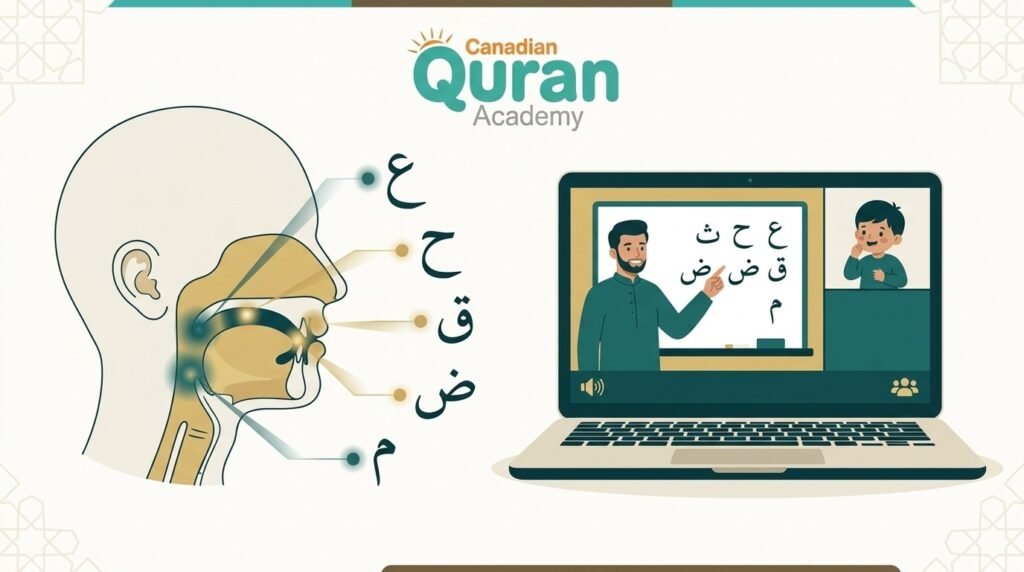
Each Arabic letter has a specific point of articulation, called a makhraj. Many English-speaking learners in Canada find letters like ع, ق, and ض difficult because English has no equivalent sounds. A teacher can show where the tongue should sit and have the student repeat until the sound is right.
Small articulation errors can change the meaning of a word entirely. For example, pronouncing قلب (heart) with a ك sound turns it into كلب (dog). This is why teachers treat makharij as the foundation of Tajweed, not an advanced extra.
In a live session, the teacher often asks the student to pronounce a letter with a sukoon, such as أَقْ or أَعْ, to isolate its exact point of origin. This simple technique helps learners hear and feel the difference, then carry it into full verses with confidence.
Building Retention Through Active Practice
Learning research supports this approach. A study at Washington University in St. Louis found that students who practised retrieving information remembered far more than those who only reread it. In a live class, reciting from memory and answering the teacher’s questions is that same kind of active retrieval.
A large analysis published in PNAS found similar results. Students in traditional lecture settings were about 1.5 times more likely to fail than those in active learning environments. Quran learning follows the same principle: when students participate, they progress faster.
From the classroom, Teachers regularly see students whose memorization is strong but whose recitation has small hidden errors. A few weeks of focused one-on-one correction usually fixes these, which is much harder to do on your own.
If you want your family’s recitation checked by an experienced teacher, joining a structured Tajweed course is a practical first step.
Live Class in Action
Watch how our instructors interact with students in real time, focusing on interactive methods.
Start Your Quranic Journey in Canada
Join our vibrant community and learn with expert tutors through our flexible online platform.
Claim Your Free TrialHow Interactive Quran Classes Work for Kids
Children learn differently from adults. A good program for young learners is designed around their attention span, curiosity, and need for encouragement.
Short, Engaging Sessions
Young children usually focus best for 20 to 30 minutes. Interactive classes keep each segment short, alternating between reading, listening, and repeating so the child stays engaged without getting tired.
Shorter sessions also make it easier to fit Quran learning into a busy school-week routine. Many families schedule classes right after school or before dinner, so learning becomes a natural daily habit rather than an extra burden.
Games, Repetition, and Positive Praise
Letter-matching games, digital whiteboards, and small rewards turn practice into something children look forward to. Regular praise builds confidence, so children see the Quran as a source of joy rather than pressure.
Repetition matters as much as fun. Hearing and repeating the same letters and short surahs many times helps children build accurate pronunciation that stays with them as they progress to longer passages.
Parent Involvement and Progress Tracking
Parents play a key role between sessions. Regular progress updates show what your child has mastered and what to review at home. This keeps the family involved in the learning process.
Parents do not need to be Quran experts to help. Listening to your child recite for five minutes a day, praising their effort, and reminding them of the teacher’s notes makes a noticeable difference over time.
Many parents start with Quran classes for kids built around the Noorani Qaida, which gives children a strong foundation in letters and pronunciation.
Experience Our Classrooms
Don’t just take our word for it—take a look inside! Watch the videos below to experience our engaging teaching methods and vibrant online classrooms firsthand.
Start Your Quranic Journey in Canada
Join our vibrant community and learn with expert tutors through our flexible online platform.
Claim Your Free TrialHow Interactive Quran Classes Work for Adults
Adults often come to Quran learning with specific goals. They may want to fix their recitation, read fluently for the first time, or understand what they recite in prayer. An interactive format respects their pace and privacy.
Starting from Zero Without Embarrassment
Many adults, including new Muslims, feel self-conscious about starting with the alphabet. One-on-one sessions give them a private, judgment-free space to learn at their own speed with a patient teacher.
Teachers who work with adult beginners understand that progress can feel slow at first. Clear milestones, such as completing the Arabic alphabet or reading your first full verse, help adults stay motivated and see how far they have come.
Flexible Scheduling Around Work and Family
Evening and weekend sessions let working professionals and parents stay consistent. Consistency matters more than intensity, so two or three focused classes a week often produce better results than one long session.
Online classes also remove commuting time entirely. Instead of driving across the city after a long workday, you can join a session from home in minutes, which makes it far easier to stay committed for the long term.
Connecting Recitation with Understanding
Learning basic Arabic changes how adults experience the Quran. When you recognize words and sentence structures, your recitation becomes more meaningful and your focus in prayer (khushu’) deepens. Adding an Arabic language course to your recitation practice helps you move from reading the words to understanding them.
Even a small vocabulary can make a big difference. Many words are repeated throughout the Quran, so each new word you learn helps you recognize meaning across many surahs and makes daily recitation more rewarding.

How to Choose the Right Quran Academy in Canada
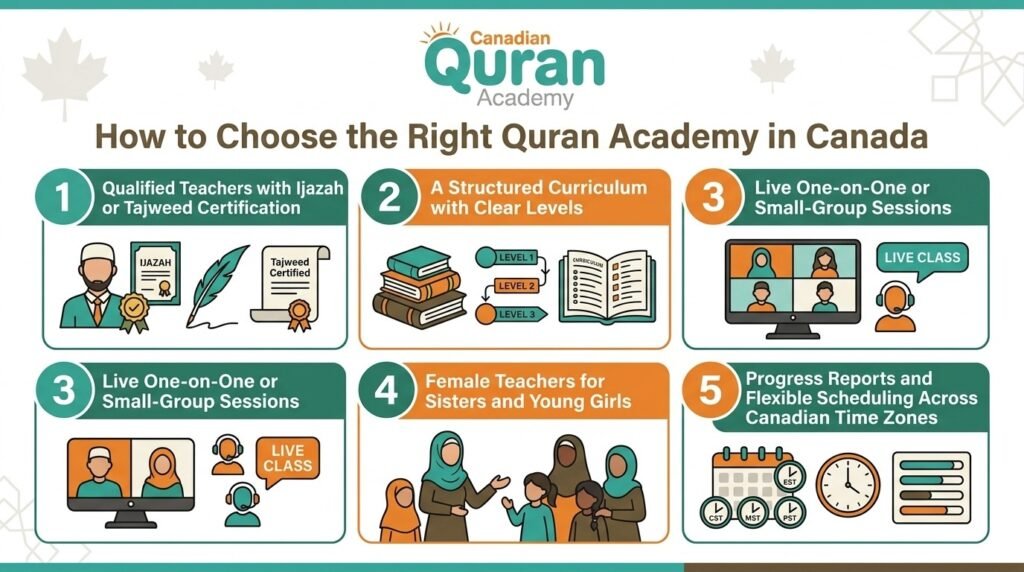
Not every program provides the same quality. Before enrolling, look for these five qualities to make sure the academy can support your family’s goals.
1. Qualified Teachers with Ijazah or Tajweed Certification
The teacher’s qualifications shape everything a student learns. An ijazah is a formal certification showing that the teacher recited the Quran to a qualified scholar through a connected chain of transmission going back to the Prophet ﷺ.
Beyond certification, look for teachers with real experience teaching non-Arabic speakers. Explaining difficult sounds clearly to a child or adult in Canada requires patience and teaching skill, not only strong recitation.
2. A Structured Curriculum with Clear Levels
A clear curriculum shows students exactly where they are and what comes next. Strong programs usually move step by step from the Noorani Qaida to reading fluency, then on to Tajweed rules and memorization.
Without a defined path, lessons can feel random, and progress becomes hard to measure. Ask the academy how levels are assessed and how students move from one stage to the next before you enroll.
3. Live One-on-One or Small-Group Sessions
Live sessions are the core of interactive learning. One-on-one classes give the teacher full attention on every letter and verse, making them ideal for beginners and students who need detailed correction.
Small groups can also work well, especially for older children and adults who enjoy learning with peers. Pre-recorded content can support review at home, but it should never replace live recitation with a teacher.
4. Female Teachers for Sisters and Young Girls
Many families prefer that women and girls learn with a female teacher. This preference is common and respected, and it often helps female students feel more comfortable reciting aloud and asking questions.
Before enrolling, confirm that qualified female teachers are available at times that suit your schedule. A good academy will match each student with a teacher who fits both their level and their personal preferences.
5. Progress Reports and Flexible Scheduling Across Canadian Time Zones
Canada spans six time zones, so scheduling flexibility matters whether you live in St. John’s or Vancouver. A reliable academy offers morning, evening, and weekend slots so classes fit around school, work, and family life.
Regular progress reports keep students and parents informed. Clear updates on what has been mastered and what needs more practice help families stay involved and celebrate each milestone along the way.
A reputable academy will also be open about its teaching methods and happy to answer your questions before you commit.
Book Your First Interactive Quran Class Today
Correct recitation is a lifelong gift for you and your children. At Canadian Quran Academy, qualified teachers guide every student through live Tajweed, recitation, and Arabic lessons designed for their level.
Whether your child is learning their first letters or you are an adult refining your recitation, each session is built around your goals and schedule. You get live correction, steady progress, and a teacher who knows you by name.
Our Quran Courses
- Quran Online Academy
- Quran Recitation Classes
- Quran Reading Classes
- Online Quran Classes for Kids
- Quran Classes for Adults
- Quran Classes for Female
- Learn Quran Course for Beginners
- Quran Memorization (Hifz) Course
- Hifz Classes for Adults
- Quran Memorization and Hifz Course for Kids
Don’t let another month go by with the same mistakes. Reserve your spot now and start reciting the Quran with confidence, accuracy, and understanding.
Book your free trial lesson now.
Start Your Quranic Journey in Canada
Join our vibrant community and learn with expert tutors through our flexible online platform.
Claim Your Free TrialConclusion
Interactive Quran learning in Canada gives families what recorded lessons cannot: a teacher who listens, corrects, and responds to each student in real time. Live feedback protects recitation from lasting errors, and it is especially important for sounds that don’t exist in English.
For children, short and engaging sessions with parental involvement build a love for the Quran from an early age. For adults, private and flexible lessons remove the embarrassment of starting over and connect recitation with a real understanding of Arabic.
Whether you are guiding a young child or beginning your own journey as an adult, the right teacher and a steady routine will turn every lesson into lasting progress.
Your main takeaway: the best Quran education is live, structured, and led by a qualified teacher. Choose a program that combines Tajweed, recitation, and Arabic, and stay consistent. Steady weekly practice matters more than anything else.
Frequently Asked Questions
Can you learn the Quran effectively online?
Yes, as long as the classes are live and interactive. A qualified teacher can hear and correct your recitation over video just as they would in person. Pre-recorded lessons alone are much less effective for Tajweed.
What age should a child start learning the Quran?
Many teachers begin with children around four or five years old, starting with the Arabic letters through the Noorani Qaida. Every child is different, so readiness and attention span matter more than exact age.
How long does it take to learn Tajweed?
Most students learn the core Tajweed rules within several months of consistent classes. Mastering them in recitation takes longer and depends on practice frequency, prior knowledge, and the teacher’s guidance.
Can adults learn to read the Quran from scratch?
Yes. Adults can learn to read the Quran fluently at any age. With two to three weekly one-on-one sessions, many adult beginners move from the alphabet to reading short surahs within a few months.
Do I need to learn Arabic to read the Quran?
No. You can learn to read and recite the Quran correctly without speaking Arabic. However, learning Arabic helps you understand the meanings and makes recitation and prayer more meaningful.
How many Quran classes per week are recommended?
Two to four sessions per week work well for most learners. Children benefit from shorter, more frequent classes, while adults can choose a pace that fits their work and family commitments.






Leave a Reply