 Quran

For Muslims who ask how to learn Quran online with Tajweed free in Canada, those who spread across Canada’s vast geography, from downtown Toronto to the suburbs of Vancouver, from Calgary’s prairies to Halifax’s Atlantic coast, accessing a qualified Tajweed teacher has historically required compromise.
Long drives to the nearest Islamic centre, fixed weeknight schedules that clash with shift work or childcare, or settling for a teacher whose pronunciation approach differs from the hafs narration most Canadian students are working to master.
The structured online Quran education landscape has changed that reality. A Muslim in Kelowna now has access to the same quality of Tajweed instruction as one in Mississauga provided they know where to look and what to look for.
This guide presents eight specific, practical pathways for Canadian residents on how to learn Quran online with Tajweed in Canada, charity-subsidized programs, and quality platforms that offer a meaningful free trial before any financial commitment.
Start Your Adult Tajweed Learning Journey in Canada
What Do Canadian Muslims Need To Know?
Before choosing a platform, schedule, or instructor, Canadian learners should first assess their Tajweed level and understand how online Quran learning works across different time zones.
Beginners who struggle with makharij and pronunciation need a different starting point from students who already read fluently but need to improve rules such as madd.
Time zones also matter, especially for students working with teachers based overseas, so it is important to confirm actual available lesson times for your province rather than relying only on claims of flexible scheduling.
It is also important to understand what learn Tajweed online free actually means. A free trial usually provides limited access to a paid platform, while a fully free program may be offered by a mosque, charity, or through public educational content.
The following are the eight pathways that clarify how to learn Quran online with Tajweed in Canada.
1. Join Canadian Quran Academy Which Offers Structured Tajweed Courses
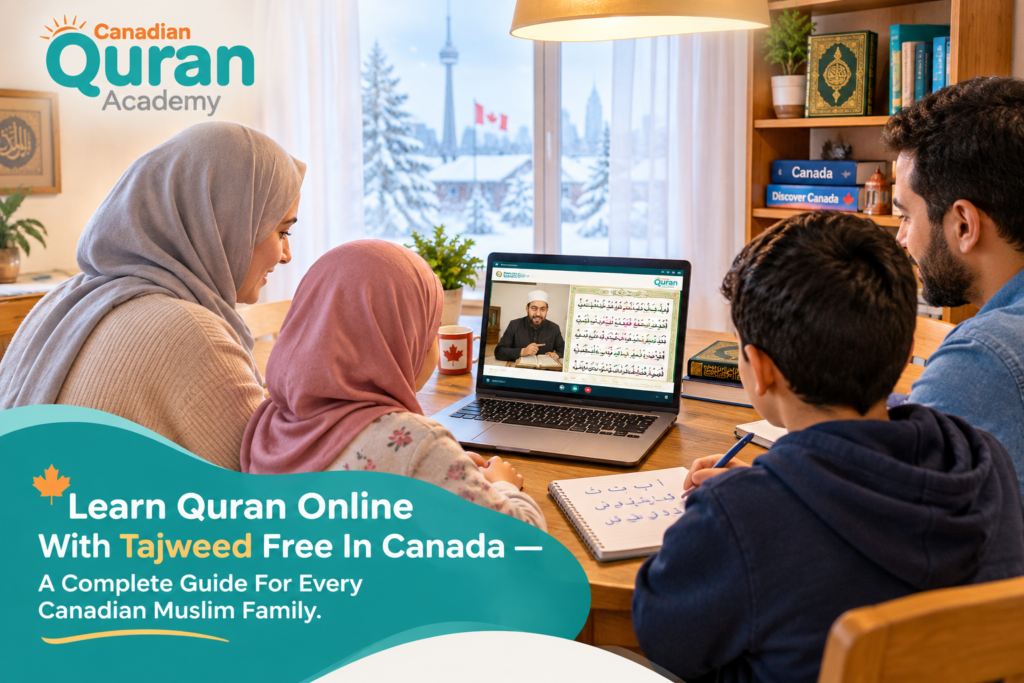
Canadian Quran Academy is one of the few platforms designed with the Canadian Muslim student specifically in mind, scheduling flexibility that accounts for all four time zones, a curriculum built around the hafs narration standard.
In addition to the instructors who understand the bilingual household dynamic that many second-generation Canadian Muslims navigate between Arabic and English.
The academy offers a free first session for new students that functions as both a placement assessment and a teaching demonstration.
Unlike platforms that assign generic beginner courses to everyone, the intake session identifies which primary Tajweed rule family, nun sakinah, meem sakinah, madd rules, heavy and light letters, or stopping rules, the student needs to address first.
Weekend-only enrollment is available for professionals and parents with constrained weekday schedules.
For those exploring how to learn Quran in Canada through a structured, timezone-aware platform, the academy’s intake process is designed to place you correctly from session one rather than starting every student at the same generic level.
Read also: How To Learn Quran Quickly In Canada?
2. Begin With Free Trial Sessions From Certified International Online Quran Academies
Several globally recognized online Quran academies offer free trial sessions accessible to Canadian residents. These platforms staff instructors from Egypt’s Al-Azhar university system and equivalent institutions.
Teachers who hold formal ijazah certification, meaning their recitation chain traces through named scholars back to the Prophet ﷺ. The practical value of a free trial is diagnosis before commitment.
One session with a qualified teacher reveals whether a student’s errors live in makharij (pronunciation), sifaat (letter characteristics), or ahkam (rule application), three distinct problems requiring different remedies.
When evaluating a free trial, ask three questions: Is the instructor ijazah-certified? Does the platform confirm availability in your specific Canadian province’s time zone?
And does the trial session include actual pronunciation feedback — or primarily a product pitch? The answers separate serious educational platforms from marketing exercises.
Master Multiple Quranic Recitation Styles Through Canadian Instruction

3. Search For Mosque And Islamic Centre Online Programs
Canada’s mosque network is more extensive and more digitally organized than many residents realize. Organizations like the Islamic Society of North America (ISNA Canada) offer remote Quran learning sessions.
As well as local masjid federations in Ontario and British Columbia, and community Islamic centres across Alberta offer the same remote sessions. Many of these sessions are fully free for community members and conducted entirely online.
A mosque-based online class typically runs as a cohort of five to fifteen students meeting a single instructor at fixed weekly times via Zoom or Google Meet, providing the kind of accountability that self-paced apps cannot replicate.
A. How To Find Mosque Online Tajweed Programs In Your Province?
The most reliable method is a direct phone call, not an email, which often goes unanswered, to the Islamic centre nearest to you.
Ask specifically whether the centre runs online Quranic classes, and whether those classes are open to non-attendees of the physical masjid (many are).
Mosques in Ontario and British Columbia tend to have the most developed programs due to community size, but centres in Halifax, Fredericton, and Winnipeg have substantially expanded their online offerings in recent years.
B. How To Join A Quran Learning Circle Online For Free?
Most mosque-based circles require brief registration, name, age, and current Quran reading level — before assigning a session time.
The group size is small enough that instructors provide individual correction during group recitation using the classical tasmee’ method: each student reads aloud while others listen, and the teacher corrects errors in real time.
This structure accelerates progress faster than solo study because errors invisible to the learner’s own ear become apparent when the same mistake emerges in another student’s recitation, a mirror effect that no digital tool replicates.
Begin Quran Learning With Female Instructors in Canada Today

C. What To Expect In The First Session?
Expect the first session to involve a five-minute recitation of Surah Al-Fatiha, Surah Al-Ikhlas, or a designated beginner passage for the teacher’s placement assessment.
Attendance is expected consistently, unlike commercial platforms where you self-schedule, so treat a mosque circle with the same calendar commitment as an in-person class.
Live Class in Action
Watch how our instructors interact with students in real-time, focusing on interactive methods.
Start Your Quranic Journey in Canada
Join our vibrant community and learn with expert tutors through our flexible online platform.
Claim Your Free Trial4. Study The Noorani Qaida As The Non-Negotiable Foundation
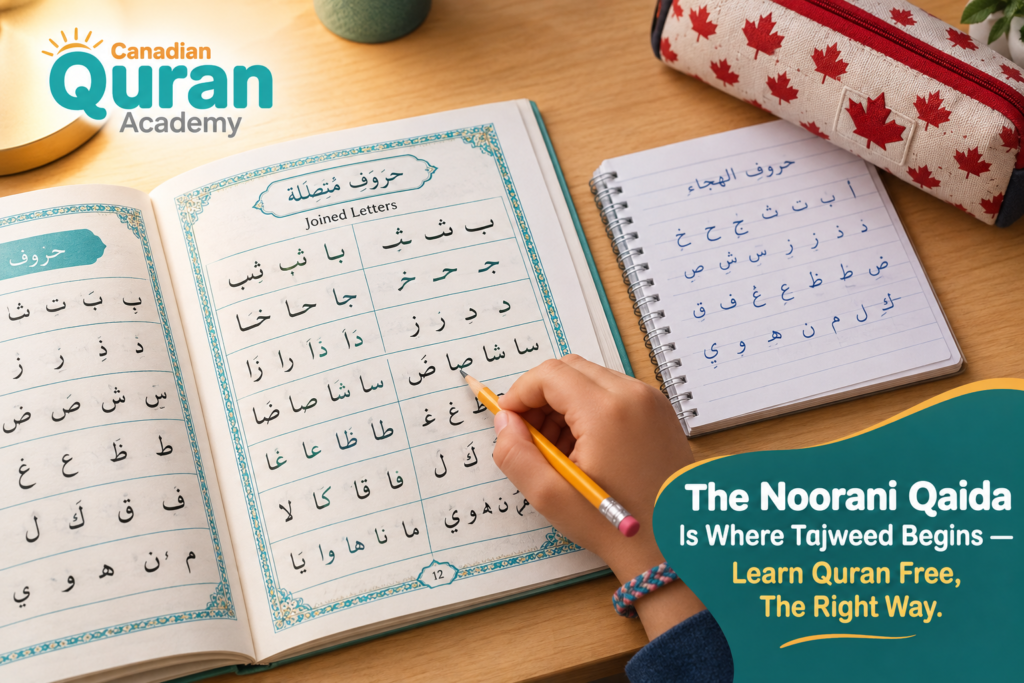
One of the most consequential errors in online Tajweed self-study is skipping the Noorani Qaida. This structured Arabic primer, developed on the subcontinent and now standard across Tajweed curricula globally.
It builds letter recognition, combination reading, and pronunciation habits before a student encounters the Quran text at the surah level. The Qaida is not supplementary material. It is the phonics foundation of Quranic Arabic.
A student who jumps directly to surah-level recitation without completing the Qaida’s letter charts, joining exercises, and vowel drills will accumulate pronunciation errors that calcify into habits, errors that take significantly longer to correct
The detailed breakdown in the Arabic Noorani Qaida guide explains what each stage covers and why skipping stages produces compounding problems months later.
The Noorani Qaida typically takes six to ten weeks to complete with a teacher, or ten to sixteen weeks when self-directed.
Canadian residents who want to learn Quran free without a paid platform can begin with the Qaida as a fully independent starting point before progressing to surah-level study.
5. Watch YouTube Tajweed Courses From Licensed Scholars With Structured Playlists
YouTube hosts a range of Tajweed instruction, from disorganized single-topic clips to genuinely comprehensive, sequenced courses delivered by ijazah-certified scholars.
The challenge for Canadian learners is identifying structured playlists from the surrounding noise, and understanding clearly what YouTube can and cannot provide. What YouTube provides effectively is theoretical grounding.
A learner can develop accurate knowledge of idghaam categories, understand the five madd types, and follow visual explanations of makharij charts through well-produced video content tied to institutional curricula.
What YouTube cannot provide is live correction: Tajweed errors are acoustic, existing in the sound of a recitation rather than on a page. A student learning to learn Tajweed online free through video alone develops theoretical awareness without acoustic habit.
The correct model is to pair YouTube content with at least one weekly live session where an instructor corrects what the student practiced that week.
Passive consumption of recorded content without periodic live feedback is the primary reason committed self-studiers plateau within months.

6. Download Tajweed Mobile Apps With Audio Feedback And Progress Tracking
Several mobile applications now offer Tajweed instruction with features that go well beyond passive playback.
The most useful include phoneme-level comparison, color-coded Tajweed symbol overlays on actual Quranic text, and level-based progression systems that do not advance a learner until competency in a specific rule category is demonstrated.
Apps do not replace a teacher for diagnosis, but they function effectively as a daily practice environment between live sessions. The correct model for Canadian learners is not app instead of teacher, but app plus teacher.
The app provides daily contact with the material, while the live session provides the acoustic correction no algorithm currently matches.
Read also: Quranic Verses on Education in Arabic.
A. Apps That Offer Consistent Audio-Level Feedback
The most practically useful apps provide color-coded overlays on Quranic text in real time, so a learner reciting Surah Al-Baqarah can see simultaneously which letters carry tafkheem, which require ghunna, and where an idghaam with ghunna applies.
This combined visual and audio reinforcement trains the eye and ear simultaneously, accelerating rule retention compared to studying Tajweed theory in a separate workbook.
B. Apps That Support Offline Access For Remote Canadian Communities
For learners in Northern Ontario, rural Alberta, or areas with unreliable high-speed internet, offline-capable apps are a practical necessity rather than a convenience.
Several established Quran applications allow full course content download ahead of time, enabling a student in a remote location to complete a full Tajweed lesson from downloaded material and sync progress when connectivity resumes.
This feature should be confirmed before selecting any platform if your location has variable coverage.
Start Quranic Arabic Training That Unlocks Direct Textual Access

7. Join The Charity-Funded Quran Programs Available To Canadian Residents
A number of registered Canadian Islamic charities operate ongoing Quran teaching programs funded through zakat, sadaqah, or government non-profit grants.
These programs are specifically designed to remove financial barriers from Quran education and are open to all Canadian Muslim residents regardless of income level or provincial location.
These programs differ from free trials in one structural way: they are not designed to convert students to a paid subscription. A charity-funded program’s sole purpose is making Quran education accessible as a community good.
The better-organized programs, particularly those affiliated with established Canadian Islamic charities, run structured curricula with qualified volunteer instructors who hold legitimate teaching credentials.
Finding these programs requires community connection more than internet search. Ask directly at your local mosque, check bulletin boards at Islamic community centres.
Or enquire with Muslim Student Associations at Canadian universities, many of which coordinate Tajweed circles through alumni and faculty networks that are open to community members.
Enroll Your Child in Online Quran Classes Across Canada Today

8. Participate In The Recitation Accountability Circles Within Canadian Muslim Communities
The least discussed but often most sustainable form of ongoing Tajweed practice is the informal peer accountability circle.
Two to six individuals who commit to reciting together online weekly, each listening critically to the others within the limits of their own knowledge and tracking errors through shared notation or recorded feedback.
This model works most effectively when at least one participant has a stronger Tajweed background, not ijazah-certified, but trained sufficiently to catch common errors such as incorrect madd lengths, inconsistent ghunna, or improper iqlab application.
The peer dynamic produces the one ingredient that solo study and app-based Quran learning online free cannot generate: real-time external accountability to individuals who share your commitment.
Canadian Muslim communities in Mississauga, Edmonton, Calgary, Brampton, and Ottawa have developed WhatsApp-based Tajweed recitation circles operating in exactly this format.
A search through local mosque WhatsApp groups, Muslim community Facebook groups, or university MSA digital spaces will typically surface at least one active group welcoming new participants.
Perfect Your Quranic Recitation With Canada’s Leading Academy

Why Learning Tajweed Properly Matters More Than Learning It Quickly
Speed is consistently the wrong goal in Tajweed education. A student who works through makharij slowly, spending three weeks on the throat letters alone (hamzah, haa al-mufradah, ain, ghain, khaa, haa al-malfuzah).
He builds phonemic muscle memory that persists across decades of daily recitation.
A student who rushes through a recorded series over a weekend acquires theoretical knowledge without the acoustic habit that theoretical knowledge is meant to produce.
The scholars of Tajweed historically measured progress not in weeks but in khatmaat, complete, teacher-supervised recitations of the full Quran from Al-Fatiha through An-Nas.
This method is slow by modern expectations and remains the most effective available. Online platforms that mirror this structure, regular live sessions, teacher-corrected recitation, are the most worth committing to, whether paid or free.
For parents deciding when to begin this process with their children, timing and developmental readiness carry specific considerations separate from adult learning pathways.
Families navigating that question will find age-appropriate starting points and practical methods outlined in the guide on how to learn Quran for kids in Canada.
For those wanting to deepen the Arabic foundation that makes Tajweed comprehensible rather than mechanical, the guide on how to learn Arabic for Quran in Canada covers that adjacent path in practical, sequenced detail.
Experience Our Classrooms
Don’t just take our word for it—take a look inside! Watch the videos below to experience our engaging teaching methods and vibrant online classrooms firsthand.
Start Your Quranic Journey in Canada
Join our vibrant community and learn with expert tutors through our flexible online platform.
Claim Your Free TrialStart Your Free Tajweed Journey With Canadian Quran Academy Today
Learning Quran with Tajweed online free in Canada does not require compromising on teacher quality, session structure, or curriculum coherence.
Canadian Quran Academy connects Canadian residents, across EST, CST, MST, and PST, with ijazah-certified instructors and a teaching method designed to correct errors at the acoustic level, not only on paper.
Your first session is free. In that session, a certified instructor assesses your current recitation, identifies your primary error patterns across makharij and applied ahkam, and outlines a clear progression from your current level to confident, accurate Quran recitation.
Our Quran Courses:
- Tajweed Course for Ladies
- Quran Reading Classes
- Online Quran Classes for Kids
- Quran Ijazah Program
- Quran Tafsir Course
- Noorani Qaida Course
Book your FREE trial class today and begin your Quran journey with Tajweed at The Canadian Quran Academy.

Conclusion
The eight pathways in this guide span a wide range of formats,from one-on-one certified instruction through Canadian Quran Academy, to mosque-based online circles, charity-funded programs, YouTube courses, mobile apps, and peer accountability groups.
What every pathway shares is a single destination: recitation that matches how the Prophet ﷺ recited, transmitted through an unbroken oral chain and now accessible to Canadian Muslims regardless of province, schedule, or financial situation.
The most important decision is not which platform to start with. It is to start — and to prioritize live correction at least occasionally above passive consumption of recorded content.
Quran learning online free in Canada is a genuine reality, not a marketing promise. But free does not mean without structure, and accessible does not mean without accountability.
Pair the right entry point from this guide with consistent practice and at least one live correction session per week, and the standard of accuracy the Quran deserves is well within reach — from wherever in Canada you are reciting.
Frequently Asked Questions
Can I Really Learn Quran With Tajweed Online For Free In Canada?
Yes, several genuinely free pathways exist for Canadian residents, including mosque-based online circles, charity-funded programs, and structured YouTube playlists from certified scholars. The most effective free approach pairs live correction through a mosque or charity circle with daily app-based practice.
How Long Does It Take To Learn Tajweed From Scratch?
An adult with no prior Arabic reading background typically reaches functional Tajweed accuracy, consistent correctness across the core rule categories, in 12 to 18 months of weekly live sessions combined with daily practice.
The Noorani Qaida phase alone takes six to twelve weeks with a teacher, or ten to sixteen weeks when self-directed.
What Is The Best Starting Point For A Complete Beginner In Canada?
The Noorani Qaida, completed under teacher supervision, is the correct entry point for any learner who does not yet read Arabic fluently.
Beginning at surah-level recitation before completing the Qaida produces pronunciation errors that are significantly harder to correct later.
Do Online Tajweed Teachers Correct Pronunciation Errors Effectively?
A qualified instructor corrects pronunciation errors effectively in a live online session, provided the audio connection is clear and the microphone picks up the student’s voice without heavy compression.
Most platforms use Zoom or similar tools with adequate audio fidelity. Correction is acoustic and immediate, the teacher listens to recitation in real time and intervenes precisely when an error occurs.
Is Tajweed Obligatory For Every Muslim?
Classical scholars distinguish two rulings. Knowing the theoretical rules of Tajweed is fard kifayah, a collective obligation that, if fulfilled by some in the community, removes the individual requirement from others.
Applying Tajweed during recitation is fard ‘ayn, individually required of every Muslim who recites the Quran.
What Is The Difference Between Free Online Tajweed Programs And Paid Courses?
Free online Tajweed programs typically offer less scheduling flexibility, larger group sizes, and fewer individualized correction sessions than paid platforms. Charity-funded and mosque programs prioritize community access over customization.
Paid platforms provide dedicated session slots, individual instructor attention, and quality accountability through institutional standards.





Leave a Reply