 Arabic

Your child may recite Al-Fatihah beautifully without knowing what the words mean. Many Muslim families across Canada run into this, and it is often the moment parents start searching for a way to learn Arabic for kids online free in Canada.
You’re far from alone. The 2021 Census counted about 290,000 Canadians who mainly speak Arabic at home, which makes it one of the fastest-growing non-official languages in the country. Many more families want their children to read the Quran and understand it.
This guide covers the free options that work, the right age to start, what a strong kids’ curriculum includes, and how to keep your child motivated. By the end, you’ll have a clear plan for starting this week.
1. Mosque and Weekend Islamic School Programs
Many mosques in Toronto, Mississauga, Ottawa, Calgary, and Montreal run free or low-cost weekend Arabic classes. They’re great for community and friendships, to learn arabic for kids online free in Canada.
Weekend programs often mix Arabic with Islamic studies, duas, and short surahs. Children get a well-rounded introduction to their faith, not just the language.
Seeing other Muslim kids learning the same letters motivates many children. That sense of belonging matters a lot for kids growing up as a minority in Canadian schools.
The downside is that group sizes are often large. Your child may get only a few minutes of one-on-one attention in each session.
So, before you enroll, ask about class size, teacher qualifications, and how progress is tracked. These answers tell you how much individual help your child will actually get.
2. Public School International Languages Programs
These programs usually run after school, on Saturdays, or in summer sessions. Each school board sets its own schedule, so check your local board’s website each term.
Several Ontario school boards run International Languages Elementary programs, and Arabic is often one of the languages offered. These classes are usually free for students.
In addition, registration often needs a minimum number of students before a class can open. In smaller cities, Arabic may not be offered every year, so sign up early when it is.
School-based classes are a good fit for everyday speaking and listening practice. Families who want Quran reading usually pair them with a dedicated Quran or Tajweed tutor. But places are limited, though, and the focus is on conversational Arabic rather than Quranic reading.
3. Free Apps and Video Channels
The third way to learn Arabic for kids online free in Canada is free apps and video channels. Short, colourful lessons suit young attention spans well. A 10-minute app session after dinner is an easy way to review letters your child learned that week.
Before handing over a device, check that the app is ad-free and has parental controls. Some “free” apps lock most of their lessons behind a paid subscription.
Apps such as Alef and Amal help young children recognize letters through games and songs. They work well as practice tools, especially for kids aged 4 to 7.
Apps can’t correct pronunciation or teach Tajweed. Treat them as a supplement, not a full course. So, sit with younger children while they use these tools and repeat the sounds together. Screen time becomes shared learning instead of passive tapping.
Free Arabic Learning Apps for Kids
Educational apps turn Arabic practice into short, game-like sessions that children look forward to. Here are some trusted free options that help kids learn letters, sounds, and their first words.
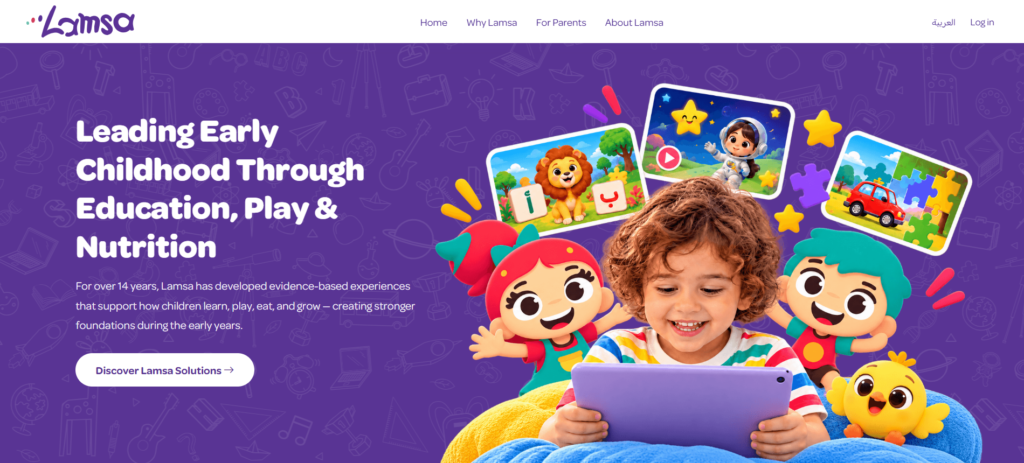
Lamsa is a popular Arabic-language app for children aged about 2 to 8. It uses animated stories, songs, and simple games to teach letters and words. The free version gives a limited selection, and a paid plan opens the full library.
Duolingo offers a free Arabic course built on short, game-style lessons with streaks and rewards. It suits children aged 8 and up who can read on their own. It covers the Arabic script, letter sounds, and basic everyday words.
Read Along by Google is the third way to learn Arabic for kids online free in Canada. It is a free app that listens to your child read aloud and gently helps when they get stuck. It includes Arabic stories and needs no subscription or in-app purchases. It works best once your child already knows the letters and short vowels.
Free YouTube Channels for Learning Arabic
Videos let children hear native pronunciation and pick up new words through songs and stories. These free channels are a good fit for kids who want to learn Arabic at home.
Learn with Zakaria (تعلم مع زكريا) is a YouTube channel made for young Arabic learners. Short, colourful videos teach the alphabet, numbers, colours, animals, and greetings. Clear pronunciation and catchy songs help children remember new words quickly.
Iftah Ya Simsim is the Arabic version of Sesame Street, and many episodes are free on YouTube. Friendly characters teach letters, numbers, and social skills in simple Modern Standard Arabic. It’s a fun way for kids to hear natural Arabic outside lesson time.
Omar & Hana is an Islamic cartoon for preschool and early elementary children. Its songs and stories teach prayer, kindness, honesty, and respect, with Arabic phrases and duas throughout. It pairs naturally with Quran and Arabic lessons at home.

Live Class in Action
Watch how our instructors interact with students in real time, focusing on interactive methods.
Start Your Quranic Journey in Canada
Join our vibrant community and learn with expert tutors through our flexible online platform.
Claim Your Free Trial4. Free Trial Lessons at Online Quran and Arabic Academies
A trial class shows you right away how a teacher explains letters, corrects mistakes, and keeps a child engaged. That’s hard to judge from a website or a video.
Use the session to ask about lesson length, the curriculum, and how parents receive progress updates. Clear answers are a good sign of a well-organized academy.
Most reputable online academies offer a free trial class. It’s the best no-cost way to see whether a qualified teacher, a structured curriculum, and your child’s learning style fit together.
For families looking to learn Arabic for kids online for free in Canada, a trial is a low-risk first step. You get expert guidance before spending anything.
At Canadian Quran Academy, a trial session lets your child meet a teacher, get a gentle level assessment, and try a real lesson before you commit to anything.

Why Arabic Matters for Canadian Muslim Children
Arabic gives children more than a second language. It connects them to their faith, their families, and important thinking skills.
1. A Direct Connection to the Quran
When children understand Arabic, the Quran stops being a string of memorized sounds and becomes a message they can reflect on. Their prayers feel more personal, and their recitation grows more confident.
This is why Arabic and Tajweed go so well together. Understanding the words supports correct pronunciation, and correct pronunciation protects the meaning.
2. Cognitive and Academic Benefits
Research on bilingual children consistently links learning a second language to stronger attention, problem-solving, and memory. Children who move between languages tend to become more flexible thinkers.
Arabic’s right-to-left script and rich root system add their own mental workout, which supports literacy in English and French too.
3. Stronger Family and Cultural Ties
For many Arab-Canadian families, Arabic keeps grandparents, cousins, and heritage close. Statistics Canada reports that more than three-quarters of Arabs in Canada speak both Arabic and an official language.
Keeping Arabic alive in the next generation helps children feel rooted in both identities.
Experience Our Classrooms
Don’t just take our word for it—take a look inside! Watch the videos below to experience our engaging teaching methods and vibrant online classrooms firsthand.
Start Your Quranic Journey in Canada
Join our vibrant community and learn with expert tutors through our flexible online platform.
Claim Your Free TrialWhat Age Should Children Start Learning Arabic?
Most children are ready for structured Arabic lessons between ages 4 and 6. At that age, they pick up new sounds easily and enjoy learning through repetition, songs, and play.
Older children and teens can start at any time. They usually progress faster in reading because they already understand how writing systems work.
Ages 4–6: Building the Arabic Alphabet Through Play
Children at this age learn best through movement, colour, and song. Tracing letters in sand or matching letter cards makes each sound easier to remember Keep sessions to 20–30 minutes. Focus on letter shapes, sounds, and simple words using visuals and games.
A structured start with our Noorani Qaida course for kids gives young learners a solid foundation. Each letter and sound builds on the one before it.
Ages 7–10: Building Reading Skills and Everyday Words
Children at this stage can join letters into words and read short sentences on their own. Regular reading aloud builds both speed and confidence.
This is the sweet spot for building fluent reading with short vowels (harakat) and everyday vocabulary. Kids this age can handle 30–45 minute lessons.
Our Arabic course for kids turns reading practice into real vocabulary that children can use at home and at the mosque.
Ages 11+: Understanding the Language of the Quran
Pre-teens and teens enjoy seeing how Arabic words come from three-letter roots. This pattern helps them guess meanings and grow their vocabulary quickly.
Older learners can study basic grammar and start understanding short surahs. Lessons can also connect Arabic directly to Quranic meaning and Tajweed rules.
Older learners can take reading further with our Tajweed course for kids, where Arabic skills turn into accurate, beautiful Quran recitation.

What Does a Good Kids’ Arabic Curriculum Include?
A strong curriculum moves step by step, so your child never feels lost. Before you choose a free or paid option, check that it covers these four stages.
Stage 1: The Arabic Alphabet and Noorani Qaida
Children learn the 28 letters, how each changes shape in a word, and the correct sound from the right point of articulation (makhraj). Noorani Qaida is a trusted method for this foundation.
Stage 2: Reading With Harakat
Next, kids learn fatha, kasra, damma, sukoon, and shaddah. Once they master these, they can read almost any Arabic word, including Quranic text.
Stage 3: Vocabulary and Simple Conversation
Everyday words like colours, family members, and numbers make Arabic feel useful and fun. Short dialogues build speaking confidence.
Stage 4: Linking Arabic to Quran Recitation
The final stage connects reading skills to correct recitation and basic Tajweed. This is where many families see the biggest spiritual payoff.
Canadian Quran Academy’s Arabic and Tajweed programs follow this same path, so children move from letters to confident Quran recitation without gaps.

Tips to Keep Your Child Motivated at Home
Consistency matters more than intensity. A few small habits make a big difference.
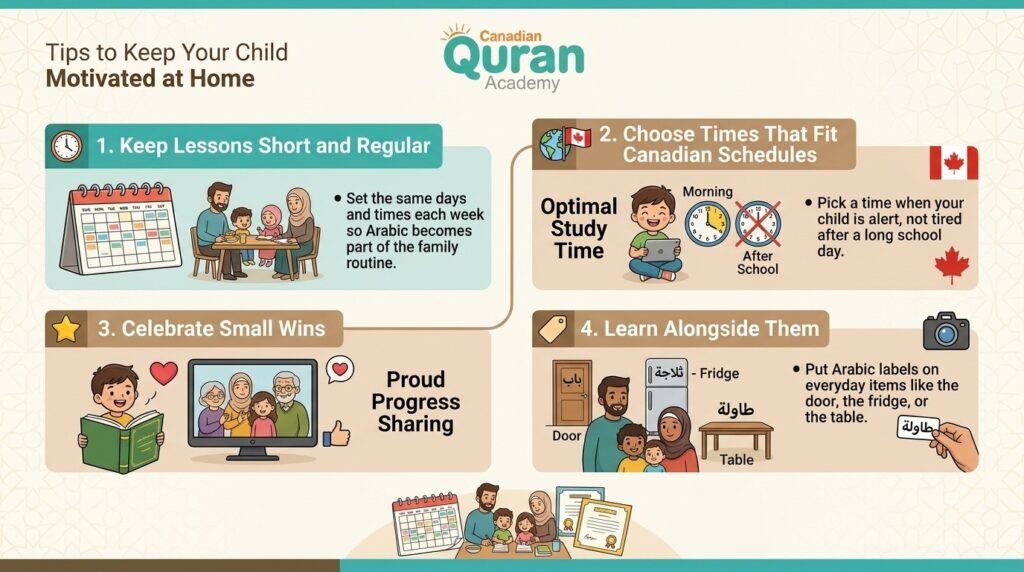
1. Keep Lessons Short and Regular
Set the same days and times each week so Arabic becomes part of the family routine. Children resist less when lessons feel as normal as homework or soccer practice.
Three 30-minute lessons a week beat one long weekend session. Short, frequent practice helps letters and words stick.
2. Choose Times That Fit Canadian Schedules
Pick a time when your child is alert, not tired after a long school day. Many families find that weekend mornings or right after an after-school snack work best.
Online classes let you book after school or on weekends in your own time zone, whether you’re in Vancouver, Winnipeg, or Halifax. No commuting, no winter-road stress.
3. Celebrate Small Wins
Share progress with grandparents or relatives through a short video of your child reading. Encouragement from family makes children proud to keep going.
Praise your child for reading a new word or finishing a surah. A simple sticker chart or a family “Arabic moment” at dinner builds pride.
4. Learn Alongside Them
Put Arabic labels on everyday items like the door, the fridge, or the table. Learning together at home turns the whole house into a gentle Arabic classroom.
You don’t need to speak Arabic to help. Sit in on a lesson, repeat new words together, and show that you value the effort.
If you’d like a teacher to guide this journey, the academy’s kids’ classes are designed with these habits in mind: short sessions, patient tutors, and regular updates for parents.
Book Your Child’s Free Arabic Trial Class Today
Give your child a strong, confident start in Arabic with a teacher who understands young learners. Our one-on-one online classes take your child from the alphabet to fluent Quran reading, at a pace that fits them.
Every lesson is live, interactive, and scheduled around Canadian time zones. Qualified teachers focus on correct pronunciation, Tajweed, and real understanding, so your child learns the right way from the first day.
Our Arabic Courses
- Online Arabic Academy
- Online Arabic Course
- Classical Arabic Course
- Arabic Course for Beginners
- Advanced Arabic Course
- Quranic Arabic Course
- Arabic Grammar Course
- Modern Standard Arabic Course
- Arabic Conversation / Speaking Course
- Online Arabic Classes for Kids
- Arabic Classes for Adults
- Arabic Classes for Ladies
Your free trial comes with no obligation. Meet the teacher, get a level assessment, and see your child’s excitement for yourself. Spots fill quickly, so reserve your session now.
Book your free trial lesson now.
Start Your Quranic Journey in Canada
Join our vibrant community and learn with expert tutors through our flexible online platform.
Claim Your Free TrialConclusion
Every family’s path looks a little different, and that’s okay. What matters most is choosing a starting point today and building on it step by step.
Choosing to learn Arabic for kids online for free in Canada is one of the most meaningful investments you can make in your child’s faith and future. Free apps, mosque programs, and school language classes each have a role to play.
The most reliable progress comes from a clear curriculum and a teacher who can correct pronunciation. Starting between ages 4 and 6 is ideal, but any age is a good age to begin, and short regular lessons work best.
If you’re ready to learn Arabic for kids online for free in Canada with expert support, a free trial class lets your child begin with a qualified teacher and no commitment.
Takeaway message: Start free, stay consistent, and pair Arabic with Quran recitation. A free trial class is the simplest first step to see which path suits your child.
Frequently Asked Questions
Can kids learn Arabic online for free in Canada?
Yes. Kids can use free apps, YouTube channels, mosque weekend programs, and school International Languages programs. For structured, teacher-led learning, start with a free trial class from an online academy before committing.
How long does it take a child to read Arabic?
Most children can read basic Arabic with harakat in 3 to 6 months with two or three lessons a week. Progress depends on age, consistency, and practice at home.
Can my child learn Arabic and Quran at the same time?
Yes, and it’s often the most effective approach. Reading skills from Arabic lessons transfer directly to Quran recitation, and Tajweed practice reinforces correct letter sounds.
Are online Arabic classes safe for children?
Reputable academies use secure video platforms, trained teachers, and parent access to every session. Parents can sit in, review progress, and talk with the teacher at any time.
Do parents need to speak Arabic to help their child?
No. Parents can support learning by keeping a steady schedule, encouraging practice, and learning a few words alongside their child. The teacher handles the language instruction.





Leave a Reply