 Arabic
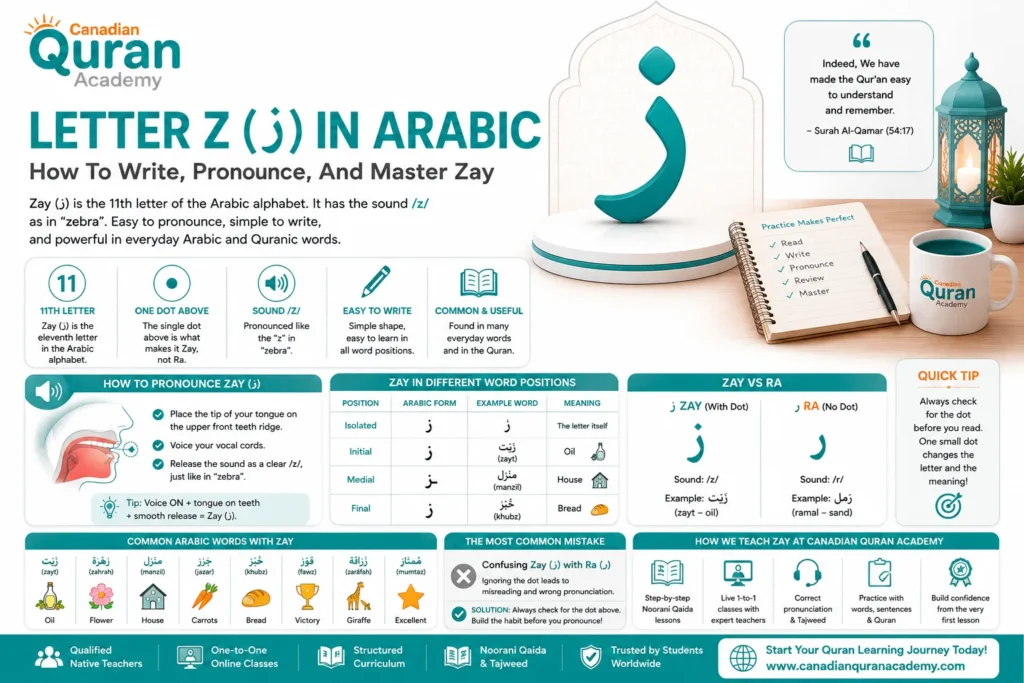
Every Arabic learner eventually hits the same two-letter puzzle: ز and ر look almost identical, yet one is a “z” and the other is an “r.” The letter Z in Arabic – ز, known as Zay, is actually one of the easiest sounds for English speakers to produce — the challenge is visual, not vocal.
This guide walks you through everything Canadian Quran Academy teaches new students about Zay: its shape, its three word positions, the correct articulation point, real vocabulary, and the exact mistake that trips up almost every beginner.
By the end, you’ll read, write, and pronounce the letter Z in Arabic – ز with confidence.
What you’ll learn in this article
- What the letter Zay (ز) is and how it differs from Ra (ر)
- How Zay changes shape across the isolated, initial, medial, and final word positions
- The correct tongue placement (makhraj) and phonetic attributes (sifat) for pronouncing ز
- Common Arabic words and a Quranic example that use the letter Z
- The single most frequent mistake learners make with this letter, and how to fix it
- How Canadian Quran Academy structures lessons for children learning Zay
What Is The Letter Zay (ز) In Arabic?
Zay (ز) is the eleventh letter of the Arabic alphabet, and it represents the sound “z” — the same voiced sound in the English words “zebra” and “zoo.”
Because its shape and sound are so distinct once you know what to look for, the letter Z in Arabic – ز is generally considered one of the more approachable letters in the alphabet. In the Abjad numeral system, Zay also carries the value seven, a detail used in classical Arabic outlines and dating conventions.
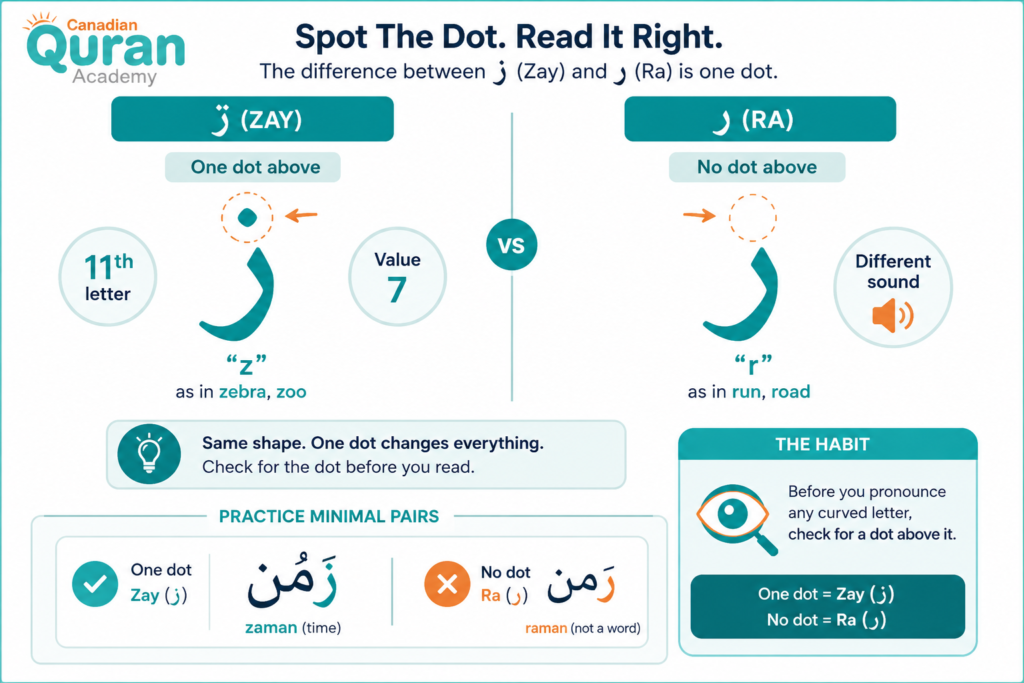
Zay’s shape is a single curved stroke resting on the baseline, topped with one dot. That one dot is the entire difference between ز (Zay) and ر (Ra) — remove it, and you’re reading a completely different letter with a completely different sound.
Zay and Ra share the exact same base curve. Beginners scanning quickly often skip over the dot entirely, especially in handwriting or decorative fonts where dots sit close to the letter body.
The fix is a habit, not a trick: before you pronounce any letter shaped like a curved hook, check for a dot above it first. One dot means Zay; no dot means Ra. Practicing minimal pairs — زَمَن (zaman, “time”) against a non-word like “raman” — trains this recognition until it becomes automatic.
Read Also: How To Learn Arabic In 5 Minutes In Canada?
Read also: The Arabic Letter Taa (ت) – Pronunciation, Writing, And Meaning
How Zay Changes Shape In Different Word Positions?
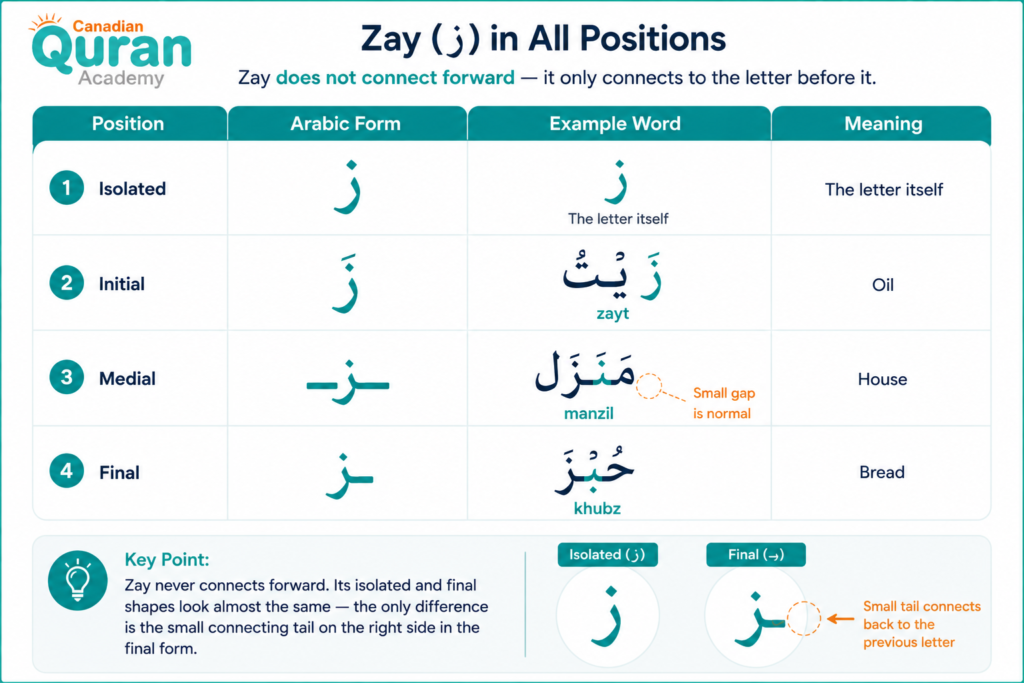
Zay belongs to a small group of non-connecting Arabic letters — along with Ra, Dal, Dhal, and Waw — meaning it connects to the letter before it but never to the letter after it. This rule holds true in every single word, with no exceptions.
Because Zay refuses to connect forward, its medial form still leaves a small visual gap before the next letter begins. Learners sometimes mistake this gap for a word break, so it’s worth training your eye to recognize it as normal mid-word spacing.
| Position | Arabic Form | Example Word | Meaning |
| Isolated | ز | ز | The letter itself |
| Initial | زَ | زَيْت | Oil |
| Medial | ـزـ | مَنْزِل | House |
| Final | ـز | خُبْز | Bread |
Because Zay never connects forward, its isolated and final shapes look almost the same — the only difference is the small connecting tail on the right side of the final form, linking back to the previous letter.
This is a detail Canadian Quran Academy instructors point out early, since it prevents learners from over-complicating a genuinely simple letter.
Common Arabic Words That Contain The Letter Z
Recognizing the letter Z in Arabic – ز in isolation is only step one. Reading it inside real vocabulary is where the letter actually sticks.
| Arabic Word | Transliteration | Meaning | Zay Position |
| زَيْت | Zayt | Oil | Initial |
| زَهْرَة | Zahrah | Flower | Initial |
| مَنْزِل | Manzil | House | Medial |
| جَزَر | Jazar | Carrots | Medial |
| خُبْز | Khubz | Bread | Final |
| فَوْز | Fawz | Victory | Final |
| زَرَافَة | Zarāfah | Giraffe | Initial |
| مُمْتَاز | Mumtāz | Excellent | Medial |
زَيْت (zayt, “oil”) is the single most useful anchor word for Zay. It appears constantly in everyday Arabic, keeps Zay in the initial position where the dot is easiest to spot, and pairs naturally with زَيْتُون (zaytūn, “olive”), reinforcing the same root.
Live Class in Action
Watch how our instructors interact with students in real-time, focusing on interactive methods.
Start Your Quranic Journey in Canada
Join our vibrant community and learn with expert tutors through our flexible online platform.
Claim Your Free TrialHow To Pronounce The Letter Zay Correctly?
Zay is pronounced with the tip of the tongue placed lightly against the edge of the upper front teeth (الثنايا العليا), letting air flow through to create a buzzing, voiced friction. This is close to the interdental fricative position, and it’s classified as a sibilant sound in classical Arabic phonetics.
Place a hand on your throat while saying “zzzzz” — you should feel a clear vibration. That vibration is what separates Zay from an unvoiced “s” sound, which is the most common pronunciation slip English speakers make.
Read also: Letter Sad ص In Arabic – How To Pronounce, Write, And Recognize
The Phonetic Attributes Of Zay
Tajweed science defines every Arabic letter by a set of fixed attributes. Zay carries five of them, and each one shapes how the letter should sound in recitation.
| Attribute | Classification | What It Means |
| Voicing | Voiced (مَجْهُور) | Vocal cords vibrate during production |
| Airflow | Sibilant (صَفِير) | Sharp, whistling-like friction |
| Openness | Open (مُنْفَتِح) | Tongue does not rise to the palate |
| Position | Low (مُسْتَفِل) | Tongue stays low in the mouth |
| Flow | Rakhawah (رَخَاوَة) | Air flows continuously, not a stopped sound |
A common pronunciation mistake is over-emphasizing the buzz until it sounds forced. Zay should be clean and moderate — the same natural weight you’d give the “z” in “zero,” not an exaggerated hiss.
If your goal is Quranic recitation rather than conversational Arabic, precision on these five attributes matters directly for tajweed accuracy — a topic Al-Azhar Arabic Course at Canadian Quran Academy covers in structured, letter-by-letter detail with certified instructors.
Zay In Quranic Recitation And Tajweed
Zay appears frequently throughout the Quran, and its sibilant quality (safir) means it should always be recited with a light, clear buzz — never softened into an “s” or over-hardened.
A well-known example is the word نَزَّلْنَا (nazzalnā) in Surah Al-Hijr:
“إِنَّا نَحْنُ نَزَّلْنَا الذِّكْرَ وَإِنَّا لَهُ لَحَافِظُونَ”
“Indeed, it is We who sent down the Reminder, and indeed, We will be its guardian” (Al-Hijr 15:9).
Here, Zay carries a shaddah, meaning the buzzing sound is held slightly longer than usual — a practical drill for controlling the letter’s duration in recitation.
Students working specifically on tajweed accuracy alongside letter recognition often benefit from a course built around that exact sequencing.
Canadian Quran Academy’s Madinah Arabic Course follows this structure, moving from letter shapes to full recitation fluency under guided instruction.
Read also: Letter Sad ص In Arabic – How To Pronounce, Write, And Recognize
How Children Learn The Letter Zay Effectively?
Young learners retain letters faster when each one is anchored to a vivid, familiar image rather than taught as an abstract shape.
زَرَافَة (zarāfah, “giraffe”) works well for this because the initial “z” sound is memorable and the animal image is easy to visualize.
Other child-friendly Zay words include زَهْرَة (flower), زَبَادِي (yogurt), and زِنْجِبِيل (ginger). Pairing each word with a flashcard image, then having the child trace the letter while saying its sound aloud, engages visual, auditory, and physical memory at once — a combination that speeds up retention noticeably compared to rote repetition.
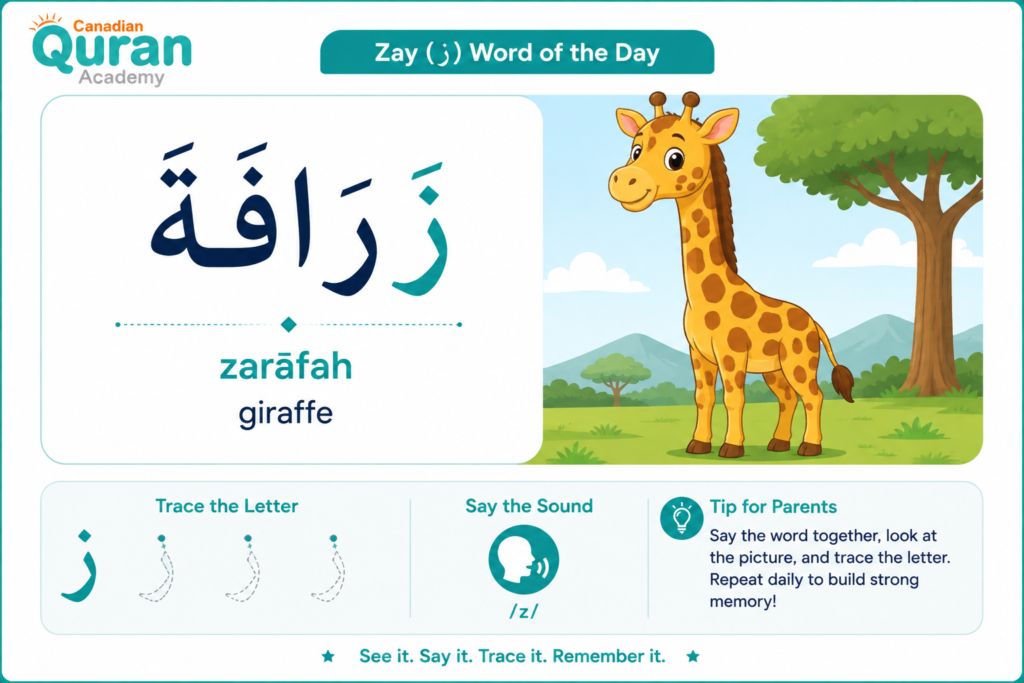
This is the exact approach used in Canadian Quran Academy’s Arabic Lessons for Kindergarten, where letters are introduced through familiar vocabulary before moving into connected reading.
For slightly older children building toward full literacy, the Arabic Elementary School program extends the same method into structured reading and writing practice.
Exercises To Practice The Letter Z In Arabic
Recognition drills move learners from passive familiarity to active reading fluency. Work through each of the following at least three times.
Letter recognition: Circle which item contains Zay. Group A: ر / ز / ن. Group B: زَيْت / رَأْس / نَوْم. The dot is your only clue — Zay has one, Ra has none.
Pronunciation repetition: Say زَيْت (initial), مِيزَان (medial), and خُبْز (final) aloud three times each, keeping the “z” buzz consistent regardless of position in the word.
Fill in the missing letter: مَن_ِل should complete as مَنْزِل (house); خُب_ should complete as خُبْز (bread). Writing the missing dot forces active recall rather than passive recognition.
If you’re an adult learner rather than teaching a child, the same drills apply — Canadian Quran Academy’s Learning Arabic for Non-Arabic Speakers course builds its entire foundation level around exercises like these, paced for someone starting from zero.
Read also: The Most Used Arabic Words In The Quran – With Meaning And Frequency
Experience Our Classrooms
Don’t just take our word for it—take a look inside! Watch the videos below to experience our engaging teaching methods and vibrant online classrooms firsthand.
Start Your Quranic Journey in Canada
Join our vibrant community and learn with expert tutors through our flexible online platform.
Claim Your Free TrialStart Learning Arabic Letters The Right Way
Reading about Zay is a start. Producing it correctly, connecting it inside real words, and reciting it accurately in Quranic context takes structured practice with feedback — which is exactly where most self-taught learners plateau.
Canadian Quran Academy’s certified instructors walk you through the Arabic letter Z in Arabic – ز and the rest of the alphabet using the same connected-vocabulary method outlined above, live and one-on-one.
Our Arabic Courses:
- Online Arabic Academy
- Online Arabic Course
- Classical Arabic Course
- Arabic Course for Beginners
- Advanced Arabic Course
- Quranic Arabic Course
- Arabic Grammar Course
- Modern Standard Arabic Course
- Arabic Conversation / Speaking Course
- Intensive Arabic Course
- Online Arabic Classes for Kids
- Arabic Classes for Adults
- Arabic Classes for Ladies
- Fusha Arabic Course
Start Your Quranic Journey in Canada
Join our vibrant community and learn with expert tutors through our flexible online platform.
Claim Your Free TrialConclusion
The Letter z In Arabic – ز is a single curved stroke with one dot, a voiced “z” sound identical to English, and a strict non-connecting rule that never joins the letter after it. The only real challenge is visual: mistaking it for Ra when the dot is missed.
With the position table, the sifat breakdown, and the vocabulary drills covered here, you have what you need to read, write, and pronounce Zay accurately — and to recognize it instantly the next time it appears in a word, a Quranic verse, or your own handwriting.
Frequently Asked Questions
Below are the questions learners ask most often about the letter Z in Arabic – ز, based on real classroom questions at Canadian Quran Academy.
1. What is the difference between Zay (ز) and Ra (ر)?
Zay and Ra share the exact same curved shape, but Zay has a single dot above it and Ra has none. The dot changes both the sound and the meaning entirely — for example, زَمَن (zaman, “time”) versus a word without the dot.
2. Does Zay connect to the letter after it in a word?
No. Zay is a non-connecting letter, meaning it always links to the letter before it but never to the letter that follows. This creates a small visual gap after Zay in every word where it appears mid-sequence.
3. Is the letter Z in Arabic hard to pronounce?
No. Zay is one of the easiest Arabic letters for English speakers because it matches the English “z” sound exactly, as in “zebra.” The tongue lightly touches the upper front teeth while air flows through to create the buzz.
4. What age should a child start learning the letter Zay?
Children as young as four or five can begin, provided the letter is taught through a familiar anchor word like زَرَافَة (giraffe) rather than in isolation. Multi-sensory methods — flashcards, tracing, and sound repetition together — work best at this age.
5. What is a good first word to learn for practicing Zay?
زَيْت (zayt, meaning “oil”) is the most recommended starting word. It places Zay in the initial position, where the dot is easiest to see, and it’s a word you’ll encounter constantly in everyday Arabic.
6. How is Zay used in Quranic recitation?
Zay carries the sifat of safir (sibilant friction) and should be recited with a light, clear buzz. When it carries a shaddah, as in نَزَّلْنَا (nazzalnā) in Surah Al-Hijr, the buzzing sound is held slightly longer than a single Zay.







Leave a Reply