 Arabic
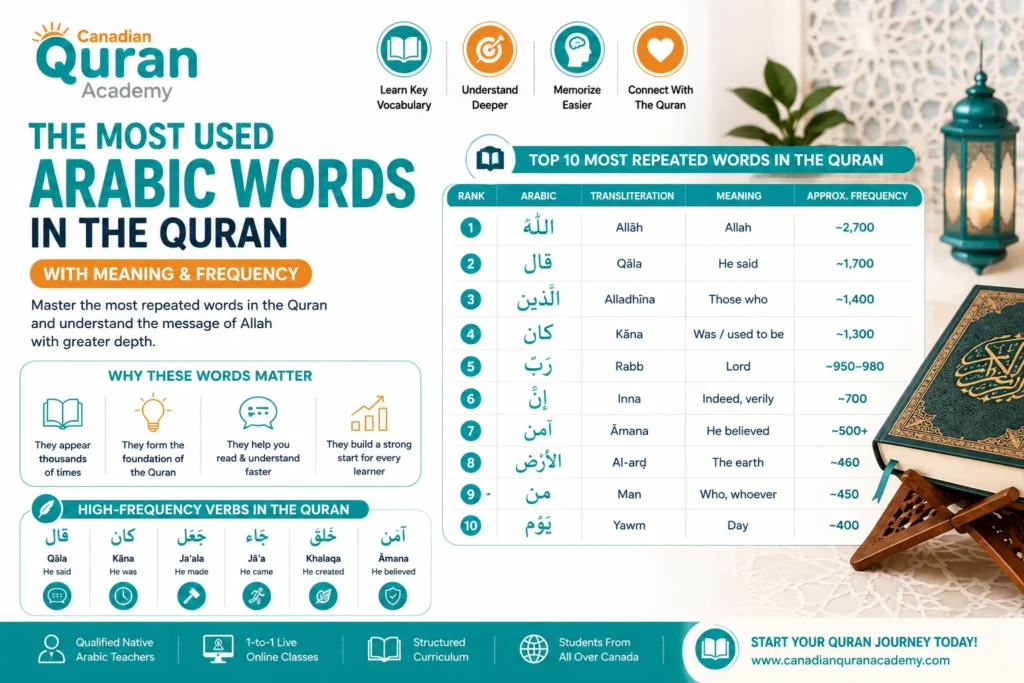
The most used Arabic words in the Quran are dominated by one name: الله (Allah), which appears roughly 2,700 times, followed by grammatical particles like وَ (and) and core verbs like قَالَ (he said).
If you’ve ever wondered which words carry the weight of the entire text — and why some of the words you already say in Salah are the exact ones scholars point to first — this guide answers that directly.
Canadian Quran Academy built this list the way we teach it in class: grouped by function, connected by root, and tied back to verses you likely already know by sound. You’ll walk away knowing not just which words repeat most, but why they repeat, and what to do with that knowledge next.
What Are The Most Used Arabic Words In The Quran?
The most used Arabic words in the Quran are a small set of divine names, particles, and verbs that appear thousands of times across its 6,236 verses. Leading this list is الله (Allāh), appearing roughly 2,700 times, followed closely by the particle وَ (wa, “and”), which attaches to tens of thousands of words as a prefix rather than standing alone.
Because وَ is a prefix and not a standalone word in most counting systems, it’s usually left out of “top word” rankings even though it technically occurs more often than any other single element in the text.
That distinction matters more than it sounds — it’s the first thing that trips up anyone trying to memorize a frequency list without understanding how Arabic particles attach to words.
The 10 Most Repeated Words In The Quran
These ten words alone account for a large share of every page in the Quran. Learning them first is the highest-return starting point for any student. These ten entries make up the backbone of any list of the most used Arabic words in the Quran, and mastering them first gives you the fastest return on study time.
| Rank | Arabic | Transliteration | Meaning | Approx. Frequency |
| 1 | اللَّه | Allāh | Allah | ~2,700 |
| 2 | قَالَ | Qāla | He said | ~1,700 |
| 3 | الَّذِينَ | Alladhīna | Those who | ~1,400 |
| 4 | كَانَ | Kāna | Was / used to be | ~1,300 |
| 5 | رَبّ | Rabb | Lord | ~950–980 |
| 6 | إِنَّ | Inna | Indeed, verily | ~700 |
| 7 | آمَنَ | Āmana | He believed | ~500+ |
| 8 | الْأَرْض | Al-arḍ | The earth | ~460 |
| 9 | مَن | Man | Who, whoever | ~450 |
| 10 | يَوْم | Yawm | Day | ~400 |
قَالَ (qāla, “he said”) ranking second isn’t a coincidence. The Quran is built heavily on direct speech — Allah addressing the angels, prophets addressing their people, believers addressing disbelievers.
Every time you see قَالَ, a quotation follows. Recognizing that single word turns any narrative passage from a wall of text into a conversation you can follow.
Read also: 8 Quran Verses About Daughters In Arabic And English With Meanings
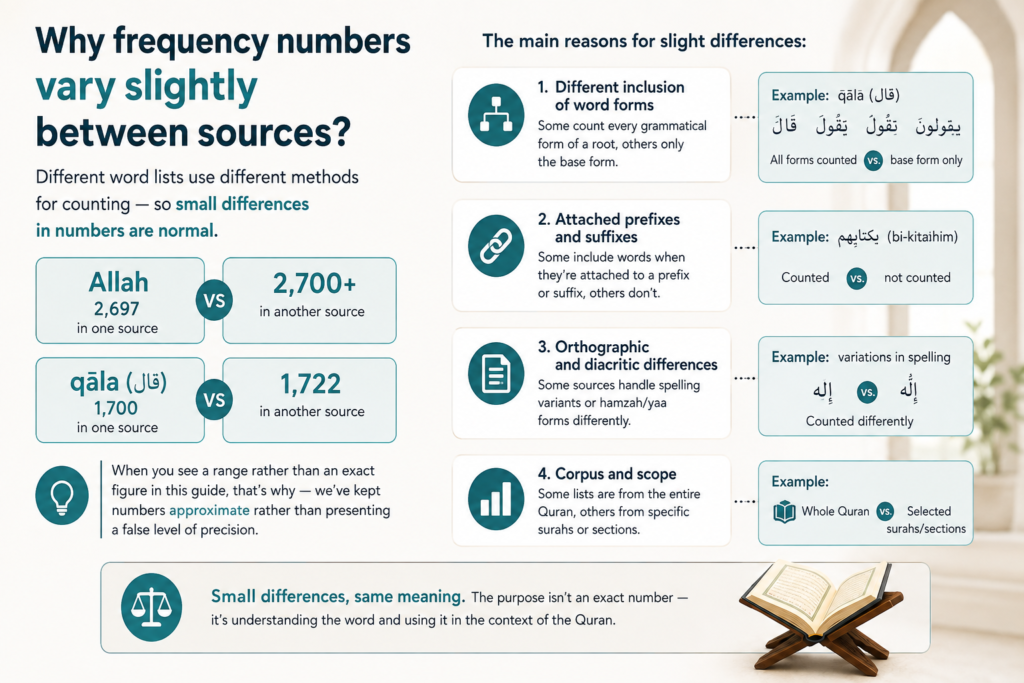
Why frequency numbers vary slightly between sources?
If you compare frequency counts across different word lists — including different sections of this one — you’ll notice small mismatches: Allah listed as 2,697 in one place and 2,700+ in another, or qāla as 1,700 versus 1,722. This isn’t sloppiness; it’s methodology.
Some counts include every grammatical form of a root (all conjugations of a verb), while others count only the base form.
Some include the word when it’s attached to a prefix or suffix, others don’t. When you see a range rather than an exact figure in this guide, that’s why — we’ve kept numbers approximate rather than presenting a false level of precision.
High-Frequency Verbs In The Quran
The two most common verbs — قَالَ (said) and كَانَ (was) — together appear well over 3,000 times. Every Quranic narrative runs through this core verb vocabulary.
| Arabic | Transliteration | Meaning | Root |
| قَالَ | Qāla | He said | ق-و-ل |
| كَانَ | Kāna | He was | ك-و-ن |
| جَعَلَ | Jaʿala | He made, placed | ج-ع-ل |
| جَاءَ | Jāʾa | He came | ج-ي-أ |
| خَلَقَ | Khalaqa | He created | خ-ل-ق |
| آمَنَ | Āmana | He believed | أ-م-ن |
| كَفَرَ | Kafara | He disbelieved | ك-ف-ر |
| عَلِمَ | ʿAlima | He knew | ع-ل-م |
| هَدَى | Hadā | He guided | ه-د-ي |
| أَنْزَلَ | Anzala | He sent down | ن-ز-ل |
آمَنَ (he believed) and كَفَرَ (he disbelieved) are exact opposites built on the same verb pattern, and the Quran pairs them constantly — a deliberate structural choice, not a coincidence of vocabulary.
Read Also: How to Write Quran in Arabic?
Names And Attributes Of Allah In The Quran
These eight words appear in almost every surah and are the first vocabulary any Quran learner should master. You already say most of them dozens of times a day in Salah and daily dhikr — this section connects the sound to the meaning.
| Arabic | Transliteration | Meaning | Root | Approx. Frequency |
| اللَّه | Allāh | God | — | ~2,700 |
| رَبّ | Rabb | Lord, Master | ر-ب-ب | ~950 |
| الرَّحْمَن | Ar-Raḥmān | The Most Gracious | ر-ح-م | ~57 |
| الرَّحِيم | Ar-Raḥīm | The Most Merciful | ر-ح-م | ~114 |
| الْعَلِيم | Al-ʿAlīm | The All-Knowing | ع-ل-م | ~150+ |
| الْحَكِيم | Al-Ḥakīm | The All-Wise | ح-ك-م | ~97 |
| الْعَزِيز | Al-ʿAzīz | The Almighty | ع-ز-ز | ~92 |
| الْغَفُور | Al-Ghafūr | The Oft-Forgiving | غ-ف-ر | ~91 |
الرَّحْمَن and الرَّحِيم share the root ر-ح-م, the same root behind رَحْمَة (raḥmah, mercy), which appears close to 79 times on its own. All three sit together in the Bismillah at the start of nearly every surah — meaning a student who learns one root has already unlocked three of the Quran’s most repeated words at once.
This is the practical value of root-based learning over word-by-word memorization, and it’s the first thing we teach in Canadian Quran Academy’s Online Tajweed Classes, where correct pronunciation and word recognition are taught together rather than as separate skills.
Read also: Verse In Quran About Alcohol In Arabic And English
Particles That Structure Every Quranic Sentence
Particles (ḥurūf) don’t carry heavy theological meaning on their own, but they determine how every clause in the Quran connects to the next. Unlike nouns and verbs, they don’t follow the three-letter root system — and they are, collectively, the most frequently occurring elements in the text.
| Arabic | Transliteration | Meaning | Type | Approx. Frequency |
| وَ | wa | and | Conjunction (prefix) | 45,000+ |
| مِن | min | from, of | Preposition | ~3,200 |
| لَا | lā | no, not | Negation | ~1,800 |
| إِنَّ | inna | indeed, verily | Emphatic particle | ~1,700 |
| فِي | fī | in, within | Preposition | ~1,700 |
| مَا | mā | what, not, that | Multiple functions | ~1,500 |
| عَلَى | ʿalā | on, upon, over | Preposition | ~1,380 |
| الَّذِي | alladhī | who, which | Relative pronoun | ~1,100 |
| إِلَى | ilā | to, toward | Preposition | ~740 |
| ثُمَّ | thumma | then, afterwards | Sequence connector | ~340 |
وَ attaches directly to the next word as a prefix, which is why new readers often miss it entirely even though it’s the single most common word in the Quran by a wide margin.
إِنَّ opens many major divine declarations — seeing “innallāha…” tells you an important statement about Allah is coming next. Once these signals register automatically, you start following the structure of a verse instead of decoding it word by word.
Read also: Quran Verses About Ramadan In Arabic And English
Pronouns Used Throughout The Quran
Arabic distinguishes singular, dual, and plural forms, along with masculine and feminine — a richer system than English. These pronouns appear constantly in narrative passages, divine commands, and direct address to believers.
| Arabic | Transliteration | Meaning | Notes |
| هُوَ | huwa | he, it | Most common subject pronoun |
| هُمْ | hum | they (m./mixed) | Masculine or mixed plural |
| هِيَ | hiya | she, it (fem.) | Feminine singular |
| أَنْتَ | anta | you (m. singular) | Address to prophets, believers |
| أَنْتُمْ | antum | you (plural) | Address to groups |
| نَحْنُ | naḥnu | we | Used by Allah — see note below |
| هُمَا | humā | they two | The Arabic dual, unique to the language |
One detail that resolves genuine confusion for new students: when Allah says نَحْنُ (naḥnu, “we”), this is the majestic plural — a classical Arabic form expressing authority, not multiplicity.
“Indeed, We revealed the Quran” (إِنَّا نَحْنُ نَزَّلْنَا الذِّكْرَ) is Allah speaking of Himself. It’s a grammatical convention, not a theological claim about plurality, and knowing this in advance prevents a common misreading.
Read also: 15 Quran Verses About Prayer In Arabic And English
People, Creation, And The World In Quranic Vocabulary
This category covers the vocabulary the Quran uses to describe humanity, the physical universe, and the unseen beings that inhabit its narrative — from people and the earth to angels and Satan. These words build the backdrop against which every Quranic story and command takes place, and several of them appear in contrasting pairs that carry symbolic weight throughout the text.
| Arabic | Transliteration | Meaning | Root | Approx. Frequency |
| النَّاس | An-nās | People, mankind | ن-و-س | ~241 |
| الأَرْض | Al-arḍ | The earth | أ-ر-ض | ~460 |
| السَّمَاوَات | As-samāwāt | The heavens | س-م-و | ~420 |
| الشَّيْطَان | Ash-shayṭān | Satan | ش-ط-ن | ~87 |
| الْمَلَائِكَة | Al-malāʾikah | The angels | م-ل-ك | ~88 |
| النُّور | An-nūr | The light | ن-و-ر | ~43 |
| الظُّلُمَات | Aẓ-ẓulumāt | The darknesses | ظ-ل-م | — |
| الْعَالَمِين | Al-ʿālamīn | All the worlds | ع-ل-م | ~73 |
| الْمُؤْمِنُون | Al-muʾminūn | The believers | أ-م-ن | — |
| الْكَافِرُون | Al-kāfirūn | The disbelievers | ك-ف-ر | — |
الْعَالَمِين closes the first verse of Al-Fatiha: “Alḥamdulillāhi rabbil-ʿālamīn.” It shares the root ع-ل-م with knowledge (الْعِلْم) — a connection worth holding onto as you move through the rest of this list.
The Quran also repeatedly contrasts النُّور (light) with الظُّلُمَات (darknesses) as its central image for guidance versus misguidance; once you can spot both words, you’ll notice that contrast recurring across unrelated surahs.
Experience Our Classrooms
Don’t just take our word for it—take a look inside! Watch the videos below to experience our engaging teaching methods and vibrant online classrooms firsthand.
Start Your Quranic Journey in Canada
Join our vibrant community and learn with expert tutors through our flexible online platform.
Claim Your Free TrialFaith And Worship Vocabulary In The Quran
This category holds the theological core of the Quran — the words that define what belief actually asks of a person and what Allah promises in return, from prayer and charity to patience and repentance. Students who master this group early tend to move fastest into real comprehension, because these words recur in almost every surah regardless of its subject.
| Arabic | Transliteration | Meaning | Root | Approx. Frequency |
| الإِيمَان | Al-īmān | Faith, belief | أ-م-ن | ~45 |
| الصَّلَاة | Aṣ-ṣalāh | Prayer | ص-ل-و | ~99 |
| الزَّكَاة | Az-zakāh | Almsgiving | ز-ك-و | ~32 |
| الدِّين | Ad-dīn | Religion, way of life | د-ي-ن | ~92 |
| الرَّحْمَة | Ar-raḥmah | Mercy | ر-ح-م | ~79 |
| الْحَقّ | Al-ḥaqq | Truth, right | ح-ق-ق | ~200 |
| الْهُدَى | Al-hudā | Guidance | ه-د-ي | ~80 |
| الْعِلْم | Al-ʿilm | Knowledge | ع-ل-م | ~105 |
| الصَّبْر | Aṣ-ṣabr | Patience | ص-ب-ر | ~90 |
| التَّقْوَى | At-taqwā | God-consciousness | و-ق-ي | — |
الإِيمَان and الْمُؤْمِنُون share the root أ-م-ن — the same root behind أمان (safety) and connected in meaning to السَّلَام (peace). Arabic theology sits inside these root relationships in a way no translation preserves. This is exactly the kind of connection a live teacher draws out across multiple lessons — it’s the difference between recognizing a word and understanding why the Quran chose it.
Students working through Canadian Quran Academy’s Quran Tafsir Course spend real time on these root families, because meaning in the Quran is rarely isolated to a single word.
Read also: Quranic Verses About Parents in Arabic
The Hereafter And Divine Judgment In Quranic Vocabulary
This category governs the Quran’s eschatological vocabulary — this life against the next, paradise against the Fire, reward against punishment. You’ll encounter these words in almost every surah, usually appearing in deliberate pairs that hold two outcomes in view at once.
| Arabic | Transliteration | Meaning | Root | Approx. Frequency |
| الدُّنْيَا | Ad-dunyā | This world, this life | د-ن-و | ~115 |
| الآخِرَة | Al-ākhirah | The Hereafter | أ-خ-ر | ~115 |
| الْجَنَّة | Al-jannah | Paradise | ج-ن-ن | ~140 |
| النَّار | An-nār | The Fire | ن-و-ر | ~145 |
| الْقِيَامَة | Al-qiyāmah | The Resurrection | ق-و-م | ~70 |
| الْحِسَاب | Al-ḥisāb | The reckoning | ح-س-ب | ~80 |
| الْعَذَاب | Al-ʿadhāb | Punishment | ع-ذ-ب | ~370 |
| الرِّزْق | Ar-rizq | Provision | ر-ز-ق | ~120 |
الدُّنْيَا and الآخِرَة appear with almost identical frequency — the Quran consistently holds this world and the next in balance rather than treating one as an afterthought. Worth flagging separately: النَّار (Fire) and النُّور (light) look and sound similar but mean opposite things. Students who haven’t drilled this distinction sometimes misread verses on first pass — it’s a small point that causes real confusion in practice.
Core Nouns Of Meaning And Perception In The Quran
This category covers six words that carry more conceptual weight than their dictionary translation suggests — the command, the heart, life, death, the face, and reason. These are the words where students most often feel the gap between knowing a translation and actually grasping what the Quran means.
| Arabic | Transliteration | Meaning | Root |
| الأَمْر | Al-amr | The command, matter | أ-م-ر |
| الْقَلْب | Al-qalb | The heart | ق-ل-ب |
| الْحَيَاة | Al-ḥayāh | Life | ح-ي-ي |
| الْمَوْت | Al-mawt | Death | م-و-ت |
| الْوَجْه | Al-wajh | The face, direction | و-ج-ه |
| الْعَقْل | Al-ʿaql | The mind, reason | ع-ق-ل |
الْقَلْب (the heart) in Quranic usage refers to the center of consciousness and moral understanding, not the physical organ alone.
When the Quran asks “do they not have hearts with which they understand?”, it’s using the heart as the seat of reason.
الْوَجْه (face, direction) appears in phrases like “whoever turns their face toward Allah” — a phrase about total orientation, not literal facial direction. This is the layer of meaning a translation alone tends to flatten.
Read Also: What Is Classical Arabic?
How To Actually Learn These Words, Not Just Recognize Them?
Once you can recognize the most used Arabic words in the Quran on sight, the real work shifts from memorization to comprehension. Here’s what consistently works with students starting from zero.
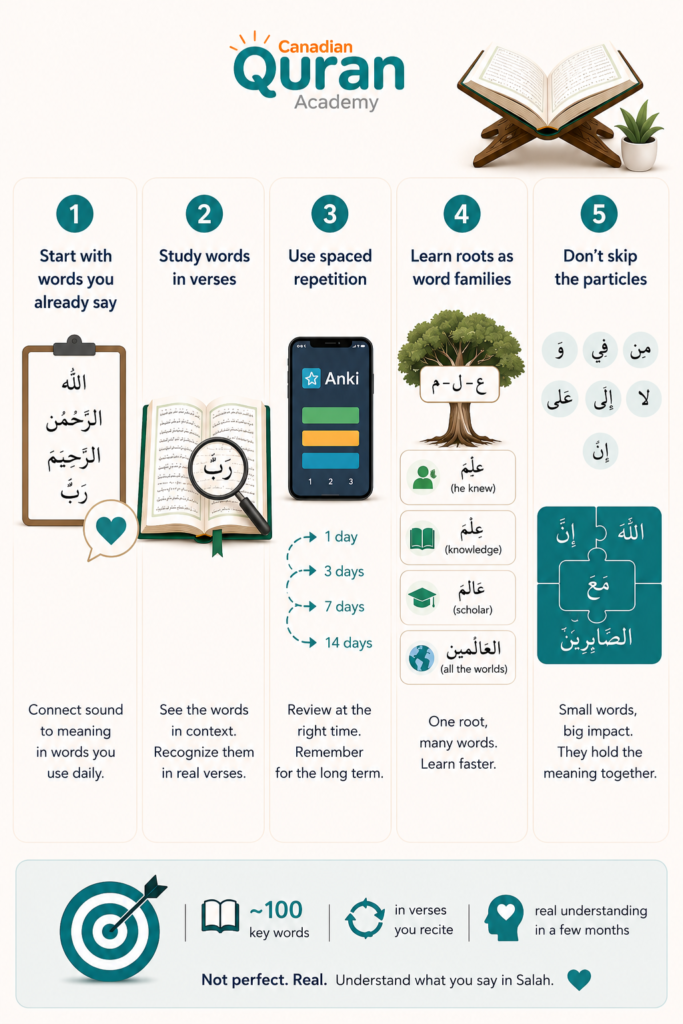
1. Start with the words you already say
You already know several of these words by sound.
اللَّه, الرَّحْمَن, الرَّحِيم sit in the Bismillah you say before every surah.
رَبّ opens the second verse of Al-Fatiha.
السَّلَام is in every greeting.
Take a word you already say daily, find it in the tables above, and read its meaning deliberately. That moment of connecting sound to sense is worth more than any study trick.
2. Study words inside verses, not in isolation
The most common self-study mistake: memorizing words on flashcards, passing a self-quiz, then failing to recognize those same words inside actual Quran text. Words in the Mushaf are surrounded by other words, connected by particles, shaped by grammar — not sitting alone on a white background.
Take a short surah you already know by heart — Al-Ikhlas, Al-Asr, Al-Kawthar — and go through it word by word against this list. Mark what you recognize. Add what you don’t to your next study session.
3. Use spaced repetition, not random review
If you use flashcards, use a spaced-repetition tool like Anki rather than paper cards or random review. Anki resurfaces each word right before you’re about to forget it, which is measurably more time-efficient than passive re-reading. Ten new cards a day, reviewed consistently, builds real retention within weeks.
4. Learn roots as word families
Every time you learn a new word from these tables, find two or three related words sharing its root. You learn عَلِمَ (he knew) — root ع-ل-م — and you’ve effectively also learned عِلْم (knowledge), عَالِم (scholar), and الْعَالَمِين (all the worlds) in the same session.
The root system scales vocabulary far faster than treating every word as a separate item, and it’s the backbone of how Canadian Quran Academy structures its Intensive Quran Course for students who want to move past word recognition into real comprehension.
5. Don’t skip the particles
The most common self-study error: months spent on theologically loaded nouns like الْجَنَّة and النَّار while ignoring the particles holding sentences together, then confusion over why individual words are recognizable but verse structure isn’t.
Learn وَ, فِي, مِن, عَلَى, إِلَى, لَا, and إِنَّ until they’re automatic. They’re not exciting to study, but they’re what makes reading comprehension click.
The common misconception here is that you need thousands of words before anything in the Quran makes sense. In practice, roughly 100 well-chosen, root-connected words — tied to verses you already recite — produce comprehension you can feel within a few months.
Not complete comprehension, but the kind where you’re standing in Salah and understand what you just said to Allah. That’s a realistic outcome, and it doesn’t require restructuring your life to get there.
Live Class in Action
Watch how our instructors interact with students in real-time, focusing on interactive methods.
Start Your Quranic Journey in Canada
Join our vibrant community and learn with expert tutors through our flexible online platform.
Claim Your Free TrialStart Learning Quranic Arabic With Canadian Quran Academy Today
A list gets you recognition. A teacher who walks through the root, the grammar, and the verse with you gets you understanding — and that gap is exactly what Canadian Quran Academy’s live instructors close every week with students who started from zero.
Whether you’re building vocabulary for the first time or preparing for Ijazah-level study, structured guidance turns this reference table into working knowledge far faster than self-study alone.
Whether you’re just starting to learn the most used Arabic words in the Quran or preparing for deeper study like Tafsir or Ijazah, structured guidance closes the gap a list alone can’t.
Book a class with Canadian Quran Academy and tell your teacher you want to work through Quranic vocabulary in context — they’ll start from exactly where you are.
Our Arabic Courses:
- Online Arabic Course
- Classical Arabic Course
- Arabic Course for Beginners
- Advanced Arabic Course
- Quranic Arabic Course
- Arabic Grammar Course
- Modern Standard Arabic Course
- Arabic Conversation / Speaking Course
- Intensive Arabic Course
- Online Arabic Classes for Kids
- Arabic Classes for Adults
Start Your Quranic Journey in Canada
Join our vibrant community and learn with expert tutors through our flexible online platform.
Claim Your Free TrialConclusion
The most used Arabic words in the Quran cluster around a small, learnable set: divine names like الله and رَبّ, connecting particles like وَ and مِن, and core verbs like قَالَ and كَانَ. None of these appear by accident — the density of certain roots, the pairing of opposites like آمَنَ and كَفَرَ, and the balance between الدُّنْيَا and الآخِرَة all reflect deliberate structure in the text itself.
The takeaway to hold onto is this: recognizing the most used Arabic words in the Quran is the first step, but root-based learning — done in context, with guidance — is what turns recognition into comprehension.
Canadian Quran Academy builds every course around that exact progression, from Noorani Qaida through Ijazah, because vocabulary without structure fades and vocabulary with structure compounds.

Frequently Asked Questions
Here are direct answers to the questions students ask most often about Quranic word frequency and vocabulary, drawn from the points this article didn’t cover in full above.
What is the most repeated word in the Quran?
الله (Allah) is the most repeated standalone word in the Quran, appearing roughly 2,700 times. If prefixed particles are counted, وَ (and) technically occurs far more often, but it’s classified as a grammatical attachment rather than an independent word in most frequency lists.
How many times does the word “Allah” appear in the Quran?
The word الله (Allah) appears approximately 2,700 times across the Quran’s 114 surahs. Exact counts vary slightly by source depending on whether every grammatical form is included, which is normal for corpus-based counting.
What is the most common verb in the Quran?
قَالَ (qāla, “he said”) is the most common verb in the Quran, appearing roughly 1,700 times. It signals direct speech throughout the text, so recognizing it helps you follow dialogue between prophets, Allah, angels, and disbelievers.
Do I need to memorize word lists before I can understand Quran recitation?
No — memorizing isolated word lists is not required to benefit from Quran recitation, though it does deepen comprehension over time. Most students get more value from learning a small set of high-frequency words in the context of verses they already recite than from flashcard drilling alone.
What’s the best way to start learning Quranic Arabic vocabulary?
The most effective starting point is learning words you already say in Salah — like الله, الرَّحْمَن, and رَبّ — then connecting each to its root family. Pairing this with a teacher who can explain grammar and context, such as through Canadian Quran Academy’s Online Tajweed Classes, accelerates the process significantly.
Is Quranic Arabic vocabulary different from Modern Standard Arabic?
Yes — Quranic Arabic shares roots and grammar with Modern Standard Arabic, but many words carry theological weight or classical usage that differs from everyday conversational Arabic. This is why courses focused specifically on Quranic Arabic, rather than general Arabic language study, produce faster comprehension for Quran-focused goals.






Leave a Reply