 Quran
Ask any parent who has taught Surah Al-Fil to a five-year-old on a Tuesday evening, and you hear the same story: the child recites the first two verses beautifully, forgets the third, and asks for a snack. The problem is rarely the child. It is usually the method.
The right Quran learning tools for kids solve this by teaching through more than one sense at a time — the eye sees the word, the ear hears it, the tongue repeats it, and the hand tracks it. That combination is what turns a shaky recitation into something a child owns.
Canada is home to nearly 1.8 million Muslims, about 4.9% of the population, and more of those families every year want Quran instruction that fits a Canadian school week (Statistics Canada, 2021 Census).
Below you will find ten tools experienced Quran teachers actually use with children, how to match them to your child’s age, and where technology stops being enough.
1. Colour-Coded Tajweed Mushaf
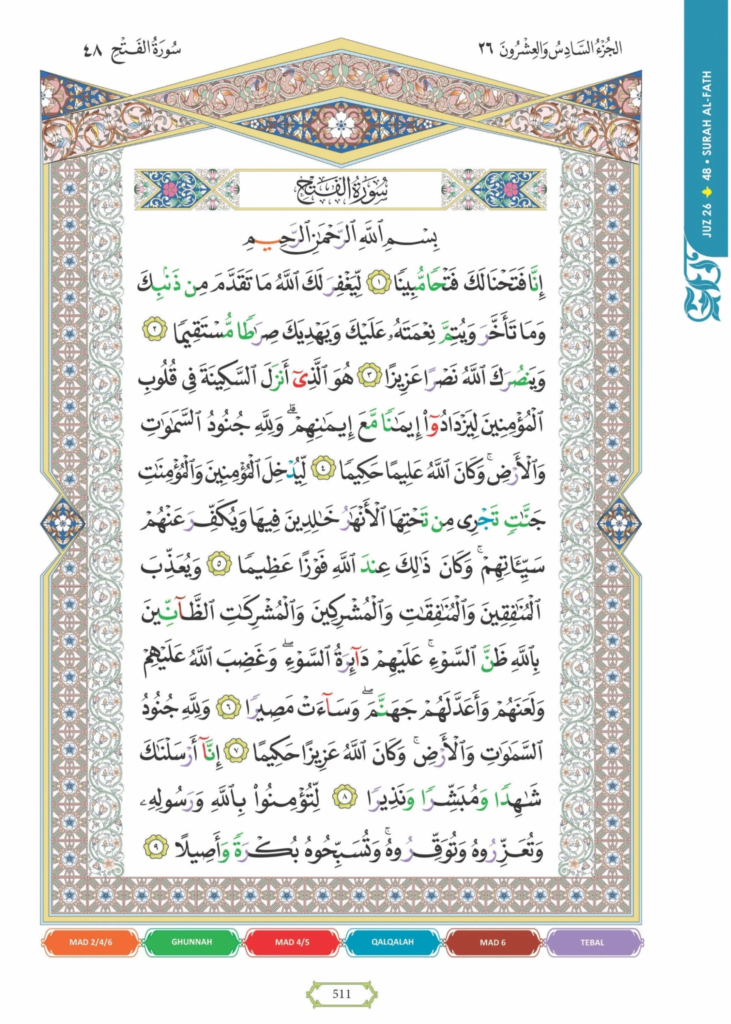
A Tajweed Mushaf prints each rule in its own colour: red for a Ghunnah, green for a Madd, and so on. The child stops memorizing rules as abstract grammar and starts recognizing them as shapes on the page.
Teachers pair this with a second visual habit: shading the verse range under study in grey and the verse being recited in green. The eye learns where it sits on the page — the same skill that lets an adult Hafiz “see” the Mushaf from memory.
Why it matters is simple: recitation is a visual task before it is a vocal one. Colour removes the mental step of remembering which rule applies, so the child spends attention on producing the sound correctly instead of recalling terminology.
Use it wherever the child reads — the home reading session, the weekend circle, and on the teacher’s shared screen during an online lesson. A tutor can teach one colour per week: ask the child to hunt for every instance of that colour on the page and read only those words aloud, then recite the full passage. Parents who do not read Arabic can still run this game by matching colours.
Read Also: The Quran Learning Journey
2. Noorani Qaida (Qaida Nooraniyah)
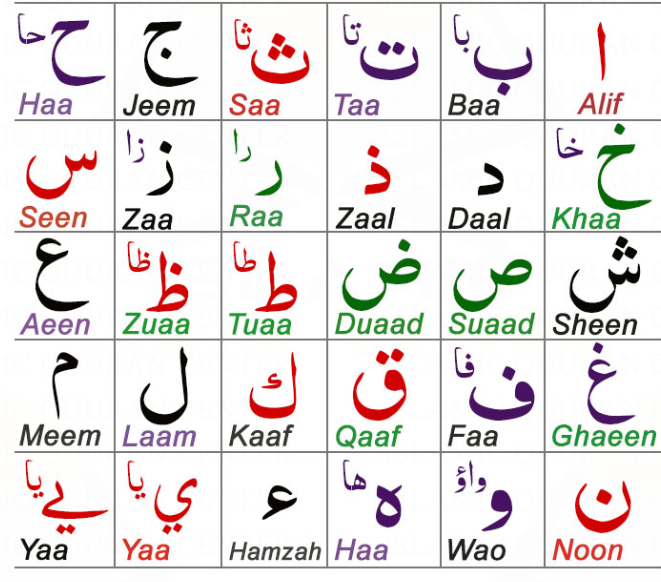
This is the foundational tool, and skipping it is the single most common mistake families make. The Qaida drills Arabic letters, their articulation points, joined forms, vowels, and elongation in a strict sequence before the child ever opens a Surah.
Most editions come with large fonts, illustrations, and colour cues that hold a young child’s attention. Two weeks of solid Qaida work saves months of correcting bad habits later.
Its importance is structural. A child who guesses at letters will read fluently for a while and then hit a wall, because the guessing has hidden weak articulation points that surface once verses get longer. The Qaida closes that gap while the habits are still soft.
Implement it as the first ten to fifteen minutes of every session, at home and in class. The rule for parents and tutors is the same: do not advance a page until the child reads it cleanly, unprompted, on two separate days. A tutor should also test letters out of order — a child who can only recite the sequence has memorized the page, not the letters.
3. Word-by-Word Audio and Follow-Along Players
Digital Mushafs such as Quran.com and King Saud University’s Ayat / Electronic Moshaf project let a child tap one word and hear it pronounced, with the text highlighted as the reciter moves.
This is the closest thing to a teacher pointing at the page. Set the audio to one verse, repeat it five times, and let the child read along silently before speaking.
The value here is isolation. A whole verse played at speed gives a beginner nothing to hold on to, while a single word repeated three times is small enough to imitate exactly — and the highlighting keeps the eye locked to the text instead of drifting.
This fits the gaps in a family’s week: the drive to school, the twenty minutes before bed, or the night before a lesson as preparation. A parent can work a three-word window at a time, tapping and letting the child echo. A tutor can assign a verse range as listening homework, then open the next lesson by asking which word the child found hardest — the answer shows exactly where to start.
Read Also: Quran Learning Games
4. Listen-and-Repeat Loops
A listen-and-repeat tool plays one verse, pauses, and waits for the child to imitate it. The pause is the whole point: it forces active production instead of passive listening.
Nearly every Quran app now offers verse-range repetition with an adjustable delay. Start with three repetitions per verse for a beginner, and drop to one as fluency builds. This is exactly the drill our teachers run in live Quran reading classes, one verse at a time, with correction on the spot.
Without that pause, children fall into a familiar trap: they can sing along with a reciter perfectly but cannot produce a single verse alone. The silence in the loop is where the actual learning happens, because the child has to retrieve the sound rather than ride along with it.
Run it as the main body of home practice between lessons, or with a single speaker in a group circle so children take turns filling the pause. Parents should sit beside the child for the first two runs to catch obvious slips, then step back and let the loop do the work. Tutors often use three minutes of it as a lesson warm-up before any new material is introduced.
5. Record-and-Compare Voice Tools
Children rarely hear their own mistakes. A record-and-compare tool fixes that: the child records a verse, plays it back beside the reciter’s version, and notices the difference themselves.
AI-assisted options such as Tarteel go a step further and flag words that appear to be misread or skipped. Treat the flags as a prompt for review, not a verdict — the final judgement belongs to a qualified teacher.
This tool builds self-monitoring, and self-monitoring is what separates a child who needs constant correction from one who catches errors alone. It also gives parents who do not read Arabic a genuine role: they can hear that two recordings differ even if they cannot name the rule involved.
Slot it in at the end of each home session, or send the recording to the teacher as submitted homework. A practical routine: record the same verse on Monday and again on Friday, play both, and ask the child which is better and why. Tutors should keep these recordings as a progress log — playing a child their own recitation from a month earlier is the most convincing encouragement available.
6. Hide-and-Reveal Memorization Screens
This tool hides part of the text and reveals it only when the child gets stuck, shifting the work from reading to recall — which is what memorization actually requires.
Digital versions do it with a tap. The low-tech version works just as well: a strip of card slid down the page, one line at a time.
Its importance lies in exposing false fluency. A child looking at the page will read smoothly, and both parent and child will assume the verse is memorized; cover the text and the truth appears within seconds. Retrieval, not rereading, is what fixes verses in long-term memory.
Use it at the close of every memorization session and again on the weekly revision day. The sequence that works: hide the second half of each verse, then the first half, then the verse entirely.
Tutors should add one twist — ask the child to start reciting from the middle of a verse, since a child who can only begin at verse one has memorized a chain of sounds rather than the verses themselves.
7. Spaced-Review Trackers and Hifz Charts
Memorized verses fade unless they are revisited on a schedule. A synthesis of 317 experiments found that the ideal gap between review sessions grows as the target retention period grows — meaning short daily reviews first, then weekly, then monthly (Cepeda et al., Psychological Bulletin, 2006).
A simple chart with three columns — new, this week, older — turns that research into something a seven-year-old can manage. Reserve one day a week for old material only, before adding anything new.
Revision is where most children’s Hifz quietly collapses, usually because nobody is tracking what is owed. A visible chart converts an invisible and growing workload into three short columns, and it hands the child a share of the responsibility instead of leaving it all with the parent.
Keep it somewhere it cannot be avoided: the fridge door, the front of the Quran binder, or a shared spreadsheet a tutor can see. Move a Surah one column to the right only after it is recited without error twice. A tutor should open each lesson by glancing at the chart and testing one Surah at random from the oldest column — that single habit is what keeps early material alive.
Live Class in Action
Watch how our instructors interact with students in real-time, focusing on interactive methods.
Start Your Quranic Journey in Canada
Join our vibrant community and learn with expert tutors through our flexible online platform.
Claim Your Free Trial8. Arabic Letter Flashcards and Hands-On Activities
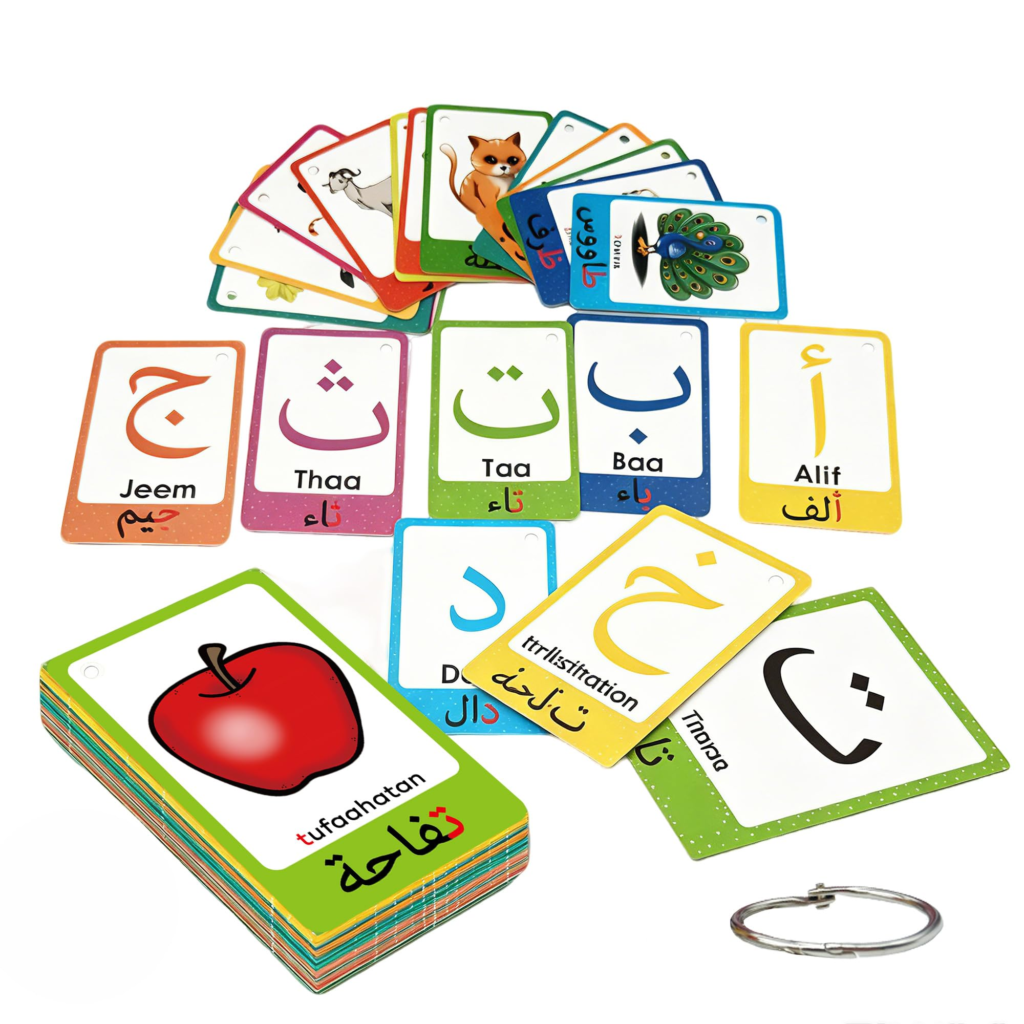
Flashcards, magnetic letters, sand trays, and tracing sheets add touch and movement to letter learning. For a three- or four-year-old, this is often the only channel that holds.
Keep sessions to ten minutes and end while the child still wants more. Attention, not ability, is the limit at this age.
Young children learn through their hands, and pairing movement with speech anchors the shape of a letter to its sound far more firmly than looking at a book does. It also lets a pre-reader participate fully, which matters: a child who feels capable at four arrives at the Qaida willing rather than reluctant.
These tools travel well — floor play at home, the car, a waiting room, or a group circle where children hold up cards. Work with five letters per session: name the letter, then hide it among others and have the child find it, then trace it in sand or salt while saying its sound aloud.
Online tutors do the same with on-screen cards and ask the child to hold up a matching card from their own set.
Read Also: Quran Learning Apps
9. Kid-Friendly Quranic Story and Meaning Libraries
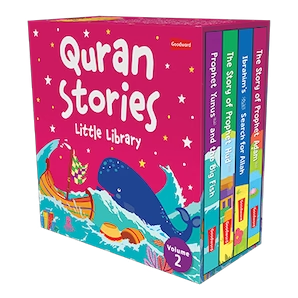
A child who knows why the elephants stopped at Makkah memorizes Surah Al-Fil faster than one repeating unfamiliar sounds. Story-based tafsir collections and illustrated verse-meaning books give the words something to attach to.
Tell the story first, then read the Surah. Meaning is a memorization tool, not a bonus.
Meaning works as a memory hook. Unfamiliar sounds are heavy to carry, but sounds attached to a scene the child can picture are much lighter — and the story supplies the emotional connection that keeps a child returning to the Mushaf over years rather than weeks.
The natural slots are bedtime, weekend mornings, and the evening before a new Surah begins. Tell the story, then ask the child to retell it in their own words — retelling is what proves it landed.
When reading, pause at the verse where the story appears and let the child say what is happening. A tutor can open every new Surah with two minutes of context before a single word is memorized.
10. A Live Teacher With an Ijazah — The Tool No App Replaces
Software can flag a missed word. It cannot show a child where the tongue touches the palate for a Daad, or hear that a Qalqalah is being softened week after week.
Every instructor at Canadian Quran Academy holds an Ijazah — a documented chain of authorization for accurate recitation — and corrects pronunciation the moment it slips.
That is why structured Tajweed classes sit at the centre of the programme, with the nine tools above supporting them between lessons.
The articulation points and letter qualities that make recitation correct are transmitted ear to ear, not read from a page. An error left uncorrected for three weeks becomes the child’s default pronunciation, and undoing it later costs far more time than catching it in the first lesson.
Two or three live sessions a week, thirty minutes each, is the pattern that works for most school-age children. Parents should sit in on the first few lessons to learn the teacher’s corrections, then step back so the child answers directly. Ask for a written progress report, and treat the nine tools above as the homework that fills the days between classes.
How to Choose Quran Learning Tools by Your Child’s Age
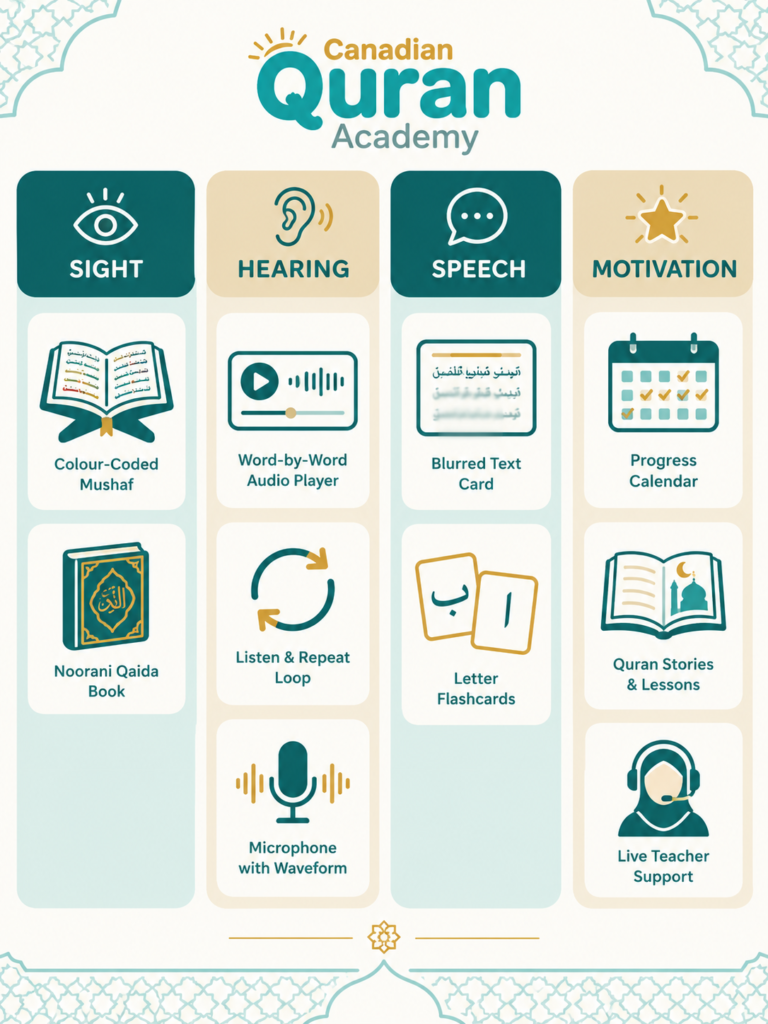
Not every tool deserves a place in your child’s routine. The ten above earn it because each activates a specific learning pathway — visual memory, auditory memory, pronunciation, or motivation. Use three or four consistently rather than ten occasionally.
In addition, Readiness varies enormously between children. Most are receptive to structured learning from about age five, though some bright, attentive four-year-olds start earlier and thrive.
1. Letter Sounds, Listening and Hands-On Play
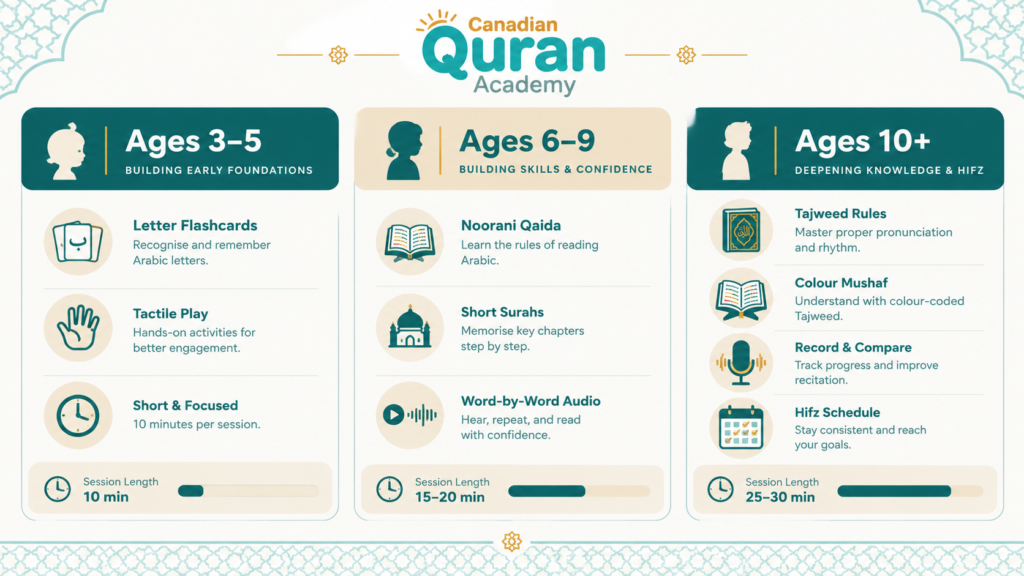
This way is suitable for kids from age 3-5. They focus on letter recognition through flashcards, tactile activities, and short listen-and-repeat clips.
Ten-minute sessions, in the morning if possible, when the child is rested rather than hungry or tired.
2. The Noorani Qaida and Fluent Reading of the Short Surahs
Between the ages of 6 – 9, move to the Noorani Qaida, then the short Surahs from Ad-Duhaa to An-Naas. Add word-by-word audio and a simple review chart. Keep the daily portion small — three verses learned well beat ten learned badly.
3. Applied Tajweed Rules and a Structured Hifz Schedule
If your kid is between the ages of 10 and up, the tajweed and structured hifz will be suitable. This is the age for formal Tajweed rules, the colour-coded Mushaf, record-and-compare practice, and a real memorization schedule.
Many families at this stage combine tools with a structured Hifz programme so that revision does not depend on a parent’s free evenings.
Read Also: Quran Hifz Quotes
Do Quran Apps Replace a Quran Teacher?
No. Apps build fluency, motivation, and review discipline, but they cannot diagnose a pronunciation fault or hold a child accountable to a memorization plan.
Think of the split this way: tools handle repetition, tracking, and exposure between lessons. A teacher handles correction, sequencing, and the encouragement that keeps a child returning to the Mushaf.
The families who progress fastest use both — twenty minutes of tool-supported practice most days, plus two or three live sessions a week.
Fitting Quran Study Into a Canadian School Week
Between school, homework, and winter commutes, the realistic window is short. Twenty to thirty focused minutes, four or five days a week, outperforms a two-hour weekend marathon.
Anchor the session to an existing routine — after breakfast on weekends, before dinner on weekdays. Consistency compounds; intensity burns children out.
For families from Halifax to Vancouver, online classes scheduled around school hours remove the drive entirely — often the difference between a plan that lasts and one that quietly stops in November.
Experience Our Classrooms
Don’t just take our word for it—take a look inside! Watch the videos below to experience our engaging teaching methods and vibrant online classrooms firsthand.
Start Your Quranic Journey in Canada
Join our vibrant community and learn with expert tutors through our flexible online platform.
Claim Your Free TrialBook a Free Trial Lesson and Hear Your Child Recite With Confidence
Give your child a teacher who catches every mispronounced letter — not an app that guesses. Canadian Quran Academy offers live one-to-one Tajweed and Quran recitation classes with Ijazah-certified instructors, scheduling across every Canadian time zone, and progress reports you can actually read.
The trial lesson is a real lesson, not a sales call. Your child reads for an Ijazah-certified teacher, who identifies exactly which letters and rules need work and recommends a starting level — whether that is the Noorani Qaida, fluent reading, applied Tajweed, or a Hifz plan. You receive that assessment in writing afterwards.
You also share the details about your preferred lesson times, your child’s age and current level, and whether you would like a male or female teacher, and we will match an instructor accordingly.
Sessions can be rescheduled when school and family life demand it, and no payment details are needed to try.
Our Quran Courses
- Quran Online Academy
- Quran Recitation Classes
- Quran Reading Classes
- Online Quran Classes for Kids
- Quran Classes for Adults
- Quran Classes for Female
- Learn Quran Course for Beginners
- Quran Memorization (Hifz) Course
- Hifz Classes for Adults
- Quran Memorization and Hifz Course for Kids
- Quran Hifz Course for Ladies
- Quran Ijazah Program
- Quran Qirat Learning Course
- Quran Tafsir Course
- Noorani Qaida Course
- Noorani Qaida Course for Kids
- Weekend Quran Classes
- Intensive Quran Course
- Al-Azhar Quran Course
- Online Tajweed Classes
- Tajweed Course for Kids
- Tajweed Course for Adults
- Tajweed Course for Ladies
Start with a free trial lesson and hear the difference after thirty minutes with a specialist.

Conclusion
The most effective Quran learning tools for kids engage several senses at once: a colour-coded Mushaf for the eye, word-by-word audio for the ear, record-and-compare for the tongue, and a review chart to hold it together. The Noorani Qaida builds the foundation, stories supply meaning, and hands-on letter work carries the youngest learners.
Take-away message: tools create repetition, but a qualified teacher creates accuracy. Pick three or four tools your child will genuinely use, pair them with live correction, and review old material before adding new — that is what carries a child from single letters to confident recitation.
FAQs
What is the best age to start teaching a child the Quran?
Most children are ready for structured learning around age five, when attention and speech are developed enough for short daily sessions. Attentive three- and four-year-olds can begin earlier with letter sounds and listening, not formal memorization.
How long should a child’s Quran session be?
Ten minutes for ages three to five, fifteen to twenty for ages six to nine, and twenty-five to thirty for older children. Stop while the child is still engaged — ending on a good note protects tomorrow’s session.
Are Quran apps enough to teach a child Tajweed properly?
No. Apps are excellent for repetition, audio exposure, and tracking, but Tajweed depends on articulation points that must be heard and corrected in real time by a qualified teacher.
Why does my child forget memorized Surahs so quickly?
Almost always because the portion was too large or the review too infrequent. Reduce the daily amount, revisit yesterday’s verses before adding new ones, and set aside one day a week for older material only.
How do I keep a child motivated to learn the Quran?
Use small staged rewards at clear milestones, record and replay their recitation, and let them hear the story behind each Surah. Modelling matters most: children who see a parent reading daily rarely need convincing.
Can my child learn the Quran online in Canada?
Yes. Live one-to-one online classes are now the most common option for Canadian families, since they remove travel and fit around school schedules in every province and time zone.







Leave a Reply